Introduction
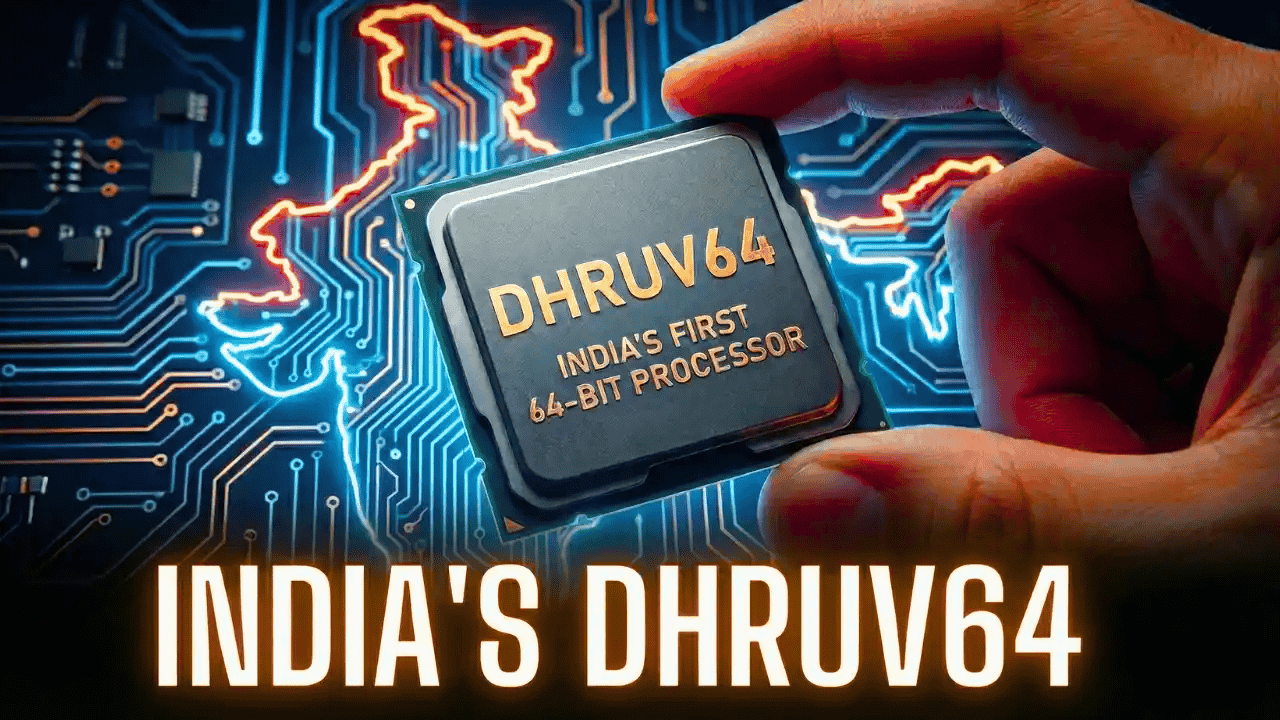
India has achieved a historic milestone in its journey toward technological self-reliance and Atmanirbhar Bharat with the launch of DHRUV-64—the country's first fully indigenous 1.0 GHz, 64-bit dual-core microprocessor. Developed by the Centre for Development of Advanced Computing (C-DAC) under the prestigious Microprocessor Development Programme (MDP), DHRUV-64 marks a watershed moment in India's semiconductor ecosystem and digital infrastructure ambitions.
Announced on December 15, 2025, this groundbreaking achievement represents far more than a technical innovation—it reflects India's strategic commitment to reduce dependence on imported semiconductor technology and establish domestic capabilities in one of the most critical technologies of the 21st century.
What is DHRUV-64? Understanding India's Microprocessor
A microprocessor serves as the brain of every electronic device, powering everything from smartphones and computers to satellites, defense systems, and industrial automation equipment. In today's interconnected world, the ability to design and manufacture microprocessors has become a cornerstone of national security and technological sovereignty.
DHRUV-64 is India's answer to this critical technology gap. It is a high-performance, fully domestically designed microprocessor that operates at 1.0 GHz clock speed with a 64-bit dual-core architecture. Unlike previous indigenous processor initiatives, DHRUV-64 represents a significant leap in processing power, efficiency, and capability, bringing India into the ranks of nations capable of designing advanced semiconductor technology.
Key Technical Specifications of DHRUV-64
Understanding the technical specifications is essential for competitive exam aspirants. Here are the critical features:
| Specification | Details |
|---|---|
| Clock Speed | 1.0 GHz |
| Architecture | 64-bit dual-core |
| Process Node | 28nm technology |
| Processing Type | Superscalar execution with out-of-order processing |
| Design Approach | RISC-V based architecture |
| Integration | Seamless integration with external hardware systems |
| Data Handling | Supports complex computing tasks and large datasets |
Key Technical Advantages:
Superscalar execution: Issues multiple instructions simultaneously, enhancing processing speed
Out-of-order processing: Instructions ready for completion execute first, improving efficiency
Built-in communication and control functions: Ready for diverse system integration
Modern architectural enhancements: Improves efficiency, multitasking, and system reliability
DHRUV-64 Applications: Strategic and Commercial Uses
One of the most significant aspects of DHRUV-64 is its versatility across multiple sectors. This makes it strategically important for India's development across various domains:
Strategic Applications:
Defense systems and military infrastructure
Space technology and satellite systems
National security infrastructure
Commercial and Industrial Applications:
5G networks and telecommunications infrastructure
Automotive systems and connected vehicles
Consumer electronics and smart devices
Industrial automation and smart factories
Internet of Things (IoT) devices and sensors
Smart city solutions
This broad applicability ensures that DHRUV-64 can catalyze India's technological advancement across multiple critical sectors simultaneously.
DHRUV-64 and the Digital India RISC-V Programme
DHRUV-64 is not an isolated achievement but part of a comprehensive long-term vision—the Digital India RISC-V (DIR-V) Programme. This ambitious initiative aims to position India as a global hub for electronics system design and manufacturing.
The DIR-V Programme Roadmap:
THEJAS32: First RISC-V processor developed under the programme
THEJAS64: Second-generation processor
DHRUV-64: Third milestone (Latest achievement, 2025)
DHANUSH-64 & DHANUSH-64+: Next-generation processors currently in development (28nm and 16/14nm process nodes)
This phased roadmap demonstrates India's strategic, long-term commitment to building a completely autonomous semiconductor ecosystem. The progression from THEJAS to DHRUV to future DHANUSH variants shows accelerating technological capability—a trajectory that positions India for global competitiveness in chip design and manufacturing.
Why DHRUV-64 Matters: India's Semiconductor Independence
India's Current Semiconductor Dependency:
India consumes approximately 20% of the world's microprocessors, yet almost entirely depends on imports for these critical components. This creates significant vulnerabilities:
Economic dependency: Foreign currency outflow for semiconductor imports
Security risks: Strategic infrastructure reliance on foreign suppliers
Supply chain vulnerability: Global disruptions affect critical sectors
Technology gap: Limited indigenous advanced chip design capabilities
DHRUV-64 as a Game-Changer:
By launching DHRUV-64, India addresses these structural vulnerabilities:
Reduced import dependence for indigenous applications
Strategic autonomy in defense and space sectors
Cost optimization through domestic manufacturing
Technology development hub emergence in India
Startup and industry enablement for indigenous product development
Comparison with Global Standards
DHRUV-64's specifications place it competitively within the global semiconductor landscape:
| Aspect | DHRUV-64 | Global Context |
|---|---|---|
| Clock Speed | 1.0 GHz | Mid-range performance tier |
| Architecture | 64-bit dual-core | Contemporary commercial standard |
| Manufacturing Node | 28nm | Proven, mature technology |
| Application Range | Diverse (5G, IoT, defense) | Enterprise-grade versatility |
| Strategic Value | Indigenous ownership | Rare for developing economies |
The 28nm process node used in DHRUV-64, while not cutting-edge, represents proven, stable, and mature technology suitable for reliable deployment across critical infrastructure.
DHRUV-64 Development: C-DAC's Role and Achievement
The Centre for Development of Advanced Computing (C-DAC) has been instrumental in DHRUV-64's development. As India's premier research institute for advanced computing, C-DAC's achievement demonstrates:
Existing indigenous expertise in microprocessor design
Government commitment to semiconductor self-reliance through the MDP
Capability parity with international semiconductor design institutions
Pathway for future advancement in processor technology
This success validates that India possesses the technical expertise, research infrastructure, and institutional commitment required for semiconductor independence.
Strategic Implications for Atmanirbhar Bharat
DHRUV-64 embodies the Atmanirbhar Bharat (Self-Reliant India) vision across multiple dimensions:
Technology Independence: Reduces reliance on foreign semiconductor suppliers for critical applications
Economic sovereignty: Keeps technology value chains and profits within India
Strategic autonomy: Ensures independent technological solutions for defense and space sectors
Innovation ecosystem: Creates pathways for Indian startups, academia, and industry to develop competitive indigenous products
Geopolitical resilience: Protects against potential semiconductor supply chain weaponization or disruption by hostile nations
Future Roadmap: Beyond DHRUV-64
The development trajectory doesn't end with DHRUV-64. C-DAC is actively developing next-generation processors:
DHANUSH-64: 28nm process node (same generation as DHRUV-64 but enhanced)
DHANUSH-64+: Advanced 16/14nm process node (representing a significant technical leap)
This roadmap indicates that DHRUV-64 is the foundation, not the ceiling, of India's semiconductor ambitions. Future processors will incorporate advanced features and potentially enable deployment in more demanding applications requiring higher performance.
Global Context: Why Microprocessor Design Matters
Microprocessor design and manufacturing has become one of the most strategically important technologies globally, evident from:
Global supply chain disruptions during COVID-19 highlighted semiconductor criticality
Geopolitical tensions over semiconductor access between major powers
Technology leadership directly correlates with economic and military superiority
5G and beyond require domestically-controlled semiconductor ecosystems
DHRUV-64's launch positions India strategically at a moment when semiconductor sovereignty has become a global priority for major economies.
Key Facts for UPSC & Competitive Exam Aspirants
Factual Summary:
✓ Full name: DHRUV-64 (1.0 GHz, 64-bit dual-core microprocessor)
✓ Developer: Centre for Development of Advanced Computing (C-DAC)
✓ Launch date: December 15, 2025
✓ Program: Microprocessor Development Programme (MDP) / Digital India RISC-V (DIR-V)
✓ Process technology: 28nm
✓ Architecture: RISC-V based, 64-bit dual-core
✓ Applications: 5G, defense, automotive, IoT, consumer electronics, industrial automation
✓ Strategic significance: First fully indigenous Indian microprocessor
✓ Part of larger roadmap: THEJAS32 → THEJAS64 → DHRUV-64 → DHANUSH-64 → DHANUSH-64+
Why This Matters for Your Exam Preparation
UPSC and Competitive Exam Relevance:
1. Government Initiatives and Policies
DHRUV-64 exemplifies India's flagship Atmanirbhar Bharat initiative and Make in India campaign. UPSC frequently tests understanding of government programs aimed at technological self-reliance and economic sovereignty. This achievement demonstrates tangible progress in these key policy areas.
2. Science and Technology (GS-3)
The microprocessor launch is crucial for understanding:
Semiconductor technology fundamentals (64-bit, clock speed, process nodes)
India's technological capabilities in advanced manufacturing
RISC-V architecture and its open-source significance
5G and IoT technology adoption in India
3. Defense and Strategic Security (GS-2)
DHRUV-64's applications in defense systems make it relevant to:
National security infrastructure development
Military modernization through indigenous technology
Strategic autonomy from foreign technology dependence
Geopolitical implications of semiconductor sovereignty
4. Internal Security and Development (GS-2)
The processor's industrial and IoT applications connect to:
Smart manufacturing and Industry 4.0
Smart city initiatives across India
Digital infrastructure development
Technological equity and digital divide reduction
5. Current Events and Trending Topics
Being launched in December 2025, DHRUV-64 represents the latest current affairs relevant to:
Recent government achievements in science and technology
India's global technology positioning
Domestic industry and innovation topics
GS Paper-3 current affairs sections in UPSC examinations
6. Interconnected Concept Understanding
DHRUV-64 connects multiple UPSC themes:
Government policies (Atmanirbhar Bharat, Make in India)
Technological advancement and innovation
Defense preparedness
Macroeconomic resilience
Strategic autonomy
Why Aspirants Must Know This:
Competitive exam questions increasingly focus on India's technological achievements and their strategic implications. DHRUV-64, being a first-of-its-kind indigenous achievement in a critical technology domain, has high probability of appearing in:
UPSC prelims (factual knowledge)
UPSC mains (detailed implications and strategic analysis)
Other competitive exams (banking, civil services, engineering services)
Additionally, this achievement reflects India's evolving technological ecosystem, making it essential for understanding the country's long-term development trajectory—a core UPSC requirement.
For more comprehensive current affairs coverage and UPSC preparation resources, visit Atharva Examwise's dedicated current affairs section for daily updates, in-depth analysis, and exam-focused insights.