ISRO Launches India's Heaviest Communication Satellite CMS-03 on 'Bahubali' Rocket: Current Affairs November 2025 for UPSC & Competitive Exams
Meta Description: ISRO successfully launches 4,410 kg CMS-03 satellite, India's heaviest from Indian soil. Complete analysis of LVM3-M5 Bahubali rocket mission for UPSC aspirants and competitive exam preparation.
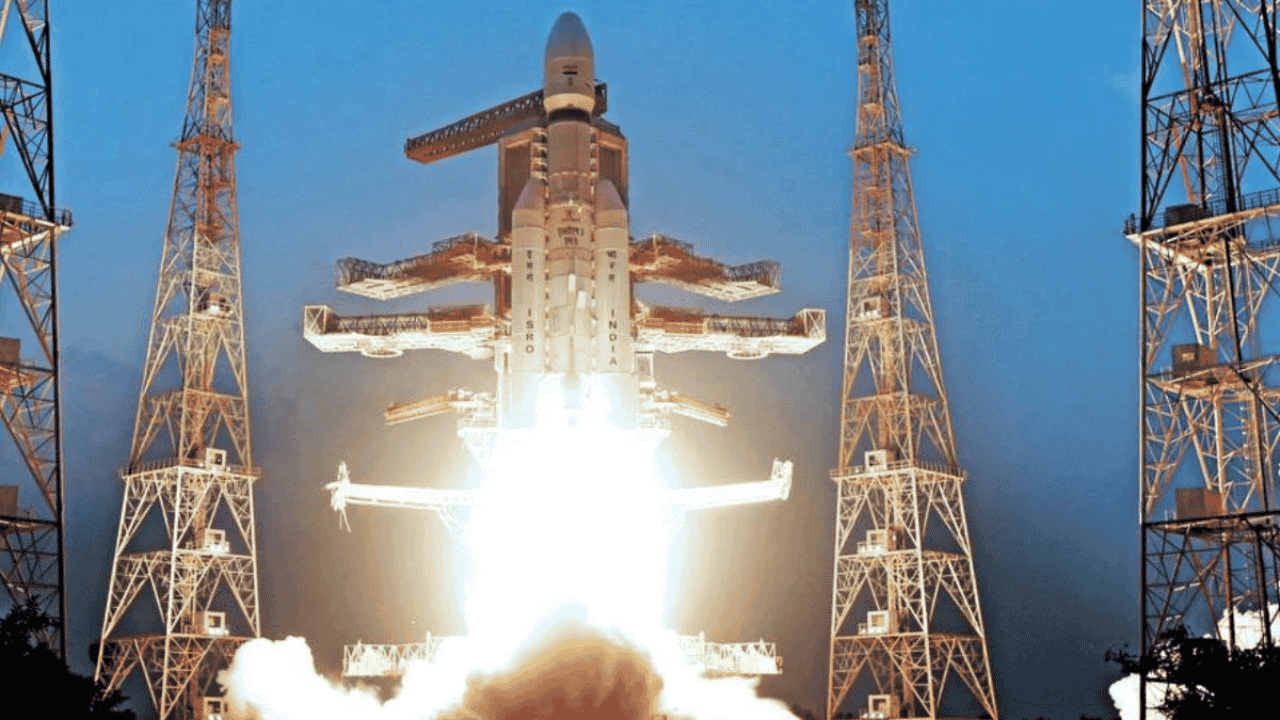
India achieved a historic milestone in its space program on November 2, 2025, when the Indian Space Research Organisation (ISRO) successfully launched the Communication Satellite CMS-03 (also known as GSAT-7R), weighing 4,410 kg—the heaviest communication satellite ever launched from Indian soil. The satellite was placed into a Geosynchronous Transfer Orbit (GTO) by ISRO's most powerful launch vehicle, LVM3-M5 (formerly GSLV Mk III), popularly referred to as 'Bahubali' for its heavy-lift capabilities.
The launch took place at 5:26 PM IST from the Second Launch Pad at the Satish Dhawan Space Centre in Sriharikota, Andhra Pradesh. This mission marks ISRO's fifth operational flight of the LVM3 rocket and its eighth overall launch, maintaining a 100% success rate.
Key Highlights of the CMS-03 Mission
About CMS-03 Satellite
The CMS-03 (GSAT-7R) is a multi-band communication satellite designed specifically for the Indian Navy. Its primary objectives include:
Enhanced Maritime Communications: Providing secure, high-capacity bandwidth communication links between warships, submarines, aircraft, helicopters, UAVs, and ground-based Maritime Operations Centres.
Multi-Band Capability: The satellite operates across UHF, S-band, C-band, extended C-band, and Ku-band frequencies, enabling versatile voice, data, and video transmission.
Coverage Area: CMS-03 will provide robust telecommunication coverage over a wide oceanic region, including the Indian Ocean Region (IOR) and the Indian landmass.
Replacement Mission: This satellite is designed to replace GSAT-7 'Rukmini', which was launched in August 2013 and has been serving the Indian Navy for over a decade.
Operational Lifespan: The satellite is designed to provide communication services for at least 15 years.
LVM3-M5 'Bahubali' Rocket Specifications
The LVM3 (Launch Vehicle Mark-3) is India's most powerful operational launch vehicle with the following capabilities:
Height: 43.5 meters
Lift-off Mass: 642 tonnes
Payload Capacity:
4,000 kg to Geosynchronous Transfer Orbit (GTO)
8,000 kg to Low Earth Orbit (LEO)
The rocket uses a three-stage configuration:
S200 Solid Boosters (2 units): Each carrying 204.5 tonnes of HTPB solid propellant
L110 Liquid Core Stage: Powered by two Vikas engines with 115.9 tonnes of UH25 and N₂O₄ propellant
C25 Cryogenic Upper Stage: Using India's indigenous CE-20 engine with 28.6 tonnes of liquid hydrogen and oxygen
Mission Flight Profile
The launch sequence unfolded as follows:
0 seconds: Simultaneous ignition of both S200 boosters at lift-off
106.94 seconds: L110 core stage ignition at ~41 km altitude
131.14 seconds: Strap-on booster separation at ~62 km altitude
198.86 seconds: Payload fairing separation at ~110 km altitude
304.70 seconds: L110 separation at ~167 km altitude
307.10 seconds: C25 cryogenic stage ignition
950.94 seconds: C25 shut-off
965.94 seconds: CMS-03 separation at ~180 km altitude with velocity of ~10.15 km/s
The satellite was precisely placed into a sub-Geosynchronous Transfer Orbit (sub-GTO) with:
Apogee (farthest point): ~29,970 km
Perigee (nearest point): ~170 km
Inclination: 21.4°
Significance for India's Space Program
Atmanirbhar Bharat (Self-Reliant India)
Prior to this mission, ISRO had to rely on foreign launch services for heavier communication satellites. Notable examples include:
GSAT-11 (5,854 kg): Launched by Ariane-5 rocket from French Guiana in December 2018
GSAT-24 (4,181 kg): Launched by Arianespace
GSAT-20 (4,700 kg): Launched by SpaceX
The successful launch of CMS-03 demonstrates that India can now launch heavy communication satellites (up to 4,000+ kg to GTO) independently, eliminating dependence on foreign launch providers. ISRO Chairman Dr. V. Narayanan called it "yet another shining example of Atmanirbhar Bharat".
Enhanced Payload Capacity
For this mission, ISRO improved the LVM3's performance by 10%, enabling it to carry the 4,410 kg satellite—exceeding its standard 4,000 kg GTO capacity. This was achieved through multiple engineering optimizations and performance enhancements.
Gaganyaan Connection
The same LVM3 rocket will be used to launch Gaganyaan, India's first human spaceflight mission, planned for no earlier than 2027. Gaganyaan aims to send a crew of three astronauts to a 400 km orbit for a 3-day mission. The consistent success of LVM3 missions—including the Chandrayaan-3 lunar mission in July 2023—validates the vehicle's reliability for crewed missions.
Strategic and Military Importance
Indian Navy's Maritime Domain Awareness
CMS-03 significantly strengthens the Indian Navy's capabilities in the Indian Ocean Region:
Network-Centric Warfare: Enables real-time coordination between approximately 60+ ships and 75+ aircraft seamlessly.
Maritime Surveillance: Provides enhanced imagery and video feeds for tracking enemy warships, monitoring piracy, smuggling, and illegal fishing activities.
Secure Communications: Offers encrypted, high-speed data transfer capabilities far superior to the ageing GSAT-7 'Rukmini'.
Strategic Coverage: The satellite's ~2,000 nautical mile footprint over the Indian Ocean Region provides comprehensive coverage of India's maritime interests.
National Maritime Domain Awareness (NMDA)
CMS-03 integrates with India's Information Management and Analysis Centre (IMAC), being upgraded to a National Maritime Domain Awareness (NMDA) platform. This system uses AI-enabled software to enhance surveillance, threat detection, and decision-making capabilities.
Defense Modernization
Defence Minister Rajnath Singh hailed the launch as a "major milestone exemplifying our nation's spirit of Aatmanirbharta," emphasizing ISRO's relentless pursuit of technological excellence.
Previous LVM3 Missions
The LVM3 rocket has maintained a perfect success record across eight launches:
December 18, 2014: Suborbital test flight with CARE module
June 5, 2017: First orbital flight with GSAT-19
November 14, 2018: GSAT-29 communication satellite
July 14, 2023: Chandrayaan-3 lunar mission—India became the first nation to land near the lunar south pole
October 22, 2022: 36 OneWeb satellites
6-7. Additional OneWeb missions in 2023
November 2, 2025: CMS-03 (current mission)
Global Context and Comparison
India's Space Power Status
With this launch, India joins an elite group of nations capable of launching heavy communication satellites independently. The mission reinforces India's position as a major space power alongside the United States, Russia, China, and the European Space Agency.
Cost-Effectiveness
The total development cost of the LVM3 project was ₹2,962.78 crore. In June 2018, the Union Cabinet approved ₹4,338 crore to build 10 LVM3 rockets over five years, demonstrating ISRO's cost-effective approach compared to global counterparts.
Future Missions and Roadmap
Upcoming ISRO Missions
Gaganyaan (planned 2027+): India's first crewed spaceflight mission
Indian Space Station: Long-term goal following successful Gaganyaan missions
Chandrayaan-4: Sample return mission from the Moon
Mars and Venus Missions: Expanding interplanetary exploration capabilities
Commercial Applications
The enhanced LVM3 capabilities open opportunities for:
Commercial satellite launch services for international clients
Launching constellations of communication and earth observation satellites
Supporting India's growing space economy and startup ecosystem
Why This Matters for Your Exam Preparation
For UPSC Prelims
Expected Question Types:
Direct Factual Questions:
"Which rocket launched India's heaviest communication satellite from Indian soil in 2025?"
"What is the payload capacity of LVM3 to Geosynchronous Transfer Orbit?"
"CMS-03 satellite is primarily designed for which defense service?"
Statement-Based Questions:
Statements about LVM3 specifications, mission objectives, and previous missions
Comparing GSAT-7 and CMS-03 capabilities
Current Affairs Match-the-Following:
Matching satellites with their launch vehicles, purposes, or launch dates
Key Facts to Remember:
CMS-03 weight: 4,410 kg (heaviest from Indian soil)
Launch date: November 2, 2025
Launch vehicle: LVM3-M5 (Bahubali)
LVM3 capacity: 4,000 kg to GTO, 8,000 kg to LEO
Previous LVM3 mission: Chandrayaan-3 (July 2023)
GSAT-7 launch year: 2013
Success rate of LVM3: 100% (8/8 missions)
For UPSC Mains
Relevant for GS Paper III (Science & Technology, Defense):
Potential Essay/Answer Topics:
"Discuss the significance of ISRO's LVM3-M5 mission in the context of India's self-reliance in space technology and strategic capabilities." (15 marks)
Answer Framework:
Introduction: Define Atmanirbhar Bharat in space context
Body:
Technical achievements (heavy-lift capability, indigenous systems)
Strategic importance (naval communications, maritime security)
Economic benefits (reduced foreign dependence)
Future potential (Gaganyaan, commercial launches)
Conclusion: India's emergence as a responsible space power
"Examine how space-based assets enhance India's maritime domain awareness and national security." (10 marks)
Answer Framework:
Introduction: Growing importance of Indian Ocean Region
Body:
Role of communication satellites (GSAT-7, CMS-03)
Integration with naval operations
Monitoring capabilities (piracy, smuggling, territorial waters)
Network-centric warfare advantages
Conclusion: Space technology as force multiplier
For Other Competitive Exams
State PSC Exams:
General Studies: Current affairs, science and technology sections
Essay: Self-reliance in technology, India's space achievements
SSC/Banking/Railway Exams:
General Awareness: Recent developments in Indian space program
Static GK: ISRO headquarters, launch centers, important missions
Defense Exams (NDA/CDS/AFCAT):
Defense Technology: Military applications of space technology
Current Affairs: Strategic importance of communication satellites
Indian Navy: Maritime domain awareness systems
Key Connecting Topics:
Space Technology: Orbits (GTO, LEO, GEO), propulsion systems, satellite types
Defense and Security: Network-centric warfare, C4ISR systems, maritime security
Atmanirbhar Bharat: Indigenous manufacturing, Make in India, defense self-reliance
Indian Ocean Region: Strategic importance, China's presence, Indo-Pacific strategy
Previous Space Missions: Chandrayaan series, Mangalyaan, Gaganyaan preparations
International Cooperation: Commercial launches, technology transfer, space diplomacy
Previous Year UPSC Questions on Space Technology:
UPSC Mains 2023: "What is the main task of India's third moon mission that could not be achieved in its earlier mission?"
UPSC Mains 2017: "India has achieved remarkable successes in unmanned space missions...What are the main obstacles to launching a manned space mission?"
UPSC Mains 2016: "Discuss India's achievements in the field of Space Science and Technology."
Practice Questions
Prelims Style:
Consider the following statements about LVM3-M5 mission:
CMS-03 is the heaviest satellite ever launched by India.
The satellite will serve exclusively for Indian Navy operations.
LVM3 has a 100% success rate.
With reference to Geosynchronous Transfer Orbit (GTO), which of the following statements is/are correct?
It is an elliptical orbit used to reach geostationary orbit.
The apogee of GTO is approximately 36,000 km.
LVM3 can carry up to 8,000 kg to GTO.
Mains Style:
"ISRO's recent launch of CMS-03 satellite marks India's growing self-reliance in space technology. Discuss the strategic and technological significance of this mission for India's defense capabilities." (250 words)
"Analyze how space-based communication systems enhance India's maritime security architecture in the Indian Ocean Region." (150 words)