
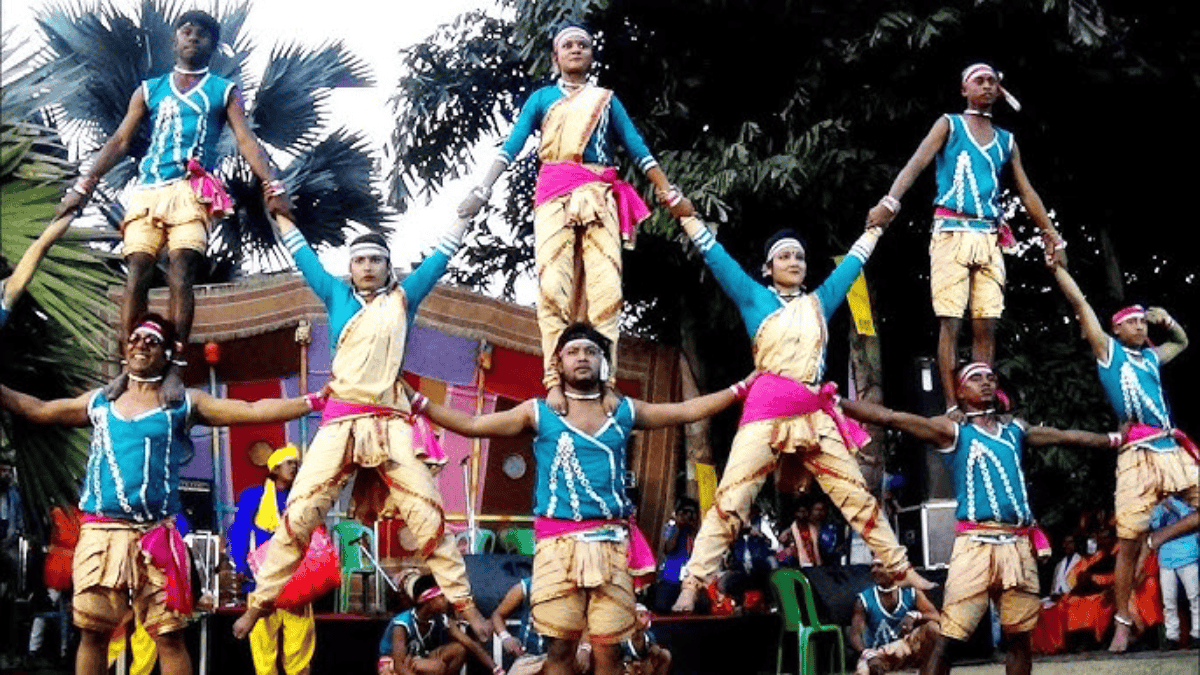
UPSC Current Affairs May 22, 2026: Traditional Raibenshe Dance of West Bengal and its Historical Significance | Daily GK Update
Introduction
In the rich cultural heritage of West Bengal, folk arts and traditional martial arts hold an immensely significant place. A vibrant symbol of this legacy is the "Raibenshe Dance" (Raibenshe), an ancient, energetic, and valor-infused folk dance prevalent in the western rural regions of the state. Historically, this performance was not merely a source of entertainment; rather, it was a display of Bengal's military traditions and the physical prowess of its warriors.
Currently, this dance survives in the rural pockets of Birbhum, Bardhaman, and Murshidabad districts and is performed on various cultural stages. For serious aspirants preparing for competitive examinations, a historical, social, and artistic study of this folk dance under the Art and Culture segment is extremely crucial. Candidates can refer to Atharva Examwise current news for regular analysis of the latest contemporary topics.
Historical Origin and Social Background
The etymology of the word "Raibenshe" and its history are deeply intertwined with the medieval military history of Bengal. The word "Rai" is believed to signify "King" or "Soldier," while "Benshe" relates to bamboo (specifically a long bamboo staff known as "Raybans"). In the medieval era, long before the invention of firearms, these sturdy bamboos served as the primary weapons for self-defense and warfare.
According to historical analysis, the Raibenshe dance originated from the military drills performed by the bodyguards and soldiers of medieval Bengali kings and landlords (zamindars). This dance was primarily performed by the marginalized and warrior classes of society, particularly the Bagdi, Bauri, and Dom communities. These communities served as lathiyals (bodyguards) and soldiers under the local zamindars of medieval Bengal.
Following the Battle of Plassey in 1757, a massive shift occurred in Bengal's military structure. After establishing its authority, the British East India Company banned the recruitment of local Bengali soldiers. As a result, these military communities had to seek shelter as security guards under local kings and zamindars to earn a livelihood. By the end of the eighteenth century, when the zamindari armies were completely disbanded, these warriors molded their martial arts into a folk dance form, which began to be performed at weddings and other social celebrations. This historical transition transformed a pure martial art into a performing folk art.
Artistic Characteristics, Performance Style, and Traditional Instruments
The greatest feature of the Raibenshe dance is that, unlike other traditional folk dances, it is not based on any specific narrative or plot. Its primary focus remains centered on the display of physical fitness, agility, balance, and valor.
The performance style of this dance essentially incorporates the following elements:
Simulation of Combat Skills: During the performance, artists vividly enact wartime postures such as shooting arrows from a bow, hurling spears, brandishing swords, and defending with shields.
Complex Acrobatics and Balance: Artists perform various balancing acts with long bamboo staffs (Raybans). Creating human pyramids and balancing on each other's shoulders is common during the dance. In one performance, an artist stands on the shoulders of another, where the performer on top controls head and hand movements while the performer below controls the footwork, requiring an exceptionally high level of coordination.
Sounds and Physical Postures: No songs or verses are sung during the dance. Instead, the energetic shouts and war cries of the artists thrill the entire atmosphere. The performers often move forward in a squat position, mimicking hunters riding horses.
Regarding traditional instruments, heavy-sounding instruments are utilized to maintain the fast pace of this dance. These primarily include the 'Dhol' (Dhol/Dhaki) and the 'Kanshi' (cymbals). As the musical rhythm accelerates with the beat of the dhol and the clanging of the kanshi, the speed of the dance and the enthusiasm of the artists rise concurrently.
In terms of costumes, artists wear a short dhoti tightly bound around the lower body (in the Malkocha style) and a red cloth around the waist (which symbolizes valor). Additionally, they wear brass anklets (nupurs) on their right ankle, which produce a unique military resonance with the stamping of their feet.
Gurusaday Dutt, the Bratachari Movement, and the Revival of Raibenshe
In the early twentieth century, a negative colonial stereotype was propagated by British colonial rulers to label Bengalis as "non-combatant" or "effeminate." To challenge this colonial discourse and awaken the lost valor and self-respect among Bengalis, Gurusaday Dutt, a Bengali Civil Servant and folklorist during the British era, played a monumental role.
During his visit to England in 1928, Gurusaday Dutt observed the workings of the folk dance organization there and, upon returning to India, resolved to preserve local folk arts. In 1929, while serving as the District Magistrate of Birbhum, he witnessed the Raibenshe dance for the first time at a fair (the Barabagan Mela). At that time, the dance had strayed from its original form and was in a state of decline due to cheap theater influences and gaudy costumes. Dutt was deeply disheartened by this degradation, as he was searching for a "manly" dance that could shatter colonial stereotypes.
Seeing Dutt's disappointment, a leading dancer of the troupe, Rampada Pramanik, stripped off his flashy theater clothes and performed the 'Palot' (a rapid, circular, dust-raising dance posture) on the ground. Gurusaday Dutt was mesmerized by this performance and declared it to be the true and pure form of Raibenshe. He instructed the dancers to abandon all flashy modern attire in the future and perform bare-bodied, wearing only the traditional short dhoti and red waistband, to maintain its historical authenticity.
Later, Gurusaday Dutt integrated the physical postures and discipline of the Raibenshe dance into the curriculum of the "Bratachari Movement" which he founded. This movement was a social program aimed at the physical, mental, and moral development of the youth, closely resembling the Scout movement. Through Raibenshe, an effort was made to make middle-class Bengali youth physically strong and disciplined, which also injected energy into the contemporary national movement.
Comparative Analysis of West Bengal's Folk Dance Traditions
From the perspective of competitive examinations, it is essential to understand the characteristics and interrelations of the major folk dances of West Bengal. The table below compares Raibenshe with other important cultural forms of the state:
| Name of Folk Art / Dance | Geographical Region | Core Theme and Nature | Use of Masks | Major Instruments & Characteristics |
|---|---|---|---|---|
| Raibenshe | Birbhum, Bardhaman, and Murshidabad | Military skills, valor, agility, and combat simulation (plotless) | No masks are used | Dhol, Kanshi, and bamboo staff (Raybans) |
| Purulia Chhau | Purulia and bordering areas | Ramayana, Mahabharata, and mythological war sagas | Heavy and colorful clay masks are mandatory | Dhansa (large kettle drum), Shehnai, and Dhol |
| Gambhira | Malda district (during the Gajan festival) | Satire on social evils and commentary on contemporary issues | Partial use of wooden or clay masks | Dhol and Mridangam; it is a dance-drama style |
| Baul Tradition | Entire Bengal (rural areas) | Sufi and Vaishnav philosophy, spiritual love, and devotion | No masks are used | Ektara, Dotara, Dubki, and Anand Lahari (Recognized by UNESCO) |
Modern Context, Conservation Efforts, and Challenges
Post-independence and in contemporary times, the Raibenshe dance tradition is undergoing various phases of transition and conservation:
Conservation and Government Incentives: Under the West Bengal Government's 'Rural Craft and Cultural Hubs' (RCCH) project, financial assistance, training, and platforms are currently being provided to approximately 288 Raibenshe artists. This has helped secure the livelihood of the artists.
Social Inclusion: Historically, this dance was confined to specific marginalized castes like the Dom, Bauri, and Bagdi. However, in modern times, it has transcended caste boundaries. Youth and professional artists from various communities are now adopting it. Furthermore, female artists have also started participating in this dance, which was previously performed exclusively by men.
The Conflict Between Tradition and Modernity: Currently, two main factions of Raibenshe are visible. The first is the 'Traditionalist Faction' (such as the troupe of Madhav Pramanik, grandson of Rampada Pramanik), which strictly adheres to the rules set by Gurusaday Dutt and performs bare-chested in traditional attire. The second is the 'Modernist Faction' (such as Basudev Bhalla's troupe from Sahora), which incorporates gymnastics, fire-trick acrobatics, and colorful modern costumes to attract audiences.
Candidates can give a new dimension to their preparation through competitive exam news today for the latest contemporary issues and competitive exam updates.
Key Facts and Exam-Oriented Data
The following is a quick list of important facts related to the Raibenshe dance for competitive examinations:
State and Region: It is a major martial folk dance of the western districts of West Bengal (Birbhum, Bardhaman, and Murshidabad).
Etymology: Named Raibenshe due to the use of bamboo staffs called "Raybans".
Community: Historically associated with the Bagdi, Bauri, and Dom castes.
Revivalist: Gurusaday Dutt gave it a new lease on life in the 1930s by making it a part of the 'Bratachari Movement'.
Nature: It features no songs or narrative text; it is entirely based on physical acrobatics, balance, and silent acting of combat skills.
Instruments: Primarily Dhol and Kanshi are used.
Conservation Scheme: More than 288 artists are currently being preserved under the RCCH II initiative of the West Bengal Government.
Why This Matters for Your Exam Preparation
This topic is highly relevant for UPSC (Civil Services Examination) and various State Public Service Commissions (such as MPPSC, WBPSC, BPSC):
Preliminary Examination (Prelims - Art and Culture): In the Preliminary examination, 'match the following' questions regarding traditional folk dances, martial arts, and their associated communities are frequently asked. For instance, a comparative understanding of Bengal's Raibenshe alongside Kerala's Kalaripayattu and Punjab's Gatka can directly secure marks.
Main Examination (Mains - GS Paper I - Indian Heritage and Culture): Analytical questions are often asked in the Mains exam regarding the decline of Indian traditional arts during the colonial period and their subsequent revival. Gurusaday Dutt's Bratachari movement and the nationalist revival of Raibenshe serve as an excellent example of how folk arts were utilized to counter colonial cultural hegemony.
Essay and Interview: To illustrate issues concerning the preservation of India's Intangible Cultural Heritage and the empowerment of local artists, examples of Raibenshe and the government's RCCH scheme can be effectively quoted.
Log in regularly to Atharva Examwise current news today for the latest daily updates and exam guidance, where complete preparation for the Civil Services Examination is conducted under expert mentorship.