
UPSC Current Affairs 16 February 2026: Bharat-VISTAAR AI Tool Launched – Daily GK Update for Competitive Exams
UPSC current affairs 16 Feb 2026: Bharat-VISTAAR multilingual AI agriculture tool launched, key features, schemes and ₹150 cr budget – prelims, mains GK update by Atharva Examwise.
Bharat-VISTAAR AI Tool Launched: UPSC Current Affairs 16 February 2026
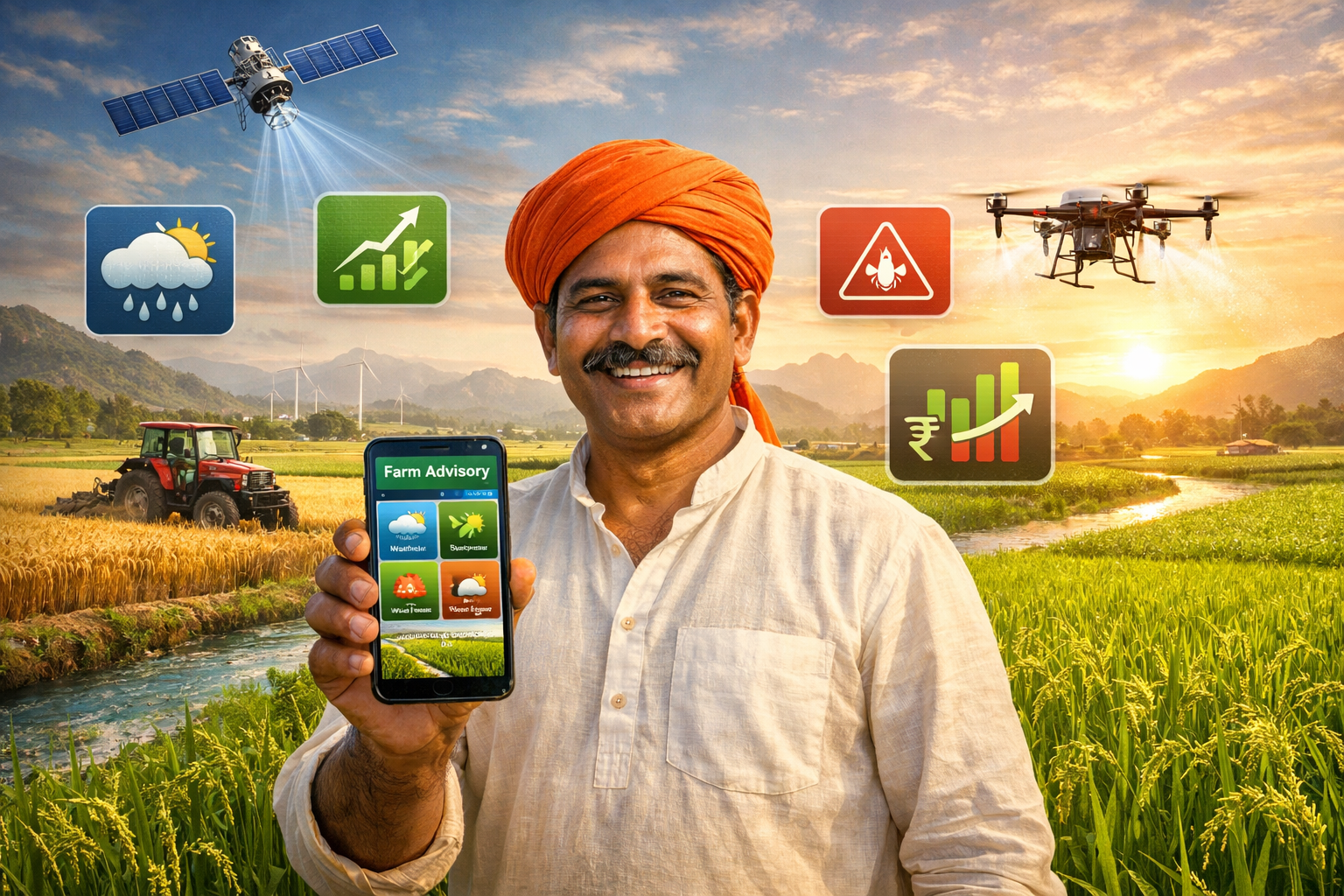
Introduction: Today's Important Current Affairs News The Central Government has launched a new multilingual AI-powered platform for farmers, Bharat-VISTAAR (Virtually Integrated System to Access Agricultural Resources), which will function as a 24x7 "Digital Agricultural Expert". This initiative was announced in the Union Budget 2026-27, and its objective is to link AgriStack portals and ICAR's package of agricultural practices with AI systems to provide location-specific, data-driven advisories to farmers.
Read for more current affairs notes: UPSC Current Affairs Daily Notes
What is Bharat-VISTAAR? (Concept, Full Form, Objective)
Full Form: Bharat-VISTAAR = Virtually Integrated System to Access Agricultural Resources
It is a multilingual AI-powered digital public infrastructure that connects various agricultural databases and research to provide customized advisories to farmers.
The objectives of Bharat-VISTAAR are:
To increase agricultural productivity,
To empower farmers in decision-making,
And to mitigate risks, such as weather, pest diseases, and market uncertainty.
Launch, Location, and Key Figures
The co-formal launch of Bharat-VISTAAR is reported to take place in Jaipur, with the presence of the Union Agriculture Minister and state leadership (this detail has emerged in press and reports as pre-launch coverage).
This launch is seen as a follow-up to the budgetary announcement made in the Union Budget 2026-27, which linked it to the broader vision of emerging technologies and AI-based public services.
Key Features: "24x7 Digital Agricultural Expert" for Farmers
1. 24x7 AI-Powered Advisory
Bharat-VISTAAR will be available 24 hours a day like a "digital agricultural expert" and will interact with farmers through a conversational AI assistant (chatbot/voicebot).
The platform will be accessible via both mobile-based interfaces and simple phone calls so that farmers without smartphones can also benefit.
2. Helpline Number and AI Assistant "Bharti"
A dedicated toll-free number 155261 has been made available for farmers, through which they can call and get information from the AI assistant.
The conversational AI assistant is named "Bharti", which will communicate with farmers in a Q&A format in their own language.
3. Multilingual Support
In its initial version, Bharat-VISTAAR is being launched in Hindi and English, and will later be expanded to other Indian regional languages.
This initiative is being developed in coordination with the national language-technology platform BHASHINI and other language-AI efforts to strengthen speech-to-text, translation, and local linguistic support.
What Information Will Farmers Get from Bharat-VISTAAR?
The following information will primarily be provided to farmers as a "one-stop" solution:
Crop Planning – Advice on which crops are suitable to sow based on the region, weather, soil, and market conditions.
Agricultural Practices & Package of Practices – Guidance on ICAR-approved advanced farming practices, seeds, irrigation, fertilizers, sowing-harvesting timing, etc.
Pest & Disease Management – Scientific methods for potential pest outbreaks, disease identification, and control, including chemical and non-chemical integrated pest management suggestions.
Weather Forecasts – Hyper-local weather data and alerts, advance warnings on risks related to rainfall, temperature, frost, drought, etc.
Market & Price Related Information – Mandi prices, demand-supply trends, potential price risks, and inputs on marketing options.
Information on Central Government Agricultural Schemes – Step-by-step guidance on scheme objectives, eligibility, benefits, application processes, and grievance redressal.
For more schemes-based notes, see: Important Government Schemes Related to Agriculture – UPSC Notes
Technical Framework: AgriStack, ICAR, IndiaAI Mission, and BHASHINI
1. AgriStack + ICAR Integration
The core architecture of Bharat-VISTAAR is based on integrating AgriStack (digital farmer records, land records, input-use data, etc.) and ICAR's "package of practices" with AI systems.
This will enable the platform to provide need-based, location-specific advisories based on farmer-specific, field-level data (soil, weather, crop history) – meaning personalized guidance based on individual farms, rather than generic advice for everyone.
2. National AI Ecosystem: IndiaAI Mission & BHASHINI
Bharat-VISTAAR is being developed in collaboration with India's national AI ecosystem – such as the IndiaAI Mission, BHASHINI, and other AI centers of excellence – to create scalable and trustworthy AI models.
The platform is designed as an open, federated digital public infrastructure, where private agritech startups, NGOs, and tech companies can also create value-added services via APIs.
Budgetary Provisions: Bharat-VISTAAR in Union Budget 2026-27
Announcing Bharat-VISTAAR in the Union Budget 2026-27, Finance Minister Nirmala Sitharaman highlighted it as a key initiative under emerging technologies and AI-driven public services.
An initial amount of ₹150 crore has been allocated for the operation and implementation of Bharat-VISTAAR in Budget 2026, enabling the platform to become operational on a national scale.
PIB and Budget Document References:
PIB Budget Summary – Bharat-VISTAAR paragraph.
Budget Speech 2026-27 PDF – Para on Bharat-VISTAAR.
Which Ministry/Agency Will Have the Lead Role?
At the policy level, Bharat-VISTAAR is being jointly led by the Ministry of Finance (announcement and budget), the Ministry of Agriculture and Farmers Welfare, and nodal agencies associated with digital technology.
In technical implementation, the AgriStack platform, ICAR, India AI Mission, BHASHINI, and various AI startups/tech companies will contribute together – such as in data integration, model development, local language interfaces, etc.
Which 10 Major Agricultural Schemes Will Provide Information?
Through Bharat-VISTAAR, farmers will be provided guidance on at least 10 major Central Government schemes via direct calls or digital interfaces (scheme-wise details may be periodically updated from official implementation documents):
PM-KISAN – Income support scheme (₹6,000/year in three installments) – help with beneficiaries, registration status, and grievance-related queries.
Pradhan Mantri Fasal Bima Yojana (PMFBY) – Information on crop insurance coverage, premiums, claim processes, cut-off dates, etc.
Soil Health Card (SHC) – Understanding of soil testing, nutrient status, recommended fertilizer dosage, etc.
Modified Interest Subvention Scheme – Interest subsidy on agricultural loans, eligibility, and bank-wise procedures.
Sub-Mission on Agricultural Mechanization – Guidance on subsidy for farm mechanization, custom hiring centers, and equipment selection.
Per Drop More Crop / PMKSY – Advice related to subsidies for micro-irrigation (drip, sprinkler) and water-use efficiency.
Pradhan Mantri Krishi Sinchayee Yojana (PMKSY) – Briefings on components related to "Har Khet Ko Pani" (water to every field).
Pradhan Mantri Annadata Aay SanraksHan Abhiyan (PM-AASHA / Price Support Schemes) – High-level information on MSP, price deficiency payments, and procurement mechanisms.
Agriculture Infrastructure Fund – Details on credit support and interest subvention for warehouses, cold storage, processing units, etc.
Kisan Credit Card (KCC) – Working capital credit, interest rates, insurance linkages, and renewal procedures.
The points given above are extremely useful as an exam-oriented list; be sure to add them to your "Government Schemes – Agriculture" notebook.
Expected Impact of Bharat-VISTAAR: Benefits and Challenges
Potential Benefits
Precision & Smart Agriculture: Real-time advisories based on soil, weather, crop stage, and input data are expected to improve input-use efficiency, productivity, and resource conservation (water, fertilizers).
Risk Reduction: Timely information on pest/disease alerts, weather warnings, and market signals can reduce both yield loss and price risk.
Informed Policy-making: This platform is interactive; farmers' queries and feedback data will flow back to government systems, aiding in evidence-based policy formulation and setting research priorities.
Key Challenges
Digital Divide: According to several reports, only a limited percentage of farmers are currently comfortable with digital tools; both connectivity and digital literacy could become bottlenecks.
Data Quality and Privacy: Questions may arise regarding the accuracy, updation, and data-privacy frameworks of the data recorded in AgriStack, especially when AI-based profiling and recommendations are done on a large scale.
Last-mile Extension: Merely an app/AI advisory is not enough; without a robust system of ground-level extension workers and training, adoption may remain limited – this has also been flagged by industry experts.
Potential Facts/MCQs for Prelims
Some high-probability points related to Bharat-VISTAAR in the context of UPSC Prelims:
Which sector is Bharat-VISTAAR related to? → Agriculture (AI-based digital advisory for farmers).
Under which ministry/initiative does Bharat-VISTAAR conceptually fall? → Announced by the Finance Minister in the Union Budget 2026-27, implemented by the Ministry of Agriculture and Farmers Welfare + Digital/AI Missions.
What is the full form of Bharat-VISTAAR? → Virtually Integrated System to Access Agricultural Resources.
What is the main objective of Bharat-VISTAAR? → To integrate AgriStack and ICAR packages with AI systems to increase productivity, improve decision-making, and reduce risks.
What is the approximate budgetary allocation kept for Bharat-VISTAAR in FY 2026-27? → ₹150 crore.
What kind of digital structure (DPI) is this platform designed as? → Multilingual, open, federated digital public infrastructure.
Approach for Mains: How to Use in Answers?
In GS-III (Agriculture, Science & Technology) or GS-II (Governance, e-Governance) answers, you can connect Bharat-VISTAAR to several themes:
"e-technology in the aid of farmers" – If the question is about digital agriculture, AgriStack, Kisan Call Centres, or AI in agriculture, Bharat-VISTAAR can be quoted as a case study.
Digital Public Infrastructure (DPI) – Like UPI, ONDC, and ABHA, showcasing Bharat-VISTAAR as an agriculture-centric DPI can strengthen arguments on "inclusive & tech-enabled growth".
Climate-resilient agriculture – Weather-linked advisories, pest early-warnings, and input optimization can be written as examples of climate-change adaptation and risk-reduction strategies.
Challenges paragraph – A balanced, critical answer can be prepared by adding points on the digital divide, data governance, AI ethics, regional language barriers, and capacity building.
For detailed notes on Digital India and e-Governance, see: Digital India and e-Governance – GS-II Notes
Why this matters for your exam preparation
High-probability current affairs topic: In Bharat-VISTAAR, AI, agriculture, government schemes, digital public infrastructure, and the Union Budget – five high-weightage themes converge, making it highly important for both Prelims MCQs and Mains.
Integrated revision anchor: Using this topic, you can revise several schemes and initiatives like PM-KISAN, PMFBY, KCC, AgriStack, IndiaAI Mission, BHASHINI, and Digital India as a "cluster," which is ideal for a smart revision strategy.
Answer-enrichment tool: Quoting Bharat-VISTAAR as a recent, India-specific, exam-friendly example in any question asked on agriculture, technology, data governance, or rural development in Mains will make your answer look factual, contemporary, and analytical – which is essential for top-tier marks.
Right now, create a separate heading "Bharat-VISTAAR (2026) – AI in Agriculture" in your notebook and write down the above points as short notes and flow-charts, so that this topic becomes part of your "ready-to-use arsenal" for both Prelims and Mains.