
UPSC Current Affairs May 25, 2026: Successful Wheat Cultivation in Thar Desert Using 'Soilification' Technique | Daily GK Update
A revolutionary scientific breakthrough has been recorded within the agricultural sector in the arid and extremely hot western regions of Rajasthan. Scientists from the Department of Microbiology at the Central University of Rajasthan (CUoR) have developed an innovative biotechnological method called 'Desert Soilification Technology'.
Through this indigenous technique, researchers have achieved historic success for the first time by converting the barren sand of the Thar Desert into a fertile, soil-like medium to successfully cultivate wheat. This scientific achievement is not only significant for boosting agricultural productivity, but it could also prove to be a milestone in preventing the eastward expansion of the Thar Desert. For candidates preparing for competitive examinations and Atharva Examwise, this serves as a highly important global case study in the field of eco-friendly agriculture and desertification control.
The Problem of Desertification and the Rise of Soilification Technology
The Thar Desert is continuously expanding due to the degradation of the Aravalli mountain ranges, unregulated plantation practices, and changing rainfall patterns. This expansion has become a serious environmental threat even for the National Capital Region (NCR).
To solve this ecological crisis, this research was accelerated under the patronage of CUoR Vice-Chancellor Prof. Anand Bhalerao. The team, led by Principal Investigator Associate Professor Dr. Akhil Agrawal, Co-investigator Dr. Lalita Ledwani, and research scholar Deeksha Kumari, started working on this technology in 2019 under the State Science and Technology Programme (SSTP) scheme of the Department of Science and Technology (DST), Government of India.
The Scientific Mechanism of Soilification
The fundamental difference between sand and fertile soil lies in their water-retention capacity, organic structure, and microbial activity. To bridge this gap, scientists have developed a special indigenous 'bioformulation' (a polymer-based bio-product). The main stages of this technical process include:
Cross-Linking of Sand Particles: The formulation uses natural polymers (such as guar polymer or guar galactomannan) and cyanobacterial biomass (blue-green algae biomass). When mixed with sand, it binds the scattered macro-particles of sand together, providing them with a stable and porous structure similar to soil.
Enhanced Water Retention: This polymer-based network drastically increases the water-holding capacity of the sand. This stops the rapid percolation (seepage) of water and ensures that moisture remains in the root zone (rhizosphere) for a longer period.
Microbial Boost: This bio-product promotes the growth of locally adapted bacteria and cyanobacteria present in the soil. Cyanobacterial biomass naturally provides essential nutrients like Nitrogen, Phosphorus, and Potassium (NPK), which enhances the plants' ability to tolerate abiotic stress (heat and drought).
Historic Field Trial of Wheat Cultivation
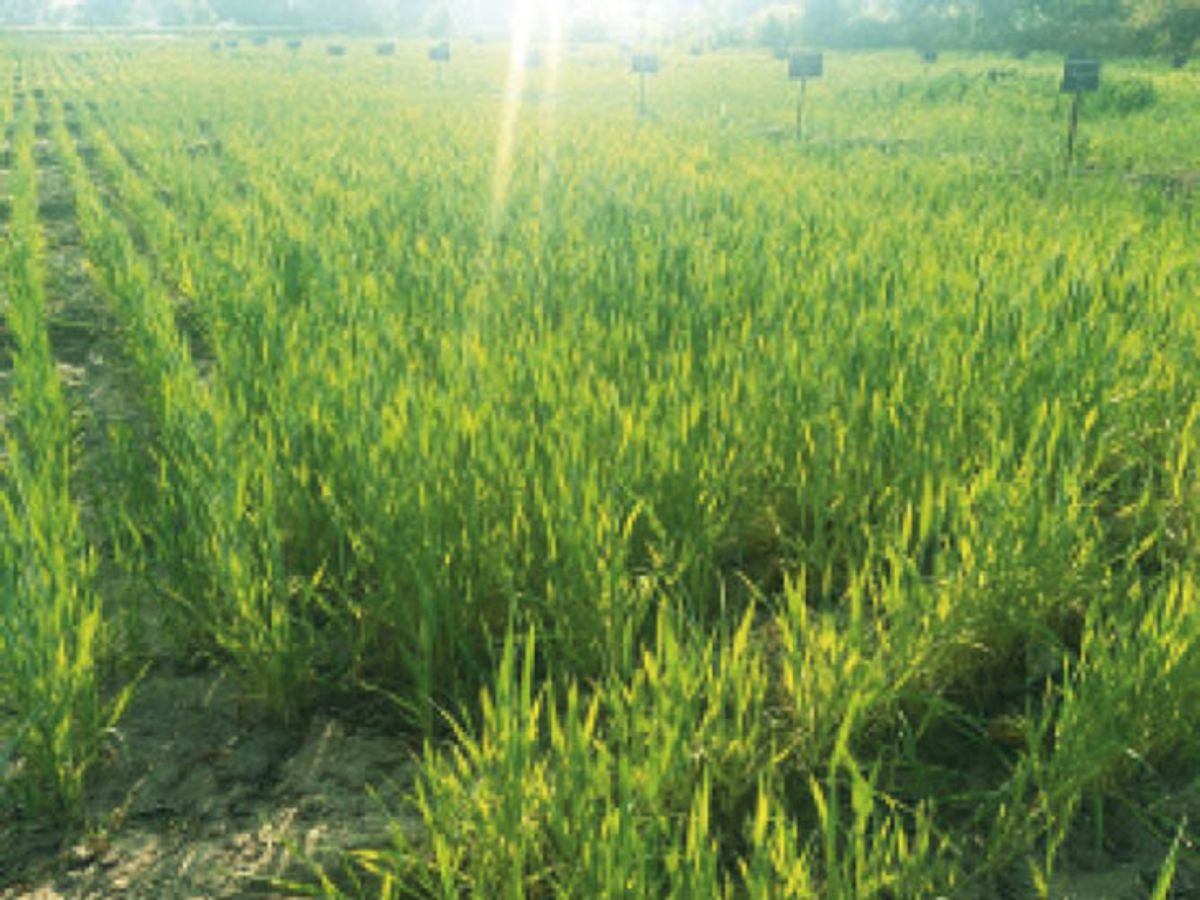
After achieving initial success in the laboratory, the scientists decided to test this technology under real geographical conditions. In November 2024, in Baseli village near Pushkar in Ajmer district—which is located on the border of the Thar Desert—the indigenous 'Wheat-4079' variety was sown across a sandy area of 1,000 m².
To successfully implement this project, the Krishi Vigyan Kendra (KVK) and the Rajasthan State Horticulture Department provided technical and practical assistance. KVK officials designed a field layout adapted to the desert ecosystem. The crop was harvested in April 2025, yielding results that are unprecedented in the history of desert agriculture.
Comparative Agricultural Data of Soilification Technology
To understand the effectiveness of this technology, a comparison of performance indicators between traditional desert agriculture and the innovative soilification method is provided below:
| Performance Indicators | Traditional Desert Agriculture | Soilification-Supported Agriculture | Scientific & Economic Impact |
|---|---|---|---|
| Irrigation Cycles Required | 5 to 6 irrigation cycles | 3 to 4 irrigation cycles | Approximately 30% to 40% water savings and conservation of groundwater. |
| Crop Productivity (Wheat) | Extremely low and uncertain | 26 kg per 100 m² | Double the yield compared to normal desert control conditions. |
| Seed-to-Crop Multiplication Ratio | 1:10 (average arid zone) | 1:20 | A net increase of 100% in seed utilization efficiency. |
| Campus Trial Results (Other Crops) | Minimal growth in control sand | Millet, guar, and chickpea trials on 100 tonnes of sand brought from Jaisalmer | A massive 54% increase in production was recorded. |
| Project Budget & Duration | — | — | $\approx$ ₹3,370,240 (DST-SSTP funded). Three-year research period (2019-2022) along with continuous field trials. |
Following this success, the team of researchers is now planning to extend this technology to millet, moong, and other pulse crops in other extremely arid districts of Rajasthan, such as Barmer and Jaisalmer.
Broader Environmental and Policy Context
This technology is highly significant in the context of India's national commitments and international agreements to combat desertification. According to the 'Desertification and Land Degradation Atlas (2021)' by ISRO, about 29.77% (approximately 97.85 million hectares) of India's total geographical area is undergoing land degradation and desertification. Rajasthan is one of the states most affected by this crisis, accounting for about 20% of the country's total desertified area.
Alignment with National and Global Commitments
This indigenous technological development directly supports India in fulfilling several major government schemes and promises made on global platforms:
United Nations Convention to Combat Desertification (UNCCD): India is an active signatory member of UNCCD. At the UNCCD COP-14 conference held in New Delhi in 2019, India pledged to achieve 'Land Degradation Neutrality' (LDN) and restore 26 million hectares of degraded land by 2030. Soilification technology offers a practical scientific solution to achieve this goal.
Pradhan Mantri Krishi Sinchayee Yojana (PMKSY): This technology aligns perfectly with PMKSY's vision of "Har Khet Ko Pani" (Water to every field) and "Per Drop More Crop", as it nearly doubles water-use efficiency in agriculture.
Global Application: The application of this technology is not limited to the Thar Desert; its scope can be expanded parallelly to similar restoration programs in Israel's Negev Desert, China's Loess Plateau, and the hyper-arid regions of the Middle East.
Long-term Impact on Desert Ecology and Socio-Economic Development
Analyzing the broader and indirect impacts of the widespread use of this technology highlights several crucial points:
Water & Soil Dynamic: Generally, in desert regions, water percolation is so rapid that water seeps deep underground before plants can absorb the nutrients. This polymer-based network retains water in the topsoil, multiplying the effectiveness of micro-irrigation systems.
Ecological Balance: The enrichment of blue-green algae (cyanobacteria) naturally promotes nitrogen fixation in the soil. This will reduce dependence on chemical fertilizers, especially urea. Lowering urea usage reduces agricultural input costs and protects underground aquifers from nitrate pollution.
Economic Sustainability: Farming in the western districts of Rajasthan has historically been limited to the monsoon season (Kharif crop). Making the cultivation of Rabi crops (such as wheat and chickpea) possible through soilification technology will pave the way for a multi-cropping system. This will stabilize farmers' annual income and curb distressed rural-to-urban migration.
Climate Mitigation: If a green belt is created west of the Aravallis using this technology, it could significantly reduce the intensity of dust storms, thereby improving the Air Quality Index (AQI) across the entirety of Northwest India.
Why This Matters for Your Exam Preparation
For serious candidates preparing for competitive exams, especially the Union Public Service Commission (UPSC) and various State Public Service Commissions (such as RPSC), this topic directly connects with multiple areas of the syllabus:
General Studies Paper-1 (Geography): Under the physical geography of India—the process of desertification, geographical features of the Thar Desert, degradation of the Aravalli mountain range, and its subsequent environmental impacts.
General Studies Paper-3 (Science and Technology): Practical applications of Biotechnology and Agricultural Microbiology. This stands as an excellent example of how sustainable, eco-friendly technologies can be developed through indigenous research.
General Studies Paper-3 (Environment and Agriculture): Sustainable agriculture, water resource management, arid-land farming techniques, and India's national environmental policies.
International Relations & Global Environmental Policies: UNCCD mandates, Sustainable Development Goals (SDG 15: Life on Land), and India's leadership role in global climate change negotiations.
Using this type of scientific advancement as a case study in the Mains answer writing and the Essay paper gives candidates a distinct analytical edge. Stay connected with Atharva Examwise for more such detailed analyses of daily current affairs.