
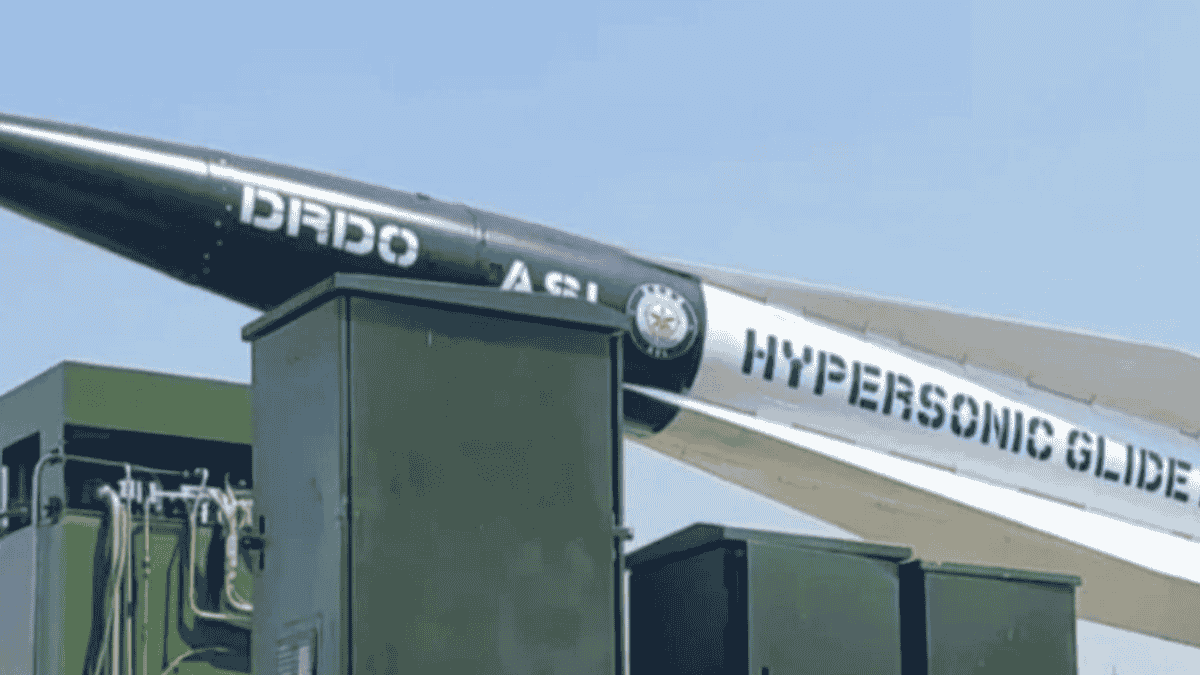
UPSC Current Affairs 2026: India's Hypersonic Missile Revolution, Agni-6, and the New Era of Strategic Security
The Indian defense and strategic landscape is currently undergoing a landmark transformation. This shift is not merely about an increase in firepower; it is a decisive step toward achieving mastery over 'niche' technologies that ensure India's autonomy and sovereignty in the battlefields of the future. Recent disclosures by the Defence Research and Development Organisation (DRDO) and developments throughout 2025-26 have made it clear that India is no longer just a follower but is emerging as a pioneer in global missile technology. In this special bulletin for May 2026, we provide an in-depth analysis of India’s hypersonic missile program, the technical maturity of Agni-6, and the shifts in modern warfare strategy—topics of critical importance for the UPSC and other State Public Service Commission examinations.
Hypersonic Missile Technology: India’s New Strike Capability
Missiles flying at hypersonic speeds (five times the speed of sound or more) have become the greatest challenge for modern air defense systems. DRDO Chairman Samir V. Kamat recently confirmed that India is rapidly working on two parallel hypersonic programs: the Hypersonic Glide Missile (HGM) and the Hypersonic Cruise Missile (HCM).
Understanding the science of hypersonic flight is essential for the 'Science & Technology' section of the UPSC syllabus. When an object attains a speed of $Mach > 5$, the air molecules around it break apart and form a shroud of ionized gas known as 'Plasma'. This plasma not only protects the missile from extreme heat but also provides a natural 'Stealth' property by absorbing or deflecting radar waves, making it nearly impossible to track.
Hypersonic Glide vs. Cruise Missiles: A Technical Comparison
Hypersonic Glide Vehicles (HGV) are launched like a ballistic missile but detach upon reaching the edge of space, 'gliding' through the atmosphere using their high velocity without an engine. On the other hand, a Hypersonic Cruise Missile (HCM) is powered by a Scramjet engine throughout its flight.
| Feature | Hypersonic Glide Missile (HGM) | Hypersonic Cruise Missile (HCM) |
|---|---|---|
| Propulsion | Launched by rocket booster, then glides without an engine | Powered by a Scramjet engine throughout |
| Altitude | Upper layers of the atmosphere (40-100 km) | Lower layers of the atmosphere (20-30 km) |
| Maneuverability | Highly unpredictable path | High, evading radar detection |
| Speed | $Mach$ 10 to $Mach$ 20+ | $Mach$ 6 to $Mach$ 8 |
| Indian Example | LR-AShM (Advanced stage of testing) | HSTDV-based future missiles |
India’s Long-Range Anti-Ship Missile (LR-AShM) is a prime example of hypersonic glide technology. Its successful test on May 1, 2026, proved that India possesses the capability to neutralize maritime targets at a distance of 1,500 km with an average speed exceeding $Mach$ 5. This missile utilizes a two-stage solid rocket motor and tracks dynamic vessels in its terminal phase via an indigenous Radio Frequency (RF) seeker.
Scramjet Engine: 'Lighting a Match in a Hurricane'
The success of hypersonic cruise missiles depends on the Scramjet (Supersonic Combustion Ramjet) engine. The challenge of a scramjet is that fuel combustion must occur while air is passing through the engine at supersonic speeds.
In May 2025, DRDO successfully tested an 'Actively Cooled Scramjet' combustion chamber in Hyderabad for over 1,000 seconds. This was followed by another historic 12-minute test in January 2026, placing India among the elite group of nations possessing the thermal management technology required for long-duration hypersonic flight.
This progress is significant not only for missile development but also for future Reusable Launch Vehicles (RLV) and space exploration. Scramjet engines use atmospheric oxygen, significantly reducing the missile's weight and allowing it to carry more fuel or a larger warhead.
Agni-6: Expanding India’s Intercontinental Reach
The Agni series of missiles forms the backbone of India’s Strategic Deterrence. Following the successful deployment of Agni-5—which demonstrated MIRV (Multiple Independently Targetable Re-entry Vehicle) technology during March 2024’s 'Mission Divyastra'—the focus has now shifted to Agni-6.
DRDO Chief Samir V. Kamat has clarified that the Agni-6 program is technically fully prepared and is merely awaiting formal government approval. This missile will not only extend India’s strike range to 10,000–12,000 kilometers but will also provide greater credibility to India’s 'No First Use' (NFU) nuclear doctrine.
Proposed Features and Strategic Impact of Agni-6
Agni-6 will be a four-stage Intercontinental Ballistic Missile (ICBM), capable of being launched from land as well as submarines. Its greatest feature will be its 'Survivability'. Equipped with radar-absorbent coatings and Maneuverable Re-entry Vehicles (MaRV), it will remain effective even against sophisticated missile defense systems like the American THAAD or the Russian S-500.
| Parameter | Agni-5 | Agni-6 (Proposed) |
|---|---|---|
| Range | 5,500 – 8,000 km | 10,000 – 12,000 km |
| Warhead | 3-6 MIRV warheads | 10-12 MIRV warheads |
| Launch Weight | ~50,000 kg | 55,000 – 70,000 kg |
| Propulsion | Three-stage solid fuel | Four-stage solid fuel |
| Key Technology | Mission Divyastra (MIRV) | Advanced MaRV and Decoy systems |
The development of Agni-6 is seen as a necessary response to China’s growing nuclear arsenal and its new missile silos. It will provide India with a true 'Global Strike' capability, ensuring India’s strategic autonomy.
Operation Sindhu: The 'New Normal' of Modern Warfare Strategy
'Operation Sindhu' in May 2025 marked a major shift in India’s military strategy. It was not just a military retaliation but an integrated demonstration of all dimensions of modern warfare—kinetic, non-kinetic, informational, and economic.
Launched on May 7, 2025, in response to the Pahalgam terror attack, the operation saw the Indian Army, Navy, and Air Force collaborate to destroy 9 terror camps in Pakistan and PoJK. The key lessons of this operation are vital for the Internal Security section of the UPSC Mains:
Rise of Drone Warfare: During Operation Sindhu, large-scale use of 'Kamikaze' drones and loitering munitions like the SkyStriker was witnessed. This proved that precision strikes can now be achieved without expensive fighter jets.
Information Warfare: Pakistan attempted to shift global perception through fake videos and social media campaigns, which India effectively neutralized through its 'Strategic Communication'.
Economic and Diplomatic Pressure: India’s suspension of the 'Indus Waters Treaty' and the closure of the Attari-Wagah border demonstrate that India will no longer hesitate to use 'water leverage' and economic isolation against terrorism.
Beyond Surgical Strikes: Operation Sindhu established that India will no longer limit itself to restricted border actions but possesses the capability and willpower to destroy terror infrastructure deep inside, a stance Prime Minister Modi termed the 'New Normal'.
Global Hypersonic Race: Where Does India Stand?
Russia and China are currently leading the hypersonic arms race. Russia has deployed missiles like the 'Zircon' and 'Kinzhal', while China possesses the DF-ZF glide vehicle. The United States has lagged slightly, as several of its hypersonic projects (such as the AGM-183 ARRW) faced failures in recent tests.
India has maintained its autonomy by developing fully indigenous hypersonic technologies while also collaborating with Russia on the 'BrahMos-2'. This 'Dual Strategy' prevents India from being dependent on a single source.
The Concept of an Integrated Conventional Missile Force
DRDO Chief Kamat has also emphasized the need for an integrated 'Conventional Missile Force', which will include a mix of short-range (Pralay missile), medium-range, and ballistic/cruise missiles with ranges up to 2,000 km. This force is being designed specifically to enhance India’s response capability in non-nuclear war scenarios.
Key Points for UPSC Preparation
Based on this report, the following facts are highly significant for competitive exams:
HSTDV (Hypersonic Technology Demonstrator Vehicle): India's indigenous scramjet demonstration vehicle that successfully achieved $Mach$ 6.
MIRV Technology: The capability to drop multiple nuclear warheads on different targets from a single missile. India proved this with Agni-5.
MaRV (Maneuverable Re-entry Vehicle): Warheads that can change their path while re-entering the atmosphere, making them difficult for missile defense systems to intercept.
Plasma Shield: Ionized gas generated at hypersonic speeds that absorbs radar signals.
Operation Sindhu: The military operation of May 2025 that defined India’s 'Pro-active' defense doctrine.
Why This Matters for Your Exam Preparation
From the perspective of UPSC and other competitive exams, this news is critical as it relates directly to General Studies Paper 3 (GS Paper 3): 'Science & Technology' and 'Internal Security'.
Science & Technology: Questions regarding Scramjet engines, $Mach$ number, plasma physics, and space debris may appear in Prelims and Mains. It is essential to understand how technologies like 'Active Cooling' and 'Maneuverable Re-entry' make a missile invincible.
Internal and National Security: The lessons from 'Operation Sindhu' reflect India's changing military strategy and its tough stance toward 'proxy war'. There is a strong possibility of essay or analytical questions on "The Completion of India's Nuclear Triad and Regional Stability" in the Mains.
International Relations: The global race for hypersonic weapons and the India-China Strategic Balance are top contemporary issues. How the reach of Agni-6 will impact India’s global stature and its role as a 'Vishwa Mitra' (Global Friend) is a significant topic of discussion.
A deep study of these technical and strategic aspects will not only keep you updated with current affairs but will also help bring 'expertise' and 'insight' to your answers. For continuous updates, keep visiting www.atharvaexamwise.com.
How would you like to explore the specific technical challenges of Scramjet engine cooling further?