UPSC Current Affairs 30 April 2026: Comprehensive Analysis of the Great Nicobar Project — Strategic Milestone or Ecological Threat? | Atharva Examwise Daily GK Update
The Great Nicobar Island Development Project (GNIP), officially termed the 'Holistic Development of Great Nicobar Island,' has emerged as one of the most ambitious and controversial infrastructure projects in the history of modern India. Envisioned by NITI Aayog and implemented by the Andaman and Nicobar Islands Integrated Development Corporation (ANIIDCO), this mega-project—valued between ₹72,000 crore and ₹92,000 crore—aims to transform India's southernmost island into a global maritime and strategic stronghold. As of April 2026, the project has become not only a focal point of geopolitical discourse but also a vivid example of the "Development vs. Conservation" debate. The project rests on four main pillars: an International Container Transshipment Terminal (ICTT), a Greenfield International Airport, a Gas and Solar Hybrid Power Plant, and a Vast Township.
Geographical and Historical Background of Great Nicobar Island
Great Nicobar Island, spanning approximately 910 sq. km, is home to 'Indira Point,' India's southernmost tip. The island is located a mere 145 kilometers from Sumatra (Indonesia) and is strategically positioned at the western entrance of the Strait of Malacca, one of the world's busiest shipping lanes. Historically, the significance of these islands dates back to the Chola Dynasty, which used the Nicobar Islands as a base for expeditions against kingdoms near the Strait of Malacca in the 11th century.
Approximately 85% of the island's area falls under the 'Great Nicobar Biosphere Reserve,' which includes 'Campbell Bay' and 'Galathea National Park.' This region is part of the Sundaland biodiversity hotspot and was recognized under UNESCO’s 'Man and Biosphere' (MAB) program in 2013.
Key Components of the Project and Economic Significance
The primary objective of the project is to establish India as a regional maritime hub and reduce dependence on foreign ports. Currently, nearly 25% of India's transshipment cargo is handled through foreign ports like Colombo, Singapore, and Port Klang, resulting in an annual revenue loss of approximately $200 million to the Indian economy.
International Container Transshipment Terminal (ICTT)
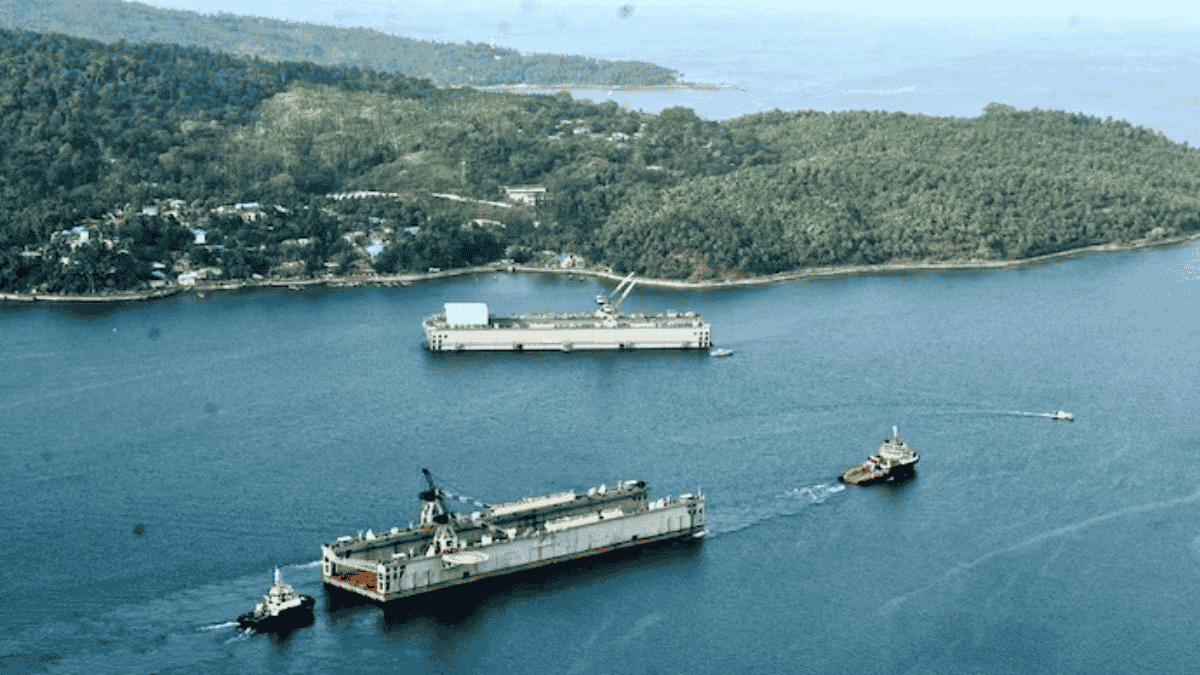
The proposed ICTT at Galathea Bay is the heart of this project. With a natural depth of 20 meters, it is ideally suited to handle the world’s largest container ships.
| Component | Description | Strategic/Economic Impact |
|---|---|---|
| Location | Galathea Bay (East Coast) | Proximity to the Strait of Malacca |
| Capacity (Phase I) | 4 Million TEUs | Accelerating Indian Ex-Im trade |
| Total Estimated Capacity | 14.2 to 16 Million TEUs | Competing with Singapore and Colombo |
| Investment | ~₹41,000 Crore (Port only) | Forex savings and job creation |
Greenfield International Airport
The proposed airport will be for 'dual-use' (civil and military). Spanning 4.2 sq. km with a 3,300-meter runway, it will be capable of handling large aircraft. This will further strengthen the capabilities of the INS Baaz naval air station, enhancing India's aerial surveillance and rapid deployment capabilities in the Indian Ocean Region (IOR).
Township and Urban Development
The project plans to develop a modern township across 149 to 160 sq. km.
| Population Data | Current Status | Future Projection (2050-55) |
|---|---|---|
| Number of Residents | ~8,000 | 3.5 Lakh to 6.5 Lakh |
| Main Economic Activities | Subsistence farming and fishing | Tourism, logistics, and international trade |
| Infrastructure | Minimal (Rural) | Smart city, industrial zones, and luxury resorts |
Experts have expressed concerns regarding this population explosion, stating it will exert excessive pressure on the island’s limited resources and fragile ecosystem.
Energy Self-Reliance: Gas and Solar Power Plant
To power the infrastructure, a 450 MVA Gas and Solar Hybrid Power Plant is proposed. This will cater to the energy needs of the township, port, and airport, ensuring the island remains independent of external supplies.
Strategic Importance: The 'Malacca Dilemma' and IOR Security
For India, the importance of Great Nicobar is not merely economic but highly strategic. It is often described as a 'Natural Aircraft Carrier' stationed at the gateway of the Indian Ocean.
Strait of Malacca and China's Influence: China imports nearly 80% of its energy requirements through the Strait of Malacca. Chinese strategists call this the 'Malacca Dilemma', as the route is outside their control and could be blocked by India or its allies during a crisis.
Power of Surveillance: From Great Nicobar, India can monitor the 'Six Degree Channel', a critical part of global trade and China's energy route.
QUAD and Regional Balance: The project aligns with the objectives of the QUAD (India, USA, Japan, Australia), which advocates for a "Free and Open Indo-Pacific."
Countering the 'String of Pearls': In response to China's development of ports in Myanmar (Coco Islands), Sri Lanka (Hambantota), and Pakistan (Gwadar), India's presence in Great Nicobar provides a robust defensive shield.
Strengthening the Andaman and Nicobar Command (ANC)
Established in 2001, the ANC is India's first and only Tri-Service Integrated Command. The expansion of airstrips and port facilities under GNIP will extend ANC’s operational reach into the deep waters of Sumatra and Southeast Asia.
Environmental Concerns: Destruction of Biodiversity?
The harshest criticism of the Great Nicobar Project stems from its environmental impact. The island's biodiversity is unique, with many species found nowhere else on Earth.
Deforestation and Loss of Carbon Sink
The project proposes to divert approximately 130.75 sq. km of pristine rainforest.
| Estimated Tree Felling | Source |
|---|---|
| 8.52 Lakh - 9.64 Lakh | Official Government Data |
| 60 Lakh - 1 Crore | Independent Ecologists' Estimates |
| Affected Forest Area | ~13,000 Hectares |
Environmentalists argue that 'Compensatory Afforestation' in states like Haryana cannot compensate for the tropical rainforests of Nicobar, as the ecologies of the two regions are entirely different.
Impact on Endangered Species
Great Nicobar is the sole habitat for several rare species that will be directly affected by the construction.
Giant Leatherback Turtle: Galathea Bay is the most important nesting site in the Indian Ocean for the world's largest turtles. Port construction will disrupt their nesting process. In the 2024 season, a record of over 600 nests was registered here.
Nicobar Megapode: This rare bird nests on the ground. According to experts, translocation of the Megapode is nearly impossible, and deforestation could lead to their extinction.
Coral Reefs: There are plans to translocate approximately 20,000 coral colonies. However, the global success rate for coral translocation is very low, and it could permanently damage the marine ecosystem.
Geological and Climate Risks
Great Nicobar is situated on the 'Ring of Fire' and falls under Seismic Zone V.
Impact of the 2004 Tsunami: During the 2004 earthquake and tsunami, the coastline of Indira Point subsided by more than 4 meters.
Future Threat: Experts warn that developing such a massive project in an unstable region could be suicidal from both a financial and humanitarian perspective.
Tribal Rights and Social Crisis: The Shompen and Nicobarese Communities
Great Nicobar is home to two major indigenous communities whose lifestyles are entirely dependent on the forests and the sea.
Shompen Tribe: A Particularly Vulnerable Tribal Group (PVTG)
The Shompen tribe is classified by the Government of India as a PVTG. Their population is estimated to be between only 200 and 450.
Health Risks: Contact with an outside population could expose the Shompen to diseases for which they have no immunity.
Shompen Policy 2015: This policy prioritizes tribal welfare, but critics claim that the 'Free, Prior, and Informed Consent' (FPIC) required for the project was ignored.
Nicobarese Tribe and the 'Consent' Controversy
The Nicobarese people were displaced after the 2004 tsunami. They are now demanding to return to their ancestral villages, which fall within the project area.
Forest Rights Act (FRA) 2006: The Tribal Council alleges that the administration pushed the project forward without their consent and without following the procedures of the FRA.
Surrender Certificates: Several tribal leaders have alleged that they were forced to sign 'Surrender Certificates' to give up their land.
Legal Developments and the Role of the NGT
The environmental clearance granted to the Great Nicobar Project has been challenged multiple times in court.
High-Powered Committee (HPC) and Confidential Report: In 2023, the NGT constituted an HPC to review the clearance. However, the committee's report was not made public, citing "national security" and "strategic importance."
Decision of February 2026: On 16 February 2026, the NGT gave the green light to the project. The tribunal stated that the "strategic importance" of the project is paramount and that adequate environmental safeguards have been included. The NGT directed that there should be "no net loss" of turtle nesting beaches and that construction should not alter the coastline.
Political Situation in April 2026: Rahul Gandhi’s Visit and Controversy
In the last week of April 2026, Leader of the Opposition Rahul Gandhi visited Great Nicobar, bringing the issue back into the national spotlight.
Opposition Stance: Rahul Gandhi termed the project "the biggest scam and crime against the country's natural and tribal heritage." He alleged the project is being implemented for the benefit of "corporate friends" without the consent of local people.
Government Response: The Central Government and the BJP have labeled these allegations "anti-development." According to the Ministry of Home Affairs, the project will become a hub of India’s sovereignty and maritime power, transforming the island into a global cargo hub.
Other Related Activities: Deep Sea Mining
Apart from the GNIP, the area near Great Nicobar is also in the news for mineral wealth. In November 2024, the Indian Government launched an e-auction for seven mineral blocks on the 'West Sewell Ridge' to the east of Great Nicobar.
| Aspect | Description |
|---|---|
| Mineral Types | Polymetallic nodules and crusts (Nickel, Cobalt, Manganese, REEs) |
| Significance | Critical for electric vehicle batteries and defense technologies |
| Current Status (April 2026) | Reports of delays or cancellations in the auction process due to lack of technical readiness and low investor interest |
Conclusion
The Great Nicobar Island Project represents a complex crossroads on India's path to development. Strategically, it appears indispensable for countering China’s growing presence in the Indian Ocean and establishing India as a maritime superpower. Economically, it promises to increase India's share in global logistics and tourism.
However, the ecological and human cost to be paid is immense. The survival of primitive tribes like the Shompen and the habitat of ancient creatures like the Giant Leatherback Turtle are at stake. Success will depend on how strictly the government implements the safeguards mandated by the NGT and whether it can truly make the local tribes partners in the development process.
Why this matters for your exam preparation
The Great Nicobar Project is an extremely important topic for the UPSC and other State Public Service Commission exams. The importance of its various dimensions is as follows:
GS Paper 1 (Geography): Questions related to the Strait of Malacca, Six Degree Channel, and the geological positioning of Andaman-Nicobar (Seismic Zone V). Characteristics of the Sundaland hotspot and tropical rainforests.
GS Paper 2 (Governance and International Relations): India's 'Act East' policy, 'QUAD' alliance, and legal issues related to tribal rights (FRA 2006). Specifically, an analysis of government policies for the Shompen (PVTG).
GS Paper 3 (Environment and Internal Security): The process of Environmental Impact Assessment (EIA), biodiversity conservation vs. infrastructure development, and naval security in the Indian Ocean Region (IOR) and the 'Malacca Dilemma.'
Essay and Ethics: Can be used as a case study for topics such as the balance between development and environment, and the state's moral responsibility in protecting the rights of indigenous communities.
Staying updated on the latest developments of this project (such as the April 2026 political controversy and NGT orders) is mandatory for the Preliminary Exam (Prelims) current affairs and Main Exam answer writing.
For more such detailed current affairs analysis, stay tuned to Atharva Examwise.