
UPSC Current Affairs April 25, 2026: The Outbreak of 'Heat Dome' in India - A Geographical and Socio-Economic Analysis | Atharva Examwise Daily GK Update
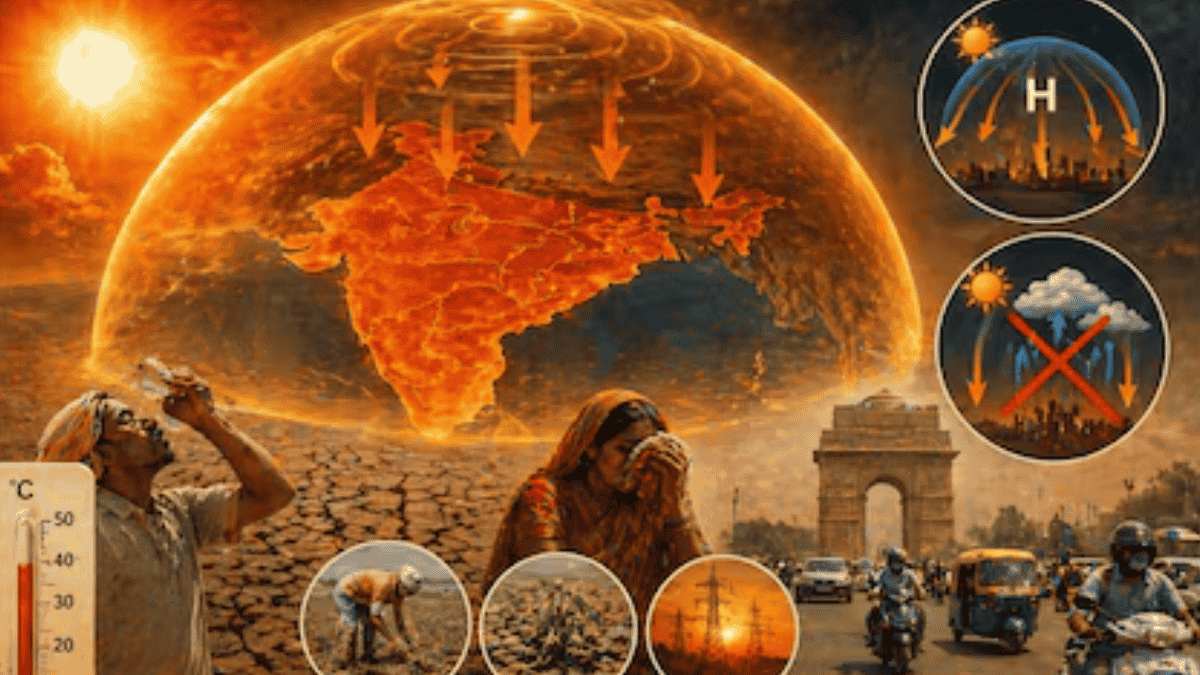
The month of April 2026 has brought a severe climate warning for the Indian subcontinent. While this period usually marks the onset of the summer season, this year’s heat has astonished both the scientific community and policymakers. According to the latest reports from Skymet and the India Meteorological Department (IMD), nearly half of the country is trapped under an atmospheric condition known as a 'Heat Dome.' This is not a standard seasonal shift; rather, it is a vicious cycle of hot air trapped in the upper layers of the atmosphere that has turned North-West, Central, and Eastern India into a furnace. States such as Maharashtra, Uttar Pradesh, Madhya Pradesh, Chhattisgarh, Telangana, and Delhi are currently at the epicenter, with temperatures having surged well past the 40°C mark.
Scientific Explanation of a Heat Dome: An Atmospheric Lid
To understand a Heat Dome in simple terms, one can imagine a pot covered with a lid. When a high-pressure zone develops over a large area of the atmosphere, it acts like a lid that prevents the hot air rising from the surface from escaping upward, instead pushing it back down toward the ground.
According to atmospheric science, this condition is caused by an 'Anticyclone.' In an anticyclone, winds circulate in a clockwise direction and sink from the upper atmosphere toward the surface. As the air descends, it compresses due to atmospheric pressure. Following the laws of thermodynamics, when the volume of a gas is decreased and pressure is increased, its temperature rises. This process is known as 'Adiabatic Heating.' Consequently, the air under a Heat Dome does not just remain hot; it continues to grow hotter as it is perpetually compressed.
The Seven-Step Process of Heat Dome Formation
The formation of a Heat Dome is not an accidental event but the result of a complex meteorological system that can be understood in the following seven stages:
| Stage | Description | Scientific Impact |
|---|---|---|
| 1 | Rising Surface Heat | The sun's intensity heats the ground, and the air attempts to rise. |
| 2 | Upper High-Pressure Activation | An anticyclonic system in the upper layers of the atmosphere pushes the air downward. |
| 3 | Clockwise Circulation | Winds rotate in a clockwise direction as they descend. |
| 4 | Compression of Hot Air | Descending air becomes intensely hot due to compression (Adiabatic Heating). |
| 5 | Loss of Moisture | Soil and plants lose their moisture, making the atmosphere even more arid. |
| 6 | Displacement of Clouds | This high pressure pushes away clouds and monsoonal moisture. |
| 7 | Direct Solar Radiation | In the absence of clouds, solar rays hit the ground directly, completing the vicious cycle. |
The Impact of Jet Streams and Climate Change
The role of the 'Jet Stream' is critical in the formation of a Heat Dome. Jet streams are ribbons of fast-moving air high up in the atmosphere that carry weather systems from one place to another. Typically, the jet stream moves in a wavy pattern, but when these waves become extremely large and stationary, weather systems get "stuck" in one position. In meteorology, this is referred to as an 'Omega Block.'
The Heat Dome observed in 2026 is a direct result of this Omega Block, where a high-pressure system has become stagnant over North-West India. Scientists believe that climate change has increased instability in jet stream behavior, causing events like Heat Domes to occur more frequently and with greater intensity. Particularly during 'La Niña' years, the temperature gradient between the western and eastern Pacific Ocean provides further strength to this system.
Heat Dome vs. General Heatwave: Key Differences
Students often confuse a 'Heat Dome' with a 'Heatwave,' but from a UPSC perspective, it is essential to understand the subtle distinctions between them.
A standard Heatwave occurs when there is a flow of hot air (advection) into a region. During a heatwave, there is often a possibility of late afternoon thunderstorms or dust storms, which allow the heat to escape upward and provide relief. However, during a Heat Dome, the sky remains completely clear as high pressure prevents clouds from forming altogether.
| Feature | General Heatwave | Heat Dome |
|---|---|---|
| Cause | Transport of hot air (Advection) | High pressure and sinking air (Subsidence) |
| Stability | Can be short-lived | Remains stagnant over a location for long periods |
| Sky Condition | Clouds or dust storms possible | Completely clear skies, scorching sun |
| Probability of Relief | Relief possible through storms/rain | Closes the doors to natural relief |
IMD Criteria and Warning Systems
For UPSC Prelims, it is mandatory to remember the criteria set by the IMD for declaring a heatwave. The IMD issues warnings based on temperature and its departure from the normal.
Basis for Declaring a Heatwave:
Plains: Maximum temperature $\ge 40^\circ C$
Coastal Areas: Maximum temperature $\ge 37^\circ C$
Hilly Regions: Maximum temperature $\ge 30^\circ C$
Classification Based on Departure:
Heatwave: A rise of $4.5^\circ C$ to $6.4^\circ C$ above the normal temperature.
Severe Heatwave: A rise of $> 6.4^\circ C$ above the normal temperature.
If the temperature in the plains touches $45^\circ C$, it is directly classified as a heatwave, and at $47^\circ C$, it is declared a 'Severe Heatwave.'
Color-Coded Warning System:
Green: No action required. Weather is normal.
Yellow: Be updated. Possible change in weather.
Orange: Be prepared. Probability of severe heat, which may be harmful to health.
Red: Take action. Extremely severe heat, a state of health emergency.
Heat Index and 'Feel Like' Temperature
A major characteristic of the 2026 summer is the 'Humid Heat.' In coastal states like Odisha, Andhra Pradesh, and Tamil Nadu, humidity has risen alongside temperatures. When humidity is high, sweat does not evaporate from the body, leading to the failure of the body's natural cooling mechanism.
To measure this, the 'Heat Index' is used, also known as the "Real Feel" temperature. For example, if the temperature is $40^\circ C$ and humidity is 70%, the body will experience heat equivalent to $48^\circ C$. For UPSC GS Paper 3, this is linked to the concept of 'Wet-bulb Temperature,' which determines the limits of human tolerance.
Impact on Agriculture and Economy: The Crisis of 'Terminal Heat'
April is the time for harvesting Rabi crops and sowing Zaid crops. The Heat Dome is having devastating effects on the agricultural sector:
Wheat Crop: Rising temperatures during the harvest in North-West India cause the grains to shrivel, resulting in a 10-15% drop in yield. This is known as 'Terminal Heat Stress.'
Zaid Crops: Issues like 'Flower Drop' in maize, moong, urad, and vegetables have increased.
Animal Husbandry: Extreme heat increases 'Heat Stress' in milch animals, leading to a decline in milk production.
Health and Social Justice: 'Thermal Injustice'
The impact of a Heat Dome is not uniform across all sections of society. This gives rise to the concept of 'Thermal Injustice.'
Vulnerable Sections: Construction workers, street vendors, and laborers working in the open have no choice but to endure the heat. Their productivity decreases, directly hitting their income.
Elderly and Children: Due to a lower capacity to regulate body temperature, these groups are more susceptible to heatstroke and dehydration.
Urban Heat Island: Due to concrete jungles and a lack of greenery, urban temperatures remain $3-5^\circ C$ higher than rural areas.
Policy Gaps and The Way Forward
In India, a heatwave is still not considered a 'Notified Disaster' under the Disaster Management Act, 2005. Because of this, states face difficulties in receiving funds from the National Disaster Response Fund (NDRF).
Necessary Reforms:
Heat Action Plan (HAP): Formulating and strictly implementing local-level Heat Action Plans for every district.
Urban Planning: Promoting 'Cool Roof' technology, urban afforestation (Miyawaki method), and the revival of water bodies.
Changes in Work Schedules: Prohibiting outdoor work during peak heat hours and providing 'Thermal Shelters' for workers.
Why this matters for your exam preparation
For UPSC and other competitive exams, the subject of 'Heat Dome' and 'Heatwaves' is extremely important for the following reasons:
Geography (GS Paper 1): Direct questions can be asked on technical topics like Jet Streams, Rossby Waves, Anticyclones, and Adiabatic Heating.
Environment (GS Paper 3): The increase in frequency of Extreme Weather Events due to climate change is a burning topic.
Disaster Management (GS Paper 3): Analytical questions regarding the effectiveness of Heat Action Plans in India and the need for legal structural reforms may appear in Mains.
Social Issues (GS Paper 1/2): The issue can be viewed through the lens of 'Thermal Injustice' and Health Rights (Article 21).
Aspirants are advised to closely study the latest IMD data, Skymet predictions, and the policy steps taken by the government. At Atharva Examwise, we will continue to provide you with an in-depth analysis of these subjects. For more information and daily GK updates, visit our website at www.atharvaexamwise.com.