
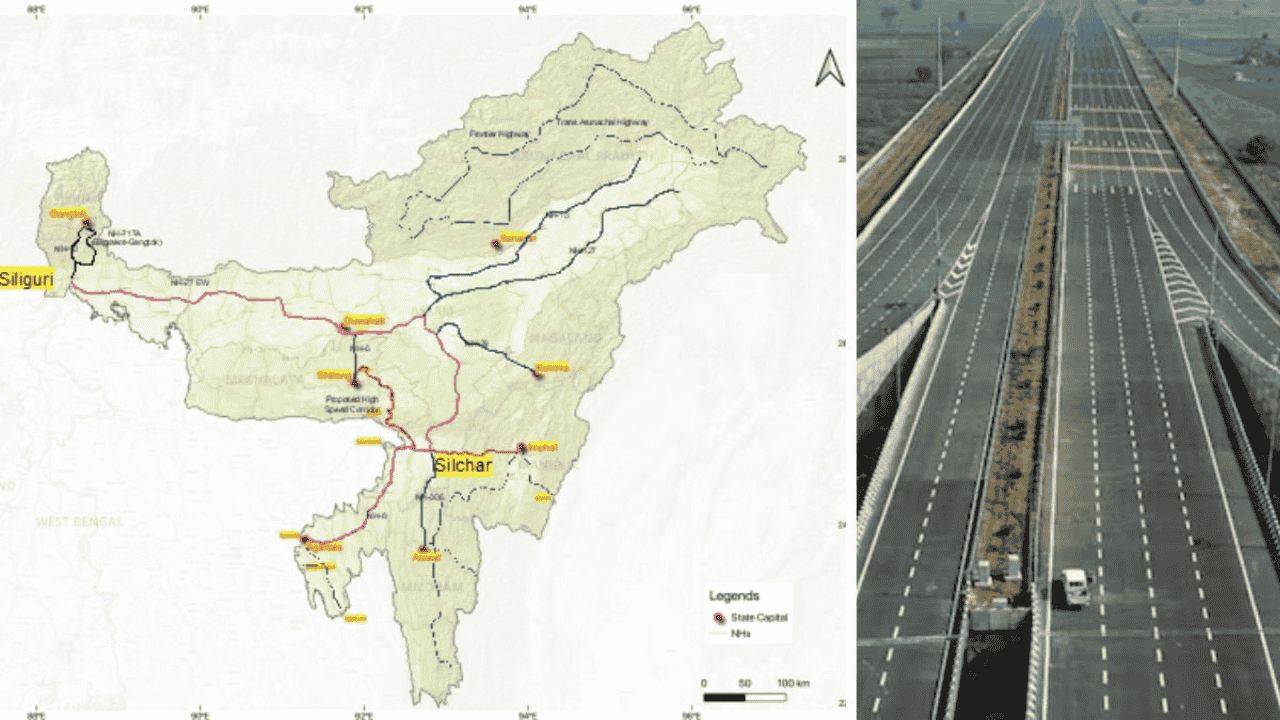
UPSC Current Affairs 9 March 2026: Guwahati–Silchar High-Speed Corridor Gives Momentum to Assam and the Northeast
Introduction: Today's Daily GK Update
The Central Government has approved a 166.8 km long greenfield high-speed corridor from Shillong (Mawlyngkhung) to Silchar (Panchgram) in Northeast India. It is now considered one of the most critical road projects in the region. By providing fast, safe, and all-weather connectivity to the Guwahati–Shillong–Silchar axis, this corridor could prove to be a game-changer for Tripura, Mizoram, Manipur, and Assam's Barak Valley.
Project Basics (Exam Facts)
Length: Approximately 166.8 km – from Mawlyngkhung (Meghalaya) to Panchgram (Assam), developed as a greenfield high-speed corridor on NH-6.
State-wise Distribution: Around 144.8 km in Meghalaya, and 22 km in Assam.
Total Estimated Cost: Approximately ₹22,864 crore (total capital cost).
Model: 4-lane access-controlled greenfield corridor under the Hybrid Annuity Mode (HAM).
Implementing Agency: National Highways and Infrastructure Development Corporation Limited (NHIDCL).
Travel Time: Expected to reduce the current 8–8.5 hours of travel time to just 4–5 hours.
Target Year: The project is targeted for completion around 2030.
Keyword Reminder (UPSC Mains/Prelims)
Keywords: Shillong–Silchar Greenfield High-Speed Corridor, NH-6, NHIDCL, Hybrid Annuity Mode, PM Gati Shakti, Kaladan Multi-Modal Project.
Geography and Location: Crucial for Map-Based Questions
This corridor passes through regions prone to heavy rainfall and landslides, where the current NH-6 frequently experiences long traffic jams and road blockages during the monsoon. The route traverses the districts of Ri-Bhoi, East Khasi Hills, West Jaintia Hills, and East Jaintia Hills in Meghalaya, and the Cachar district in Assam.
This highway will establish superior intra-regional connectivity between Guwahati, Shillong, and Silchar, acting as the primary economic corridor for the entire Northeast. Tracing these districts and NH-6 will be highly useful for map-based questions.
Economic and Logistic Impact
Faster Connectivity: It will provide swift road connectivity for Tripura, Mizoram, Manipur, and Assam's Barak Valley to mainland India and Guwahati, significantly reducing freight time and costs.
Industrial Boost: Passing through Meghalaya's cement and coal-producing regions, the corridor is expected to enhance market access and competitiveness for these industries.
Logistical Efficiency: Reduced travel times for long-distance transit and fuel savings will boost national logistical efficiency, aligning perfectly with the objectives of the PM Gati Shakti National Master Plan.
Employment: Large-scale employment generation is expected during the construction phase and subsequent maintenance.
Link to Act East Policy and the Kaladan Multi-Modal Project
The Shillong–Silchar High-Speed Corridor is viewed as an extension of the road component of the Kaladan Multi-Modal Transit Transport Project, which connects the Northeast to sea routes via Myanmar.
This route will bypass Bangladesh, providing an alternative high-speed connectivity route from the Northeast to Kolkata, which holds tremendous strategic and commercial importance. Therefore, this project is considered a vital part of India's Act East Policy, Indo-Pacific vision, and the strategy to enhance connectivity with neighboring countries. This theme is directly applicable to GS Paper 2 (International Relations).
Potential Benefits for Tourism and Border Areas
Tourism Access: Improved road infrastructure will make it easier for domestic and international tourists arriving at Guwahati, Shillong, and Silchar airports to reach various tourist destinations in the Northeast. Meghalaya’s waterfalls, caves, and hill stations will particularly benefit.
Inclusive Growth: An influx of tourists can increase employment and income opportunities for local communities in sectors like homestays, guiding, transport, and handicraft/food products, serving as a prime example of inclusive growth.
Engineering and Environmental Challenges
Complex Terrain: The project includes numerous major and minor bridges, viaducts, culverts, underpasses, and overpasses to safely navigate complex terrains involving valleys and rivers.
Advanced Techniques: With a design speed of 80–100 km/h, advanced engineering techniques such as slope stabilization, tunneling, cut-and-cover, and high-quality drainage systems are being implemented.
Disaster Management: Geoscience expert institutes, such as the National Institute of Rock Mechanics (NIRM), have been roped in to determine slope stability and landslide management measures—a critical point linking Disaster Management and Infrastructure.
Potential Prelims Questions – For Short Notes
Statement-based or fact-based MCQs can be formed on the following points:
Which two locations does the Shillong–Silchar Greenfield High-Speed Corridor connect?
Answer: Mawlyngkhung (Meghalaya) to Panchgram (Assam).
This corridor is a part of which National Highway?
Answer: National Highway-6 (NH-6).
What is the total estimated capital cost of the project?
Answer: Approximately ₹22,864 crore.
Under which model is this project being developed?
Answer: Hybrid Annuity Mode (HAM).
Who is the implementing agency?
Answer: NHIDCL (National Highways and Infrastructure Development Corporation Limited).
Major interconnected highways: Integration with NH-27, NH-106, NH-206, NH-37, etc.
Target completion year: Around 2030.
Tip: Writing these facts on flashcards or a One-Pager Current Affairs Sheet for frequent revision will be highly beneficial.
Potential Mains Questions – Answer Writing Angles
Potential question directives for Mains GS Papers 1, 2, and 3:
GS Paper 1/3:
"Discuss the socio-economic and strategic significance of developing high-speed road infrastructure in Northeast India, with special reference to the Shillong–Silchar High-Speed Corridor."
GS Paper 2 (IR + Neighbourhood Policy):
"Analyze the challenges and prospects of India's Act East Policy in the context of the Kaladan Multi-Modal Project and the Shillong–Silchar Corridor."
GS Paper 3 (Environment + Disaster Management):
"Highlight the environmental challenges associated with greenfield highway construction in landslide-prone mountainous regions and suggest mitigation measures."
In these answers, you can appropriately quote data (length, cost, number of states, travel time reduction), policies (PM Gati Shakti, Act East Policy), and institutions (NHIDCL, NIRM) in your introductions and body paragraphs.
Quick Revision Table (One-View Summary)
| Parameter | Details |
|---|---|
| Project | Shillong–Silchar Greenfield High-Speed Corridor (Guwahati–Silchar connectivity) |
| Length | 166.8 km – from Mawlyngkhung (Meghalaya) to Panchgram (Assam) |
| States Involved | Meghalaya (~144.8 km), Assam (~22 km) |
| Cost | Approximately ₹22,864 crore (Total capital cost) |
| Model | Hybrid Annuity Mode (HAM), 4-lane access-controlled greenfield corridor |
| Agency | NHIDCL – National Highways and Infrastructure Development Corporation Limited |
| Connected Highways | Along NH-6, interlinked with NH-27, NH-106, NH-206, NH-37, etc. |
| Beneficiary Regions | Assam's Barak Valley, Tripura, Mizoram, Manipur, Meghalaya |
| Travel Time | Reduced from ~8–8.5 hours to 4–5 hours |
| Kaladan Link | Connected to the Kaladan Multi-Modal Transit Transport Project; a new route to Kolkata bypassing Bangladesh |
| Target Year | Expected completion around 2030 |
Why this matters for your exam preparation
Multi-Topic Coverage in One Issue: This single news item connects to GS Paper 1 (Regional Development), GS Paper 2 (Act East Policy, Neighbourhood, Connectivity Diplomacy), and GS Paper 3 (Infrastructure, Logistics, Disaster Management, Environment).
Data + Concept Integration: You can quote data like the project's length, cost, model (HAM), agency (NHIDCL), travel time reduction, and the Kaladan link as concrete examples in your Mains answers. This makes your answers fact-rich and high-scoring.
Prelims-Oriented Facts: Facts such as NH-6, the districts involved, the 2030 completion target, and links to PM Gati Shakti and Act East Policy can be directly asked in statement-based MCQs. Be sure to prepare short notes and flowcharts for these.
Answer Writing Practice: By writing short 150–250 word Mains answers on this topic, you can strengthen your grasp on integrated themes like "Infrastructure + Geopolitics + Regional Imbalance," which are frequently seen in recent UPSC trends.