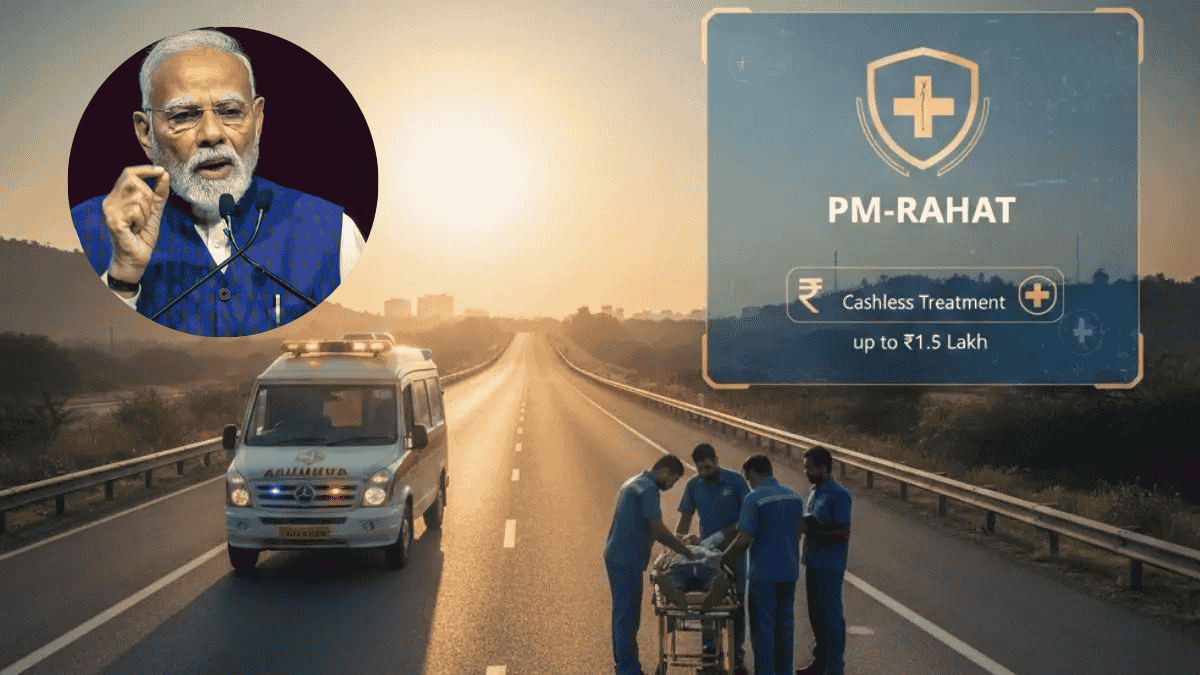
PM RAHAT Scheme: Cashless Treatment for Road Accident Victims
UPSC Current Affairs – 17 February 2026
Date Context (Important for Exams)
The formal announcement of the scheme was made toward the end of 2025, and it has been operationalised in early 2026. Therefore, it has become a high-impact current affairs topic for all examinations in 2026.
Introduction to the PM RAHAT Scheme (Definition and Objective)
Full form:
PM RAHAT — Road Accident Victim Hospitalisation and Assured Treatment
It is a national-level scheme that provides cashless medical treatment to victims of road accidents occurring on any type of road — national highways, state highways, district roads, or urban roads.
The government’s primary objective is to ensure that the “Golden Hour” — the first hour after an accident — is not wasted due to financial constraints and that no life is lost merely because of inability to pay.
Studies indicate that nearly 50% of road accident deaths can be prevented if the victim is admitted to a hospital within the first hour.
Key Features (Important for Prelims)
The following facts can be directly asked in UPSC Prelims or other MCQs:
Coverage Limit
• Cashless treatment up to ₹1.5 lakh per victim
• Available for 7 days from the date of accident
Duration of Treatment (Non-life vs Life-threatening)
Non-life-threatening cases:
• Stabilisation and necessary treatment up to 24 hours
Life-threatening cases:
• Extended treatment up to 48 hours, subject to police authentication
Applicability
Applies to accidents on any category of road (national, state, district, and urban roads).
Cashless Nature
• No advance deposit required from the victim or family
• Payment is settled later by fund/insurance/government
Example factual question:
“Under the PM RAHAT scheme, what is the maximum amount of cashless treatment provided?”
Integration with Emergency Response System (112)
The PM RAHAT scheme is integrated with Emergency Response Support System (ERSS) – 112.
In case of a road accident:
• The victim, a bystander, or a Good Samaritan / Rah-Veer can call 112
• Information about the nearest designated hospital and ambulance support will be provided
• Coordination among police, ambulance, and hospitals ensures treatment begins during the Golden Hour
Prelims point to remember:
PM RAHAT is directly linked with ERSS-112, which digitally integrates accident reporting, ambulance dispatch, and hospital referral.
Coverage and Benefits
1. Who will receive the benefit?
All eligible road accident victims — regardless of state of residence or type of road in India.
The scheme is victim-centric:
Determining who is at fault comes later; treatment comes first.
2. Treatment Limit and Duration
Up to ₹1.5 lakh cashless treatment, including:
• Medicines
• Diagnostic tests
• Surgeries
• ICU services
(at Ayushman-empanelled and other authorised hospitals)
Treatment within 7 days is covered.
The 24/48-hour stabilisation window is crucial in high-risk cases.
3. Economic Protection and Social Impact
The scheme reduces:
• Out-of-pocket expenditure
• Catastrophic health expenditure
These often push low- and middle-income families into debt.
The government expects improved financial resilience and reduced economic shock from accidents.
Funding and Claim Settlement Mechanism
One of the strongest aspects of PM RAHAT is its structured payment framework.
Who Pays?
Motor Vehicle Accident Fund (MVAF):
Primary payment to hospitals comes through this fund.
If the vehicle is insured:
Insurance companies contribute.
Uninsured / Hit-and-Run cases:
Paid through Government of India budget allocation.
Claim Settlement Timeline
• Claims approved by the State Health Agency (SHA)
• Hospitals must be paid within 10 days
This ensures financial certainty for hospitals.
Grievance Redressal
• Each district will have a Grievance Redressal Officer
• Appointed by the District Road Safety Committee
The committee is chaired by the District Collector / District Magistrate / Deputy Commissioner, ensuring accountability.
Technology-Driven Implementation: eDAR & TMS 2.0
PM RAHAT is not just a financial scheme; it is a technology-enabled governance model.
Two digital platforms are integrated:
eDAR (Electronic Detailed Accident Report)
Ministry of Road Transport & Highways platform for digitising accident reporting and police data.
TMS 2.0 (Transaction Management System)
National Health Authority platform for health claim processing and payment management.
Police Authentication Timeline
• Non-life-threatening cases: within 24 hours
• Life-threatening cases: within 48 hours
Thus the entire chain becomes digital and traceable:
Accident reporting → hospital admission → treatment → claim processing → payment
This also relates to exam topics like:
• e-governance
• Direct Benefit Transfer
• Digital Public Infrastructure
Quick Revision Box
• Scheme: PM RAHAT — Road Accident Victim Hospitalisation and Assured Treatment
• Objective: Immediate cashless treatment, especially in Golden Hour
• Coverage: ₹1.5 lakh per victim
• Coverage period: 7 days
• Treatment window:
— Non-life-threatening: 24 hours
— Life-threatening: 48 hours
• Helpline: ERSS 112
• Funding: MVAF + insurance + central government
• Claim settlement: within 10 days
• Technology: eDAR + TMS 2.0 integration
Possible Exam Questions
Prelims (Statement-type MCQ)
(1) The scheme applies only to national highways.
(2) Cashless treatment up to ₹1.5 lakh is provided.
(3) It is integrated with ERSS-112.
(4) Claim settlement must occur within 30 days.
Correct: (2) and (3)
Incorrect: (1) and (4)
One-liner MCQs
• What does RAHAT stand for?
Road Accident Victim Hospitalisation and Assured Treatment
• Helpline number?
112
• Which fund pays hospitals?
Motor Vehicle Accident Fund
Mains / Descriptive Angle
GS Paper II (Governance, Social Justice, Health):
Discuss how PM RAHAT strengthens the emergency healthcare ecosystem and road safety framework in India.
Examine the role of technology (eDAR, TMS 2.0, ERSS-112) in improving outcomes for road accident victims.
GS Paper III (Infrastructure, Road Safety):
Nearly half of accident deaths are preventable with timely intervention. Evaluate the significance of PM RAHAT.
External References (Study Sources)
• PIB Press Release – Cashless Treatment of Road Accident Victims
• NDTV Hindi explainer on PM RAHAT
• Finance and auto sector explainers (supplementary sources)
(For exams, always treat PIB and ministry websites as primary sources.)
Why This Matters for Exam Preparation
PM RAHAT is a high-probability topic for:
• Prelims
• Mains
• Essay
• Interview
It covers multiple syllabus areas simultaneously:
Governance, social justice, health, road safety, financial protection, and digital governance.
How You Should Prepare
• Make flashcards of factual points
(₹1.5 lakh, 7 days, 24/48 hrs, ERSS-112, MVAF, eDAR, TMS 2.0, 10-day claim)
• Use it as an example in answers on:
Road safety, Good Samaritan policy, health financing, and digital governance.
• Use it in Ethics and Essay as a model of:
Compassionate governance and citizen-first approach
If prepared properly, PM RAHAT becomes not just a scheme but a multi-dimensional answer-enrichment case study that can give you a clear edge over other candidates.