UPSC Current Affairs 15 December 2025 – US-led ‘Pax Silica’ Initiative and India’s Exclusion
Pax Silica Initiative: Key Current Affairs for UPSC and Competitive Exams
What is the Pax Silica initiative?
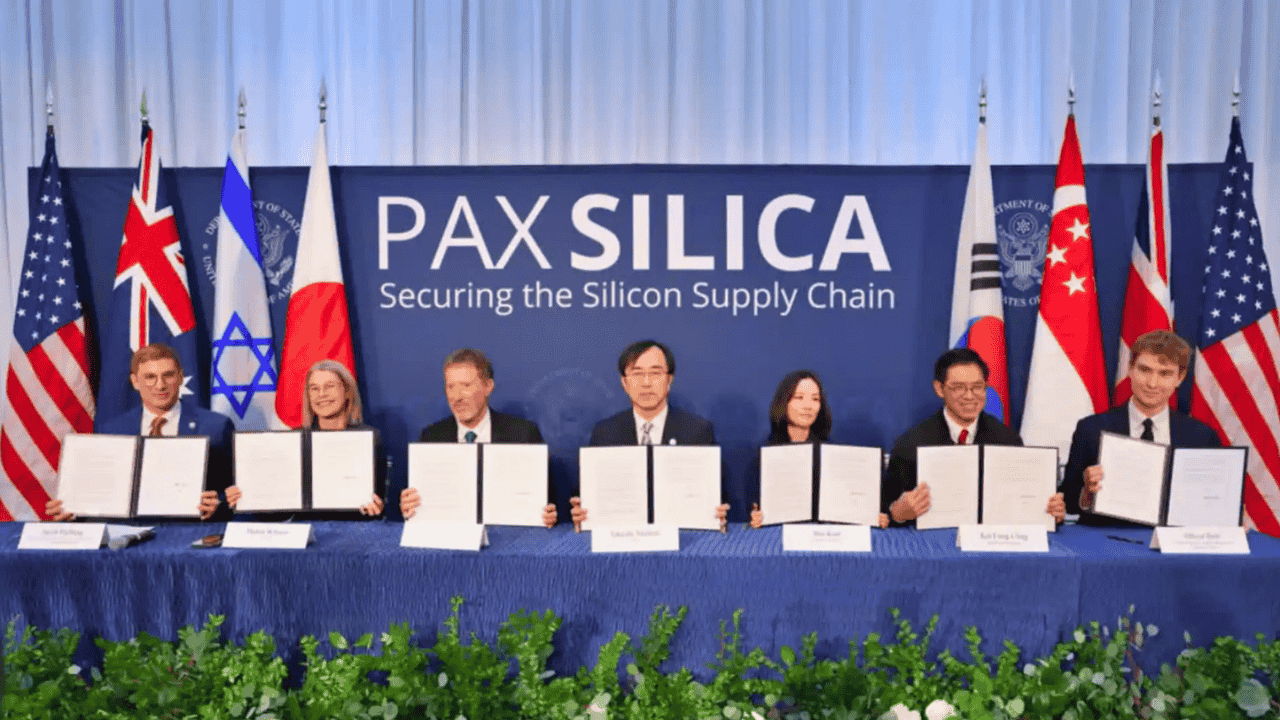
Pax Silica is a new US-led strategic initiative aimed at creating a secure, prosperous and innovation-driven global silicon supply chain across the entire value chain, from critical minerals and energy inputs to advanced manufacturing, semiconductors, AI infrastructure and logistics. The initiative seeks to reduce “coercive dependencies” in technology supply chains and ensure that partner countries can develop and deploy AI and other emerging technologies at scale.
Silicon is treated here as a critical mineral because it is the base material for semiconductors, solar cells and many digital technologies that power AI, EVs and modern computing. This initiative therefore falls at the intersection of critical minerals security, technology geopolitics and strategic supply-chain resilience.
Member countries and India’s exclusion
The declaration for Pax Silica has been signed by the United States along with Japan, South Korea, Singapore, the Netherlands, the United Kingdom, Israel, the United Arab Emirates and Australia. India is not a part of this grouping, despite its growing semiconductor, digital and green energy ambitions.
Several commentaries view India’s exclusion as a strategic signal at a time when the US and its allies are trying to build alternatives to Chinese-dominated supply chains in critical minerals and advanced technologies. This has triggered debate within India on whether the country has missed an opportunity to be inside a core technology and AI supply-chain coalition.
Quick facts for prelims
Lead country: United States.
Nature: Strategic, technology and supply-chain initiative (not a defence pact).
Focus: End-to-end silicon and AI-related supply chains – from minerals to chips, AI infrastructure, logistics and energy.
Members: US, Japan, South Korea, Singapore, Netherlands, UK, Israel, UAE, Australia.
India: Not a member as of December 2025.
Why silicon is strategically important
Silicon is the fundamental material used in most semiconductors and integrated circuits, making it central to microchips, computing and AI systems. High‑purity silicon is also the dominant material in solar photovoltaic cells, used in around 95% of solar modules globally.
Because semiconductors, solar energy and EVs are critical to both economic growth and the green energy transition, secure access to silicon and silicon-based technology inputs is now seen as a strategic national security concern for many states. Control over different stages of the semiconductor supply chain is already highly concentrated in a few countries, which increases vulnerability to geopolitical shocks.
Silicon in key sectors (exam angle)
Semiconductors and microchips: Core to computers, smartphones, data centres and AI hardware.
Solar energy: Silicon-based cells dominate global solar PV markets.
Electric vehicles (EVs): Power electronics and chips in EVs rely heavily on silicon and related materials.
AI and digital infrastructure: Data centres, AI accelerators and communication networks are all built on silicon-based semiconductor platforms.
Objectives and scope of Pax Silica
The formal statements around Pax Silica emphasize building a “secure, prosperous and innovation-driven” silicon and AI supply chain by coordinated action across several “strategic stacks” of technology. Partner countries intend to cooperate on:
Securing critical minerals, refining and processing capacity needed for silicon and advanced chips.
Strengthening semiconductor design, fabrication and packaging capabilities in trusted locations.
Ensuring resilient logistics, transportation and energy systems to support AI and chip manufacturing.
Protecting sensitive technologies and critical infrastructure from undue control by “countries of concern” and building trusted technology ecosystems, including networks, data centres and AI models.
Though officials stress that Pax Silica is not aimed at “isolating” any specific country, analysts widely interpret it as part of the broader US strategy to reduce overdependence on China in high-technology supply chains.
India’s position and possible implications
India has announced its own semiconductor mission, PLI schemes and solar/EV targets to reduce import dependence and build domestic capabilities, but it remains outside the first grouping of Pax Silica. Commentators suggest that India may pursue parallel or overlapping frameworks (such as bilateral tech partnerships and other critical-mineral arrangements) while continuing negotiations with the US on trade and technology issues.
Political debate within India has framed the omission as a potential diplomatic setback and a missed opportunity to be part of an inner circle on AI and semiconductor governance. At the same time, some analysts argue that India can leverage its market size, talent pool and existing partnerships (such as with Japan, EU and Quad members) to still position itself as a major semiconductor and AI hub, even if it is not yet in Pax Silica.
Pax Silica and India – exam‑oriented points
| Dimension | Pax Silica members’ position | India’s current position (Dec 2025) |
|---|---|---|
| Membership | US + 8 allies (Japan, South Korea, Singapore, Netherlands, UK, Israel, UAE, Australia) | Not a member; outside initial coalition. |
| Core focus | Secure silicon/AI supply chains, from minerals to chips. | Building domestic chip fabrication and design ecosystem. |
| Geopolitical angle | Reduce dependence on China in critical tech supply chains. | Balancing strategic autonomy with closer US and Quad ties. |
| Opportunity/Risk for India | Potential exclusion from key tech‑standard and supply-chain club. | Scope to negotiate entry, or build alternative/parallel frameworks. |
Useful external references
US State Department press release on Pax Silica – official description and member list.
News analysis on India’s exclusion and its diplomatic implications.
Background on silicon as a critical material in semiconductors and solar energy.
Why this matters for your exam preparation
For UPSC Prelims, Pax Silica is important as a “new initiative” in news connecting critical minerals, semiconductors, AI, EVs and solar energy – all frequent topics in recent papers. Questions can test you on: the objective of Pax Silica, member countries, India’s status, and why silicon is considered strategically important.
For UPSC Mains (GS-2 and GS-3), this development fits into themes like “geopolitics of technology,” “strategic partnerships,” “critical minerals and energy security,” and “Atmanirbhar Bharat in electronics and renewables”. In essays and interview, you can use Pax Silica as a contemporary example to discuss how control over technology and mineral supply chains is reshaping global order and where India positions itself in the emerging AI and semiconductor landscape.