
UPSC Current Affairs September 30, 2026: Madhya Pradesh Heritage Sites Enter UNESCO Tentative List – Atharva Examwise Daily GK Update
In a landmark recognition of India's cultural geography, four prominent archaeological landmarks from Madhya Pradesh have been officially inscribed on the UNESCO Tentative List of World Heritage Sites. The newly recognized landmarks include the rock-cut Udayagiri Caves in Vidisha, the Buddhist Bagh Caves in Dhar, the medieval Gond stronghold of Ginnorgarh Fort in the Ratapani ecosystem, and the sacred Chambal Group of Temples in Morena. Concurrent with these entries, India submitted a serial transnational proposal commemorating the heritage routes of Mahatma Gandhi’s Satyagraha spanning nine components across India and South Africa.
This expansion, documented by the Archaeological Survey of India and ratified through the UNESCO World Heritage Centre, elevates India's total inventory on the Tentative List to 78 properties and expands Madhya Pradesh’s state total to 19 sites. For civil services aspirants monitoring the Atharva Examwise Daily Current Affairs, this competitive exam news today reflects key intersections of classical dynastic history, early iconography, and multilateral heritage conservation frameworks.
Overview of the Inscription: Expanding India's Global Cultural Footprint
The inclusion of these four sites on the Tentative List represents the foundational statutory step required under the 1972 UNESCO Convention Concerning the Protection of the World Cultural and Natural Heritage. A property must remain on a State Party's Tentative List for a minimum statutory period of one year before a formal Nomination Dossier can be submitted for full World Heritage status. The recent additions highlight Madhya Pradesh's position as an open-air repository of Indian artistic evolution, spanning Buddhist rock-cut architecture, classical Gupta-era sculptural bas-reliefs, medieval Gurjara-Pratihara masonry, and Gond engineering.
| Administrative Metric | Operational Data and Status |
|---|---|
| New Inscriptions (September 2026) | 5 proposals (4 Madhya Pradesh complexes + 1 Transnational Satyagraha route) |
| Total Indian Properties on UNESCO Tentative List | 78 properties |
| Total Madhya Pradesh Sites on Tentative List | 19 properties |
| Sponsoring Agency | Archaeological Survey of India (ASI), Ministry of Culture |
| Statutory Framework | 1972 UNESCO World Heritage Convention & Operational Guidelines |
Udayagiri Caves (Vidisha): Masterpiece of Gupta Rock-Cut Architecture
Situated five kilometers west of the ancient commercial hub of Vidisha (ancient Besnagar) along the Betwa River valley, the Udayagiri ridge stands as a premier rock-cut sanctuary from the classical Gupta epoch. Stretching over an isolated sandstone ridge approximately one kilometer in length, the site was historically venerated as Visnupadagiri, translating to "the hill at the foot of Vishnu". The site encompasses 20 rock-excavated chambers, consisting of 18 Hindu sanctuaries and two Jain rock-cut shrines.
Chronological Stratigraphy and Epigraphic Records
Archaeological analysis and epigraphic records date the primary excavations to the classical Gupta era between 350 and 550 CE. The caves preserve foundational royal records executed in Sanskrit using early Gupta-Brahmi script:
Cave 6 Royal Record (Gupta Era 82 / 401 CE): Documents the excavation of a rock-cut shrine by Virasena 'Saba', the minister of external affairs and defense (Sandhivigrahika) hailing from Pataliputra, who accompanied Emperor Chandragupta II (reigned 375–415 CE) during his military campaigns against the Western Kshatrapas.
Cave 7 Shaivite Inscription: An undated 5th-century Sanskrit epigraph documenting private religious endowments by an imperial Gupta administrator.
Cave 20 Jain Record (Gupta Era 106 / 425 CE): Located on the northern ridge, this inscription dates to the reign of Kumaragupta I (reigned 415–455 CE) and records the installation of an image of the Jain Tirthankara Parshvanatha by a devotee named Acharya Gosharmin.
Pre-Gupta Stratigraphy: The presence of extensive Sankha Lipi (shell script) engravings across the rock platforms proves that the ridge served as an established religious sanctuary prior to imperial Gupta patronage.
Theological and Iconographic Masterpieces
The Udayagiri ensemble contains some of the earliest securely dated iconography of classical Hinduism, illustrating the formalization of Vaishnavite, Shaivite, and Shakta theologies:
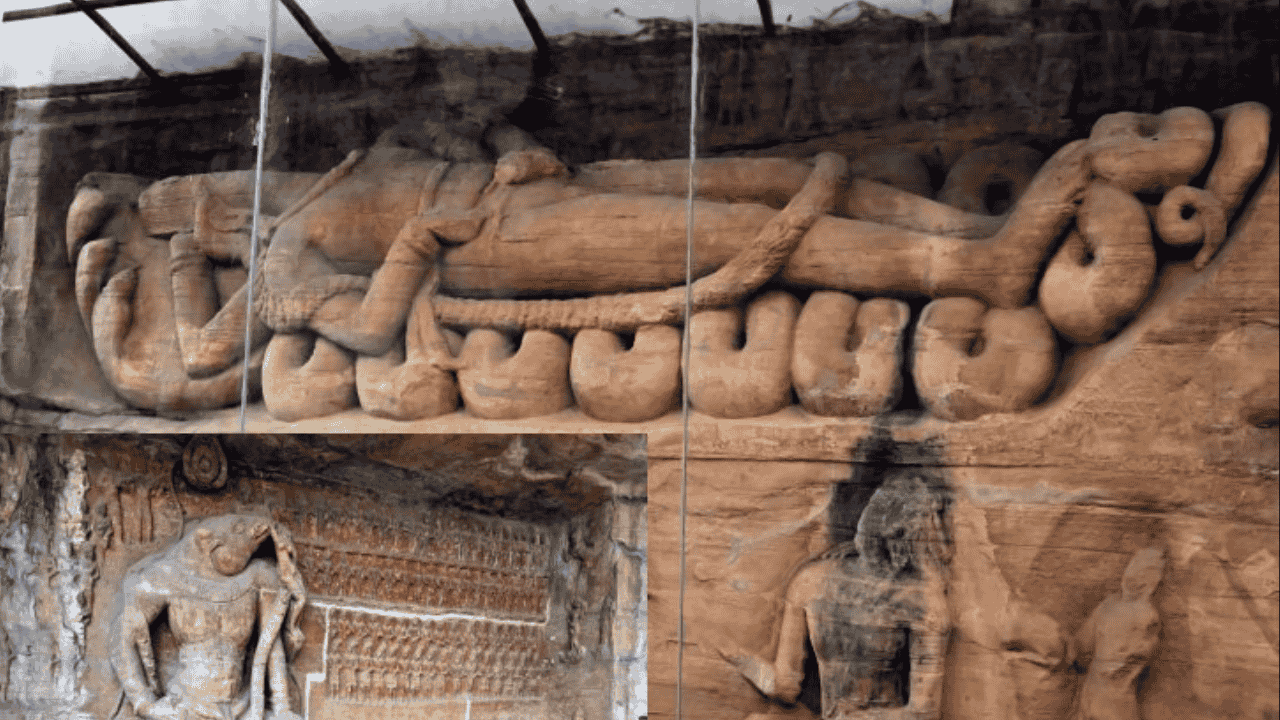
The Colossal Varaha Panel (Cave 5): The central iconographic masterpiece of Udayagiri is a five-meter-long relief depicting Vishnu in his zoomorphic boar incarnation (Varaha). The deity is sculpted lifting the personified Earth goddess (Bhudevi) from the cosmic deluge, an allegory mirroring the unification and political stabilization of northern India under Chandragupta II. Flanking the scene are friezes of rishis, the Adityas, Brahma, Shiva seated on Nandi, and anthropomorphic personifications of the sacred rivers Ganga and Yamuna standing upon the makara and kurma.
Cave 4 (Shiva Mukhalinga): Contains a sanctum housing an Ekamukha Linga (single-faced Shiva Linga), characterized by locks of hair (jata) carved to represent the mythic descent of the celestial river Ganga onto Shiva's crown.
Cave 6 (Iconographic Synthesis): Features an ornate T-shaped rock-cut doorway guarded by Dvarapalas, flanked by one of India's earliest dated sculptures of a seated Ganesha and a relief of Mahishasuramardini depicting Durga slaying the buffalo demon.
Cave 13 (Anantasayana Vishnu): Depicts an expansive relief of Vishnu resting on the cosmic serpent Shesha, with a kneeling royal attendant at his feet traditionally identified as Emperor Chandragupta II.
Architectural Taxonomy and Comparative Analysis of the Nominated Sites
The four properties nominated from Madhya Pradesh highlight distinct chronologies, functional designs, and structural techniques. The following comparative analysis outlines their architectural diversity across ancient, early medieval, and medieval India:
| Heritage Complex | Administrative District | Epoch & Royal Patronage | Structural Media & Typology | Prominent Architectural & Art Historical Hallmarks |
|---|---|---|---|---|
Udayagiri Caves [cite: 1, 12] | Vidisha | 4th–5th Century CE (Gupta Empire) | Sandstone rock-cut shrines (18 Hindu, 2 Jain) | Colossal Varaha panel, Ekamukha Linga, early Ganesha, Chandragupta II and Kumaragupta I inscriptions |
Bagh Caves [cite: 1, 18] | Dhar | 4th–6th Century CE (Late Gupta / Vakataka era) | Sandstone rock-cut monastic complex (Viharas) | Nine excavations; Cave 4 (Rang Mahal) tempera murals depicting Jatakas, processions, and the Hallisaka dance |
Ginnorgarh Fort [cite: 1, 21] | Raisen / Sehore border | 15th–18th Century CE (Gond Dynasty) | Indigenous military citadel and hill fort | Isolated Vindhyan peak (1,965 ft); seat of Nizam Shah and Rani Kamlapati; 25 stepwells (baoris) and 4 reservoirs |
Chambal Group of Temples [cite: 1, 3] | Morena | 8th–11th Century CE (Gurjara-Pratihara & Kachchhapaghata) | Structural stone Nagara temple architecture | Bateshwar cluster (>200 shrines); carved friezes of Garhi Padavali; mortarless dry-masonry spire of Kakanmath |
Buddhist Murals of Bagh Caves (Dhar)
Situated on the southern slopes of the Vindhya Range along the Baghani River, the Bagh Caves consist of nine Buddhist excavations created between the late 4th and 6th centuries CE. Functioning primarily as residential monasteries (viharas) complete with pillared prayer halls, Bagh is best known for its mural paintings executed using tempera techniques over lime and clay plaster. While contemporary caves at Ajanta are primarily monastic, the murals at Bagh—particularly inside Cave 4, known as the Rang Mahal—blend religious themes with secular subjects. The paintings portray courtly processions, musicians, aristocratic life, and group dances like the Hallisaka, providing visual evidence of early central Indian society.
Indigenous Fortifications and Hydraulics of Ginnorgarh Fort (Ratapani)
Positioned on a sandstone ridge within the Ratapani Wildlife Sanctuary, Ginnorgarh Fort represents central Indian Gond military architecture. The citadel served as a stronghold for Gond rulers like Nizam Shah and his widow, Rani Kamlapati, before falling under the influence of Dost Mohammad Khan, the founder of Bhopal State.
Beyond its natural defenses, the fort is noted for its medieval hydraulic engineering. Built atop a plateau 1,965 feet high, the fort retains water through 25 stone-cut stepwells (baoris) and four perennial reservoirs. This catchment system captured monsoon rains directly from the surrounding ridge, sustaining both the garrison and civilian settlements during extended sieges.
Nagara Architectural Synthesis in the Chambal Group of Temples (Morena)
The Chambal temple group includes the Bateshwar complex, Garhi Padavali, and Kakanmath, showing the architectural transition from early post-Gupta styles to mature Nagara temple designs:
Bateshwar Temple Complex: A collection of over 200 sandstone shrines dedicated to Shiva and Vishnu, built between the 8th and 10th centuries CE under Gurjara-Pratihara rulers, and later restored through anastylosis by the Archaeological Survey of India.
Garhi Padavali: A 10th-century temple complex later converted into a fortress, known for its open mukhamandapa (entrance hall) featuring relief carvings of the Ramayana, Mahabharata, and Krishna Lilas.
Kakanmath (Suhaniya): Built in the 11th century by Kachchhapaghata ruler Kirttiraja, this 100-foot Shiva temple was assembled without mortar, using dry-masonry interlocking stones that have stood for centuries despite weathering and seismic activity.
Statutory Framework: The UNESCO World Heritage Nomination Mechanism
Inclusion in the UNESCO Tentative List follows procedures outlined in the Operational Guidelines for the Implementation of the World Heritage Convention. The submission process and legal obligations proceed through distinct stages:
State Party Inventory: The Archaeological Survey of India (ASI), operating under the Ministry of Culture, identifies and submits properties with potential Outstanding Universal Value (OUV) to UNESCO's World Heritage Centre in Paris.
Mandatory Statutory Waiting Period: A site must remain on the Tentative List for a minimum of one year before a formal Nomination Dossier can be submitted for review.
Technical Evaluation by Advisory Bodies: Cultural properties are evaluated by ICOMOS (International Council on Monuments and Sites), while natural sites are appraised by the IUCN (International Union for Conservation of Nature).
Deliberation by the World Heritage Committee: The 21-member World Heritage Committee reviews the evaluation reports during its annual session and decides whether to formally inscribe the site, defer it, or refer it back to the State Party.
Domestic Statutory Protection: Inscribed sites receive domestic legal protection under the Ancient Monuments and Archaeological Sites and Remains (AMASR) Act of 1958, requiring buffer zones, regulated construction limits, and site management plans.
Candidates can consult the Atharva Examwise Ancient Indian History Series for detailed studies on dynastic architectural transitions.
Why this matters for your exam preparation
For candidates preparing for the UPSC Civil Services Examination and State PSCs (such as MPPSC), this current affairs development connects directly to core topics across General Studies Paper I, General Studies Paper II, and General Studies Paper III.
Key Exam Dimensions
Evolution of Temple and Cave Architecture (GS Paper I - Art & Culture):
Rock-Cut to Structural Transition: Udayagiri illustrates the structural transition from early rock-cut chambers to flat-roofed Gupta stone sanctums, bridging the architectural gap to structural temples like Tigawa and Sanchi Temple 17.
Nagara Temple Typology: The Chambal complexes provide examples of the evolving northern Nagara architectural idiom, particularly the development of latina spires, jagati platforms, and intricate mandapa carvings.
Secular versus Sacred Art: The Bagh murals offer an architectural case study contrasting the Buddhist monastic paintings of Ajanta with central Indian secular court art.
Epigraphy and Political Legitimacy (GS Paper I - Ancient History):
Administrative Epigraphy: The Sanskrit inscriptions of Cave 6 and Cave 20 at Udayagiri offer primary source material on imperial administrative positions (Sandhivigrahika) and provincial military campaigns during the reigns of Chandragupta II and Kumaragupta I.
Visual Royal Ideology: The Cave 5 Varaha bas-relief shows how religious mythology was used to legitimize royal authority, illustrating how the Gupta dynasty linked sovereign rule with divine preservation.
Vernacular Military Architecture and Water Systems (GS Paper I & III):
Gond State-Building: Ginnorgarh Fort draws attention to medieval tribal sovereignty in central India, offering a historical perspective beyond conventional Sultanate, Mughal, and Rajput military sites.
Traditional Water Harvesting: The network of 25 stepwells (baoris) and four reservoirs at Ginnorgarh serves as an example of indigenous water management and environmental resilience in arid highland terrains.
Conservation Policy and International Bodies (GS Paper II & III):
Heritage in Protected Areas: Because Ginnorgarh Fort lies within the Ratapani Wildlife Sanctuary, it raises administrative and environmental questions regarding the balance between eco-sensitive buffer zones, tiger habitats, and cultural heritage tourism.
Institutional UNESCO Governance: Aspirants should understand the nomination process under the 1972 World Heritage Convention, the role of advisory bodies like ICOMOS, and the enforcement of the AMASR Act of 1958.
By understanding the epigraphic, stylistic, and administrative details of these four Madhya Pradesh monuments, candidates can effectively tackle both analytical Mains questions on Indian art history and factual Prelims questions on heritage, geography, and international designations.