
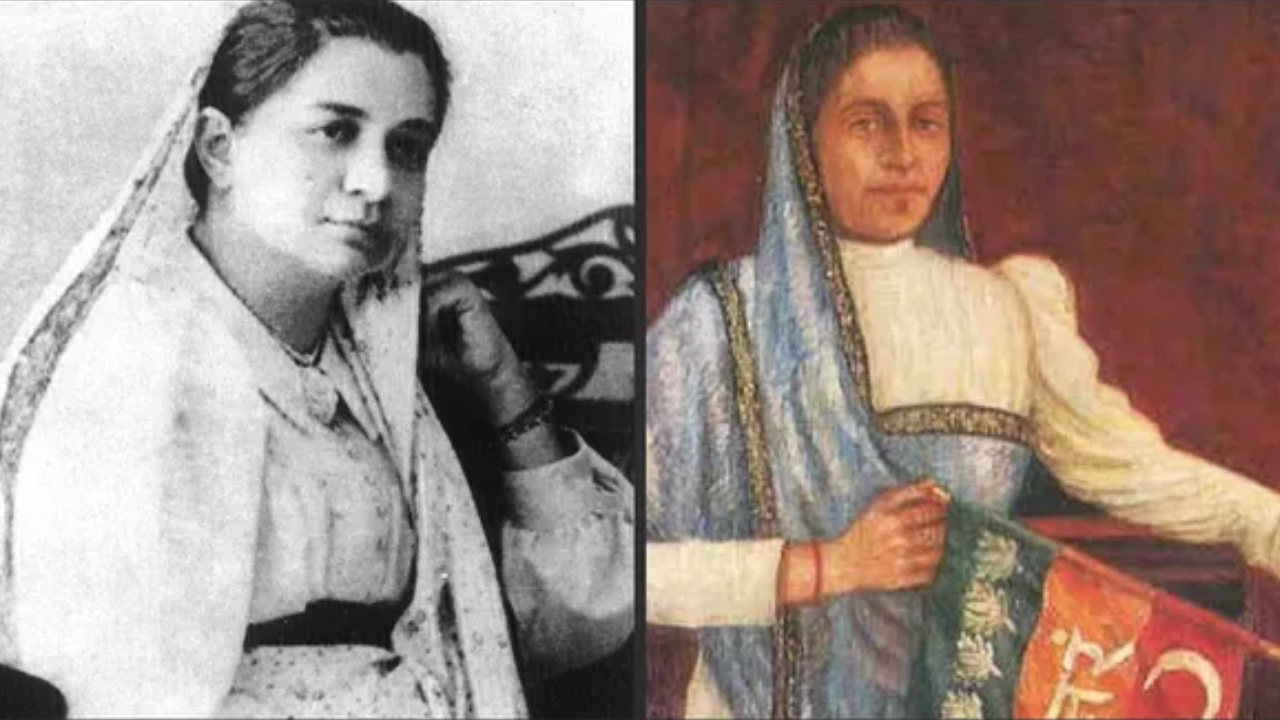
UPSC Current Affairs: Madam Bhikaiji Cama, the 1907 Stuttgart Flag, and Overseas Revolutionary Movements | Daily GK Update
The Indian national liberation movement was not fought solely within the borders of British India; it developed a sophisticated, globalized dimension led by expatriate intellectuals, students, and political dissidents. Operating across Europe and North America, these activists challenged British imperial hegemony through international diplomatic appeals, clandestine arms procurement, and anti-colonial political literature.
At the forefront of this external campaign stood Madam Bhikaiji Rustom Cama, revered in Indian historiography as a pioneer of revolutionary nationalism and the "Mother of the Indian Revolution". Her act of hoisting the first precursor to the Indian national flag at the Second International Socialist Congress in Stuttgart, Germany, on August 22, 1907, remains a landmark event in Modern Indian History.
For candidates following Atharva Examwise Current Affairs, analyzing Madam Cama’s ideological evolution, organizational initiatives, and diplomatic strategies provides critical context for both the Preliminary and Main stages of competitive examinations.
Early Life, Humanitarian Relief, and Ideological Transformation
Bhikaiji Patel was born on September 24, 1861, into an affluent, English-educated Parsi family in Bombay (now Mumbai). Her father, Sorabji Framji Patel, was an influential merchant and trained lawyer who supported Western education for women within the progressive mercantile community. She received her primary education at Bombay’s Alexandra Girls' English Institution, an institution founded by reformer Manockjee Cursetjee Shroff that emphasized linguistic proficiency, discipline, and modern social sciences. In August 1885, Bhikaiji married Rustomji Cama, a prominent barrister and son of orientalist scholar Khurshedji Rustomji Cama.
The marriage suffered from fundamental political and philosophical differences. While Rustomji Cama remained a pro-British conservative aspiring to enter institutional politics under the colonial framework, Bhikaiji leaned strongly toward radical nationalism and public philanthropy.
Her decisive entry into public life took place in October 1896, when severe famine struck the Bombay Presidency, followed immediately by an outbreak of bubonic plague that devastated the city of Mumbai. Voluntarily joining medical relief teams in municipal wards, she spent months nursing patients and organizing sanitation measures. During these relief operations, she contracted bubonic plague herself. Although she recovered, the disease weakened her health and required specialized medical treatment. In 1901–1902, she departed India for Europe, marking the beginning of an exile that lasted over three decades.
Chronology of Madam Bhikaiji Cama's Life and Political Milestones
The trajectory of Madam Cama’s career illustrates the transition of Indian anti-colonial activism from moderate institutional lobbying to assertive revolutionary propaganda across European capitals.
| Year | Key Milestone / Event | Historical Significance |
|---|---|---|
| 1861 | Born in Bombay Presidency (September 24). | Born into an elite Parsi family; acquired deep multilingual capability. |
| 1885 | Married Rustomji Cama; attended early INC sessions. | Exposed early to contemporary political discourses and nationalist debates. |
| 1896 | Famine and Bubonic Plague Relief in Bombay. | Contracted plague; transformed from philanthropist to activist. |
| 1902 | Relocated to London for medical care. | Began prolonged European exile; joined expatriate networks. |
| 1904–1905 | Private Secretary to Dadabhai Naoroji. | Gained direct insight into British parliamentary and committee procedures. |
| 1905 | Co-founded Indian Home Rule Society in London. | Partnered with Shyamji Krishna Varma to demand absolute Swaraj. |
| 1907 | Hoisted Flag of Indian Independence in Stuttgart (August 22). | First unfurling of an Indian national flag on foreign soil. |
| 1909 | Shifted to Paris; co-founded Paris Indian Society. | Established an international base; launched Bande Mataram journal. |
| 1914–1917 | Internment in France during World War I. | Attempted to incite Indian troops in Marseilles; interned by French police. |
| 1935 | Repatriated to Bombay following medical petition. | Permitted return under strict non-involvement conditions. |
| 1936 | Passed away at Mumbai's Parsi General Hospital (August 13). | Left personal assets to female orphanages and Parsi trusts. |
Political Activities in London and Transition to Radical Nationalism
During her initial years in London, Madam Cama immersed herself in metropolitan constitutional politics. Her organizational skills led to an association with Dadabhai Naoroji, who was then leading the British Committee of the Indian National Congress and serving as the first Indian Member of the British House of Commons. Working as Naoroji's private secretary, Cama participated in political lobbying, correspondence with British liberals, and public lectures detailing colonial economic drain.
However, the moderate strategy of prayer, petition, and protest failed to satisfy her political outlook. As the 1905 Partition of Bengal triggered the Swadeshi Movement across India, Cama aligned herself with more uncompromising figures, most notably Shyamji Krishna Varma. Varma had established India House in Highgate, London, creating a residential and political sanctuary for radical Indian students.
In February 1905, along with Varma and Singh Rewabhai Rana (S.R. Rana), Madam Cama helped establish the Indian Home Rule Society. She began addressing public meetings at London’s Hyde Park, condemning British autocracy in India and urging expatriates to fight for total independence.
Recognizing her growing influence, the British colonial government initiated strict intelligence surveillance against her. When she applied for official permission to return to India, the colonial administration demanded that she sign a formal pledge disavowing all anti-British activities. Refusing to compromise her principles, Cama declined to sign the undertaking and remained in exile, expanding her activist network across continental Europe.
Aspirants examining the phases of the nationalist movement can review detailed analyses via the Atharva Examwise Modern History Study Modules.
The 1907 Stuttgart Congress: Unfurling the Flag of Indian Independence
The defining moment of Madam Cama’s career occurred on August 22, 1907, during the Second International Socialist Congress held in Stuttgart, Germany. The congress was attended by over one thousand international delegates representing trade unions and socialist parties, including prominent global figures such as Vladimir Lenin, Jean Jaurès, and Rosa Luxemburg.
Green Stripe (Top) : Eight Half-Open Lotuses (Eight British Indian Provinces) Saffron Stripe (Middle) : "Vande Mataram" in Devanagari Script Red Stripe (Bottom) : Sun on Hoist (Hindu) and Crescent Moon on Fly (Muslim)
British diplomatic representatives attempted to bar Cama from speaking, arguing that India was not an independent sovereign state. However, influential European socialist leaders August Bebel, Clara Zetkin, and Hyndman secured her access to the podium. Addressing the international gathering, Cama delivered a denunciation of British colonial rule, demonstrating how British economic policies and high land revenue extractions had caused severe, recurring famines that resulted in millions of avoidable deaths.
Concluding her speech, she unfurled a hand-sewn tricolour before the assembly, proclaiming:
"This flag is of Indian Independence. Behold, it is born! It has been made sacred by the blood of young Indian martyrs. In the name of this flag, I appeal to lovers of freedom all over the world to support this struggle."
[cite: 1, 16]
Design and Symbolism of the Stuttgart Flag
The banner hoisted by Madam Cama was co-designed by her alongside Vinayak Damodar Savarkar and Shyamji Krishna Varma. It was an evolution of the 1906 "Calcutta Flag" (or Lotus Flag) created during the anti-partition agitation, adapted to present a unified national identity.
The flag's structural composition featured:
The Top Band (Green): Inscribed with eight half-open lotuses, each symbolizing one of the eight major administrative provinces of British India (Bengal, Bombay, Madras, United Provinces, Punjab, Central Provinces, Assam, and Burma).
The Middle Band (Saffron/Golden-Yellow): Emblazoned with the national rallying cry "Vande Mataram" in bold Devanagari script.
The Bottom Band (Red): Displayed two syncretic religious-cultural symbols: a radiant Sun near the hoist (representing Hindu tradition) and a Crescent Moon with a Star near the fly (representing Islamic tradition), underscoring communal unity against imperial rule.
Following the conference, the original flag was preserved by socialist networks in Europe before being smuggled into British India by Gujarati nationalist and parliamentarian Indulal Yagnik. It was later safeguarded in Maharashtra and is on public display at the Maratha and Kesari Library in Pune.
Evolution of Early Nationalist Flags in India
Tracing the architectural and symbolic transformation of early Indian flags is a recurring theme in modern Indian history evaluations.
| Flag Iteration | Year and Location | Primary Architects / Hoisted By | Key Heraldic & Symbolic Features |
|---|---|---|---|
| Calcutta Flag (Lotus Flag) | August 7, 1906; Parsee Bagan Square, Calcutta | Sachindra Prasad Bose and Sukumar Mitra | Three horizontal bands of Green, Yellow, and Red; eight white lotuses on top; central Vande Mataram in Devanagari; Sun and Crescent at the bottom. |
| Stuttgart Flag (Flag of Indian Independence) | August 22, 1907; Stuttgart, Germany | Madam Bhikaiji Cama, V.D. Savarkar, and S.K. Varma | Three horizontal bands of Green, Saffron, and Red; eight lotuses (provinces); central Vande Mataram; Sun and Crescent Moon. |
| Home Rule Movement Flag | 1917; Hoisted across British India | Bal Gangadhar Tilak and Annie Besant | Five red and four green horizontal alternating bands; Union Jack at the top canton; seven stars of the Saptarishi constellation; white crescent and star. |
| Swaraj Flag (Swarajya Dhwaj) | 1921 (Vijayawada) & modified 1931 (Karachi) | Pingali Venkayya (endorsed by Mahatma Gandhi) | 1921: Red and Green bands with spinning wheel (Charkha). 1931: Saffron, White, and Green with central blue Charkha. |
| Tiranga (National Flag of India) | Adopted July 22, 1947; Constituent Assembly, New Delhi | Designed by Pingali Venkayya; Ad-hoc Flag Committee led by Dr. Rajendra Prasad | Deep Saffron, White, and Dark Green; central 24-spoke Navy Blue Ashoka Chakra replacing the spinning wheel; 2:3 dimensional ratio. |
The Paris Indian Society and Revolutionary Propaganda Networks
Following the July 1909 assassination of British political aide Sir William Hutt Curzon Wyllie in London by Madan Lal Dhingra, Scotland Yard cracked down on Indian expatriates at India House. Madam Cama relocated her organizational headquarters to Paris, France, establishing the Paris Indian Society alongside Munchershah Burjorji Godrej and S.R. Rana.
Paris was then an intellectual center for international dissidents, socialist theorists, and anti-imperialist thinkers. Madam Cama’s residence at 25 Rue de Ponthieu served as an operational safe house, intellectual salon, and staging area for Indian revolutionaries traveling across continental Europe, including V.D. Savarkar, Virendranath Chattopadhyaya, and Lala Hardayal.
Underground Publishing and Distribution
To counter colonial press restrictions in British India, Madam Cama financed, edited, and distributed underground nationalist periodicals abroad:
Bande Mataram: Launched on September 10, 1909, from Paris in direct response to the colonial ban on the song and publication of the same name in India. Edited in its initial months by Lala Hardayal (who later helped found the Ghadar Party in North America), the monthly periodical published critiques of British colonial administration and detailed revolutionary proceedings.
Madan's Talwar (The Talvar): Established in late 1909 to commemorate the execution of Madan Lal Dhingra. Published primarily from Paris and Berlin, it was managed editorially by Virendranath Chattopadhyaya. The paper openly justified revolutionary resistance and ideological action against colonial personnel.
Smuggling and Clandestine Logistical Channels: Because direct shipments to British Indian ports were prohibited under the Sea Customs Act and Indian Press Act, the Paris network routed these publications through the French colony of Pondicherry (Puducherry). Literature was concealed inside religious texts, industrial crates, and musical instruments. This smuggled material helped sustain domestic revolutionary cells in Bengal, Maharashtra, and Madras, influencing prominent figures like Bhagat Singh.
| Publication / Network | Foundational Period | Primary Base of Operations | Key Promoters & Collaborators | Core Function and Target Audience |
|---|---|---|---|---|
| Indian Home Rule Society | February 1905 | London, England | S.K. Varma, Bhikaiji Cama, S.R. Rana | Constitutional and political agitation targeting British public opinion. |
| Paris Indian Society | 1905–1909 | Paris, France | Madam Cama, S.R. Rana, M.B. Godrej | Coordinating overseas revolutionary cells and securing political asylum. |
| Bande Mataram (Journal) | September 10, 1909 | Paris / Geneva | Madam Cama (Publisher), Lala Hardayal (Editor) | International dissemination of Indian national sovereignty demands. |
| Madan's Talwar (The Talvar) | Late 1909 | Paris / Berlin | Madam Cama, Virendranath Chattopadhyaya | Defending armed revolutionary resistance and commemorating political martyrs. |
Additional insights into external political coordination are covered in our study notes on Atharva Examwise Revolutionary Movements in India Notes.
World War I Internecine Politics, Exile, and Final Repatriation
The geopolitical realignments of World War I disrupted the activities of the Paris Indian Society. When the conflict began in August 1914, Britain and France formed an official military alliance. The French government, previously tolerant of anti-British political organizing within its borders, came under heavy pressure from the British Foreign Office to suppress Indian dissident operations.
In October 1914, Madam Cama and S.R. Rana visited the French military staging port of Marseilles to distribute political pamphlets among Indian soldiers of the British Indian Army’s Punjab Regiment, who were arriving for deployment on the Western Front. French authorities promptly intervened. S.R. Rana was deported with his family to the Caribbean island of Martinique, while Madam Cama was interned under military surveillance at Vichy and later transferred to southern France. Although failing health secured her release from detention in November 1917, she remained under police surveillance in Bordeaux, required to report weekly to the local prefecture until the end of hostilities.
Throughout the interwar years, Cama maintained contact with European intellectuals and international socialist figures, including French parliamentarians and Vladimir Lenin, who invited her to take up residence in the Soviet Union—an offer she declined in favor of remaining in France.
By 1935, a severe paralytic stroke, combined with advancing age, left Madam Cama bedridden and dependent on medical care. Aided by influential friends in India, including industrialist Sir Cowasji Jehangir, she formally petitioned the British Government of India for permission to return home. Given her physical incapacity, the colonial administration granted repatriation on the condition that she sign an undertaking to refrain from political activity.
She arrived in Bombay in November 1935. After nine months of failing health, Madam Bhikaiji Cama passed away at the Parsi General Hospital in Mumbai on August 13, 1936, at the age of 74. Reflecting her lifelong commitment to social welfare, she bequeathed the majority of her personal assets to the Bai Avabai Framji Petit Girls' High School and established trust endowments for the Framji Nusserwanjee Patel Agiary fire temple in Mazgaon, Mumbai.
Key Facts and Exam-Relevant Data
The following factual points summarize Madam Cama's life and historical legacy for competitive exam revisions:
Birth & Demise: Born September 24, 1861, in Bombay; passed away August 13, 1936, at the Parsi General Hospital, Bombay.
Stuttgart Distinction: First Indian to unfurl an Indian national flag on foreign soil during the Second International Socialist Congress in Stuttgart, Germany (August 22, 1907).
Institutional Associations: Private Secretary to Dadabhai Naoroji in London; founding supporter of the Indian Home Rule Society (London, 1905); co-founder of the Paris Indian Society (1905–1909).
Key Underground Publications: Established, financed, and circulated Bande Mataram (edited by Lala Hardayal) and Madan's Talwar (collaborating with Virendranath Chattopadhyaya).
Smuggling Hub: Clandestine shipments of banned revolutionary newspapers and literature were systematically routed through French Pondicherry into British India.
Physical Flag Preservation: The original 1907 Stuttgart flag was brought into India by Indulal Yagnik and is preserved at the Maratha and Kesari Library in Pune, Maharashtra.
Commemorative Post-Independence Honors:
Commemorative postage stamp issued by the Department of Posts on India's 11th Republic Day (January 26, 1962).
Indian Coast Guard commissioned a Priyadarshini-class fast patrol vessel named ICGS Bhikaji Cama in 1997.
Bhikaji Cama Place, a major central government and commercial office district in New Delhi, named in her honor.
A commemorative statue and memorial display located at the Kranti Van in Vadodara, Gujarat.
Official archival records can be referenced through the National Portal of India and the commemorative initiatives on Azadi Ka Amrit Mahotsav.
Why this matters for your exam preparation
Why this matters for your exam preparation: For candidates preparing for the UPSC Civil Services Examination and State PSC examinations (including UPPSC, BPSC, MPSC, and RAS), the historical role of Madam Bhikaiji Cama intersects multiple core themes across the syllabus.
Relevance for UPSC Prelims: History of India and Indian National Movement
Questions on revolutionary organizations, their geographic bases, and key publications appear regularly in the Preliminary Examination:
Direct PYQ Precedent (UPSC CSE 2006): A multi-statement question explicitly tested knowledge of Madam Cama’s career, asking candidates to verify: (1) whether she unfurled the flag in Paris or Stuttgart, (2) whether she served as private secretary to Dadabhai Naoroji, and (3) her Parsi heritage. Aspirants must know precise factual details—such as distinguishing Stuttgart, Germany, from Paris, France—to eliminate incorrect statements.
Chronological Mapping: State exams often test the chronology of early national flags, from the 1906 Calcutta Lotus Flag and the 1907 Stuttgart Flag to the 1931 Karachi INC Flag and the 1947 Constituent Assembly adoption.
Organizational and Editorial Attribution: Matching revolutionary periodicals (Bande Mataram, The Talvar, The Indian Sociologist) with their founders and overseas printing centers is a frequent question type in Modern Indian History.
Relevance for UPSC Mains GS Paper 1: The Freedom Struggle
Madam Cama's contributions provide concrete evidence for several recurring themes in GS Paper 1:
The External Dimension of Indian Anti-Colonialism: Mains evaluations frequently test how nationalism operated beyond India's borders. Answers can analyze how Cama and her contemporaries leveraged overseas networks (London, Paris, Berlin) to challenge British international standing, exploit imperial rivalries, and build logistical routes into India.
Women's Agency in the Early Freedom Struggle: While textbooks often highlight female participation during the mass Gandhian movements (1920 onward), Madam Cama demonstrates that women took active leadership roles during the early revolutionary and Swadeshi phases (1905–1914). Her public advocacy for universal adult franchise, women's education, and civil liberties illustrates how early political leaders connected female emancipation with anti-colonial sovereignty.
Connecting Anti-Imperialism with Global Socialist Movements: Cama’s intervention at the Stuttgart Congress is an early example of an Indian nationalist linking colonial subjugation to broader international anti-imperialism and labor politics, anticipating the ideological directions that later influenced Jawaharlal Nehru and Subhas Chandra Bose.
Aspirants are advised to incorporate these biographical, institutional, and ideological details to write well-rounded, high-scoring answers in both preliminary and mains examination papers.