UPSC Current Affairs: Global Gender Gap Index 2026 | Atharva Examwise Daily GK Update and Competitive Exam News Today
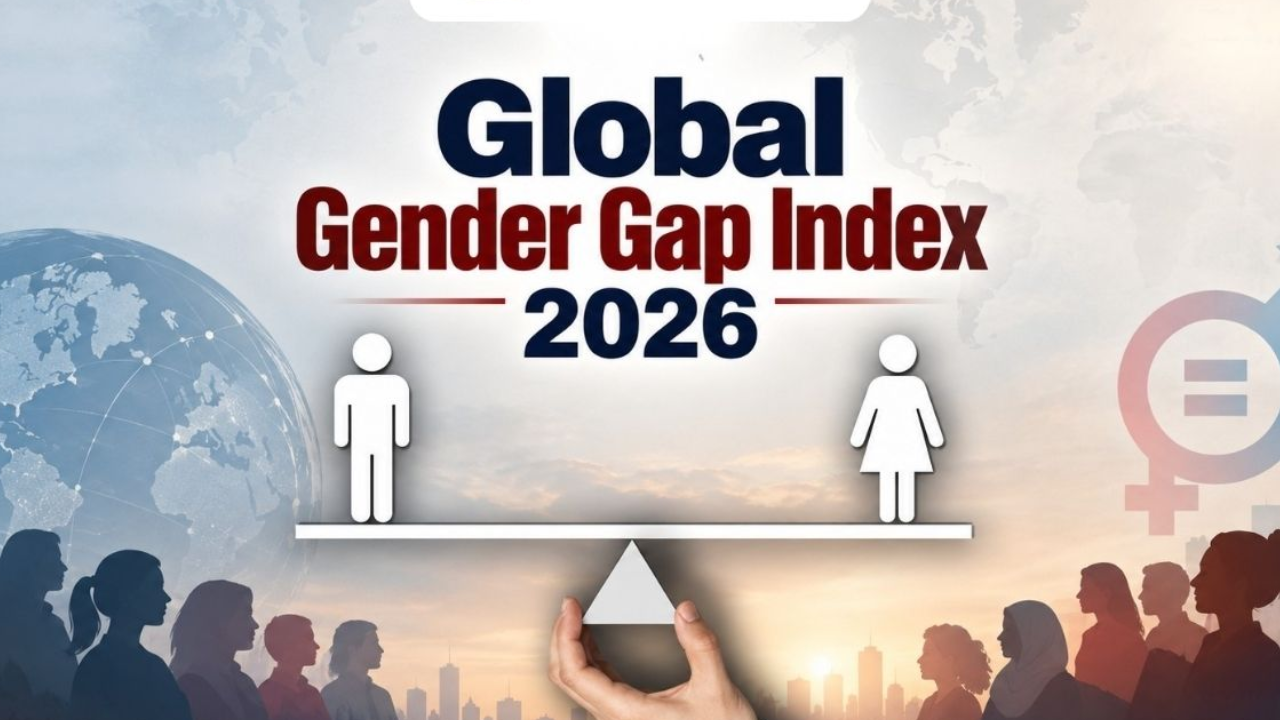
The World Economic Forum (WEF) has released the 20th edition of its benchmarking study, the Global Gender Gap Report 2026, assessing 145 economies alongside a constant longitudinal sample of 97 countries monitored uninterruptedly since 2006. For aspirants following competitive exam news today, international indices tracking human development serve as essential benchmarks for evaluating socio-economic progress. Global development reports provide the analytical bedrock required to substantiate qualitative arguments in civil services examinations, transforming general observations into structured, empirical evaluations across General Studies papers.
The 2026 report emphasizes that global gender parity has advanced at an incremental pace, revealing widening divergences between human capital accumulation and active institutional representation. Understanding these quantitative indicators is fundamental for aspirants tracking developments through Atharva Examwise Current Affairs, where contemporary policy developments are regularly contextualized against core syllabus themes.
Overview of the Global Gender Gap Report 2026
Introduced by the World Economic Forum in 2006, the Global Gender Gap Index benchmarks the evolution of gender parity across four institutional dimensions. Unlike raw economic indices that measure absolute levels of resource availability, this index evaluates the relative gap between women and men, establishing whether access to resources and opportunities is equitable regardless of a country's national wealth.
The index computes national scores across a scale ranging from 0.00 to 1.00:
A score of 1.00 signifies complete gender parity.
A score of 0.00 indicates total disparity.
The gender gap itself is defined as the distance an economy must traverse to achieve full parity.
Key Quantitative Takeaways
Global Parity Score: Globally, 69.2% of the cumulative gender gap has been closed in 2026.
Annual Progress Rate: The global score reflects an advance of 0.4% compared to the previous edition, demonstrating that systemic parity gains remain gradual.
Absence of Full Parity: In 2026, no surveyed nation has attained complete parity (1.00) across all combined dimensions.
Longitudinal Coverage: The 20th edition evaluates 145 economies in its cross-sectional sample, while tracing structural evolution across 97 constant economies over a 20-year timeline.
Four Dimensions of Gender Parity: Structural Divergence
The Global Gender Gap Index evaluates parity across four primary pillars, synthesized from fourteen underlying indicators. Significant variation exists across these sectors, demonstrating that progress in health and basic schooling does not automatically dismantle barriers in governance and employment markets.
| Dimension | Global Parity Closed (2026) | Measured Sub-Indicators | Systemic Characteristics |
|---|---|---|---|
| Educational Attainment | 96.9% | Literacy rates, primary, secondary, and tertiary enrollment ratios | Closest dimension to complete global convergence; universal basic schooling has minimized basic enrollment divides. |
| Health and Survival | 96.2% | Sex ratio at birth, healthy life expectancy | High global convergence, though adverse birth sex ratios in specific Asian economies impede full closure. |
| Economic Participation and Opportunity | 61.7% | Labor force participation rates, wage equality for similar work, earned income, managerial and technical positions | Substantial structural deficit; reflects occupational segregation, wage stagnation, and unequal care responsibilities. |
| Political Empowerment | 22.1% | Women in parliament, ministerial-level appointments, cumulative years of female heads of state | Represents the widest gender gap globally, demonstrating entrenched entry barriers in formal governance. |
The empirical divergence across these pillars illustrates a structural conversion deficit. While national governments have successfully democratized primary education and primary survival healthcare, societies struggle to translate these educational investments into equitable economic leverage and decision-making power. Women worldwide enter the workforce with near-equal credentials, yet encounter professional drop-off points, the "glass ceiling," and disproportionate domestic care responsibilities that suppress economic advancement. Furthermore, the political empowerment gap remains the primary factor suppressing overall national scores, as legislative bodies and executive cabinets worldwide continue to underrepresent female leaders.
International Rankings: Leaders, Regional Dynamics, and Outliers
Regional concentration at the top of the index remains heavily centered in Europe, which accounts for 70% of the top ten positions in 2026. Iceland maintains its top rank for the 17th consecutive year, standing as the only economy worldwide to have eliminated more than 90% of its overall gender gap.
Eastern Asia and the Pacific holds the second-highest footprint among the highest-performing nations, accounting for 17% of the top ten. Outside Europe, Sub-Saharan Africa demonstrates notable institutional progress through economies such as Namibia, which outranks numerous advanced industrial powers due to robust female representation in governance.
| Rank | Economy | Parity Score | Regional and Strategic Significance |
|---|---|---|---|
| 1 | Iceland | 93.0% | Global leader for the 17th consecutive iteration; only economy above 90% parity. |
| 2 | Finland | 87.2% | High institutional equality supported by egalitarian social care infrastructure. |
| 3 | Norway | 85.7% | Early adopter of corporate board gender quotas and shared parental benefits. |
| 4 | Namibia | 84.5% | Highest-ranked Sub-Saharan economy; high legislative participation. |
| 5 | United Kingdom | 84.2% | Sustained parity gains across technical vocations and political appointments. |
| 6 | New Zealand | 82.8% | Consistent high performer across Asia-Pacific governance metrics. |
| 7 | Sweden | 82.3% | Comprehensive institutional welfare networks and equal pay mechanisms. |
| 8 | Australia | 81.9% | Debut in the global top ten, driven by expanded legislative representation. |
| 9 | Germany | 81.7% | High parity in professional professions and federal ministries. |
| 10 | Ireland | 81.4% | Advanced female tertiary attainment and executive leadership inclusion. |
| 143 | Iran | <55.0% | Constrained female economic agency and restricted legislative roles. |
| 144 | Pakistan | <55.0% | Significant deficits in labor force inclusion and secondary educational completion. |
| 145 | Chad | Lowest | Lowest overall score; severe challenges across health, literacy, and economic access. |
At the opposite end of the distribution, Chad ranks 145th, completing the bottom three alongside Pakistan and Iran. These nations face compound vulnerabilities, including restrictive social conventions, elevated maternal mortality, depressed female workforce engagement, and minimal legislative representation.
India's Performance: Historical Trajectory and Contemporary Realities
In the Global Gender Gap Index 2026, India ranks 131st out of 145 countries, securing an overall gender parity score of 64.5%. While this represents an overall improvement of 4.3 percentage points relative to the inaugural 2006 index, India remains below the global average parity score of 69.2%.
The country's performance presents a complex socio-economic landscape:
India has made significant progress in Educational Attainment, approaching parity in primary and secondary school enrollments through targeted interventions like the Right to Education Act and the Samagra Shiksha framework. Basic literacy gaps among younger cohorts have narrowed, though disparities persist in elite tertiary education and specialized technical fields.
In Health and Survival, India's score continues to reflect historical deficits in the sex ratio at birth. While targeted state programs such as Beti Bachao Beti Padhao have stabilized sex ratios in several historically low-performing districts, adverse birth ratios continue to affect India's standing in international survival comparisons.
The primary structural challenges pulling down India's overall standing are concentrated in Economic Participation and Opportunity. India's female labor force participation rate (FLFPR) remains comparatively low, marked by high concentrations of female workers in informal, low-productivity agricultural work and unpaid domestic care economies. Wage differentials for comparable labor, limited ownership of formal productive assets, and safety concerns in urban transport networks restrict mobility and career advancement.
In Political Empowerment, India benefits from a historical legacy of women holding the office of Prime Minister and President, which aids its cumulative multi-decade score. However, actual female representation in contemporary parliamentary and state legislative bodies has historically fluctuated between 14% and 15%. While Parliament enacted the 106th Constitutional Amendment Act (Nari Shakti Vandan Adhiniyam), which mandates a 33% reservation for women in the Lok Sabha and State Legislative Assemblies, its operationalization remains contingent upon subsequent census and delimitation exercises, leaving its formal impact on international parity metrics pending.
Aspirants examining these trends benefit from connecting contemporary developments directly to foundational sociological concepts, as emphasized across the NCERT Foundation Program.
Comparative Assessment of Major International Gender Indices
Civil services examinations demand clear differentiation among metrics published by international bodies like the WEF, the United Nations Development Programme (UNDP), and UN Women.
| Index Name | Publishing Organization | Evaluated Dimensions | Core Conceptual Focus |
|---|---|---|---|
| Global Gender Gap Index (GGGI) | World Economic Forum (WEF) | Economic Participation, Educational Attainment, Health and Survival, Political Empowerment | Evaluates distance to parity across four pillars, detached from absolute income levels or resource endowments. |
| Gender Inequality Index (GII) | UNDP (Human Development Report) | Reproductive Health (MMR, Adolescent Birth Rate), Empowerment (Parliament, Secondary Education), Labor Market | Quantifies the loss of human development potential due to disparity; ranges from 0 (equality) to 1 (total inequality). |
| Gender Development Index (GDI) | UNDP (Human Development Report) | Disaggregates standard HDI: Life Expectancy, Education (expected & mean years), Estimated Earned Income | Measures the ratio of female HDI to male HDI (HDIf/HDIm), assessing gender disparity in basic human capabilities. |
| Global Gender Parity Index (GGPI) | UNDP and UN Women | Life and health, education and knowledge, labor and financial inclusion, decision-making | Assesses women's relative achievements compared to men across core human development domains. |
| Women's Empowerment Index (WEI) | UNDP and UN Women | Health, education, inclusion, decision-making, violence against women | Measures women's absolute agency and autonomy; scores closer to 1.0 indicate higher cumulative empowerment. |
These complementary frameworks allow analysts to differentiate between relative parity (GGGI), lost societal human potential (GII), absolute capability ratios (GDI), and baseline personal agency (WEI).
Why this matters for your exam preparation
Evaluating reports and indices is a high-yield area across competitive examinations, including the Union Public Service Commission (UPSC Civil Services Examination) and State Public Service Commissions like MPPSC. Mastering these metrics allows aspirants to synthesize quantitative evidence directly into qualitative analytical arguments across multiple papers:
General Studies Paper I: Indian Society
Syllabus Intersection: Role of women and women's organizations; Social empowerment; Poverty and developmental issues.
Application Strategy: Aspirants can utilize India’s 131st rank (64.5% parity) to support analytical discussions on why macroeconomic expansion does not automatically eliminate societal gender disparities without supportive social care infrastructure.
General Studies Paper II: Governance, Constitution, and Social Justice
Syllabus Intersection: Welfare schemes for vulnerable sections and their operational performance; Issues relating to the development and management of Social Sector/Services relating to Health, Education, and Human Resources; International organizations.
Application Strategy: The divergence between high Educational Attainment (96.9%) and lagging Economic Participation (61.7%) can be cited to evaluate public policy delivery. Aspirants can evaluate the transformative potential of the 106th Constitutional Amendment Act (Nari Shakti Vandan Adhiniyam) while detailing implementation challenges related to census and delimitation requirements.
General Studies Paper III: Indian Economy
Syllabus Intersection: Inclusive growth and issues arising from it; Employment and labor market patterns.
Application Strategy: The index's labor market data provides empirical backing for evaluating the "U-shaped" female labor force participation curve, occupational segregation, and the macroeconomic benefits of integrating women into the formal labor force.
Preliminary Examination: Objective Precision
Direct multiple-choice questions regularly assess the publishing institutions (distinguishing the WEF's GGGI from UNDP's GII and GDI), the precise pillars involved, and relative rank trajectories.
Essay Paper and Analytical Value Addition
Global best practices provide credible models for reform. Aspirants can cite Iceland's continuous top ranking (93.0%) to illustrate the impact of equal, non-transferable parental leave, or highlight Namibia's (84.5%) institutional gender-responsive budgeting to support actionable recommendations in Mains answer writing.
By systematically linking dynamic current affairs with foundational static coursework, candidates build the analytical depth required to excel across all stages of civil services testing, a framework reinforced through the integrated curriculum at Atharva Examwise Study Resources.