UPSC Current Affairs: Nati Folk Dance of Himachal Pradesh – Art, Culture, and Daily GK Update for Competitive Exam News Today
Cultural Heritage of Himachal Pradesh: Socio-Spiritual Foundations of Nati
The performing arts of the Western and Central Himalayas reflect an intimate synthesis of mountain ecology, seasonal agricultural cycles, and localized devotional traditions. Within the analytical scope of Indian heritage featured in the Atharva Examwise Current News, regional folk performances provide crucial insights into how mountain communities preserve social cohesion and intangible cultural expressions. Among these indigenous traditions, the Nati (नाटी) dance stands as the most recognized and culturally significant folk form of Himachal Pradesh.
Practiced throughout the mountainous valleys of Kullu, Shimla, Sirmaur, Mandi, and Kinnaur, Nati functions as a communal institution rather than an isolated theatrical performance. The dance is deeply intertwined with the social fabric of rural life, accompanying major rites of passage, domestic festivities, seasonal harvests, and village temple assemblies centered on local village deities (Gram Devtas). Unlike classical Indian dances that demand specialized individual virtuosity, Nati is defined by collective participation. In its traditional setting, village performers join ranks regardless of socio-economic background, linking arms or shoulders in open formations where community solidarity supersedes individual display.
Geographical Spread and Regional Typologies across the Hill Valleys
Topographic barriers and ecological isolation across the Himalayan massifs have historically fostered diverse micro-traditions across Himachal Pradesh. Although a shared choreographic foundation unites the state's folk expressions, Nati exhibits distinct localized characteristics across different administrative and cultural zones. Regional traditions frequently point to Sirmaur as the historical cradle of the dance, while its institutional and festive expansion found its most celebrated stage in the Kullu Valley.
| Regional Variant | Primary Geographic Core | Distinguishing Choreographic and Cultural Characteristics |
|---|---|---|
| Kulluvi Nati | Kullu Valley | Characterized by sweeping arm gestures, thirteen distinct stylistic stages, and widespread public performance during the International Kullu Dussehra. |
| Sirmauri Nati | Sirmaur District | Features measured, earthbound foot movements synchronized with heavy percussion, maintaining strong ties to agrarian fertility celebrations. |
| Mahasuvi Nati | Shimla and Solan (erstwhile Mahasu region) | Known for measured eight-step rhythmic cadences and synchronized torso sways, traditionally performed in thick, hand-woven woollen regalia. |
| Kinnauri Nati | Kinnaur District | Incorporates languid, mime-like footwork and deliberate pacing, displaying stylistic integration with trans-Himalayan Buddhist festive rituals. |
| Jaunpuri / Tandi | Border tracts between Sirmaur and Uttarakhand's Jaunsar-Bawar | Features interlocking arm formations, elevated musical tempos, and narrative folklore recounting regional historical epics. |
While Nati remains dominant across the sub-Himalayan and mid-Himalayan valleys, adjacent high-altitude arid tracts maintain separate cultural traditions. In the trans-Himalayan district of Lahaul, local communities perform an indigenous ritual dance known as Garphi, demonstrating that Nati belongs specifically to the Pahari cultural continuum of the middle mountain belts.
Due to historical migration from hill tracts to urban educational centers, Nati has also transitioned beyond state boundaries. Pahari youth groups regularly perform the dance in neighboring administrative centers such as Chandigarh and Dehradun, transforming a regional rural tradition into an emblem of modern Himalayan cultural identity.
Artistic and Kinesthetic Framework: Performance Dynamics, Lasya Tradition, and Musicality
The movement vocabulary of Nati is fundamentally rooted in the Lasya tradition of Indian aesthetics, emphasizing gentle, flowing, and lyrical gestures over aggressive or acrobatic flourishes. The spatial structure relies on egalitarian geometry, with dancers organizing into serpentine lines, expanding semicircles, or concentric rings. Male and female participants share equal footing, either standing in alternating sequences or forming continuous parallel arcs.
The kinesthetic progression begins at a deliberate, slow pace (Vilambit), guided by an eight-beat foundational footwork pattern. Performers sway gently forward, pivot diagonally, and step rhythmically backward in lockstep with acoustic cues. Depending on local custom, performers either interlock alternate hands to form a continuous chain or keep their hands unjoined, sweeping their arms in fluid horizontal figure-eight patterns through the air. The structural direction of the ensemble is frequently led by senior male dancers holding ceremonial accoutrements such as a yak-tail flywhisk (Chowrie) or an ornate ceremonial axe (Dangru).
Thematic narratives woven into the accompanying vocal chants derive from regional folklore, oral histories, and classical Vaishnava traditions. Echoes of the Raas Lila—the mythological circular dance of Lord Krishna and the Gopis—are prominent, alongside traditional enactments of the humorous romantic ballads of Chandravali. When staged during temple fairs, performances culminate in a ritual fire offering (Yajna) to seek divine protection and express community gratitude to local deities.
| Musical Instrument | Organological Classification | Functional Acoustic and Ceremonial Role |
|---|---|---|
| Dhol | Membranophone (Double-headed barrel drum) | Establishes the core rhythmic framework and governs shifts in movement tempo. |
| Nagara / Damau | Membranophone (Kettle drum pair) | Provides resonant, low-frequency beats that punctuate collective foot-stamping sequences. |
| Shehnai / Sarnai | Aerophone (Double-reed wind instrument) | Leads the melodic progression and establishes the emotional tone of the folklore. |
| Karnal | Aerophone (Straight, elongated brass trumpet) | Sounds sharp, ceremonial flourishes that signal transitions between choreographic patterns. |
| Narsingha | Aerophone (Curved, C-shaped copper or brass horn) | Delivers soaring acoustic signals during climactic festive moments and temple processions. |
The visual impact of Nati is amplified by the traditional attire and ornaments of the performers, which are documented comprehensively in the Atharva Examwise Art and Culture Module. Male dancers traditionally wear the flared woollen Chola, fitted Churidar, a woven sash (Gachi), and a decorated Himachali woollen cap (Topa) accented with seasonal flowers or a ceremonial plume (Kalagi). Female performers wear patterned handloom woollen wraps (Pattu), bound with silver brooches, along with bright headscarves (Dhatu) and traditional silver jewelry such as Chanki and Tunki neckpieces. In specific stylistic variations, dancers accentuate their hand movements with ornate hand-held fans and vibrant handkerchiefs, creating a unified visual rhythm.
Historical Milestones and Social Advocacy: The Guinness World Record
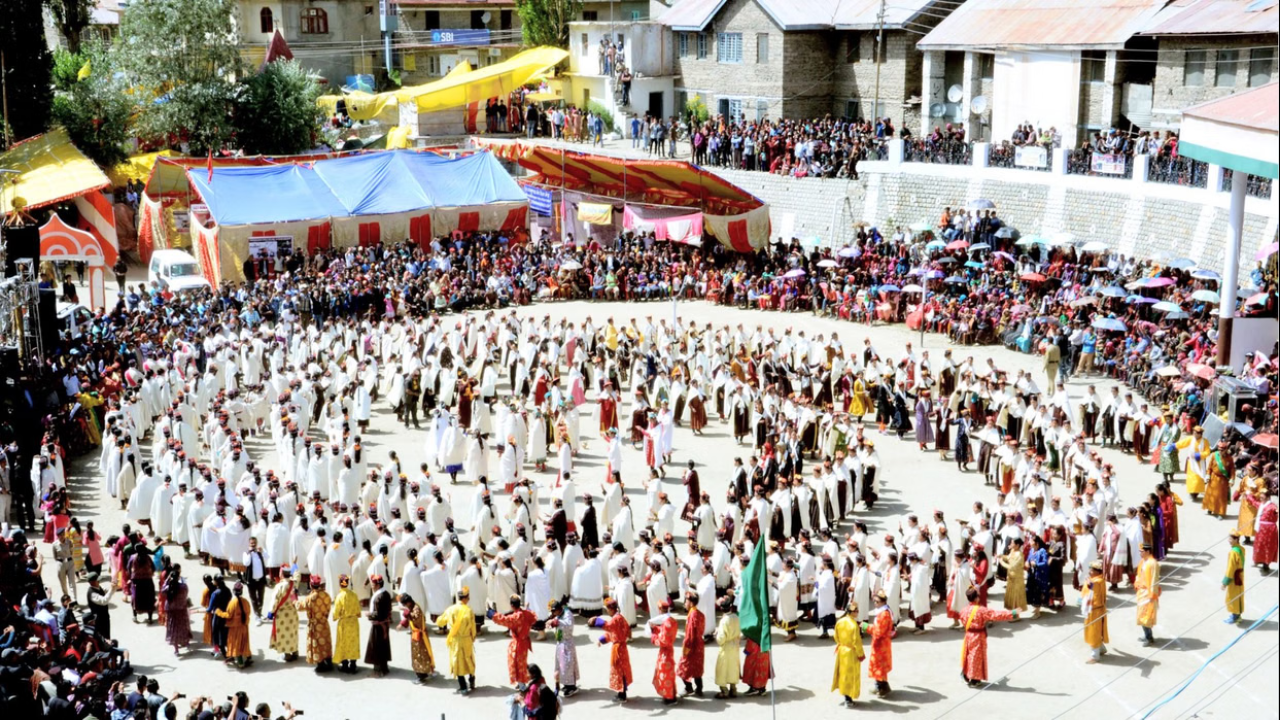
Over recent decades, Nati has evolved from a decentralized rural folk practice into an organized vehicle for regional projection and social advocacy. Historically dominated by male troupes in feudal court contexts, the contemporary era has seen women assume a central role in both preservation and public performance. This shift was institutionalized during the annual International Kullu Dussehra celebrations at the historic Dhalpur Grounds in Kullu.
2014 Limca Book of Records Entry (8,540 dancers at Kullu Rath Ground) │ ▼ October 26, 2015: Mega Kullu Nati Performance (Dhalpur Ground) │ ▼ January 11, 2016: Formal Induction into the Guinness Book of World Records (9,892 participants)
The administrative mobilization of the dance began in October 2014, when 8,540 dancers gathered to set an initial benchmark documented in the Limca Book of Records. Building on this framework, the Kullu district administration organized a larger performance on October 26, 2015, under the banner of the state-sponsored "Beti Hai Anmol" (The Girl Child is Precious) campaign. The event was designed to use mass cultural participation to raise public awareness against female feticide and tackle declining child sex ratios in the region.
A total of 9,892 dancers—predominantly local women dressed in traditional Kulluvi handloom attire—performed synchronized choreography across the festival grounds. Participants were monitored and verified using individual barcoded electronic tracking chips to ensure compliance with international documentation criteria.
On January 11, 2016, Guinness World Records officially designated the gathering as the "Largest Nati Dance" and the largest voluntary folk dance assembly in recorded history. This milestone elevated Nati onto the global stage and underscored how traditional performing arts can serve as effective instruments for modern civic and social reform.
The institutional preservation of Nati is reinforced through regular documentation by the Sangeet Natak Akademi, India’s national academy for music, dance, and drama. Furthermore, Nati features within cultural studies associated with the Ministry of Culture's National List of Intangible Cultural Heritage (ICH), affirming its value as a living, community-sustained art form.
Key Facts and Exam-Relevant Data
State of Origin: Himachal Pradesh, with major cultural hubs in Kullu, Shimla, Sirmaur, Mandi, and Kinnaur districts.
Regional Exclusion: The cold-desert Lahaul Valley maintains a separate ritual dance called Garphi and historically excludes Nati from its traditional repertoire.
Aesthetic Classification: Folk dance reflecting the Lasya idiom, characterized by graceful, fluid, and slow-tempo movements.
Choreographic Pattern: Formed in serpentine lines, concentric rings, or semicircular arcs, utilizing an eight-count footwork progression.
Instrumental Ensemble: Indigenous aerophones and membranophones including the Dhol, Damau / Nagara, Shehnai / Sarnai, Karnal, and Narsingha.
Thematic Narratives: Local Pahari folklore, nature ballads, Raas Lila episodes of Lord Krishna, and folk dramas of Chandravali.
Guinness World Record: Achieved on October 26, 2015, and certified on January 11, 2016, involving 9,892 verified dancers in Kullu to champion the "Beti Hai Anmol" social welfare initiative.
Institutional Support: Archival documentation and preservation under the Sangeet Natak Akademi and inclusion within the broader framework of the National List of Intangible Cultural Heritage.
Revision Resources: Track related daily static and current updates via the Atharva Examwise Daily GK Updates.
Why this matters for your exam preparation
For serious aspirants preparing for the Union Public Service Commission (UPSC) Civil Services Examination and State Public Service Commissions (such as HPAS, UPPSC, and UKPSC), the study of Nati offers an instructive, multi-dimensional subject spanning cultural history, sociology, and public policy.
Relevance to UPSC CSE General Studies Paper I (Indian Heritage and Culture)
Distinction Between Classical and Folk Traditions: The UPSC syllabus requires a nuanced understanding of how folk traditions differ from classical forms codified under the Natya Shastra. Nati illustrates how folk dances rely on oral pedagogy, generational transmission, and community inclusion rather than rigid canonical texts.
Aesthetic Classification: Candidates should be able to analyze how classical dramaturgical principles—specifically the contrast between Tandava (vigorous, masculine) and Lasya (graceful, feminine)—manifest within regional folk forms. Nati provides an excellent example of Lasya-dominated folk choreography in the Himalayan belt.
Intangible Cultural Heritage (ICH): In light of UNESCO and Ministry of Culture frameworks, questions increasingly target living heritage and community custodianship. Nati exemplifies an art form preserved through collective practice rather than institutional patronization alone.
Relevance to UPSC CSE General Studies Paper I & II (Indian Society, Social Justice, and Governance)
Cultural Traditions as Vehicles for Social Messaging: The integration of the "Beti Hai Anmol" campaign into the 2015 mega-Nati performance illustrates how district administrations can leverage traditional art forms to alter societal behaviors and address issues like adverse child sex ratios. Aspirants can use this as an empirical case study in Mains essays and GS Paper II answers on behavioral-change governance and participatory administration.
Gender Parity in Folk Systems: While many classical and ritual arts historically enforced gender exclusions, the structural parity of male and female dancers in Nati offers an important reference point for discussing gender inclusivity in indigenous Indian traditions.
Relevance to UPSC Prelims and State Competitive Examinations
Direct Factual Questions: Objective tests routinely evaluate knowledge of Indian folk dances, their geographic origins, primary instruments, and socio-religious contexts. Questions frequently require matching dances to their native states or distinguishing between regional varieties such as Kulluvi Nati, Kinnauri Nati, and Sirmauri Nati.
Current Affairs and Global Recognitions: Understanding the scale, context, and date of the Guinness World Record achieved during the International Kullu Dussehra provides an advantage for state-specific and national general studies papers focused on contemporary cultural milestones.