
UPSC Current Affairs: Russian Nuclear Battlecruiser Admiral Nakhimov Completes Sea Trials | Atharva Examwise Current News and Daily GK Update
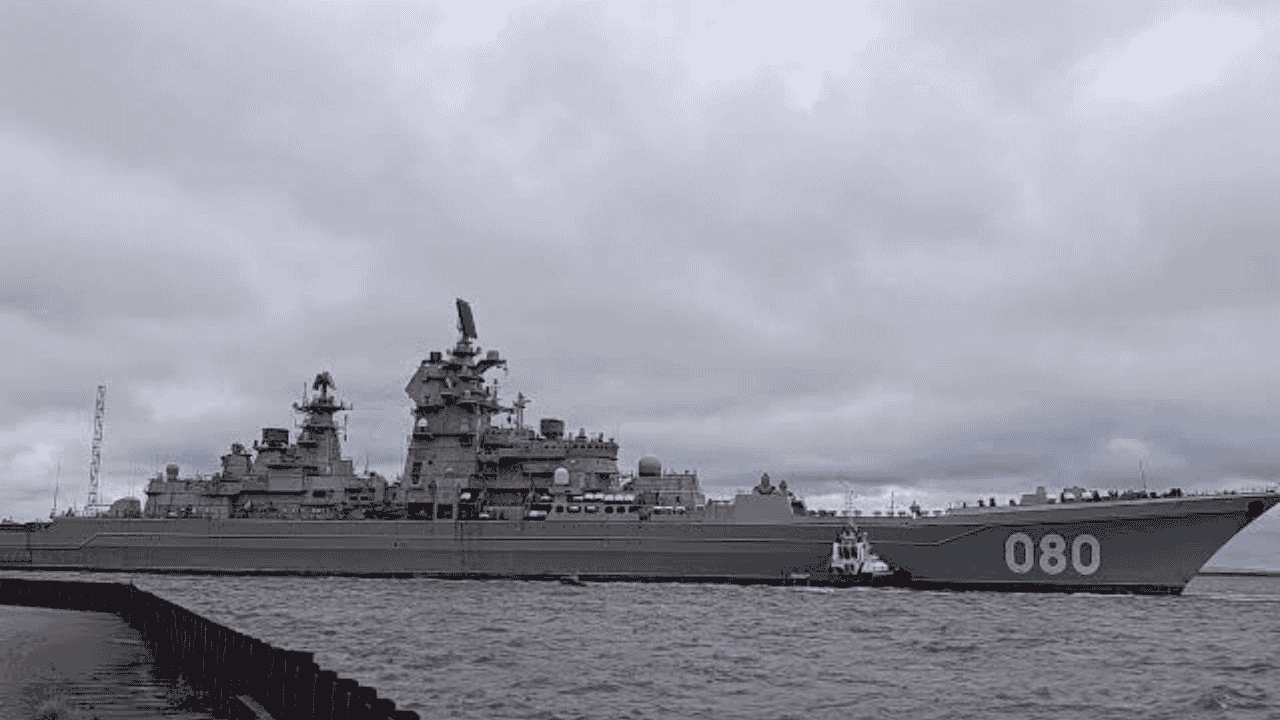
The revival of heavy surface combatants reached an operational milestone as the Russian Navy's Project 11442M Kirov-class nuclear-powered battlecruiser, the Admiral Nakhimov, concluded its comprehensive sea trials. Originally commissioned into the Soviet Northern Fleet in 1988 under the name Kalinin, the warship was withdrawn from frontline operational service in the late 1990s and transferred to the Sevmash Shipyard in Severodvinsk. The extensive modernization contract formally commenced in 2013, initiating an overhaul that evolved into a thorough structural, electronic, and kinetic reconstruction of the platform.
Following the reactivation of its onboard nuclear reactors and rigorous harbor tests, the warship departed for open-water trials to validate its modified propulsion machinery, integrated digital fire control architecture, phased-array sensor suites, and multi-layered weapons payload. Scheduled for formal induction into the Russian Navy by late 2026, the Admiral Nakhimov stands as the world's most heavily armed and largest non-carrier surface warship.
For aspirants following Atharva Examwise Current News to prepare for the UPSC Civil Services Examination and other competitive exams, this development intersects critical areas of military technology, hypersonic propulsion systems, blue-water power projection doctrines, and Arctic maritime security.
Technical Architecture and Propulsion Engineering
The Admiral Nakhimov belongs to the Project 1144 Orlan class (designated by NATO as the Kirov class), conceptualized during the late Cold War to interdict Western naval formations and hunt aircraft carrier strike groups. Displacing 24,000 metric tons standard and approximately 28,000 metric tons under full operational combat load, the ship is 251 meters in overall length, with a beam of 28.5 meters and a draft of 10.3 meters. This displacement is roughly three times greater than that of primary Western surface combatants, such as the United States Navy's Arleigh Burke-class destroyers and Ticonderoga-class cruisers, which displace between 9,600 and 10,000 metric tons.
The mechanical heart of the battlecruiser relies on a Combined Nuclear and Steam (CONAS) propulsion system. Primary thermal propulsion is generated by two KN-3 pressurized water nuclear reactors rated at 150 megawatts each, supplemented by two oil-fired auxiliary boilers designed to provide superheated steam boost during combat sprints. This power plant drives two propeller shafts, delivering an aggregate output of 140,000 shaft horsepower.
Under continuous nuclear power alone, the platform achieves cruising speeds of 25 knots (approximately 46 km/h) with unlimited operational transit range. When steam turbine boosters are engaged, the warship reaches top speeds of 31 to 32 knots (approximately 59 km/h), allowing it to match or exceed the operational sprint speed of conventional escort destroyers, cruisers, and aircraft carriers. The deployment endurance of the platform is constrained primarily by lubricating supplies and provisions for its crew complement of more than 700 officers and enlisted personnel, granting up to 60 days of autonomous high-seas operations.
| Technical Parameter | Engineering Specification | Strategic Utility |
|---|---|---|
| Length Overall | 251.1 meters | Houses modular vertical launch silos and automated combat direction centers |
| Beam (Width) | 28.5 meters | Provides hydrodynamic stability in rough sub-Arctic sea states |
| Full Load Displacement | 28,000 metric tons | Accommodates heavy armor, dual nuclear reactors, and deep missile magazines |
| Propulsion System | CONAS (2 × KN-3 Nuclear Reactors + 2 Steam Boilers) | Unlimited cruising endurance at 25 knots; 32 knots sprint capability |
| Total Power Output | 140,000 shaft horsepower | Provides power for phased-array tracking radars and electronic countermeasures |
| Aviation Wing | 3 × Kamov Ka-27 / Ka-29 / Ka-31 helicopters | Under-deck hangar provides anti-submarine screening and airborne early warning |
| Crew Complement | 700+ officers and enlisted personnel | Supports multi-shift operational command across all combat sectors |
Modular Strike Arsenal and Integrated Defensive Network
The combat redesign of the Admiral Nakhimov centered on dismantling the ship's original Cold War armament—notably its 20 inclined launchers for legacy P-700 Granit (SS-N-19 Shipwreck) anti-ship missiles—and replacing them with modern, modular vertical launching systems (VLS).
| Defensive / Offensive Layer | System Designation | Munitions / Caliber | Operational Performance Metrics |
|---|---|---|---|
| Hypersonic Strike | UKSK 3S14 VLS (Part of 80 Strike Cells) | 3M22 Zircon | Speed: Mach 8–9 (~11,000 km/h); Range: 400–1,000 km; Warhead: 300–400 kg |
| Supersonic Maritime Strike | UKSK 3S14 VLS | P-800 Oniks | Speed: Mach 2.5 (~3,182 km/h); Range: 600 km; Warhead: 300 kg |
| Precision Land Attack | UKSK 3S14 VLS | 3M-14 Kalibr | Speed: Subsonic (~1,000 km/h); Range: 1,500–2,500 km; Warhead: 450 kg |
| Long-Range Fleet Air Defense | Fort-M Revolving VLS | Navalized S-400 / 48N6DM series | 96 Cells; Engagement Range: 150–250 km; Altitude: up to 30 km |
| Medium Point Defense | Redut VLS / 4K33 Osa-M | 9M96E / 9M100 Series | Engages saturation aerial targets, cruise missiles, and unmanned combat systems |
| Terminal Close-In Weapon System | 6 × Pantsir-M CIWS Modules | Twin 30 mm rotary cannons + 8 SAM tubes | Gun Range: 4 km; Missile Range: 20 km; Multi-target simultaneous engagement |
| Anti-Submarine & Torpedo Defense | Paket-NK & Otvet Rocket Systems | 324 mm thermal torpedoes & rocket-boosted ASW | Hard-kill active anti-torpedo interception and long-range submarine interdiction |
| Naval Artillery | 1 × Twin 130 mm A-192M / AK-130 | Dual-purpose automated kinetic gun mount | Effective surface and coastal bombardment out to 23 km |
Universal Strike Battery (UKSK 3S14 VLS)
The offensive capability of the battlecruiser is concentrated within ten 8-cell UKSK 3S14 universal vertical launch modules, providing 80 heavy strike silos. These cells are engineered to fire three complementary missile classes, creating an adaptable operational profile:
3M22 Zircon Hypersonic Anti-Ship Cruise Missile: Propelled by a solid-fuel booster followed by an air-breathing scramjet engine, the Zircon cruises at velocities between Mach 8 and Mach 9 (approximately 11,000 km/h) across an engagement envelope spanning 400 to 1,000 kilometers. Operating at extreme speed within a protective plasma sheath, the missile compresses defensive reaction windows down to single-digit seconds, challenging conventional kinetic interception systems like the Aegis Combat System and Aster-30 networks.
P-800 Oniks Supersonic Cruise Missile: Optimized for medium-to-long-range anti-ship missions up to 600 kilometers, the Oniks travels at Mach 2.5 (3,182 km/h) carrying a 300 kg warhead. It employs programmed flight paths with sea-skimming terminal trajectories to evade surface search radars.
3M-14 Kalibr Land-Attack Cruise Missile: Delivering deep precision-strike capabilities, the subsonic Kalibr flies at 1,000 km/h over distances between 1,500 and 2,500 kilometers. Guided by satellite coordinates and digital terrain-contour matching, its 450 kg high-explosive warhead targets critical land infrastructure far inland.
With 80 universal strike cells supported by 96 dedicated air defense cells, this single hull delivers firepower comparable to five modern guided-missile frigates operating concurrently.
Multi-Tier Air Defense and Undersea Protection
To defend its concentrated strike assets against coordinated saturation strikes, the Admiral Nakhimov fields a 360-degree, three-tier defensive umbrella:
Long-Range Sector (Fort-M Network): The warship houses 96 vertical launch silos using the Fort-M system, incorporating navalized technologies from the terrestrial S-400 missile complex. This system tracks and engages aerodynamic targets, high-altitude surveillance craft, and tactical ballistic missiles out to ranges between 150 and 250 kilometers.
Close-In Weapon System (Pantsir-M): Terminal point defense is provided by six Pantsir-M modules. Integrating dual 30 mm multi-barrel rotary cannons with eight command-guided interceptor missiles, each module can simultaneously engage low-altitude cruise missiles, loitering munitions, and anti-ship glide bombs breaking through the long-range shield.
Active Anti-Submarine Warfare (ASW) and Anti-Torpedo Networks: The battlecruiser integrates the Paket-NK system, which deploys compact 324 mm torpedoes designed for dual-role duty: hunting hostile submerged submarines or executing kinetic hard-kill intercepts against incoming homing torpedoes. This is supplemented by the Otvet rocket-boosted anti-submarine missile system, which rapidly lofts acoustic-homing torpedoes to distant coordinates identified by onboard hydroacoustic suites or shipborne Ka-27 helicopters.
Global Warship Comparison: Strategic Metrics and Doctrinal Shifts
The re-commissioning of the Admiral Nakhimov renews debate within maritime strategic communities over the military utility of super-heavy capital ships compared to distributed, smaller combat vessels. Detailed comparative defense studies on Atharva Examwise Competitive Exam Resources examine how the battlecruiser stacks up against contemporary capital platforms, including Russia's un-modernized sister ship Pyotr Velikiy, the United States Navy's Ticonderoga-class guided-missile cruisers, and the Chinese People's Liberation Army Navy (PLAN) Type 055 large destroyers.
| Operational Metric | Admiral Nakhimov (Russia) | Pyotr Velikiy (Russia) | Ticonderoga-Class (USA) | Type 055 Large Destroyer (China) |
|---|---|---|---|---|
| Classification | Heavy Nuclear Battlecruiser | Heavy Nuclear Battlecruiser | Guided Missile Cruiser (CG) | Guided Missile Destroyer / Cruiser |
| Displacement (Full) | ~28,000 metric tons | ~28,000 metric tons | ~9,600 to 10,000 metric tons | ~12,000 to 13,000 metric tons |
| Propulsion Power | Nuclear CONAS (Unlimited Range) | Nuclear CONAS (Unlimited Range) | 4 × Gas Turbines (COGAG, Conventional) | 4 × Gas Turbines (COGAG, Conventional) |
| Total VLS Capacity | 176 Cells (80 Strike + 96 SAM) | 116 Launchers (20 Granit + 96 SAM) | 122 Mk 41 VLS Cells [cite: 9, 16] | 112 Universal VLS Cells [cite: 15, 17] |
| Strike Missiles | 3M22 Zircon, P-800 Oniks, Kalibr | P-700 Granit (Cold War supersonic) | BGM-109 Tomahawk, RGM-84 Harpoon | YJ-18, YJ-21 (Hypersonic ASBM), CJ-10 |
| Air Defense Complex | Fort-M (S-400 navalized) + Pantsir-M | S-300F + Kortik CIWS | Standard Missile SM-2/SM-6, ESSM | HHQ-9B Long-Range SAM, HQ-10 CIWS |
| Doctrinal Role | Blue-Water Bastion Anti-Access/Area-Denial | Flagship / Carrier Interdiction | Carrier Strike Group Air Defense Escort | Multi-Role Carrier Escort & Task Force Lead |
Western naval doctrine moved away from large nuclear cruisers after decommissioning the Long Beach, Bainbridge, and Virginia classes. The United States Navy prioritized distributed carrier air wings paired with mass-produced Arleigh Burke-class destroyers that use standardized Mk 41 vertical launchers and the Aegis Combat System.
In contrast, Russian naval architecture addresses carrier group challenges asymmetrically: because the Russian surface fleet operates without large supercarriers, it relies on heavily armed surface units like the Admiral Nakhimov to function as floating anti-access bastions capable of conducting long-range missile strikes outside the combat radius of carrier air wings.
China’s Type 055 reflects a synthesis of these doctrines, combining low-observable stealth hull shaping and dual-band radar arrays with 112 vertical launch cells capable of deploying hypersonic anti-ship ballistic weapons like the YJ-21.
Further tactical evaluations of these naval doctrines can be explored via specialized analyses from authoritative sources like Naval News Surface Warfare Studies.
Geopolitical Implications and Naval Economics
The return of the Admiral Nakhimov to the Russian Northern Fleet carries major consequences for regional deterrence and naval resource management.
Reinforcing the Arctic Bastion and the Northern Sea Route
Stationed at the Northern Fleet's headquarters in Severomorsk on the Kola Peninsula, the Admiral Nakhimov will oversee operations across the Barents Sea, the Norwegian Sea, and the central Arctic Ocean. Russia’s naval strategy prioritizes the "Bastion Defense" concept: establishing secure zones in Arctic waters to protect its nuclear ballistic missile submarines (SSBNs) from Western attack submarines and maritime patrol aircraft.
With its long-range Fort-M air defenses and anti-submarine capabilities, the battlecruiser provides a defensive perimeter over these staging areas. Additionally, as warming polar waters expand commercial transit along the Northern Sea Route (NSR), the ship's reinforced hull and nuclear endurance provide Moscow with a platform capable of maintaining presence across strategic choke points without constant support from fleet replenishment oilers.
Anti-Access/Area-Denial (A2/AD) Dynamics
The deployment of operational hypersonic weapons at sea alters the tactical balance in contested waterways. Operating at Mach 8 to 9, the 3M22 Zircon significantly reduces the reaction times of Aegis-equipped combat platforms. A salvo combining subsonic Kalibr missiles, supersonic Oniks missiles, and hypersonic Zircons creates a multi-axis attack profile designed to saturate naval defense systems. This capability reinforces Russia’s Anti-Access/Area-Denial (A2/AD) posture across the North Atlantic and the Greenland-Iceland-United Kingdom (GIUK) gap, challenging NATO maritime transit routes.
The Industrial Procurement Dilemma
While the Admiral Nakhimov delivers formidable firepower, the project highlights challenges in modern Russian naval manufacturing. The modernization timeline spanned over two decades, during which projected costs grew from an initial 50 billion rubles to more than 200 billion rubles (several billion USD).
Naval economists point out that the resources and shipyard capacity allocated to refitting this single Cold War platform could have funded a squadron of modern Project 22350 Admiral Gorshkov-class frigates or several Project 885M Yasen-M-class nuclear attack submarines. Consequently, upon the re-commissioning of the Admiral Nakhimov, the Russian Navy is expected to decommission its sister ship Pyotr Velikiy due to the high financial and industrial burden of a second overhaul, leaving the Admiral Nakhimov as the only operational vessel of its class.
Key Facts and Exam-Relevant Data
Vessel Name and Classification: Admiral Nakhimov (originally Kalinin), Project 11442M Kirov-class heavy nuclear-powered guided-missile battlecruiser.
Dimensions: Length of 251.1 meters, beam of 28.5 meters, draft of 10.3 meters; standard displacement of 24,000 metric tons and full load displacement of 28,000 metric tons.
Propulsion System: Combined Nuclear and Steam (CONAS) utilizing two KN-3 pressurized water nuclear reactors (150 MW each) and two oil-fired boilers driving two shafts, producing 140,000 shaft horsepower.
Operational Speed & Range: Cruising speed of 25 knots under nuclear power with virtually unlimited range; maximum sprint speed of 31 to 32 knots (59 km/h); operational endurance of 60 days.
Strike Missiles (80 UKSK Cells): 3M22 Zircon (hypersonic, Mach 8–9, range 400–1,000 km), P-800 Oniks (supersonic, Mach 2.5, range 600 km), and 3M-14 Kalibr (subsonic, range 1,500–2,500 km).
Defensive Weapons: 96 Fort-M (naval S-400 equivalent) long-range SAM cells, 6 Pantsir-M close-in weapon systems, Paket-NK anti-torpedo complexes, and Otvet anti-submarine missiles.
Aviation Facilities: Under-deck hangar and landing pad accommodating up to three Kamov Ka-27, Ka-29, or Ka-31 helicopters.
Strategic Role: Flagship of the Northern Fleet stationed at Severomorsk, tasked with Arctic Bastion defense and long-range surface interdiction.
Why this matters for your exam preparation
For candidates preparing for the UPSC Civil Services Examination (CSE), State PCS, and Defense Services Examinations (CDS/NDA/CAPF), the re-commissioning of the Admiral Nakhimov provides relevant case material across multiple syllabus areas.
UPSC Syllabus Integration
General Studies Paper 3 (Science & Technology):
Propulsion Regimes: Understanding the design and mechanics of marine nuclear propulsion (pressurized water reactors) versus conventional gas-turbine (COGAG) and Combined Nuclear and Steam (CONAS) systems.
Aerodynamics and Hypersonic Technology: Differentiating between subsonic ($<\text{Mach } 0.8$), supersonic ($\text{Mach } 1.2\text{ to } 5.0$), and hypersonic ($>\text{Mach } 5.0$) flight mechanics. Candidates should understand the differences between air-breathing scramjet systems (such as the 3M22 Zircon) and ramjet systems (such as the Indo-Russian BrahMos).
General Studies Paper 3 (Security Challenges & Maritime Strategy):
Anti-Access/Area-Denial (A2/AD): How modern precision-strike architectures allow coastal powers to establish defensive zones against expeditionary naval forces.
Fleet Architecture Trends: The strategic debate between building high-value, heavily concentrated surface ships versus procuring dispersed, networked fleets of smaller frigates, corvettes, and uncrewed vessels.
General Studies Paper 2 (International Relations & Geopolitics):
Arctic Militarization: The strategic interests surrounding maritime shipping through the Northern Sea Route (NSR), resource rights in the polar seabed, and their connection to India’s Arctic Policy unveiled in 2022.
Preliminary Examination Focus:
Identifying global naval missile systems, matching weapon platforms (Zircon, Kalibr, Kinjal, BrahMos) to their propulsion types, operational ranges, and origin nations.
Assessment Questions for Aspirants
Preliminary Examination Practice Question
Q. With reference to marine propulsion and hypersonic missile systems, consider the following statements:
In a scramjet (supersonic combustion ramjet) engine, airflow through the combustion chamber remains supersonic throughout the operational cycle.
The 3M22 Zircon missile employs scramjet propulsion to maintain cruise velocities exceeding Mach 8.
A Combined Nuclear and Steam (CONAS) marine plant relies on oil-fired boilers for baseline cruising while reserving nuclear reactors exclusively for maximum-speed operations.
Which of the statements given above is/are correct?
(a) 1 and 2 only
(b) 2 only
(c) 1 and 3 only
(d) 1, 2, and 3
Correct Answer: (a) 1 and 2 only
Explanation:
Statement 1 is correct: Unlike conventional ramjets that decelerate incoming airflow to subsonic speeds prior to ignition, scramjet engines maintain supersonic airflow throughout the combustion chamber, allowing sustained flight beyond Mach 5.
Statement 2 is correct: The Russian 3M22 Zircon is an air-breathing hypersonic cruise missile powered by a scramjet that reaches speeds between Mach 8 and Mach 9.
Statement 3 is incorrect: In a CONAS system, the nuclear reactors provide continuous baseload power for regular cruising with unlimited operational range, while auxiliary conventional boilers provide supplemental steam to boost the turbines during high-speed combat sprints.
Mains Analytical Practice Question
Q. "The development of long-range hypersonic cruise missiles on heavily armed surface platforms presents new challenges to traditional aircraft carrier battle groups." Critically examine this statement in light of recent developments in naval warfare and evaluate its implications for maritime security. (250 Words, 15 Marks)
Answer Approach:
Introduction: Highlight the conclusion of sea trials for the Admiral Nakhimov and its integration of 80 vertical launch cells armed with hypersonic weapons like the 3M22 Zircon.
Impact on the Carrier Strike Model: Discuss how carrier strike groups (CSGs) rely on stand-off distances, air defense shields, and carrier air wings. Contrast this with hypersonic cruise missiles traveling at Mach 8 to 9, which significantly reduce target reaction times to seconds and challenge traditional shipborne missile defense radars.
Operational Constraints of Heavy Surface Vessels: Balance the analysis by noting that super-heavy battlecruisers lack organic carrier air wings for over-the-horizon reconnaissance, represent concentrated targets for coordinated submarine strikes, and carry high procurement and maintenance costs.
Significance for India and the Indian Ocean Region: Link the discussion to the Indian Navy’s maritime force design. Examine the ongoing balance between acquiring additional indigenous aircraft carriers (such as the proposed IAC-2) and procuring extended-range land- and sea-based missile systems (like the BrahMos-II hypersonic project) to safeguard the Indian Ocean Region.
Conclusion: Summarize that while hypersonic surface platforms introduce strong A2/AD challenges, effective maritime control requires a balanced fleet architecture that combines surface strike systems, carrier-based naval aviation, and modern attack submarines.
For regular syllabus analyses, current affairs syntheses, and exam preparation material, consult the latest resources available at the Atharva Examwise Learning Portal.