UPSC Current Affairs: Manipuri Raas Leela Classical Dance Heritage and Daily GK Update
Manipuri Raas Leela represents one of the most sublime aesthetic and spiritual expressions among India's eight recognized classical dance traditions. Developed within the northeastern state of Manipur, the art form synthesizes ancient Meitei ritual choreographies with Gaudiya Vaishnavism, transmuting devotion into fluid, circular bodily motions. For civil services aspirants tracking competitive exam news today, the historical evolution, socio-religious underpinnings, unique iconographical costumes, and musical accompaniment of Manipuri Raas constitute a recurring, high-yield thematic cluster within Indian Heritage and Culture. This analysis by Atharva Examwise Current News contextualizes the traditional dance-drama, offering an examination-focused breakdown tailored for both the Preliminary and Main stages of competitive examinations.
Historical Origins and the Royal Patronage of King Bhagyachandra
The choreographic lineage of Manipur is rooted in the pre-Hindu indigenous performance practices of the Meitei community, particularly the ancestral Lai Haraoba festival. In these foundational ceremonies, priestesses known as Maibis enacted cosmological hymns of creation dedicated to local territorial deities (Umang Lai), alongside Shiva worshipped as Nongpok Ningthou and Parvati as Panthoibi. During the 18th century, however, the cultural landscape underwent a decisive shift with the widespread adoption of Gaudiya Vaishnavism by the royal court.
Pre-Vaishnava Rituals (Lai Haraoba / Maibis) │ ▼ 18th-Century Vaishnavite Shift (Gaudiya Preceptors) │ ▼ Royal Patronage & Codification (Maharaja Bhagyachandra) │ ▼ Inaugural Raas Leela Performance (1779, Kartik Purnima)
The formal institutionalization of Manipuri Raas occurred under the reign of Maharaja Bhagyachandra (also historically known as Rajarshi Bhagyachandra or Meidingu Ching-Thang Khomba), who ruled Manipur between 1763 and 1798. Cultural chronicles record that the king experienced a vivid spiritual vision in which Lord Krishna commanded him to establish a dedicated devotional dance-drama. Acting upon this epiphany, Bhagyachandra convened preeminent traditional gurus, theological scholars, and master musicians to formalize the choreography, melodic ragas, and ritual structure of the performance.
The public consecration of this codified tradition took place in 1779 on the full moon night of Kartik Purnima. In this inaugural presentation, the king's daughter, Princess Bimbabati (widely venerated by the epithet Shija Laiobi), portrayed the central role of Sri Radha. Princess Bimbabati’s lifetime dedication to devotional music, ascetic practice, and poetic adoration of Krishna led regional historians to draw strong parallels between her life and that of Rajasthan’s Bhakti poetess, Meerabai. Through royal sanction, Raas Leela moved from peripheral religious ritual into the definitive cultural expression of the Meitei kingdom.
Theological Architecture: The Metaphysics of Jivatma and Paramatma
Manipuri Raas Leela functions distinctly from purely dramatic or narrative theatrical forms; it is conceived and executed as an act of Sadhana (spiritual discipline) and Bhakti (devotional worship). The thematic material draws primarily from the canonical verses of the Bhagavata Purana, the Gita Govinda of Jayadeva, and the devotional lyrics composed by medieval Vaishnava poets.
The philosophical bedrock of the performance rejects secular or erotic connotations. Instead, the divine romantic interplay between Krishna, Radha, and the Gopis symbolizes Apratikrita Prema—the metaphysical union between the Jivatma (the mortal individual soul) and the Paramatma (the supreme universal consciousness). The circular arrangement of the dance mirrors the cosmic wheel, wherein multiple individual souls revolve around the single Divine Center, experiencing both the ecstasy of communion and the agony of separation (Viraha).
Performances are systematically organized across the ritual and agricultural calendars into specific compositions:
| Variant of Raas | Astrological / Seasonal Timing | Core Narrative Repertoire |
|---|---|---|
Maha Raas [cite: 5] | Kartik Purnima (October–November) | The principal autumnal Raas depicting the cosmic dance, Krishna's temporary disappearance to subdue the Gopis' pride, and their ultimate devotional reconciliation. |
Vasanta Raas [cite: 5] | Chaitra Purnima (March–April) | The celebration of spring, centering on playful interactions with colored waters, Radha’s temporary jealousy (Mana), and restorative harmony. |
Kunja Raas [cite: 5] | Ashwin Purnima (September–October) | Portrays the tranquil, intimate pastimes of Radha and Krishna in the forest bowers (Kunja) of Vrindavan. |
| Nitya Raas | Non-seasonal (Performed throughout the year) | Enacts the eternal, uninterrupted spiritual love of the divine couple without specific temporal restrictions. |
| Diba Raas | Diurnal (Daytime performance) | Depicts Krishna’s daytime pastoral activities alongside his cowherd companions (Gopas). |
Choreographic Aesthetics and the Semiotics of the Kumil Costume
The stylistic hallmark of Manipuri Raas is its adherence to the Lasya aesthetic, emphasizing soft, fluid, serpentine, and continuous kinetics. The primary kinetic motif is called Chali (or Chari), which relies on unbroken figure-eight patterns mapped by the upper torso, wrists, and arms. Facial Abhinaya remains remarkably restrained and introspective; performers eschew exaggerated grimaces or abrupt ocular darts, projecting instead an aura of meditative tranquility.
Unlike most classical traditions across the subcontinent, Manipuri Raas dancers strictly refrain from stamping their feet and never wear ankle bells (ghunghroos). The absence of percussive heel-strikes ensures that the dancer's contact with the sacred earth remains gentle and soundless, emphasizing an ethereal detachment.
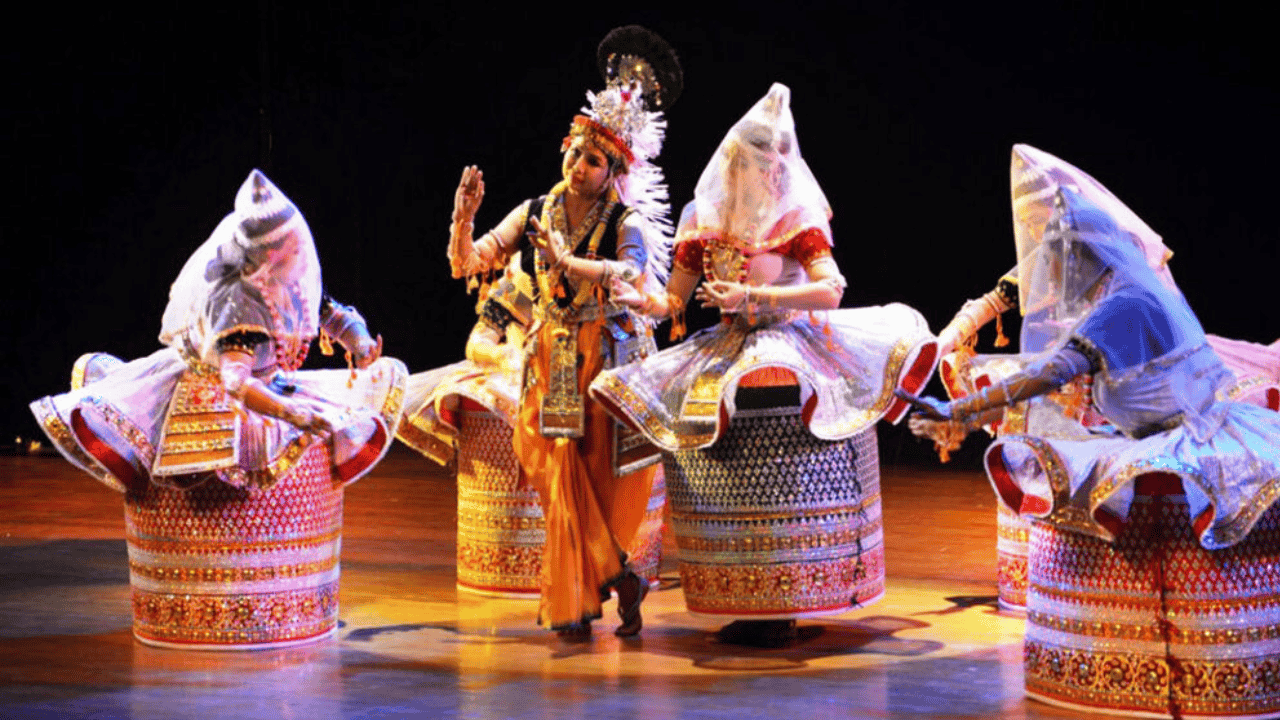
The physical costume worn by female performers—termed the Kumil or Potloi—reinforces this visual philosophy:
[Inaphi: Translucent white gauze veil over high topknot] │ [Resham Choli: Tight-fitting velvet blouse] │ [Pasuan: Short, undulating frilled over-skirt] │ [Kumil / Potloi: Rigid, barrel-shaped cylindrical skirt]
The Kumil (Potloi): A stiff, barrel-shaped cylindrical skirt constructed over an internal frame of bamboo splits and canvas, preventing the fabric from collapsing. The surface is richly adorned with geometric mirrors, gold and silver zari embroidery, and lotus leaf appliques.
Semiotic Mechanism: The rigid cylindrical silhouette reaches nearly to the floor, completely concealing the dancer's lower legs and feet. As the performer glides across the stage using smooth, curved knee flexion, the skirt remains undisturbed, creating the optical illusion that the dancer is floating across the sacred precinct without physical exertion.
Headwear and Upper Garments: The head is crowned with a gathered white transparent veil (Inaphi), draped over a high conical topknot adorned with fresh floral garlands. The upper torso is clad in a dark velvet blouse (Resham Choli), tied at the waist by an undulating, semi-translucent frill known as the Pasuan.
In stark contrast to the structured geometry of the Gopis, the character of Krishna wears an embroidered yellow silk dhoti (Pitambar), accented with an intricate headdress (Mukut) bearing a peacock feather (Mayur Pankh), emphasizing his role as the divine shepherd and cosmic flute player.
Musical Dynamics: Sankirtana, Percussion, and Pung Cholom
Manipuri classical dance is structurally embedded in the regional congregational singing tradition known as Sankirtana. The accompanying music forms a sophisticated acoustic canvas derived from ancient metric frameworks combined with indigenous tonal systems.
Key musical components include:
The Pung (Manipuri Mridanga): A hand-beaten wooden barrel drum that serves as the rhythmic heartbeat of the ensemble. The performer modulates pitch and tonal resonance using specialized fingertip and palm strikes.
Kartal and Manjira: Hand-held metal cymbals employed by musicians and background singers to outline the metric cycle (tala).
The Pena: An ancient single-stringed Meitei bowed instrument crafted from a bamboo neck and a coconut shell resonator, providing haunting, modal microtonal accompaniment.
Vocal Compositions: The devotional verses (padas) are sung in an eclectic linguistic mixture of Brajabuli, Sanskrit, Old Maithili, and Meiteilon, underscoring the broad cultural synthesis of the Bhakti movement.
While the Raas itself embodies the lyrical Lasya idiom, the Manipuri tradition also preserves a powerful, acrobatic Tandava component known as Pung Cholom (drum dance). In this performance, male dancers play the Pung while executing athletic leaps, circular spins, and abrupt ground drops, demonstrating the duality of vigor and grace within the broader Manipuri performing arts spectrum.
Comparative Matrix: Classical Dance Traditions of India
To facilitate comparative analysis for examinations, the structural differences separating Manipuri Raas from other major classical dance styles recognized by the Sangeet Natak Akademi are detailed below:
| Metric | Manipuri Raas Leela | Kathak | Bharatanatyam | Kathakali |
|---|---|---|---|---|
| Geographic Origin | Manipur (North-East India) | Northern India (Uttar Pradesh / Rajasthan) | Tamil Nadu (South India) | Kerala (South-West India) |
| Principal Patronage | 18th-century Meitei Kings (Maharaja Bhagyachandra) | Mughal courts, Nawabs of Awadh, Hindu temples | Chola, Nayaka, and Maratha rulers of Thanjavur | Travancore royalty and Malabar chieftains |
| Primary Kinetic Mode | Pure Lasya; continuous wave-like arcs, absence of sharp lines | Linear geometry, rapid footwork (Tatkar), spins (Chakkars) | Symmetrical geometry, triangular postures (Araimandi) | Intense Tandava; dramatic, muscular, exaggerated kinetics |
| Use of Ghunghroos | Strictly prohibited; steps remain silent and soft | Essential; hundreds of bells used for complex rhythmic display | Mandatory; accentuates metric precision of foot strikes | Mandatory; heavy bells underline aggressive stamping |
| Defining Costume | Stiff cylindrical barrel skirt (Kumil / Potloi) | Long pleated Anarkali dress or Ghagra-Choli with veil | Fan-pleated silk saree worn in dhoti style | Multi-layered flared skirt (Udukku), heavy crown, face paint |
| Percussion Driver | Pung (Manipuri Mridanga) and Kartal | Tabla and Pakhawaj | Mridangam and Nattuvangam cymbals | Chenda, Maddalam, and Chengila |
| 20th-Century Revival | Rabindranath Tagore via Visva-Bharati, Santiniketan | Pandit Birju Maharaj, Madame Menaka, Shambhu Maharaj | Rukmini Devi Arundale (Kalakshetra), E. Krishna Iyer | Vallathol Narayana Menon (Kerala Kalamandalam) |
Modern Revival: Tagore's Santiniketan and Global Inscriptions
Following the British annexation of Manipur in 1891 after the Anglo-Manipur War, royal court patronage waned, placing traditional gurus under severe financial stress. The national revitalization of the dance form gained decisive momentum in 1919, when Nobel Laureate Rabindranath Tagore attended a performance of Manipuri Raas in Sylhet (modern Bangladesh). Profoundly moved by its restraint, lack of vulgarity, and organic musicality, Tagore invited master gurus—such as Guru Buddhimanta Singh and Guru Atomba Singh—to join the faculty of Visva-Bharati University in Santiniketan.
Tagore incorporated Manipuri dance techniques into his modernist dance-drama repertoire (Rabindra Nritya), effectively introducing North-Eastern cultural traditions into mainland Indian intellectual life. Later exponents, such as Guru Bipin Singh and the renowned Jhaveri Sisters (Nayna, Suverna, Ranjana, and Darshana Jhaveri), standardized institutional training, bringing Manipuri Raas to global prominence.
In contemporary cultural governance, the tradition is actively documented and preserved through the Centre for Cultural Resources and Training (CCRT) and the Jawaharlal Nehru Manipur Dance Academy in Imphal. Notably, the ritual framework surrounding this dance—Sankirtana of Manipur—was officially inscribed in 2013 on the UNESCO Representative List of the Intangible Cultural Heritage of Humanity, securing international recognition for its communal, religious, and aesthetic significance. Candidates can explore wider comparative frameworks via the Atharva Examwise Art and Culture Module.
Key Facts for Quick Revision
Aspirants reviewing this Daily GK Update should note the following critical examination facts:
Codifier and Royal Patron: Maharaja Bhagyachandra (Rajarshi Jai Singh), an 18th-century Meitei monarch, organized the modern classical repertoire following an epiphany.
First Formal Performance: Organised in 1779 on Kartik Purnima; Princess Bimbabati (Shija Laiobi) performed as the first Radha and is frequently compared to Meerabai.
Signature Costume: The Kumil (or Potloi), an embroidered, barrel-shaped cylindrical skirt with mirror work, designed to hide lower leg footwork and create an illusion of levitation.
The Ankle-Bell Exception: Manipuri is the only major classical Indian dance where performers do not wear ghunghroos (ankle bells), emphasizing quiet, gentle steps.
Primary Percussion: The Pung (cylindrical two-headed drum); male drummers execute the acrobatic and martial Pung Cholom dance.
Theological Basis: Rooted in Gaudiya Vaishnavism; interprets the Radha-Krishna relationship as the metaphysical communion of Jivatma and Paramatma.
UNESCO Inscription: Sankirtana: Ritual singing, drumming and dancing of Manipur was inscribed on UNESCO's Intangible Cultural Heritage list in 2013.
For continuous coverage of emerging syllabus topics, consult the UPSC Current Affairs section on Atharva Examwise.
Why this matters for your exam preparation
For candidates preparing for the UPSC Civil Services Examination (CSE), State PSCs (e.g., UPPSC, BPSC, MPSC), and allied national competitive assessments, Manipuri Raas Leela represents an important focus area under General Studies Paper 1: Indian Heritage and Culture.
Prelims Analytical Nuances
In the Prelims examination, the Union Public Service Commission consistently constructs questions designed to identify exceptions, regional crossovers, and costume terminology:
The "Ghunghroo" Statement Trap: Standard objective questions often generalize that "all Indian classical dance forms utilize ankle bells to sustain rhythmic syncopation." Candidates aware of the Manipuri exception can immediately eliminate incorrect statements.
Costume Identification: Terminology such as Kumil, Potloi, Inaphi, and Pasuan are specific to Manipuri Raas. Conflating these garments with the attire of Sattriya (Assam) or Kathakali (Kerala) is a common testing trap.
Heritage Designations: Test questions require a clear distinction between the classical dance recognized by the Sangeet Natak Akademi and the cultural tradition inscribed by UNESCO (specifically Sankirtana, inscribed in 2013).
Mains Analytical Frameworks (GS Paper 1)
In the Mains examination, questions in Art and Culture have evolved beyond pure rote recitation toward analytical examinations of cultural synthesis, regional state formation, and modern revival:
Syncretism of Bhakti and Indigenous Lore: Manipuri Raas serves as an empirical case study of how a pan-Indian theological movement (Gaudiya Vaishnavism) assimilated pre-existing tribal/indigenous performance forms (the Meitei Lai Haraoba) to produce an entirely distinct classical tradition.
Royal Patronage as a Catalyst for Cultural Identity: Aspirants can utilize King Bhagyachandra’s institutionalization of the Raas Leela to argue how regional dynasties used cultural patronage to forge internal political cohesion during periods of external geopolitical threat.
Cultural Nationalism in the Pre-Independence Era: The intervention of Rabindranath Tagore at Santiniketan highlights how nationalist intellectuals leveraged peripheral and folk arts to counter colonial narratives of Indian cultural degeneration, creating an inclusive national aesthetic identity.
Mastering these multi-layered connections ensures aspirants can construct well-evidenced, high-scoring answers that connect historical facts with broad cultural patterns.