UPSC Current Affairs: India-Uzbekistan Comprehensive Strategic Partnership, Oliy Darajali Dostlik Honour, and SCO Summit Analysis
The geopolitical architecture of Central Asia is undergoing a strategic realignment as New Delhi consolidates its diplomatic, economic, and security presence in the Eurasian landmass. In the latest edition of Atharva Examwise Current News, this comprehensive report evaluates the multi-dimensional breakthroughs resulting from Prime Minister Narendra Modi’s two-day state visit to Tashkent, followed by high-stakes engagements at the Shanghai Cooperation Organisation (SCO) Summit in Bishkek.
The state visit delivered several landmark outcomes: the formal elevation of bilateral ties to a Comprehensive Strategic Partnership, the signing of 11 multi-sectoral agreements, long-term civilian uranium supply assurances, digital public infrastructure expansion via the Unified Payments Interface (UPI), and the conferral of Uzbekistan’s highest civilian distinction upon the Indian Prime Minister. For aspirants following Atharva Examwise Daily GK Updates and evaluating competitive exam news today, these developments illuminate critical shifts across energy diplomacy, regional connectivity, and multilateral balancing.
High-Level Diplomatic Recognition: Order of Oliy Darajali Dostlik
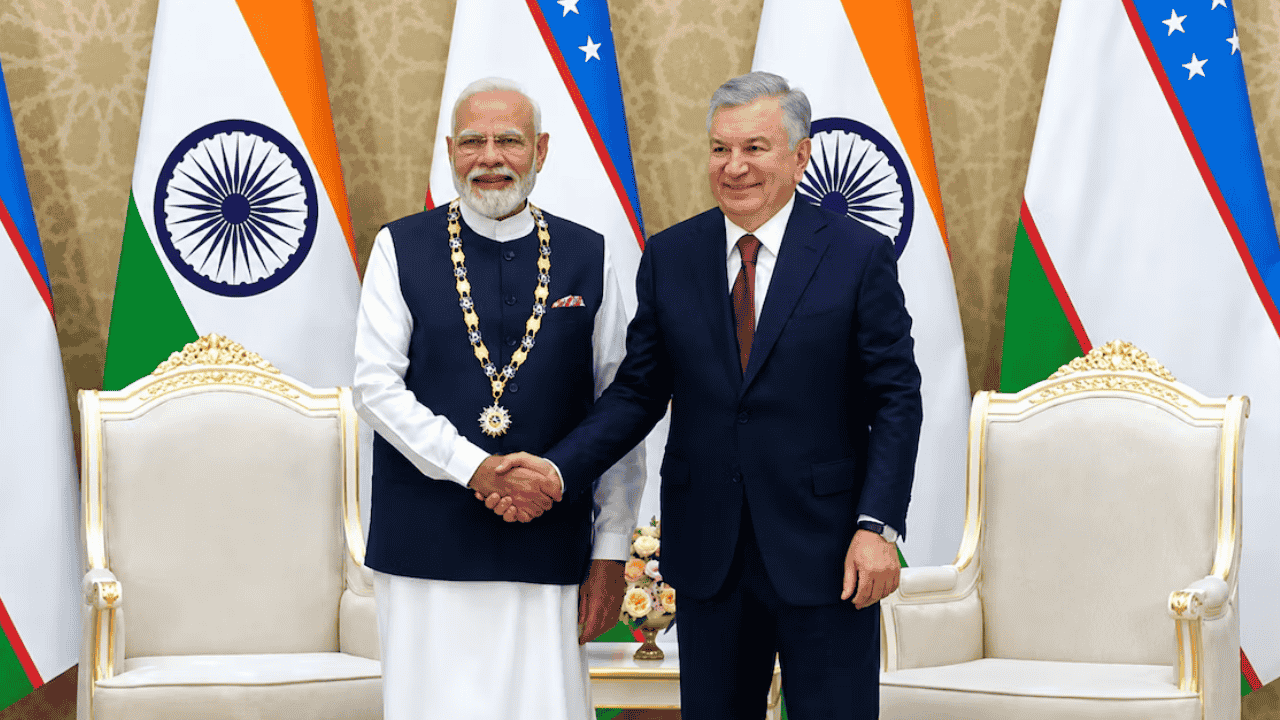
During formal delegation-level talks convened at the Kuksaroy Presidential Palace in Tashkent, President Shavkat Mirziyoyev conferred the Order of Oliy Darajali Do'stlik (Order of the Highest Degree of Friendship) upon Prime Minister Narendra Modi. Instituted as Uzbekistan’s premier state decoration for foreign statesmen, scholars, and diplomats, the order acknowledges transformative contributions to mutual trust, regional peace, and bilateral strategic alignment.
The distinction represents the 36th international civilian honour conferred upon the Indian Prime Minister by foreign sovereign governments and international bodies. In diplomatic engagements, the linguistic and civilizational resonance of Dostlik (friendship) underscores historical affinities shared across Central and South Asia. The decoration was formally dedicated to the enduring cultural heritage connecting the two nations and to the 1.4 billion citizens of India under the diplomatic doctrine of Vishwa Bandhutva (global brotherhood).
| Diplomatic Parameter | Strategic Detail |
|---|---|
| State Honour | Order of Oliy Darajali Do'stlik (Highest Degree of Friendship) |
| Conferring Authority | President Shavkat Mirziyoyev, Republic of Uzbekistan |
| Context & Milestone | 15th Anniversary of Strategic Partnership & 35th Uzbek Independence Day |
| International Award Tally | 36th global civilian honour conferred upon PM Narendra Modi |
| Distinguished Prior Recipients | António Guterres (UN Secretary-General), Kassym-Jomart Tokayev (President of Kazakhstan), Serdar Berdimuhamedov (President of Turkmenistan) |
Strategic Agreements and Economic Cooperation Framework
The bilateral summit yielded 11 intergovernmental agreements spanning clean energy supply chains, capital market integration, cross-border digital payments, tourism deregulation, and multilateral governance.
| Sectoral Domain | Key Bilateral Agreement / Strategic Objective |
|---|---|
| Nuclear Fuel & Energy Security | Long-term sovereign supply pact for civilian-grade uranium imports to power Indian reactors. |
| Bilateral Trade Expansion | Targeted five-fold increase in bilateral trade volume to ₹4.76 lakh crore (~$57 billion) by 2030. |
| Digital Public Infrastructure (DPI) | Interoperable cross-border deployment of Unified Payments Interface (UPI) rail by 2027. |
| Financial Services Integration | Deputation of an Uzbek financial delegation to Gujarat International Finance Tec-City (GIFT City). |
| Mobility & Tourism Deregulation | Bilateral 30-day visa-free entry regime for Indian tourists visiting Uzbekistan. |
| Multilateral Governance | Formal Uzbek reaffirmation of India’s permanent seat bid in a reformed United Nations Security Council (UNSC). |
| Heritage & Cultural Diplomacy | Indian technical assistance for Buddhist site conservation, Hindi scholarships, and a state Yoga event. |
| Diplomatic Memorialization | State tribute and floral offering at the former Prime Minister Lal Bahadur Shastri memorial in Tashkent. |
Geopolitical Implications for India-Central Asia Connectivity
The elevation of ties to a Comprehensive Strategic Partnership addresses vital strategic priorities within India's broader "Connect Central Asia" policy framework.
Nuclear Fuel Diversification and Clean Energy Security
Securing uranium contracts from Uzbekistan expands India's civilian nuclear fuel reserves beyond traditional partners such as Kazakhstan and Canada. Base-load nuclear power generation constitutes a cornerstone of India's long-term energy transition strategy. Access to reliable Central Asian uranium reserves insulates domestic reactors from global market volatility, providing critical feedstock for both pressurized heavy water reactors (PHWRs) and imported light water reactors (LWRs) placed under International Atomic Energy Agency (IAEA) safeguards.
Digital Public Infrastructure and Offshore Financial Linkages
The agreement to operationalize UPI payment systems across Uzbekistan by 2027 highlights the internationalization of India's indigenous fintech infrastructure. This payment integration reduces retail remittance friction, enables seamless merchant transactions for Indian travelers, and establishes a secure settlement channel bypass for local currencies. Furthermore, channeling bilateral trade financing and venture investment through Gujarat International Finance Tec-City (GIFT City) establishes a resilient institutional framework for cross-border investments in agriculture, pharmaceuticals, and textile value chains.
Soft Power Projection and Civilizational Diplomacy
India’s diplomatic outreach is reinforced by civilizational linkages spanning the ancient Silk Road. Providing technical expertise for the restoration of Buddhist cultural monuments and sponsoring academic Hindi language fellowships cultivates durable institutional and cultural goodwill. Complementing these measures, the 30-day visa-free regime significantly reduces structural barriers for business delegations, researchers, and leisure travel, strengthening people-to-people ties.
Multilateral Balance: The 26th SCO Summit in Bishkek
Following the conclusion of engagements in Tashkent, diplomatic proceedings advanced to the 26th Shanghai Cooperation Organisation (SCO) Summit held in Bishkek, Kyrgyzstan.
The multilateral summit convened leadership delegations from across the 10-member grouping, featuring scheduled bilateral dialogues between Prime Minister Modi, Chinese President Xi Jinping, and Russian President Vladimir Putin. Originally founded in Shanghai in 2001 by China, Russia, Kazakhstan, Kyrgyzstan, Tajikistan, and Uzbekistan, the Eurasian grouping expanded in 2017 with the full accession of India and Pakistan.
The SCO serves as a critical multilateral forum through which New Delhi balances Eurasian power dynamics, monitors regional security architectures via the Regional Anti-Terrorist Structure (RATS), and promotes multimodal transport corridors like the International North-South Transport Corridor (INSTC) to circumvent continental transit bottlenecks.
Why this matters for your exam preparation
A comprehensive understanding of India-Uzbekistan relations and Eurasian multilateral diplomacy is vital for aspirants preparing for the UPSC Civil Services Examination and State PSCs.
Syllabus Alignment for UPSC CSE
General Studies Paper II (International Relations):
Bilateral, Regional, and Global Groupings and Agreements: Evolution of India-Central Asia partnerships and institutional maneuvering within the 10-nation Shanghai Cooperation Organisation.
Effect of Policies of Developed and Developing Countries: South-South cooperation frameworks, uranium supply diversification, and shared advocacy for United Nations Security Council restructuring.
Indian Diaspora and Soft Power Instruments: Cultural diplomacy via Buddhist conservation, educational exchange programmes, and visa deregulation mechanisms.
General Studies Paper III (Economy, Infrastructure, & Energy):
Energy Security & Nuclear Infrastructure: Raw uranium procurement agreements to support India’s decarbonization and net-zero commitments.
Financial Infrastructure & Internationalization of DPI: Cross-border adoption of the UPI architectural framework and offshore capital mobilization via GIFT City.
Key Facts for Prelims and Competitive Exams
Award Title: Order of Oliy Darajali Do'stlik (Uzbekistan's highest state honour for foreign nationals; 36th international award received by PM Modi).
SCO Chronology: Established in 2001; India and Pakistan inducted as permanent members in 2017; current strength stands at 10 member states.
Bilateral Targets: Scaling trade to ₹4.76 lakh crore by 2030; full cross-border UPI integration targeted for 2027.
Geographical Identifiers: Tashkent (Uzbekistan), Bishkek (Kyrgyzstan), Yangi Park (Lal Bahadur Shastri memorial site).
For structured study notes, current affairs modules, and analytical practice questions, candidates can review the Atharva Examwise UPSC Current Affairs repository and consult the Atharva Examwise International Relations specialized portal.