UPSC Current Affairs: Prof. Annapurni Subramaniam Conferred COSPAR Vikram Sarabhai Medal 2026 | Atharva Examwise Daily GK Update
Landmark Milestone in Global Space Astronomy
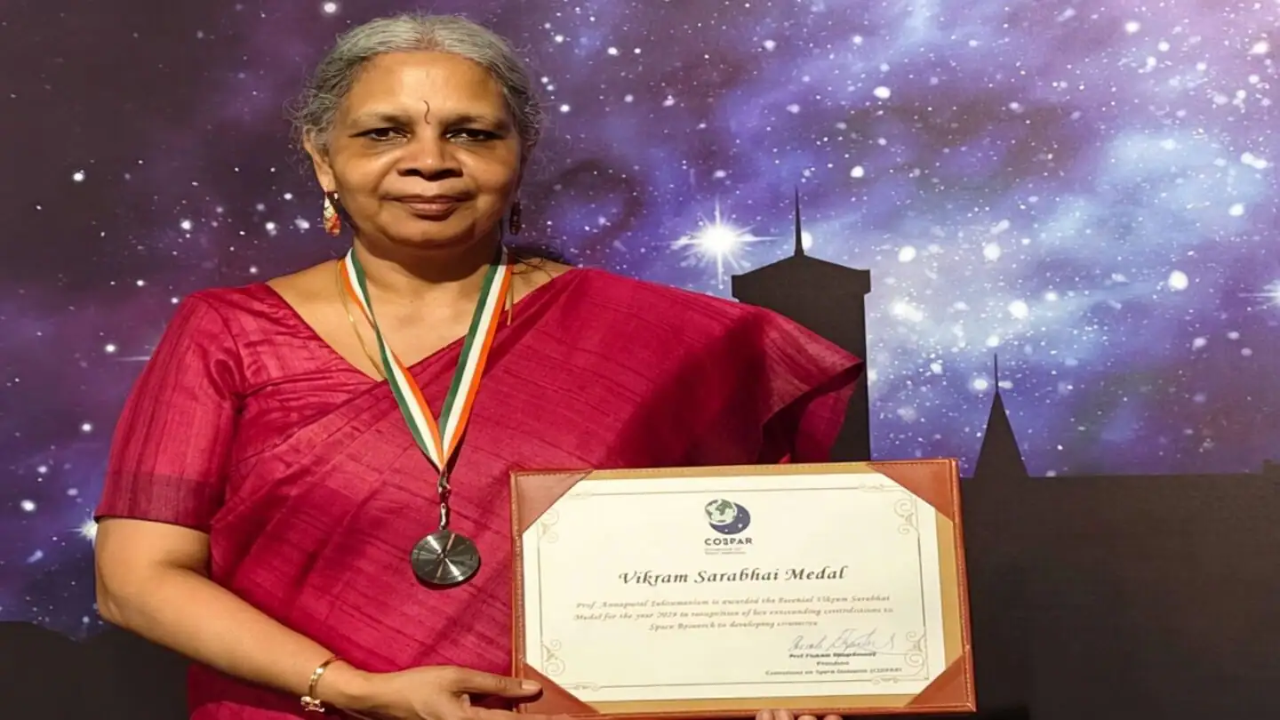
In a major milestone for Indian astrophysics and the representation of women in scientific leadership, Professor Annapurni Subramaniam, Director of the Indian Institute of Astrophysics (IIA), Bengaluru, has been awarded the prestigious Committee on Space Research (COSPAR) Vikram Sarabhai Medal for 2026. Conferred jointly by the Committee on Space Research (COSPAR) and the Indian Space Research Organisation (ISRO), the medal represents one of the premier international honors recognizing exceptional scientific research carried out in or directly benefiting developing nations.
The official conferment took place during the 46th COSPAR Scientific Assembly convened in Florence, Italy. Professor Subramaniam’s recognition establishes several historic benchmarks for the Indian scientific ecosystem:
She is the first Indian woman scientist to be awarded the COSPAR Vikram Sarabhai Medal.
She is the fourth Indian scientist overall to receive the medal since its inception in 1990.
She represents only the third female researcher globally to be recognized with this honor.
This distinction highlights India’s transition from an engineering-focused space program to an international leader in observational astrophysics, multi-wavelength instrumentation, and ultraviolet space astronomy. Aspirants reviewing daily developments via the Atharva Examwise UPSC Current Affairs Portal must evaluate the institutional mechanisms, observational technologies, and strategic significance of this award for national and international science governance.
Institutional Framework: The COSPAR Vikram Sarabhai Medal
The COSPAR Vikram Sarabhai Medal was established in 1990 through a joint agreement between COSPAR and ISRO to honor the memory of Dr. Vikram Sarabhai, widely recognized as the founding father of the Indian space programme. Sarabhai championed the philosophy that developing nations must apply advanced technologies directly to real-world socio-economic development and indigenous capacity-building rather than merely copying advanced economies.
Institutional Structure of COSPAR
COSPAR was established in 1958 by the International Council of Scientific Unions—now the International Science Council (ISC)—during the dawn of satellite-based research. Operating in direct collaboration with the United Nations Committee on the Peaceful Uses of Outer Space (UN-COPUOS), COSPAR serves as an open global forum dedicated to advancing scientific research with space vehicles, rockets, and high-altitude balloons without political or ideological boundaries.
Award Criteria and Eligibility Mandates
The medal is conferred biennially during the COSPAR Scientific Assembly. Award eligibility mandates that the candidate's primary scientific contributions must have been carried out predominantly during the five-year period ending one year prior to the assembly at which the award is presented. Although open to candidates worldwide, the charter explicitly prioritizes high-impact contributions to space research conducted in developing countries.
| Year | Recipient | Domain of Specialization | Key Institutional Affiliation |
|---|---|---|---|
| 1996 | Prof. U. R. Rao | Satellite Technology, Space Applications, Cosmic Rays | ISRO / Department of Space |
| 2014 | Prof. Gurbax Singh Lakhina | Space Plasma Physics, Geomagnetism, Space Weather | Indian Institute of Geomagnetism (IIG) |
| 2024 | Prof. Anil Bhardwaj | Planetary Sciences, Lunar-Martian Atmospheres | Physical Research Laboratory (PRL) |
| 2026 | Prof. Annapurni Subramaniam | Stellar Physics, UV Space Instrumentation, AstroSat | Indian Institute of Astrophysics (IIA) |
This sequence reflects the chronological maturation of Indian space science: initiating with satellite bus development and platform engineering (Prof. U. R. Rao), expanding toward near-Earth space plasma and planetary atmospheric science (Prof. G. S. Lakhina and Prof. Anil Bhardwaj), and advancing into deep-space astronomical instrumentation and stellar evolutionary modeling (Prof. Annapurni Subramaniam).
Academic Profile and Scientific Contributions of Dr. Annapurni Subramaniam
Professor Annapurni Subramaniam is an astrophysicist specializing in stellar systems, galactic evolution, and space-borne astronomical instrumentation. In 2019, she was appointed the first female Director of the Indian Institute of Astrophysics (IIA), an autonomous research institute operating under the Department of Science and Technology (DST), Government of India. Additionally, she has served as the additional Director of the Centre for Nano and Soft Matter Sciences (CeNS), Bengaluru.
Her primary research focuses on the formation and evolutionary dynamics of star clusters, classical and magnetic Be stars, the structural mechanics of the Milky Way, and stellar populations across the Magellanic Clouds. Over a career spanning more than three decades, Professor Subramaniam has authored approximately 175 scientific research papers in leading global journals and supervised the doctoral dissertations of 15 PhD scholars.
In recognition of her extensive scientific leadership and contributions to space missions, she was awarded the Rashtriya Vigyan Puraskar – Vigyan Shri (2024) in the category of Space Science and Technology by the Government of India. The citation specifically recognized her observational astrophysics research and leadership in developing space-based instrumentation for India's space observatories. For comprehensive analyses of national scientific honors, review the Atharva Examwise Science and Technology Dossier.
Space Astronomy: UVIT on AstroSat and Next-Generation Telescopes
A central component of Professor Subramaniam’s award citation is her instrumental role in space-based ultraviolet astronomy.
Earth's atmosphere absorbs almost the entire ultraviolet spectrum—specifically below $300\text{ nm}$—due to the stratospheric ozone layer and atmospheric molecular absorption. While vital for terrestrial life, this atmospheric shielding prevents ground-based observatories from studying hot, energetic celestial processes that emit predominantly in ultraviolet wavelengths. Consequently, ultraviolet astronomy requires space-borne observatories positioned outside Earth's atmosphere.
1. AstroSat and the Ultraviolet Imaging Telescope (UVIT)
Launched on September 28, 2015, aboard the PSLV-C30, AstroSat is India’s first dedicated multi-wavelength space observatory. Operating from a low Earth orbit at an altitude of approximately $650\text{ km}$, AstroSat carries five payloads that observe the cosmos simultaneously across optical, near-UV, far-UV, and broadband X-ray spectra.
The Ultraviolet Imaging Telescope (UVIT) serves as the primary optical-UV payload aboard AstroSat. Designed, assembled, and calibrated by the IIA at its CREST campus in Hosakote, UVIT was developed in collaboration with the Inter-University Centre for Astronomy and Astrophysics (IUCAA), Tata Institute of Fundamental Research (TIFR), multiple ISRO centers (URSC, LEOS, IISU, SAC), and the Canadian Space Agency (CSA).
Twin-Telescope Optical System: UVIT employs two co-aligned 375 mm telescopes. One telescope observes the Far-Ultraviolet (FUV: $130\text{--}180\text{ nm}$) band, while the second uses a dichroic beam splitter to record the Near-Ultraviolet (NUV: $200\text{--}300\text{ nm}$) and Visible (VIS: $320\text{--}550\text{ nm}$) channels simultaneously.
High Spatial Resolution: UVIT delivers a spatial resolution better than $1.5\text{ arcseconds}$ across a wide $28\text{ arcminute}$ field of view, providing clearer spatial detail than NASA's predecessor satellite GALEX.
Calibration Leadership: As the Calibration Scientist for UVIT, Professor Subramaniam led the pre-launch laboratory characterization, contamination control in specialized cleanrooms, and in-orbit calibration phases to verify that scientific data downlinked from the telescope met exact astronomical standards.
Major Discoveries: Operating for over a decade, UVIT has recorded observations across 1,451 celestial targets, yielding approximately 300 peer-reviewed articles and 19 doctoral dissertations. Key discoveries include tracing Lyman continuum radiation from galaxies at redshift $z = 1.42$, identifying hot binary companions of Be stars, and mapping blue straggler formation paths in globular clusters.
2. The INSIST Mission: India's Next-Generation Space Observatory
Building on the success of UVIT, Professor Subramaniam serves as the Principal Investigator (PI) of the Indian Spectroscopic and Imaging Space Telescope (INSIST).
As global observatories shift heavily toward infrared astronomy—exemplified by the James Webb Space Telescope—the global astronomical community faces a projected shortfall in high-resolution space-based UV imaging facilities during the late 2020s and 2030s. INSIST is designed to bridge this observational gap:
Optical Architecture: A 1.0-meter class aperture space telescope operating simultaneously across UV and optical wavelengths.
Spatial Performance: Engineered to achieve spatial resolutions of $\sim 0.2\text{ arcseconds}$, approaching the imaging quality of the Hubble Space Telescope.
Spectroscopic Capability: Incorporates a Multi-Object Spectrograph (MOS) using Digital Micromirror Devices (DMD) to collect spectra from multiple astronomical targets across a $30 \times 30\text{ arcminute}$ field of view ($R \sim 1000\text{--}2000$).
Mission Integration: Designed to be launched aboard ISRO’s standard launch vehicles to provide broad-field UV surveys of star-forming regions, low-mass dwarf galaxies, and distant Active Galactic Nuclei (AGN).
3. Participation in the Thirty Meter Telescope (TMT) Consortium
India is a key partner in the international Thirty Meter Telescope (TMT) consortium, planned for construction on Mauna Kea, Hawaii. Coordinated by the IIA alongside IUCAA and the Aryabhatta Research Institute of Observational Sciences (ARIES), Indian scientists and industry partners are contributing segment support assemblies, precision actuator mechanisms, edge sensors, and core telescope control software. Professor Subramaniam has served as a core contributor to India's scientific participation in this project.
| Astronomical Mission | Primary Spectral Band | Operating Environment | Core Scientific Function | Institutional Leadership |
|---|---|---|---|---|
AstroSat (UVIT) [cite: 1, 4, 10] | UV ($130\text{--}300\text{ nm}$), Optical, X-ray | Space (Low Earth Orbit, $650\text{ km}$) | Simultaneous multi-wavelength cosmic surveys | ISRO / IIA (Payload lead) |
INSIST [cite: 11, 12] | High-Resolution UV & Optical | Space (Proposed LEO) | Deep UV wide-field imaging and multi-object spectroscopy | IIA-led National Consortium / ISRO |
Thirty Meter Telescope [cite: 1, 5] | Optical to Mid-Infrared ($0.31\text{--}28\text{ }\mu\text{m}$) | Ground-based (Mauna Kea, Hawaii) | Early star formation, deep galactic evolution, exoplanets | International Consortium (India, USA, Japan, Canada, China) |
Aditya-L1 [cite: 5] | Visible, UV, X-ray, Particle sensors | Space (Halo Orbit at Sun-Earth L1) | Solar coronal dynamics, CME tracking, space weather | ISRO / IIA (VELC payload lead) |
To review more details on national space hardware and observatories, explore the Atharva Examwise Deep Space Analysis.
Strategic and Systemic Implications for Indian Science
The conferment of the 2026 COSPAR Vikram Sarabhai Medal to Professor Subramaniam carries broader strategic implications for India's scientific research ecosystem:
First, it reflects a shift in India’s space program from purely utilitarian platforms to cutting-edge fundamental science. While early decades were dedicated to establishing domestic telecommunications, agricultural mapping, and meteorological monitoring through INSAT and IRS satellites, missions like AstroSat, Aditya-L1, and Chandrayaan demonstrate India's growing capacity in primary scientific discovery and deep-space physics.
Second, the success of the UVIT payload provides a repeatable operational model for inter-institutional collaboration. The project unified autonomous academic bodies (IIA, IUCAA, TIFR) and ISRO centers to develop high-vacuum testing infrastructure, specialized optical coatings, and space-grade instrumentation locally.
Third, this recognition reinforces institutional pathways for women in STEM leadership. As the first female Director of the IIA and the first Indian woman to win the Sarabhai Medal, Professor Subramaniam’s trajectory provides a concrete model for increasing female representation across academic leadership and major national mission directors.
Finally, India's active presence in COSPAR, the International Science Council, and UN-COPUOS expands the nation’s science diplomacy. By developing competitive space science instruments and maintaining open-access archives such as ISRO’s PRADAN portal, India positions itself as an accessible, high-value collaborator for international research teams and developing countries alike.
Why this matters for your exam preparation
For candidates preparing for the UPSC Civil Services Examination (CSE) and State Public Service Commissions, this topic connects directly across multiple segments of the syllabus:
Syllabus Mapping and Exam Dimensions
UPSC Preliminary Examination (General Studies Paper I):
Current Events of National and International Importance: Details of the COSPAR Vikram Sarabhai Medal, host assemblies, and past Indian recipients (U. R. Rao, Gurbax Singh Lakhina, Anil Bhardwaj, Annapurni Subramaniam).
General Science: Principles of the electromagnetic spectrum, reasons why ultraviolet observations require space-based platforms due to atmospheric absorption, and operational specifications of AstroSat and the proposed INSIST mission.
UPSC Mains General Studies Paper III (Science & Technology):
Achievements of Indians in Science & Technology: Contributions of Indian astrophysicists and ISRO/IIA scientists in establishing world-class observational facilities.
Indigenization of Technology: Designing and manufacturing space instruments, cleanroom laboratories, detector systems, and high-precision mirrors within India.
Awareness in Space: The technological transition from application satellites to multi-wavelength space observatories like AstroSat and future deep-space projects.
UPSC Mains General Studies Paper I (Social Issues):
Role of Women and Women's Organizations: Overcoming structural barriers to female advancement in STEM, highlighting women in senior scientific leadership roles.
UPSC Mains General Studies Paper II (International Relations & Governance):
International Institutions: Governance mandates of COSPAR, its institutional relationship with the International Science Council (ISC), and multilateral scientific cooperation under UN-COPUOS.
Preliminary Practice Question (UPSC Pattern)
Q. Consider the following statements regarding the Ultraviolet Imaging Telescope (UVIT) and space astronomy:
UVIT is a multi-channel payload aboard AstroSat capable of observing simultaneously in the Far-Ultraviolet, Near-Ultraviolet, and Visible spectra.
Ultraviolet astronomy can be carried out with identical angular resolution from ground-based telescopes because Earth's atmosphere is completely transparent to ultraviolet radiation.
The COSPAR Vikram Sarabhai Medal is conferred jointly by the International Astronomical Union (IAU) and NASA to honor astronauts exclusively from developed countries.
Which of the statements given above is/are correct?
(A) 1 only
(B) 1 and 2 only
(C) 2 and 3 only
(D) 1, 2, and 3
Correct Answer: (A) 1 only
Explanation: Statement 1 is correct (UVIT operates in FUV, NUV, and VIS channels). Statement 2 is incorrect because Earth's atmosphere absorbs most UV wavelengths, requiring space observatories. Statement 3 is incorrect because the medal is awarded jointly by COSPAR and ISRO to scientists who have made major contributions to space research in developing nations.
Mains Practice Question (GS Paper III)
Q. "India's space endeavors are transitioning from application-driven engineering missions to high-impact fundamental science and space astronomy." Critically analyze this transition in the context of missions such as AstroSat and proposed projects like INSIST. Examine how collaborative partnerships between ISRO and autonomous academic institutions contribute to indigenous technological capabilities.