
UPSC Current Affairs: Indigenous Vahak-6 Multi-UAV Mothership and Swarm Warfare | Atharva Examwise Daily GK Update
UPSC Current Affairs: Indigenous Vahak-6 Multi-UAV Mothership and Swarm Warfare | Atharva Examwise Daily GK Update
Meta Description: Explore the indigenous Vahak-6 Multi-UAV Mothership system by EndureAir and BEL for UPSC current affairs. Discover swarm warfare, specs, and GS-3 impact.
Contemporary military operations across global theaters demonstrate an accelerated transition toward distributed, autonomous, and asymmetric aerial combat. Modern battlefields present severely contested electromagnetic conditions, where integrated air defense systems and aggressive electronic countermeasures frequently sever satellite navigation signals and communications links. In response to these operational imperatives, Indian defense innovation has marked a notable milestone with the introduction of the indigenous Vahak-6 multi-unmanned aerial vehicle (UAV) mothership system.
Developed through a collaborative partnership between deep-tech aerospace enterprise EndureAir Systems (incubated at the Indian Institute of Technology Kanpur) and defense public sector undertaking Bharat Electronics Limited (BEL), the Vahak-6 highlights the technological maturity being achieved under the Make in India and Atmanirbhar Bharat frameworks. For aspirants monitoring competitive exam news today and core UPSC current affairs, this platform represents a significant development in unmanned aerial doctrine, swarm robotics, and border security.
Technical Architecture of the Vahak-6 Mothership
The Vahak-6 architecture utilizes an airborne carrier concept designed to transport, air-launch, network, and orchestrate multiple miniaturized sub-drones directly over hostile terrain. By consolidating launch mechanisms, sensor fusion nodes, and command links onto an airborne platform, the system mitigates the range and payload constraints traditionally associated with standalone micro-drones.
The Sabal-20 Aerial Platform
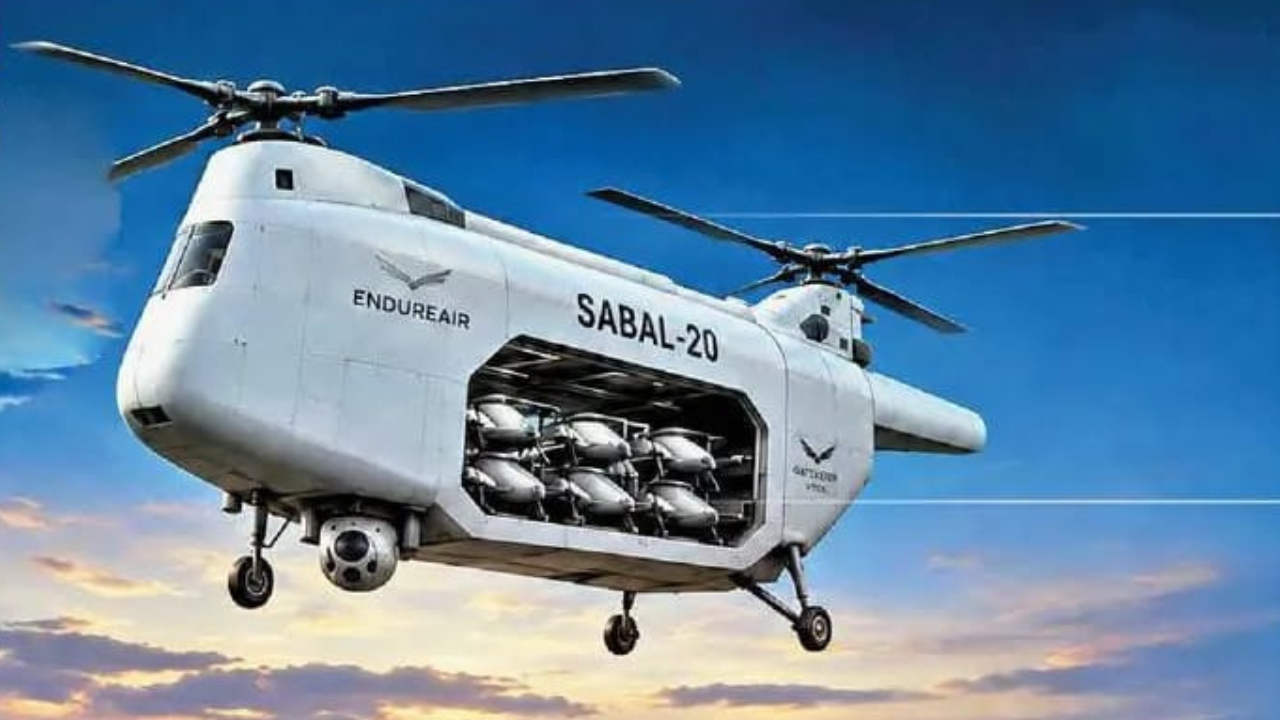
The mothership core of the Vahak-6 is mounted on the Sabal-20, an electric unmanned helicopter engineered specifically for high-altitude tactical lift and rugged deployment. Moving away from conventional multi-rotor architectures that suffer severe aerodynamic performance decay in thin mountain air, the Sabal-20 utilizes a tandem-rotor configuration integrated with variable-pitch rotor blades.
Aerodynamically inspired by heavy-lift tandem helicopters such as the CH-47 Chinook, the counter-rotating dual-rotor system cancels counter-torque mechanically without requiring a dedicated tail rotor. This channels aggregate motor output directly into vertical lift and stability, minimizing turbulence vulnerability during operations along high-altitude mountain ridgelines. Furthermore, the variable-pitch mechanism enables immediate mechanical thrust modulation without relying on motor acceleration or deceleration, providing rapid flight-attitude adjustments, strong autorotation descent safety, and high energy efficiency.
| Operational Parameter | Technical Specification | Tactical Significance |
|---|---|---|
| Host Aerial Platform | Sabal-20 Electric Tandem-Rotor Unmanned Helicopter | Maximizes lift-to-weight ratio within a compact tactical footprint |
| Payload Capacity | Up to 20 kg (~50% of platform dry weight) | Carries 6 micro-UAVs alongside optical and communication payloads |
| Operational Ceiling | Exceeds 4,000 to 5,000 meters above mean sea level (AMSL) | Tailored for Himalayan frontiers (LAC and LoC deployments) |
| Sub-UAV Capacity | 6 $\times$ Alakh Micro-UAVs (Vahak-6 configuration) | Enables distributed tactical swarm saturation and reconnaissance |
| Propulsion System | High-density electric tandem-drive powertrain | Provides low acoustic noise and suppressed thermal infrared signatures |
| Flight Dynamics | Vertical Take-Off and Landing (VTOL) with variable pitch | Eliminates the need for runways; deploys from unprepared forward bases |
| Navigation Architecture | Dual-redundant GNSS with GPS-denied autonomous drift correction | Sustains combat missions within intense electronic countermeasure zones |
| Safety Redundancies | Automated Return-to-Base (RTB) & Emergency Ballistic Parachute | Protects sensitive avionics and payloads in case of critical hardware loss |
| Industrial Developers | EndureAir Systems in partnership with Bharat Electronics Limited (BEL) | Exemplifies indigenous deep-tech and DPSU manufacturing synergy |
Parasite Drone Architecture: The Alakh Micro-UAV Swarm
The operational striking power of the Vahak-6 system is realized through its payload: the Alakh series of indigenous micro-UAVs. Originally engineered as compact, backpackable reconnaissance units for special operations and disaster management, the Alakh platform has been adapted into an airborne-deployable swarm component.
Variant Specialization and Mission Profiles
The mothership carries two primary tactical variants of the micro-drone to execute complementary roles in the engagement area:
Alakh-S (Surveillance and Target Acquisition): Fitted with high-resolution daylight electro-optical and thermal infrared (EO/IR) imaging systems. The Alakh-S is tasked with broad-area scanning, localized forward reconnaissance, electronic mapping, and real-time target identification, feeding optical tracking data back into the mothership's central processor.
Alakh-K (Kinetic Strike / Kamikaze): Configured with an integrated high-explosive micro-warhead and terminal guidance sensors. Once a hostile asset is confirmed and prioritized, the Alakh-K acts as a precision-guided loitering munition, executing high-speed kinetic strikes against radar installations, communication nodes, light armored vehicles, or enemy personnel.
The Autonomous "Search-Detect-Destroy" Loop
The coordination between the Sabal-20 host and the Alakh parasite swarm operationalizes an automated sensor-to-shooter kill chain. Upon reaching the operational sector, the mothership releases up to six Alakh drones simultaneously. The sub-drones form an interconnected, self-organizing tactical mesh network, dividing the search area into distinct autonomous surveillance sectors.
As the Alakh-S units detect and classify hostile targets via onboard computer vision algorithms, positional telemetry is shared across the swarm and relayed to the Sabal-20 command node. The mothership assigns target vectors to the loitering Alakh-K kinetic units, which perform simultaneous multi-axis terminal strikes. This saturation tactic overwhelms point-defense weapon systems while keeping the high-value mothership at a safe standoff distance.
Electronic Warfare Countermeasures and Navigation Autonomy
A significant vulnerability of standard commercial and legacy military drones is their reliance on continuous Global Positioning System (GPS) signals and unencrypted command links. In modern warfare, adversary electronic jamming can disrupt satellite links, inducing navigational drift or mission failure.
The Vahak-6 system addresses this operational challenge through an integrated anti-jamming navigation architecture:
Inertial and Optical Flow Navigation: When GPS access is compromised, the platform relies on Visual Inertial Odometry (VIO), onboard dead reckoning, and optical surface tracking to calculate flight parameters and maintain positional accuracy.
Encrypted Intra-Swarm Data Mesh: The communications architecture between the Sabal-20 and the Alakh drones utilizes encrypted, frequency-hopping radio waveforms featuring low probability of intercept and low probability of detection (LPI/LPD). Even if long-range terrestrial signals to the base station are jammed, the mothership maintains localized command and control over the swarm.
Manned Aircraft Risk Reduction: By deploying autonomous swarm systems into high-threat radar and air-defense envelopes, the armed forces can conduct deep suppression of enemy air defenses (SEAD) without risking manned fighter platforms or helicopter crews.
Dual-Use Capabilities and Strategic Deployments
While engineered primarily for frontline electronic and kinetic engagements, the structural capabilities of the Vahak-6 system lend themselves to multi-domain logistics and civil protection operations.
High-Altitude Border Logistics
The Sabal-20 platform was designed to address logistics challenges across high-altitude forward posts in the Himalayas. Operating at altitudes above 4,000 meters, it can deliver vital supplies, specialized munitions, and emergency communication nodes to remote defensive positions, minimizing reliance on vulnerable ground convoys or large manned transport helicopters.
Humanitarian Assistance and Disaster Relief (HADR)
During natural disasters such as cloudbursts, landslides, and avalanches—scenarios where the Alakh series has previously supported National Disaster Response Force (NDRF) missions—the Vahak-6 system can deploy to survey inaccessible disaster zones. The mothership can release Alakh micro-drones into narrow valleys or collapsed infrastructure to locate survivors while using its 20 kg payload capacity to air-drop critical medical kits, rations, and satellite transceivers.
Global Comparative Analysis of Airborne Drone Motherships
Armed forces globally are prioritizing carrier-drone combinations to enhance operational radius and survivability. The table below contextualizes the Vahak-6 alongside comparable international platforms.
| Parameter | India: Vahak-6 / Sabal-20 | Turkey: TAI ANKA-3 Carrier | Russia: Bars-Sarmat System |
|---|---|---|---|
| Base Vehicle Category | Electric Tandem-Rotor Unmanned Helicopter | Flying-Wing Stealth Turbofan UCAV | Tactical Fixed-Wing Multirole UAV |
| Parasite Sub-Drones | Up to 6 $\times$ Alakh Micro-UAVs (ISR / Strike) | 2 $\times$ Süper Şimşek High-Speed Jet Drones | Multiple First-Person View (FPV) / Interceptors |
| Primary Mission Role | High-altitude tactical ISR, logistics, swarm strikes | Deep operational strike, decoy, radar suppression | Low-cost battlefield strike and counter-drone defense |
| Infrastructure Demands | Runway-independent (VTOL from forward terrain) | Standard paved military airbases required | Forward tactical airstrips or pneumatic launch rails |
| Navigation Resilience | GPS-denied VIO, optical tracking, mesh network | Satellite-linked INS with EW jamming payload | Direct radio-command link with optical guidance |
Why this matters for your exam preparation
For candidates preparing for the UPSC Civil Services Examination and state public service exams, developments in defense technology intersect directly with the General Studies (GS) Paper III syllabus, particularly in the areas of Science & Technology, Indigenization, and Internal Security.
Core Takeaways for UPSC Prelims
System Nomenclature: Vahak-6 is an indigenous multi-UAV mothership developed by EndureAir Systems in collaboration with Bharat Electronics Limited (BEL).
Mothership Platform: Utilizes the Sabal-20 electric tandem-rotor helicopter featuring variable-pitch control, capable of vertical take-off and landing (VTOL).
Sub-UAV Integration: Deploys up to six Alakh micro-drones in dedicated surveillance (Alakh-S) and kinetic loitering munition (Alakh-K) configurations.
Operating Profile: Service ceiling exceeding 4,000–5,000 meters AMSL, a 20 kg payload capacity, and autonomous functionality in GPS-denied environments.
Relevance for UPSC Mains (General Studies Paper III)
Science and Technology — Indigenization of Technology: The transition of academic research from IIT Kanpur into commercially viable, field-tested military hardware developed with a DPSU showcases an evolving defense innovation ecosystem.
Internal Security and Border Infrastructure: The deployment of high-altitude VTOL platforms addresses supply chain and surveillance challenges along contested northern borders (LAC and LoC).
Evolution of Modern Warfare: The system reflects the doctrinal shift toward asymmetric swarm tactics, loitering munitions, and electronic-warfare-resilient autonomous kill chains.
Model Practice Questions
UPSC Prelims Practice Question
Q. With reference to the recently developed 'Vahak-6' system, consider the following statements:
It is an indigenous multi-UAV mothership platform developed jointly by EndureAir Systems and Bharat Electronics Limited (BEL).
The carrier platform relies on a jet-propelled fixed-wing configuration requiring extensive paved runways for operation.
It can deploy micro-drones capable of conducting coordinated surveillance and kinetic strikes in GPS-denied environments.
Which of the statements given above are correct?
(a) 1 and 2 only
(b) 2 and 3 only
(c) 1 and 3 only
(d) 1, 2, and 3
Answer: (c) 1 and 3 only
Explanation: Statement 2 is incorrect because the Vahak-6 uses the Sabal-20, an electric tandem-rotor unmanned helicopter with VTOL capabilities, removing the requirement for standard runways. Statements 1 and 3 accurately describe the platform's joint development and its GPS-denied swarm operational capabilities.
UPSC Mains Practice Question
Q. "The deployment of autonomous drone swarms and airborne mothership systems is redefining modern tactical warfare." In light of recent domestic advancements such as the Vahak-6 platform, evaluate the operational advantages and technological challenges associated with deploying unmanned swarm architectures along India's high-altitude frontiers. (15 Marks, 250 Words)
For structured study materials, editorial analyses, and continuous coverage, follow the Atharva Examwise Current Affairs Portal.