
UPSC Current Affairs: Complete Analysis of Elephant Corridors and Reserves in India | Atharva Examwise Current News
Macro-Ecological Context: Asian Elephants as Keystone and Umbrella Species
The Asian elephant (Elephas maximus) occupies a foundational position within tropical and subtropical forest ecosystems across South and Southeast Asia. Functioning as a quintessential keystone species and ecosystem engineer, the Asian elephant alters vegetative architecture, creates physical clearings that facilitate forest succession, disperses large-seeded flora across extensive distances, and maintains hydrological depressions that support sympatric wildlife during seasonal droughts. Because an individual herd maintains extensive home ranges extending across hundreds of square kilometers, the elephant serves as an umbrella species; securing its expansive, contiguous habitat indirectly ensures the protection of broad ecological assemblages, including apex predators such as the Bengal tiger (Panthera tigris).
Historically distributed continuously from the Tigris-Euphrates basin in the west to the Yangtze River in the east, the Asian elephant has suffered a drastic spatial range contraction, currently occupying only 5% to 7% of its historical range. India remains the paramount demographic stronghold for the species, harboring more than 60% of the global wild population (~29,964 individuals recorded in the synchronized national enumeration across Northwest, Northeast, East-Central, and Southern regional landscapes).
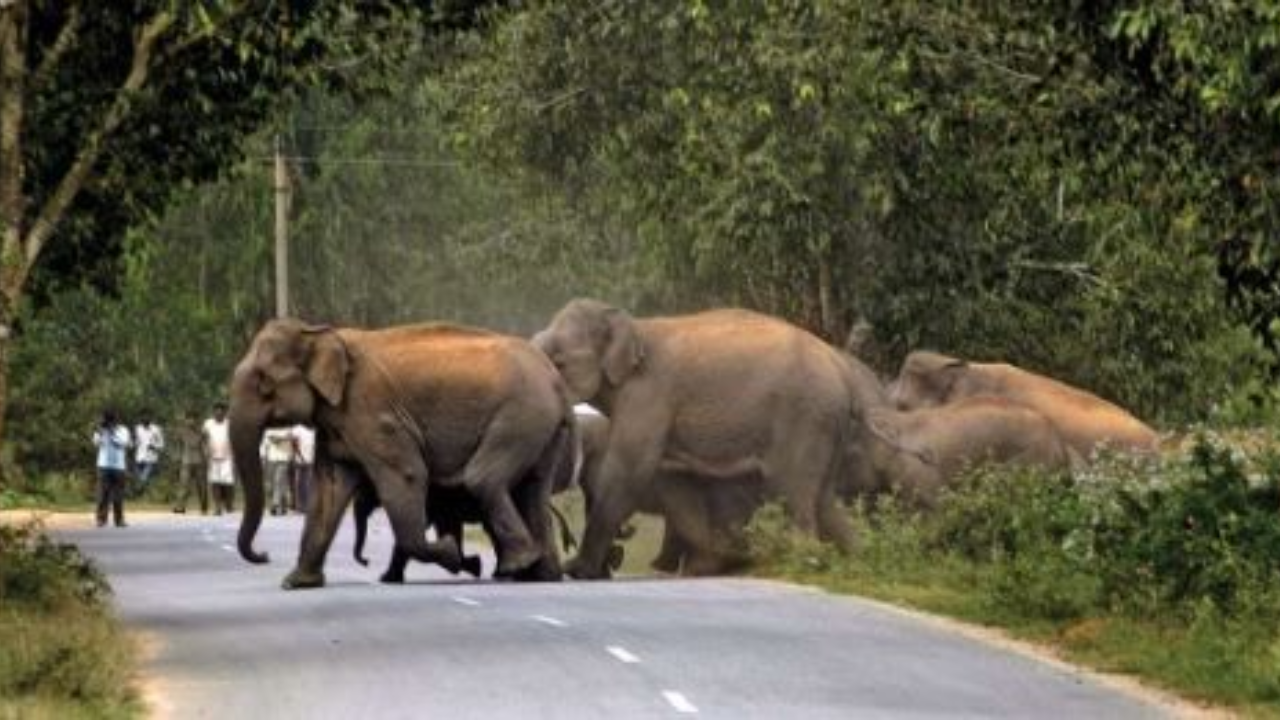
The accelerating insularization of protected areas due to agricultural expansion, extractive industries, and linear infrastructure necessitates landscape-scale connectivity. Elephant corridors—ecologically defined as functional, contiguous strips of land that facilitate the seasonal or permanent migration of elephants between two or more viable habitat patches—serve as genetic bridges. Maintaining these ecological lifelines averts the perils of demographic isolation, mitigates genetic drift, curbs local inbreeding depression, and sustains long-term metapopulation viability. Aspirants can explore complementary ecological frameworks in Atharva Examwise Environment Notes.
Key Findings: The Elephant Corridors of India Report
The Ministry of Environment, Forest and Climate Change (MoEFCC), through the Project Elephant Division and in collaboration with State Forest Departments and wildlife research bodies, released the ground-validated report titled Elephant Corridors of India. This landmark publication delineates the current spatial boundaries, operational status, and ecological health of the nation's movement pathways.
| Regional Landscape | Ground-Validated Corridors | Share of National Total (%) | Dominant Ecological and Anthropogenic Characteristics |
|---|---|---|---|
| East-Central India | 52 | 35% | High fragmentation driven by open-cast mining, extensive agriculture, and severe human-elephant conflict. |
| North-East India | 48 | 32% | Dense foothill connectivity intersected by linear transport networks, tea estates, and floodplains. |
| Southern India | 32 | 21% | Western and Eastern Ghats montane complexes fragmented by commercial plantations and infrastructure. |
| Northern India | 18 | 12% | Terai-Bhabhar linear tracts under pressure from expanding urban sprawl, canals, and highways. |
| Pan-India Total | 150 | 100% | Connects 33 designated Elephant Reserves across 15 elephant-range states. |
Quantitative Growth and Spatial Delineation
Ground-Validated Inventory: The national assessment cataloged 150 field-verified corridors across 15 elephant range states, representing a 40% increase over the 88 corridors originally identified by the Elephant Task Force in its seminal 2010 Gajah report.
State-Level Concentration: West Bengal possesses the highest density of corridors nationwide, accounting for 26 pathways (distributed across both northern sub-Himalayan Dooars and southern fragmented landscapes).
Network Linkage: These 150 pathways interconnect 33 Elephant Reserves distributed across 10 major macro-landscapes, maintaining structural connectivity between disparate protected enclaves.
Ground-Validation Methodology
The assessment utilized a rigorous, standardized methodology to ensure spatial accuracy and actionable conservation planning:
Joint field validation committees, comprising Project Elephant nominees, state wildlife division officers, and domain experts, deployed structured questionnaires to record real-time elephant movement evidence.
Corridors were categorized into functional classes: Active (habitually and effectively utilized by herds, confirmed by direct sightings, spoor surveys, and GPS-telemetry data) and Impaired (pathways where animal passage has virtually ceased due to physical disruption, severe degradation, or built barriers).
Mapping protocols utilized indicative directional vectors overlaid on raster forest-cover base maps and administrative boundaries, deliberately avoiding rigid cadastral demarcations to maintain dynamic ecological flexibility while steering regional land-use zoning.
Functional Status and Usage Trajectories
Stable to Intensified Use: 59 corridors demonstrate consistent or increasing seasonal elephant traffic, reflecting resilient biological utility.
Declining Utilization: 29 corridors exhibit reduced passage frequency, primarily driven by developmental fragmentation, human disturbance, and physical bottlenecks.
Critical Restoration Urgency: Approximately 10 corridors require immediate ecological restoration to avert permanent structural severance.
The Network of Elephant Reserves in India
Elephant Reserves (ERs) represent dedicated landscape-level conservation units established under Project Elephant—a Centrally Sponsored Scheme initiated in 1992 by the MoEFCC. Unlike national parks or wildlife sanctuaries, Elephant Reserves provide an administrative overlay across varied land-tenure systems, including protected areas, reserved forests, community forests, and revenue land.
| Conservation Parameter | Verified Data Point | Strategic and Ecological Significance |
|---|---|---|
| Total Elephant Reserves | 33 designated reserves across 14 states | Encompasses approximately 80,000 $\text{km}^2$ of critical habitat. |
| First Designated Reserve | Singhbhum Elephant Reserve, Jharkhand (Notified 2001) | Historic foundation of landscape-scale elephant management in India. |
| Largest Elephant Reserve | Singhbhum Elephant Reserve (~13,440 $\text{km}^2$) | Safeguards vast, contiguous East-Central deciduous and Sal forest tracts. |
| Smallest Elephant Reserve | Singphan Elephant Reserve, Nagaland (23.5 $\text{km}^2$) | Vital refuge patch providing critical foothill connectivity in the Northeast. |
| Latest Notification | Terai Elephant Reserve, Uttar Pradesh (33rd Reserve, 2022) | Facilitates transboundary wildlife migration across the Indo-Nepal landscape. |
| States with Highest Reserves | Assam (5 Reserves) and Tamil Nadu (5 Reserves) | Protects high-density populations inhabiting high-conflict interface regions. |
| Tiger-Elephant Overlaps | Kaziranga (AS), Periyar (KL), Anamalai (TN), Simlipal (OD) | Maximizes management synergy across multi-species protected habitats. |
Demographic monitoring indicates that southern and north-eastern landscapes harbor the highest numbers of wild elephants, led by Karnataka (6,049 individuals), Assam (5,719 individuals), and Kerala (3,054 individuals). Regular analytical summaries on wildlife demographic trends are available at Atharva Examwise Current Affairs.
Drivers of Fragmentation and Anthropogenic Pressure Points
The intersection between expansive elephant home ranges and expanding human spatial frontiers has magnified structural fragmentation. This habitat severance triggers a predictable causal cascade: linear infrastructure and agricultural encroaching compress viable core habitats; this shrinkage elevates forest edge density, which in turn alters herd foraging behavior toward highly nutritious cultivated crops. The resulting human-elephant conflict (HEC) causes substantial socioeconomic damage, human and elephant casualties, and severe retaliatory pressure, culminating in genetic fragmentation and population decline.
Linear Infrastructure and Industrial Hazards
Transport Networks: Unmitigated railway tracks and multi-lane national highways slicing through designated corridors remain a primary source of unnatural elephant mortality, as high-speed collisions and electrocutions from sagging power lines disrupt generational migration.
Hydrological Alterations: Hydropeaking operations from large-scale hydroelectric installations—such as sudden water volume releases from the Lower Subansiri Hydroelectric Project—threaten elephant calf survival and destabilize seasonal riparian crossings.
Extractive Industrialization: Open-cast coal and iron-ore mining, particularly across Jharkhand, Odisha, and Chhattisgarh, degrades core forest canopies and severs traditional pathways like the Ankua–Ambia and Jampani–Bhagabilla corridors, forcing herds into agrarian landscapes.
Human-Elephant Conflict Dynamics
As structural connectivity diminishes, herd foraging strategies shift dynamically toward human-dominated spaces. Elephants display adaptive intelligence and cultural transmission, circumventing non-lethal barriers to exploit high-energy agricultural crops. This dynamic induces severe socio-economic distress, property loss, and chronic human casualties—such as the over 1,400 fatalities recorded across Assam's forest divisions over two decades—which erode local community support for conservation initiatives.
Technological Innovations in Corridor Protection and Conflict Mitigation
Modern wildlife management integrates spatial modeling and sensor technologies to monitor corridors and prevent fatal encounters.
| Technological Initiative | Core Mechanism & Architecture | Deployment Scope & Demonstrated Outcomes |
|---|---|---|
| Gajraj System (AI Detection) | Uses Distributed Optical Fiber Sensing (DAS) along railway tracks to capture real-time acoustic and seismic vibration signatures of elephant movement, alerting loco-pilots instantly. | Deployed along a 700-km railway network across sensitive corridors in the Northeast, achieving 99.5% accuracy in preventing collisions. |
| GIS & Predictive Spatial Modeling | Combines satellite remote sensing, land-use/land-cover (LULC) rasters, and machine learning to map micro-corridors and movement paths. | Delineates finer-scale functional reserve pathways in complex landscapes like West Singhbhum–Odisha. |
| Early Warning & Geo-Fencing | Deploys infrared thermal sensor arrays, automated SMS alerts to local communities, and solar-powered non-lethal e-fencing at bottlenecks. | Reduces sudden human-elephant interface encounters and empowers community-led mitigation responses. |
Further reviews of environmental technologies can be tracked on the Atharva Examwise Daily GK Update.
Legal, Constitutional, and Institutional Governance Architecture
Elephant conservation in India operates across a multi-tiered legal framework balancing statutory enactments, constitutional duties, and judicial pronouncements.
Statutory and Constitutional Foundations
Wildlife (Protection) Act, 1972: The Asian elephant receives highest legal protection under Schedule I. Crucial corridor links outside the conventional National Park and Sanctuary network can be legally gazetted as Conservation Reserves (Section 36A) on government-owned lands or Community Reserves (Section 36C) on community holdings, securing their land-use status.
Constitutional Directives: Environmental protection is embedded within Article 48A (Directive Principles of State Policy, obligating the State to protect forests and wildlife) and Article 51A(g) (Fundamental Duty of every citizen to protect living creatures), both serving as guiding principles for conservation jurisprudence.
Judicial Pronouncements on Right of Passage
Migratory Right of Passage: The Supreme Court of India has affirmed the "Right of Passage" for elephants as an essential facet of environmental protection, directing state administrations to secure corridors and demolish unauthorized commercial structures impeding migratory tracts.
The Sigur Plateau Landmark Verdict: The Supreme Court and Madras High Court upheld the Tamil Nadu Government's statutory notification establishing the Sigur Elephant Corridor within the Nilgiri Biosphere Reserve, validating state authority to acquire private commercial resort properties to restore ecological pathways.
International Conservation Instruments
CITES & the MIKE Programme: India actively implements the CITES-mandated Monitoring the Illegal Killing of Elephants (MIKE) programme across 10 designated elephant reserve sites, monitoring poaching metrics and illegal ivory trade trends to evaluate baseline protection effectiveness.
Verified baseline documents are accessible directly through the Ministry of Environment, Forest and Climate Change and the Wildlife Trust of India.
Institutional Realignment: The Project Tiger and Elephant Merger
On June 23, 2023, the MoEFCC issued an administrative order merging the Centrally Sponsored Schemes of Project Tiger and Project Elephant into a unified entity: the Project Tiger and Elephant (PT&E) Division, subsumed under the umbrella scheme Integrated Development of Wildlife Habitats.
| Structural Dimension | Independent Status (Pre-Merger Era) | Unified PT&E Division (Post-2023 Governance) |
|---|---|---|
| Administrative Framework | Independent divisions operating within MoEFCC. | Unified PT&E Division overseeing both flagship species. |
| Statutory Backing | National Tiger Conservation Authority (NTCA, statutory) vs. Project Elephant (non-statutory). | NTCA statutory framework remains distinct; Project Elephant retains administrative advisory status. |
| Fiscal Management | Disparate, dedicated budgetary allocations for each scheme. | Amalgamated budgetary allocation managed via consolidated Annual Plans of Operation. |
| Landscape Management | Independent field-level operational mandates. | Streamlined resource deployment across overlapping Tiger and Elephant Reserves. |
The amalgamation seeks to eliminate administrative redundancy and streamline fiscal resources across overlapping habitats (such as Kaziranga, Corbett, and Periyar). However, wildlife ecologists note that Project Elephant operates without statutory backing equivalent to the NTCA, creating concerns that financial resources could disproportionately favor tiger-centric protected areas over wider elephant migratory corridors.
Why this matters for your exam preparation
Comprehending the spatial, technological, and institutional dimensions of elephant conservation is essential for candidates appearing for the UPSC Civil Services Examination (CSE) and State PSC examinations:
UPSC Preliminary Examination
Ecology and Environmental Geography:
Memorize core statistics: 150 ground-validated corridors across 15 states, with East-Central India hosting 35% (52 corridors) and West Bengal containing the highest state-level total (26 corridors).
Note key details regarding the 33 Elephant Reserves: Singhbhum (Jharkhand) is the first and largest, Singphan (Nagaland) is the smallest, and Terai (Uttar Pradesh) is the 33rd notification.
Policy, Schemes, and Governance:
Understand the operational framework of the AI-driven Gajraj System (Distributed Optical Fiber Sensing).
Track the administrative architecture of the Project Tiger and Elephant (PT&E) Division under the MoEFCC.
Review India's 10 designated CITES MIKE monitoring sites and the statutory mechanisms under Sections 36A and 36C of the Wildlife (Protection) Act, 1972.
UPSC Mains Examination (General Studies Paper III)
Conservation and Linear Infrastructure Planning: Construct balanced answers regarding the integration of developmental goals with ecological preservation, using examples like hydropeaking risks and railway collisions.
Human-Wildlife Conflict Dynamics: Analyze the structural causes of human-elephant conflict, including the Conservation-Agrarian Squeeze, edge-effect expansion, and community-driven mitigation models.
Constitutional and Legal Jurisprudence: Anchor environmental essays and governance answers in Articles 48A and 51A(g), integrating landmark Supreme Court judgments regarding the "Right of Passage" and corridor protection.