
Gorukana Dance and Soliga Tribe: UPSC Current Affairs and Daily GK Update | Atharva Examwise Current News
Ethno-Geographical Profile of the Soliga Community
The Soliga community (alternatively known as Solega, Sholaga, or Shōlaga) constitutes an indigenous Scheduled Tribe primarily inhabiting the forested slopes of the southern Western Ghats. Their demographic core spans the Biligirirangan Hills (B.R. Hills) and the contiguous Male Mahadeshwara Hills (M.M. Hills) located within the Chamarajanagar and Mysuru districts of southern Karnataka, with adjacent populations distributed across Kodagu, Mandya, Ramanagara, and the Erode district of Tamil Nadu. With a total population estimated at approximately 40,000 individuals, the community communicates in Sholaga, an independent Dravidian language.
Ethno-historical traditions trace the nomenclature Soliga to the indigenous phrase signifying "those who have emerged from within the bamboo". The Soliga organize their habitation into distinct nucleated settlements termed podu, typically comprising 10 to 50 vernacular huts constructed from forest bamboo, sticks, and thatch, designed with low entryways engineered to insulate against the montane climate. Their socio-ecological matrix has historically centered on traditional forest gathering, non-timber forest product (NTFP) harvesting, wild honey foraging, and subsistence horticulture. A deeply embedded communal sharing mechanism characterizes their customary economy, ensuring resource distribution across the podu. To explore further case studies on indigenous demographics, refer to the Atharva Examwise Art and Culture Repository.
Cultural Morphology and Ecological Foundations of the Gorukana Dance
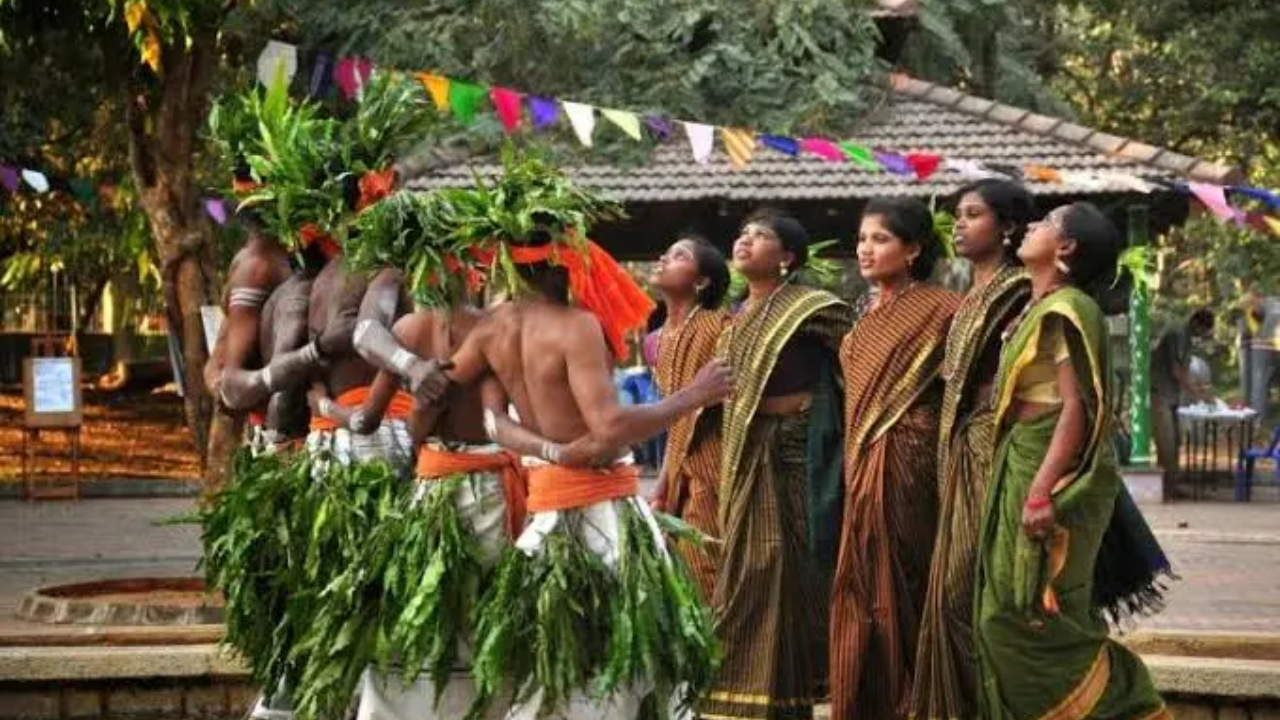
The expressive culture of the Soliga community manifests through the Gorukana dance, an intangible heritage practice that functions as an oral archive of ecological knowledge, spiritual devotion, and collective memory.
Etymology and Ecological Semantics
In the Soliga lexicon, Goruu denotes the acoustic resonance of the forest, while Kana signifies the evergreen montane canopy. A parallel etymological tradition associates Gurukana with the web-weaving patterns of the forest spider, symbolizing communal interdependence and structural cohesion. Consequently, the performance serves as a pedagogical medium wherein elder practitioners transmit knowledge of wildlife ethology, floral phenology, precipitation cycles, and agrarian timelines to younger generations.
Ritual Occasion and Performance Mechanics
The primary performance of Gorukana coincides with Rotti Habba (the annual food and harvesting festival), celebrated between February and May following the harvest of finger millet (ragi). The performance unfolds continuously from dusk until dawn:
Choreographic Configurations: Dancers execute synchronized, circular movements characterized by vigorous, grounded footwork that shifts dynamically in response to percussive acceleration.
Acoustic Architecture: The cadence is driven by the Tamatte (a traditional frame drum), complemented by supplementary folk percussion including the Dammadi, Dollu, and ankle bells (Gejje).
Vocalizations and Liturgical Invocation: Choral singing alternates with rhythmic breaks to invoke deities such as Biligiri Rangaswamy, Jadeswamy, Huliveerappa, and Madeshwara. The community maintains an affine spiritual connection with Lord Biligiri Rangaswamy, revered as their brother-in-law following his mythical marriage to the Soliga maiden Kusumale.
Ethno-Mimetic Expression: Choreographic sequences incorporate mimetic gestures simulating the behavioral patterns of forest animals, avian species, hunting maneuvers, and honey-gathering techniques (Jenu Hadu).
Historical Lineage and Classical Literary Parallels
Recent ethnochoreological research connects the performative structures of the Soliga tribal dance with classical Sanskrit dramatic traditions. Comparative qualitative analyses demonstrate that the circular formation, kinetic patterns, costuming, and thematic concepts of the Gorukana dance correspond to the carcarī, an ancient uparūpaka (minor dramatic category) documented in classical dramatic literature.
The carcarī is prominently detailed in the 9th-century CE play Karpūramañjarī, composed by the Gurjara-Pratihāra court poet Rājaśekhara. This structural correspondence suggests a historical bridge between courtly Sanskrit dramatic conventions and indigenous folk performances, illustrating how ancient classical treatises shared choreographic elements with tribal traditions preserved across the Deccan and Western Ghats. Aspirants analyzing the evolution of early medieval performing arts can review additional historical notes on the Atharva Examwise Ancient Indian History Modules.
Institutional Documentation and Key Anthropological Indicators
The documentation of the Gorukana dance highlights the modern state apparatus's initiatives to preserve tribal cultural forms. The Government of India has formally indexed the Soliga community's performative traditions on the Ministry of Tribal Affairs Aadi Kalakar Portal. Furthermore, performance troupes participate in national showcases, including the Vanaj National Tribal Festival, integrating regional indigenous arts into the broader national cultural landscape.
| Analytical Indicator | Anthropological & Administrative Details | Academic / Legal Context |
|---|---|---|
| Geographic Range | Biligirirangan Hills (B.R. Hills), Chamarajanagar & Mysuru (Karnataka); Erode (Tamil Nadu) | Southern Western Ghats Biodiversity Hotspot |
| Linguistic Identity | Sholaga (Southern Dravidian family) | Scheduled Tribe under Indian Jurisprudence |
| Settlement Type | Podu (10 to 50 nucleated thatch and bamboo units) | Traditional micro-architectural adaptation |
| Agrarian Festival | Rotti Habba / Hosa Ragi Habba (February–May) | Post-harvest celebration of Finger Millet (Eleusine coracana) |
| Key Instrumentation | Tamatte (Frame drum), Dammadi, Dollu, Gejje | Primary rhythmic drivers of Kunitha (dance) |
| Classical Literary Parallel | Carcarī form within the uparūpaka genre | Documented in Rājaśekhara's 9th-century CE Karpūramañjarī [cite: 5] |
| State Recognition | Aadi Kalakar Repository & National Tribal Festivals (Vanaj) | Ministry of Tribal Affairs documentation initiatives |
Key Exam Facts
The Soliga community is recognized for securing Community Forest Rights under the Scheduled Tribes and Other Traditional Forest Dwellers (Recognition of Forest Rights) Act, 2006 (FRA) within the core zone of the Biligiriranganatha Swamy Temple (BRT) Tiger Reserve.
The ritual practice of Gorukana extends beyond recreational art, functioning as a conservation repository of Traditional Ecological Knowledge (TEK) that encodes sustainable resource management practices.
The sacred ecology of the Soligas centers on specific geographic landmarks and arboreal veneration, such as the Dodda Sampige (Michelia champaca) tree.
Why this matters for your exam preparation
Understanding the cultural and institutional facets of the Soliga community is essential for aspirants preparing for the Union Public Service Commission (UPSC) Civil Services Examination and State PSCs, aligning with multiple general studies modules:
UPSC GS Paper 1 (Indian Heritage and Culture & Society):
Appraisal of tribal and folk dances (Gorukana, Dollu Kunitha, Mari Kunitha) as expressions of intangible cultural heritage.
Analysis of historical continuities between classical Sanskrit aesthetic traditions (Karpūramañjarī, carcarī) and tribal performing arts.
Socio-anthropological dynamics of Dravidian tribal groups, settlement morphology (Podu), and customary community institutions.
UPSC GS Paper 2 (Governance, Schemes, and Social Justice):
Governmental interventions and digitization efforts by the Ministry of Tribal Affairs, including the Aadi Kalakar platform and tribal cultural preservation schemes.
Legal frameworks governing indigenous land tenure, tribal autonomy, and the operational enforcement of the Forest Rights Act (FRA), 2006.
UPSC GS Paper 3 (Environment, Ecology, and Biodiversity):
Integration of Traditional Ecological Knowledge (TEK) in modern protected area management, using the Soliga co-management model within the BRT Tiger Reserve as a case study.
Ethno-botanical interactions, sustainable NTFP harvesting, and human-wildlife co-existence strategies in fragile Western Ghats biomes.
UPSC Prelims (Current Affairs and Daily GK Update):
Direct multiple-choice questions on tribal demographics, regional folk instruments (Tamatte), post-harvest festivals (Rotti Habba), and associated literary texts.
For comprehensive analytical modules, structured answer-writing frameworks, and competitive exam news today, visit the Atharva Examwise Current Affairs Portal.