
UPSC Current Affairs: 1400-Year-Old Mahakuta Temples and Early Chalukyan Architecture | Daily GK Update
The architectural landscape of the Malaprabha River basin in northern Karnataka represents one of the most formative incubators of structural temple design in South Asia. Located in the Bagalkot district near the ancient imperial capital of Vatapi (modern Badami), the Mahakuta group of temples stands as an extant 1,400-year-old testament to the experimental phase of Early Chalukyan art, religious eclecticism, and epigraphic culture. Constructed during the 6th and 7th centuries CE under the royal patronage of the Chalukyas of Badami, this sacred complex bridges archaic rock-cut traditions with mature structural forms, offering crucial empirical insights for candidates preparing for civil services and state competitive examinations.
Historical and Geographical Setting of the Mahakuta Complex
The Early Chalukyas, established by Pulakeshin I around 543 CE, transformed the semi-arid river valley of the Malaprabha—a vital tributary of the Krishna River system—into a thriving geopolitical and artistic core. Alongside the contemporary urban and religious centers of Aihole, Pattadakal, and Badami, the Mahakuta complex emerged as a prime Shaivite pilgrimage center (tirtha) and monastic settlement.
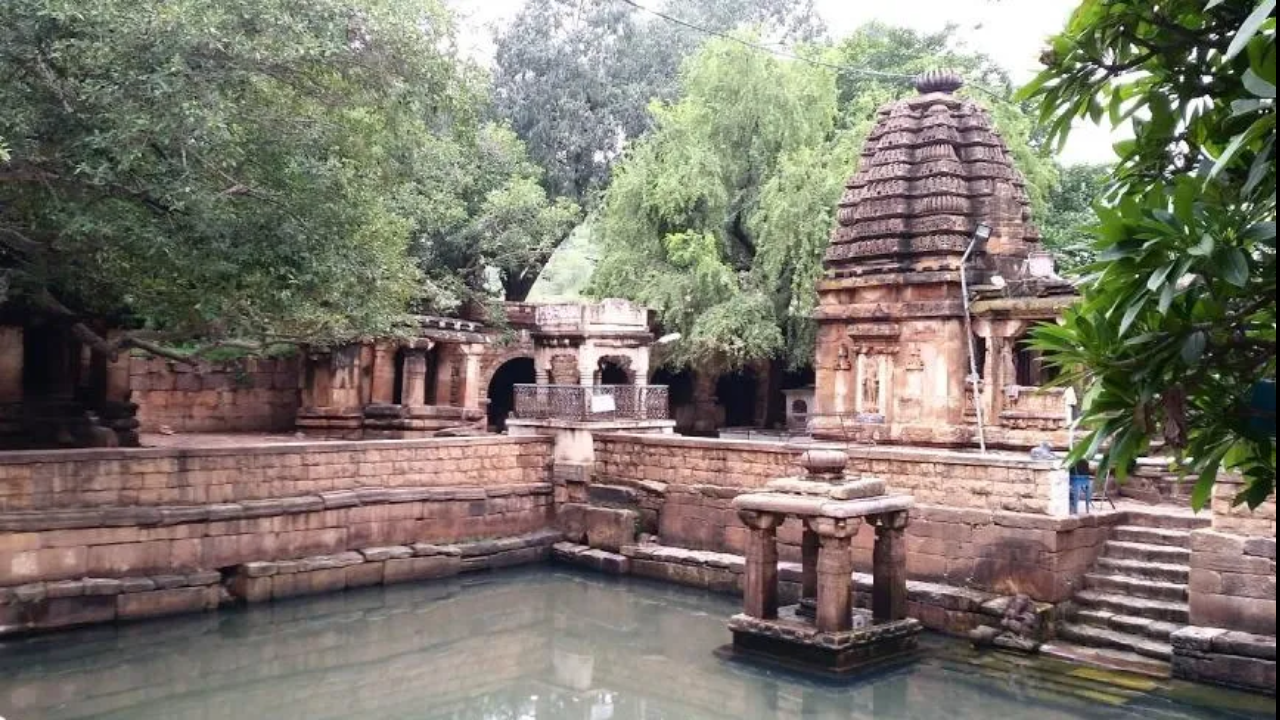
The sacred layout of Mahakuta centers on the Deva Droni, a perennial natural spring-fed tank that forms the ritualistic heart of the settlement. Devotees historically performed ritual ablutions in this holy pool prior to offering worship at the primary shrine of Mahakuteshvara. The presence of natural hydraulic features within a forested valley reflects the deliberate selection of sanctified topographies common to early medieval Shaiva sectarian institutions.
Key Facts and Exam-Relevant Data
Geographic Location: Mahakuta, Bagalkot District, Northern Karnataka.
River Basin: Malaprabha-Ghataprabha Doab (Krishna River basin).
Dynastic Association: Badami Chalukyas (Early Western Chalukyas).
Chronological Span: Late 6th century CE to 8th century CE.
Primary Deity: Lord Shiva (Maukteshvara / Mahakuteshvara).
Primary Epigraph: The Mahakuta Sandstone Pillar Inscription of King Mangalesha.
Architectural Eclecticism: Confluence of Dravida and Nagara Traditions
The Early Chalukyan artisans did not merely imitate regional styles; they engaged in profound formal experimentation that laid the foundations for the Vesara (or Karnata-Dravida) style of architecture. The Mahakuta complex hosts approximately two dozen structural shrines that display a simultaneous juxtaposition of southern Dravida and northern Nagara idioms constructed side by side.
The Karnataka artisans of this era developed local, indigenous variants of these superstructures rather than directly copying regional paradigms from the Madhyadesha or the Tamil south. The structural masonry relies on massive, fine-grained red sandstone blocks fitted together without mortar, showcasing advanced stone-dressing techniques inherited from contemporary cave-excavation traditions at nearby Badami.
| Architectural Element | Dravida Tradition (e.g., Mahakuteshvara Temple) | Nagara Tradition (e.g., Mallikarjuna Variants) |
|---|---|---|
| Superstructure (Shikhara / Vimana) | Tiered pyramidal tower crowned by a domical stupi or octagonal shikhara. | Curvilinear tower (Rekha-Nagara-Prasada) with central vertical bands (latas). |
| Ground Plan | Square sanctum (garbhagriha) with enclosed circumambulatory path (sandhara pradakshinapatha). | Compact square plan with projecting offsets (rathas) on external sanctum walls. |
| Crowning Member | Kalasam positioned atop a defined dome-like griva-shikhara roof. | Ribbed stone disc (amalaka) surmounted by a sacred water-pot finial (kalasha). |
| Niche Decoration | Pilastered niches housing diverse Shaiva sculptural iconography. | Projecting niche shrines (bhadra niches) displaying dynamic relief carvings. |
The Mahakuta Pillar Inscription: Epigraphic and Historical Value
The Mahakuta Pillar Inscription stands as one of the most vital primary epigraphic records of the Badami Chalukyan dynasty. Discovered adjacent to the Mahakuteshvara temple and later relocated to the Bijapur Archaeological Museum in 1920, this cylindrical red sandstone pillar provides a detailed dynastic genealogy and socio-political record.
Written in classical Sanskrit using the transitional Early Kannada script, the pillar was commissioned by King Mangalesha (r. c. 597–610 CE), the son of Pulakeshin I and younger brother of Kirtivarman I. The record is dated to Mangalesha’s fifth regnal year, corresponding to the Siddhartha cyclic year on the full-moon day of the month of Vaisakha (calculated by epigraphists as 12 April 601 CE or c. 595–602 CE).
The inscription records the ancestry of the Chalukyas, tracing the lineage through Pulakeshin I (titled Ranavikrama and Satyashraya), confirming his performance of the Vedic Bahusuvarna-Agnishtoma sacrifices. It also mentions Mangalesha's military campaigns against the northern Kalachuri ruler, Buddharaja, indicating that the wealth plundered from the Kalachuris was utilized to sponsor religious endowments and idol processions for the Mahakuta shrine. Furthermore, the record indicates Mangalesha’s intent to erect a pillar of victory (jayastambha) on the banks of the sacred Bhagirathi (Ganges) River, illustrating the pan-Indian geopolitical outlook of the Deccan monarchs. It details the imperial grant of ten villages to the shrine of Maukteshvara (Mahakuteshvara), underscoring the role of temples as economic nodes for land management and revenue redistribution.
A secondary Kannada inscription found within the complex, dated to the reign of King Vijayaditya (696–733 CE), records a gift of land and a ruby-set crown by his concubine (pranayi) Vinapoti, highlighting continued royal patronage and female participation in high-status temple donations across generations.
| Epigraphic Record | Patron / Issuer | Language & Script | Primary Historical Insights |
|---|---|---|---|
Mahakuta Pillar Inscription (c. 601 CE) [cite: 3, 9] | King Mangalesha | Sanskrit language; Old Kannada script | Validates early dynastic genealogy, Kalachuri wars, grant of ten villages, and Vedic sacrifices of Pulakeshin I. |
Badami Cave No. 3 Inscription (578 CE) [cite: 1, 4] | Mangalesha (during the reign of Kirtivarman I) | Sanskrit language; Old Kannada script | Records the excavation of the Maha-Vishnu-Griha rock-cut shrine and land endowments for temple maintenance. |
Aihole Prashasti (634 CE) [cite: 5] | Pulakeshin II (Composed by court poet Ravikirti) | Sanskrit language; Old Kannada script | Documents the military triumphs of Pulakeshin II, his victory over Harshavardhana, and internal dynastic conflicts. |
Peddavaduguru Inscription [cite: 4, 5] | Pulakeshin II | Kannada language and script | Details the internal civil war that resulted in the demise of Mangalesha and the accession of Pulakeshin II. |
Sociopolitical Implications and Dynastic Legitimacy
The Mahakuta architectural complex and its textual records expose several critical underlying socio-political phenomena of early medieval South India:
The Mahakuta pillar was erected during a contested transition of power. Mangalesha, initially assuming power as regent due to the minority of his nephew Pulakeshin II, used extensive monumental construction and elaborate epigraphic declarations at Badami and Mahakuta to solidify his imperial legitimacy. By attributing ancestral monuments to his father and elder brother while detailing his own military triumphs over the Kalachuris and Revati-dvipa (modern Redi), Mangalesha leveraged sacral architecture to reinforce royal authority.
Furthermore, although Mangalesha designated himself as Parama-Bhagavata (a devout Vaishnava) in the Badami Cave 3 inscription, his primary structural investment at Mahakuta was dedicated to Shiva (Maukteshvara). This deliberate cross-sectarian patronage indicates that the Early Chalukya state utilized religious endowments as a unifying political instrument across diverse linguistic and theological constituencies of the Deccan.
The coexistence of distinct roof profiles—the proto-Dravidian stepped horizontal tiers (kadamba-nagara and dravida-vimana) and the northern curvilinear towers (rekha-prasada)—demonstrates that the Malaprabha basin served as an active architectural laboratory. The hybrid solutions formulated at Mahakuta directly influenced the mature architectural paradigms seen at the UNESCO World Heritage site of Pattadakal and the later Western Chalukyan shrines of the Tungabhadra basin.
Why this matters for your exam preparation
A comprehensive grasp of the Mahakuta temple group and its epigraphic records provides direct utility across several dimensions of competitive examination syllabi:
UPSC Civil Services Preliminary Examination (General Studies Paper I): Objective questions regularly evaluate ancient dynastic chronologies, epigraphic scripts, and temple typologies. Aspirants must note that the Mahakuta Pillar Inscription was composed in Sanskrit using Old Kannada script under King Mangalesha, distinguishing it from the Aihole Inscription composed by Ravikirti.
UPSC Civil Services Main Examination (General Studies Paper I - Art & Culture): The evolution of Indian temple architecture requires candidates to trace transitions from Gupta-era rock-cut forms to mature structural temples. Mahakuta serves as an essential case study illustrating the formative experimentation leading to the Vesara (Karnata-Dravida) architectural style.
History Optional (Papers I & II): Questions regarding early medieval state formation, Vedic legitimation through yajnas, royal sectarian patronage, and agrarian expansion via temple land grants (devadana) find direct empirical evidence in the Mahakuta epigraphs.
For additional preparation modules, explore the Atharva Examwise Art and Culture Series and review our latest updates on the Atharva Examwise Daily GK Portal. Authoritative archaeological survey archives can also be reviewed through the Archaeological Survey of India and research records at the Digital South Asia Library.