
UPSC Current Affairs: India Unveils First Guide to Grasslands at UNCCD COP17 | Daily GK Update
Overview: India’s First Guide to Grasslands and Open Natural Ecosystems
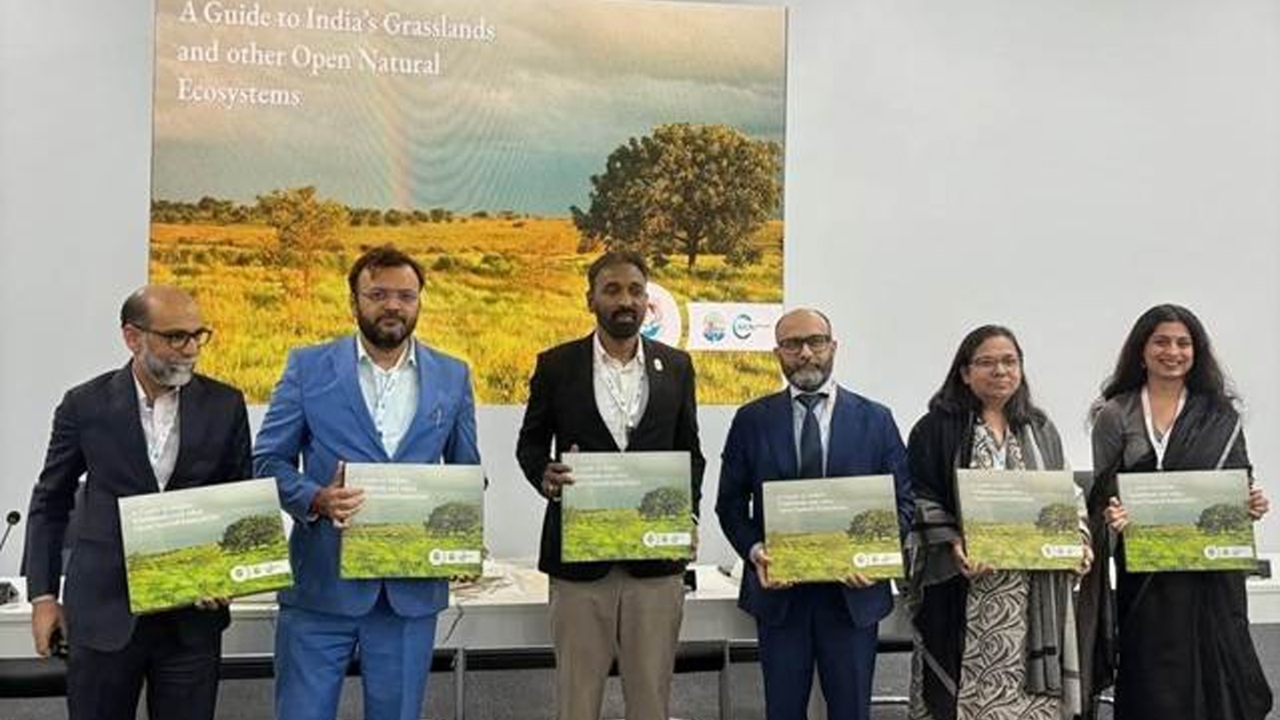
In a major milestone for national environmental governance and global conservation policy, India unveiled its first-ever Guide to Grasslands and Other Open Natural Ecosystems (ONEs) of India. The document was officially launched during an official side event at the 17th Session of the Conference of the Parties (COP17) to the United Nations Convention to Combat Desertification (UNCCD) held in Ulaanbaatar, Mongolia.
This pioneering publication represents a paradigm shift away from traditional tree-centric forestry policies toward a comprehensive, science-based conservation framework that recognizes the ecological, economic, and climatic value of non-forest biomes. Developed under the guidance of the Ministry of Environment, Forest and Climate Change (MoEFCC), the guide was spearheaded by the Ashoka Trust for Research in Ecology and the Environment (ATREE) in collaboration with the International Union for Conservation of Nature (IUCN), the Centre of Excellence on Sustainable Land Management (CoE-SLM), and the Indian Council of Forestry Research and Education (ICFRE).
The initiative addresses historic policy oversights that classified biodiverse open habitats as unproductive land. By establishing standard baselines across 24 distinct ecosystem types, the publication offers policymakers, researchers, development agencies, and local communities a structured blueprint for ecological restoration, sustainable land management, and rural livelihood support. Candidates tracking competitive exam news today can reference further structured learning materials via the Atharva Examwise Environment Notes.
Key Highlights of the National Guide to Open Natural Ecosystems
The creation of the national guide establishes a standardized ecological framework for non-forest biomes across the subcontinent. The core features and takeaways from the publication include:
Classification of 24 Ecosystem Types: The guide systematically documents 24 non-forest biomes, offering spatial mapping, ecological baselines, and species inventories.
Multidisciplinary Scope: It integrates specialized thematic sections on fire ecology, soil carbon sequestration, pastoralism, and traditional resource rights.
Institutional Alignment: Formulated through multi-institutional coordination involving ATREE, MoEFCC, IUCN, CoE-SLM, and ICFRE.
Correcting the 'Wasteland' Misclassification: In a video message at the launch, Union Minister for Environment, Forest and Climate Change Bhupender Yadav highlighted that grasslands, scrublands, and ravines have historically been undervalued due to the absence of tree canopy. Recalling his youth in Ajmer, Rajasthan, he noted how vast grazing lands were routinely mislabeled as "wastelands".
Integration of Traditional Wisdom: The Minister emphasized ancient community-led conservation institutions, such as Orans (sacred community groves/commons) and Gauchars (village grazing lands), demonstrating that local pastoral knowledge aligns with modern ecological science.
Support for Global Commitments: The guide enhances India's representation in international forums regarding Land Degradation Neutrality (LDN), climate resilience, and rangeland governance.
Spatial Distribution and Diversity of India’s Open Ecosystems
Open Natural Ecosystems (ONEs) cover nearly a quarter of India’s total geographical landmass. These habitats range from high-altitude alpine zones to coastal arid landscapes.
| Ecosystem Category | Geographic Locations & Regions | Ecological Characteristics & Features | Associated Native Flora & Fauna |
|---|---|---|---|
| Alpine Meadows (Bugyals & Margas) | High Himalayas (Ladakh, Jammu & Kashmir, Himachal Pradesh, Uttarakhand) | Herbaceous vegetation above the tree line; seasonal grazing systems. | Snow Leopard, Himalayan Tahr, Musk Deer |
| Terai & Alluvial Grasslands | Himalayan foothills, floodplains of the Ganges and Brahmaputra rivers | High-biomass alluvial grasslands (Chaurs) subject to seasonal flooding. | One-horned Rhinoceros, Swamp Deer, Bengal Florican |
| Floating Wet Grasslands (Phumdis) | Loktak Lake, Manipur | Heterogeneous vegetation and organic matter masses floating on open water. | Sangai Deer (Rucervus eldii eldii) |
| Arid & Semi-Arid Landscapes | Thar Desert, Banni Grasslands of Kutch (Gujarat, Rajasthan) | Saline flats, xerophytic scrub, seasonal clay meadows supporting pastoralism. | Great Indian Bustard, Indian Wild Ass, Desert Fox |
| Deccan Savannas & Scrublands | Peninsular Plateau, Aravalli range (Maharashtra, Karnataka, Telangana) | Open tree-grass mosaics interspersed with rocky lateritic plateaus. | Blackbuck, Indian Wolf, Chinkara |
| Shola Grasslands | High elevations of the Western Ghats (Nilgiris, Anamalai, Palani Hills) | Rolling grassland expanses interspersed with stunted evergreen forest patches (Sholas). | Nilgiri Tahr, Nilgiri Pipit |
| Ravines and Badlands | Yamuna-Chambal river basins (Madhya Pradesh, Rajasthan, Uttar Pradesh) | Steeply eroded gully networks with drought-tolerant scrub formations. | Indian Wolf, Striped Hyena, Golden Jackal |
| Specialized Formations | Central Nicobar, Tamil Nadu (Theri Kaadu), Western Ghats laterite plateaus | Red dune complexes (Theri), seasonal rocky pools, coastal grassy fringes. | Endemic geckos, specialized xeric plants |
For candidates preparing for upcoming examinations, reviewing these geographic associations is crucial for preliminary exam mapping questions. Access further spatial study material via the Atharva Examwise Geography Section.
Ecological Significance and Global Nomenclature of Grasslands
Ecosystem Services and Biodiversity Support
Grasslands represent dynamic terrestrial biomes dominated by plants of the Poaceae family, which contains between 10,000 and 12,000 individual species worldwide. These ecosystems generally flourish in climatic zones receiving annual rainfall between $600\text{ mm}$ and $1500\text{ mm}$.
The primary ecological functions provided by grasslands include:
Soil Carbon Storage: Unlike closed-canopy forests that store carbon primarily in above-ground woody structures, grasslands fix up to 80% of their carbon in deep root systems and underground soil layers. This underground carbon pool is remarkably resilient to surface wildfires.
Hydrological Management: Deep root matrices improve infiltration rates, stabilize topsoil against erosion, recharge aquifers, and mitigate flash flooding.
Habitat for Critically Endangered Fauna: Open natural ecosystems harbour endemic species adapted to open plains, such as the Great Indian Bustard (Ardeotis nigriceps), Lesser Florican (Sypheotides indicus), Bengal Florican (Houbaropsis bengalensis), Indian Wolf (Canis lupus pallipes), and Blackbuck (Antilope cervicapra).
Support for Pastoral Economies: Millions of semi-nomadic and traditional pastoralists depend directly on grasslands for livestock forage, fodder security, and rural income generation.
Global Terminology for Grassland Biomes
Grasslands are identified by distinct regional designations globally, as detailed by the World Wide Fund for Nature (WWF):
Savannah: Tropical and subtropical grasslands featuring scattered trees, characteristic of Africa.
Cerrado: Biodiverse tropical savanna biome in South America.
Prairie: Broad temperate grasslands dominated by tall grasses in North America.
Steppe: Vast, semi-arid continental grassland belts extending across Central Asia.
Meadow: Moist, low-altitude grass habitats prevalent in the United Kingdom and Europe.
Beyond the Nugget: India’s Second Progress Report on the Bonn Challenge
Overview of the Bonn Challenge
The Bonn Challenge is a global restoration initiative launched in 2011 by the Government of Germany and the International Union for Conservation of Nature (IUCN), with IUCN serving as its Secretariat. The movement supports international environmental agreements, including the United Nations Decade on Ecosystem Restoration, the Sustainable Development Goals (SDGs), the Aichi Biodiversity Targets under the Convention on Biological Diversity (CBD), and the Paris Agreement.
2020 Global Target: Restore 150 million hectares of degraded and deforested landscapes.
2030 Global Target: Restore 350 million hectares worldwide.
India's Pledges and Achievements
India originally pledged to restore 13 million hectares of degraded land by 2020, with an additional target of 8 million hectares by 2030. At the 14th Session of the Conference of the Parties (COP14) to the UNCCD hosted in New Delhi in 2019, Prime Minister Narendra Modi enhanced India’s target to 26 million hectares by 2030.
According to India’s Second Progress Report on the Bonn Challenge—released jointly by the MoEFCC and IUCN on June 17, 2026:
| Performance Parameter | Quantitative Statistic / Metric |
|---|---|
| Total Area Restored (2011–2020) | 21.7 million hectares |
| Revised 2030 Restoration Pledge | 26.0 million hectares |
| Total Area Affected by Degradation/Desertification | 97.85 million hectares ($29.77\%$ of Total Geographical Area) |
| Degradation Increase (2011–13 to 2018–19) | 1.45 million hectares ($0.44\%$ of Total Geographical Area) |
| Gross Carbon Sequestered via Restoration | 461.14 million tonnes $\text{CO}_2$ equivalent |
| Net Carbon Sequestered (Adjusted for Mortality) | 343.66 million tonnes $\text{CO}_2$ equivalent |
State-Wise Performance and Flagship Schemes
Land restoration between 2011 and 2020 was accomplished through planted forests, natural regeneration, silviculture, agroforestry, and mangrove restoration.
Top Performing State: Telangana achieved the highest restoration figure at 4.18 million hectares, driven substantially by a large-scale agroforestry expansion covering over 3.6 million hectares.
Other Leading States: Madhya Pradesh, Odisha, Gujarat, and Andhra Pradesh contributed significantly to national restoration outcomes.
These results were achieved through the coordination of major national programs and dedicated state-level greening initiatives:
Compensatory Afforestation Fund (CAF / CAMPA)
[cite: 8]
Green India Mission (GIM)
[cite: 8]
National Afforestation Programme (NAP)
[cite: 8]
Mahatma Gandhi National Rural Employment Guarantee Scheme (MGNREGS)
[cite: 8]
Detailed analysis of environmental policy execution is regularly updated on the Atharva Examwise Current Affairs Portal.
Policy Implications and Strategic Outlook
The launch of the guide at UNCCD COP17 alongside the second Bonn Challenge report marks a major shift in India's land-use strategy. By incorporating non-forest biomes into mainstream conservation policy, state forestry departments can move away from inappropriate tree-planting initiatives in naturally open habitats.
Furthermore, accounting for below-ground carbon sequestration in grasslands allows India to improve its carbon inventory accuracy under the Land Use, Land-Use Change, and Forestry (LULUCF) framework for the Paris Agreement. Aligning legal land protection with traditional institutions like Orans and Gauchars provides a community-centered framework to curb land degradation while protecting livestock livelihoods across arid and semi-arid regions.
Why this matters for your exam preparation
A comprehensive understanding of India's Guide to Grasslands, Open Natural Ecosystems, and the Bonn Challenge progress report is highly relevant across multiple stages of competitive examinations, particularly the UPSC Civil Services Examination.
Relevance for UPSC Prelims
Environment & Ecology: Direct factual questions regarding biome locations (e.g., Phumdis in Loktak Lake, Bugyals in Uttarakhand, or Theri Kaadu in Tamil Nadu).
International Treaties & Conventions: Focus on UNCCD COP17 host details (Ulaanbaatar, Mongolia), the Secretariat of the Bonn Challenge (IUCN), and Land Degradation Neutrality (LDN) goals.
Government Initiatives & Schemes: Specific details regarding CAMPA, Green India Mission, NAP, and MGNREGS convergence.
Relevance for UPSC Mains (GS Paper III & Essay)
Conservation and Environmental Degradation: Quantitative data points (e.g., 21.7 Mha restored, 97.85 Mha affected by degradation, $343.66\text{ Mt}$ net carbon stored) provide empirical evidence for questions on environmental management and climate mitigation.
Agriculture and Rural Livelihoods: Discussion on pastoral economies, traditional land tenure systems (Orans, Gauchars), and agroforestry strategies.
Analytical Essay Writing: Strong case study material demonstrating the transition from historical policy oversights (mislabeling habitats as "wastelands") to science-based, inclusive landscape conservation.
Key Exam Concepts Summary
| Term / Concept | Summary Definition | Exam Application |
|---|---|---|
| Open Natural Ecosystems (ONEs) | Non-forest biomes naturally characterized by open canopies and low tree density. | Prelims Definition / Mains GS-III |
| Oran & Gauchar | Sacred community groves and traditional village grazing lands. | Prelims Culture/Ecology & Mains GS-III |
| Bonn Challenge | Global pledge to restore 150 Mha by 2020 and 350 Mha by 2030. | Prelims International Conventions |
| Land Degradation Neutrality | A target state where the amount of healthy land remains stable or increases. | Mains GS-III Climate Targets |
For full study notes, daily GK updates, and test series tailored to UPSC and state PSC exams, visit Atharva Examwise.