UPSC Current Affairs Today: ISRO Aditya-L1 Solves Solar Coronal Heating Paradox | Atharva Examwise Daily GK Update
Solar Coronal Heating Paradox: Discovery Overview
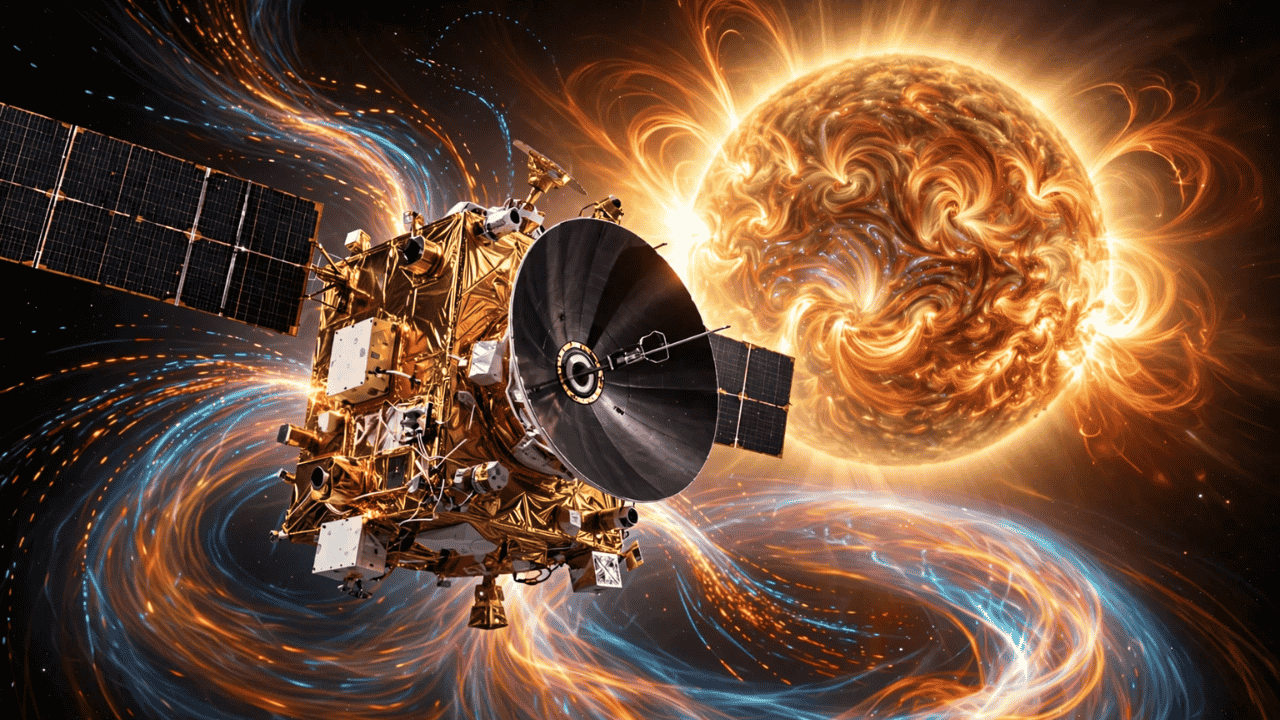
In a milestone achievement for observational astrophysics, India's first dedicated solar mission, Aditya-L1, has provided observational evidence resolving one of solar physics' most persistent mysteries: the Solar Coronal Heating Paradox. For over eight decades, scientists struggled to explain why the Sun's outer atmosphere, known as the corona, is superheated to temperatures exceeding two million degrees Celsius—and upwards of forty million degrees Celsius during high-energy solar eruptions—while its visible surface, the photosphere, maintains a far cooler temperature of approximately 5,500°C to 5,600°C. Under standard thermodynamic principles, thermal energy decreases as distance increases from a heat source; however, the solar atmosphere presents a stark inversion of this fundamental expectation.
A research team led by Prof. R. Ramesh and Dr. V. Muthupriyal at the Indian Institute of Astrophysics (IIA), Bengaluru, analyzed spectroscopic data collected by the Visible Emission Line Coronagraph (VELC) aboard Aditya-L1. The resulting study, published in The Astrophysical Journal Letters, demonstrates that wave energy originating from convective motions on the solar surface supplies only approximately 7% of the total thermal budget required to heat the corona. The remaining 93% of the coronal heating energy is provided through magnetic reconnection, a continuous physical process in which tangled, twisted magnetic field lines snap, release stored magnetic energy, and reconfigure within the solar plasma.
The observational breakthrough was accomplished by analyzing major Coronal Mass Ejections (CMEs) captured on July 16, 2024, and August 5, 2024. Spectroscopic recordings obtained in the VELC instrument's sit-and-stare mode revealed that following the explosion of a CME, the magnetic network reconfigures and restores the lost atmospheric energy within approximately 10 hours. This mechanism continuously replenishes the corona's energy budget, preventing the solar atmosphere from cooling down despite frequent, large-scale mass ejections.
Energy Budget Mechanics: Wave Dissipation vs. Magnetic Reconnection
To map the precise mechanisms transferring energy across the solar atmosphere, researchers at the Indian Institute of Astrophysics targeted the green coronal emission line at 5303 Å (Fe XIV), emitted by iron atoms ionized at temperatures exceeding one million degrees Celsius. High-resolution spectroscopic observations enabled the team to measure emission line broadening, plasma turbulence, and directional velocity shifts before, during, and after CME events.
During the July 16, 2024 CME event, VELC recorded a localized drop in coronal brightness—a phenomenon designated as coronal dimming—of nearly 50%, lasting approximately 6 hours as mass was expelled into interplanetary space. Concurrently, local plasma temperatures increased by 30%, accompanied by enhanced turbulent non-thermal velocities reaching 24.87 km/s. Doppler velocity shifts revealed a redshift of 10 km/s, indicating that dynamic magnetic forces deflected plasma flows as they expanded outward.
Spectral power density (PSD) analysis of the 5303 Å line widths yielded a power-law distribution with a slope of -5/3, closely aligning with Kolmogorov's theoretical model of fluid turbulence. Line width broadening increased by 15% during the July 16 event and 7% during the August 5 event, demonstrating that while acoustic and turbulent surface waves transport baseline energy outward, the dominant mechanism driving high-temperature coronal heating is magnetic field snapping and reconfiguration.
| Solar Region / Layer | Physical Boundaries | Nominal Temperature Range | Primary Energy Transport Mechanism |
|---|---|---|---|
| Photosphere (Surface) | Visible solar surface | ~5,500°C – 5,600°C | Radiative transport & convective fluid motion |
| Corona (Outer Atmosphere) | Extends millions of km into space | ~2,000,000°C to 40,000,000°C | Magnetic Reconnection (93%) & Acoustic Waves (7%) |
| Heating Mechanism | Energy Contribution | Physical Process & Observational Signature |
|---|---|---|
| Magnetic Reconnection | ~93% | Tangled magnetic flux lines snap and reconnect, restoring atmospheric energy within 10 hours post-CME. |
| Photospheric Waves | ~7% | Convective boiling at the surface generates acoustic waves that dissipate through upper atmospheric layers. |
Technical Architecture of the Aditya-L1 Solar Mission
Conceptualized initially as "Aditya-1"—a single-payload, 400 kg satellite planned for an 800 km Low Earth Orbit (LEO)—the mission was significantly redesigned to maximize scientific yield. To ensure continuous 24x7 solar observations free from orbital eclipses, ISRO upgraded the project to Aditya-L1, placing the spacecraft into a halo orbit around the first Sun-Earth Lagrangian point (L1), situated 1.5 million kilometers from Earth.
Launched on September 2, 2023, aboard ISRO's PSLV-XL C-57 rocket from Sriharikota, Aditya-L1 completed its 126-day interplanetary transit and executed halo orbit insertion on January 6, 2024. The satellite carries seven payloads divided into remote-sensing and in-situ observation categories.
| Payload Name | Instrument Classification | Primary Measurement Wavelength / Parameter | Lead Developing Agency |
|---|---|---|---|
| VELC | Remote Sensing Payload | Coronagraphy, Spectroscopy (530.3 nm, 789.2 nm, 1074.7 nm), Spectropolarimetry | Indian Institute of Astrophysics (IIA) |
| SUIT | Remote Sensing Payload | Full-disk UV Photosphere & Chromosphere Imaging (200–400 nm) | IUCAA, Pune |
| SoLEXS | Remote Sensing Payload | Soft X-ray emission spectroscopy from solar flares | UR Rao Satellite Centre (URSC) |
| HEL1OS | Remote Sensing Payload | High-energy Hard X-ray flare monitoring | UR Rao Satellite Centre (URSC) |
| ASPEX | In-Situ Payload | Solar wind ion analysis (protons & alpha particles) | Physical Research Laboratory (PRL) |
| PAPA | In-Situ Payload | Plasma density, electron energy, and heavy ion velocity | Space Physics Laboratory (VSSC) |
| MAG | In-Situ Payload | Interplanetary Magnetic Field (IMF) magnitude & vector at L1 | LEOS, Bengaluru |
The flagship payload, VELC, uses an internally occulted optical design capable of simultaneous imaging, high-resolution spectroscopy, and spectropolarimetry. Its spectroscopic channel operates across field-of-view limits from 1.05 to 1.5 solar radii, enabling real-time detection of space weather events that could impact orbiting satellites, terrestrial power grids, and communication systems.
Key Facts and Data for Competitive Examinations
Mission Identity and Launch Vehicle: Aditya-L1 is India's first dedicated space observatory for solar research, launched on September 2, 2023, aboard the PSLV-XL C-57 launch vehicle.
Orbital Mechanics: Placed in a halo orbit around Lagrangian Point 1 (L1) at a distance of 1.5 million kilometers from Earth (~1% of the total Sun-Earth distance), enabling continuous, eclipse-free solar monitoring.
Core Scientific Discovery: VELC observations proved that magnetic reconnection supplies ~93% of the energy required to maintain coronal heating, while photospheric wave dissipation contributes only ~7%.
Primary Target Emission: The Fe XIV green coronal line at 5303 Å, originating from highly ionized iron atoms at temperatures exceeding 1,000,000°C.
Observed CME Dynamics: The July 16, 2024 CME produced a 50% drop in coronal brightness (dimming) lasting 6 hours, elevated local plasma temperatures by 30%, and caused a Doppler redshift of ~10 km/s.
Energy Restoration Timeframe: Tangled solar magnetic fields snap, release energy, and reconfigure to pre-eruption states within ~10 hours post-CME, keeping the corona continuously superheated.
Institutional Leadership: Research conducted by the Indian Institute of Astrophysics (IIA), Bengaluru, supported by ISRO and a worldwide network of ground-based solar radio spectrographs.
Related Articles and External Resources
Aspirants can access comprehensive study materials and analysis on space science updates through the Atharva Examwise Science & Technology Section and review complete satellite profiles in the Atharva Examwise ISRO Space Missions Guide.
For official technical documentation and scientific releases, visit the primary online portals of the Indian Space Research Organisation (ISRO) and the Indian Institute of Astrophysics (IIA).
Why this matters for your exam preparation
The findings from Aditya-L1 provide valuable current affairs material directly relevant to the General Studies syllabi of the UPSC Civil Services Examination (CSE) and State Public Service Commission (PSC) examinations.
UPSC Prelims Relevance (GS Paper I - General Science & Current Events)
Celestial Mechanics & Orbit Types: Candidates must understand the physics of Sun-Earth Lagrangian points (L1–L5), halo orbits, and how spacecraft placement minimizes station-keeping fuel consumption while avoiding orbital eclipses.
Solar Physics Concepts: Questions frequently target atmospheric layering (photosphere, chromosphere, corona), solar wind generation, coronal mass ejections, and atomic emission spectra like the Fe XIV 5303 Å line.
ISRO Mission Configurations: Exam papers assess payload identification, distinguishing remote-sensing payloads (VELC, SUIT, SoLEXS, HEL1OS) from in-situ measuring instruments (ASPEX, PAPA, MAG).
UPSC Mains Relevance (GS Paper III - Science & Technology and Space)
Indigenous Innovation & Basic Science Leadership: Aditya-L1 highlights India's transition from launching earth-observation satellites to leading fundamental astrophysics research that solves long-standing international science paradoxes.
Space Weather & Critical Infrastructure: Mains prompts test the societal and economic impacts of solar activity, requiring candidates to explain how solar flares and CMEs generate geomagnetic storms that threaten orbital satellites, GPS navigation accuracy, aviation electronics, and ground-based electrical power distribution networks.
Analytical Writing Advantage: Incorporating specific quantitative data—such as the 93% to 7% energy distribution ratio between magnetic reconnection and wave dissipation—strengthens answers in GS Paper III and Science & Technology optionals.