UPSC Current Affairs: Indian Physicist Deepak Dhar Conferred 2026 ICTP Dirac Medal | Daily GK Update
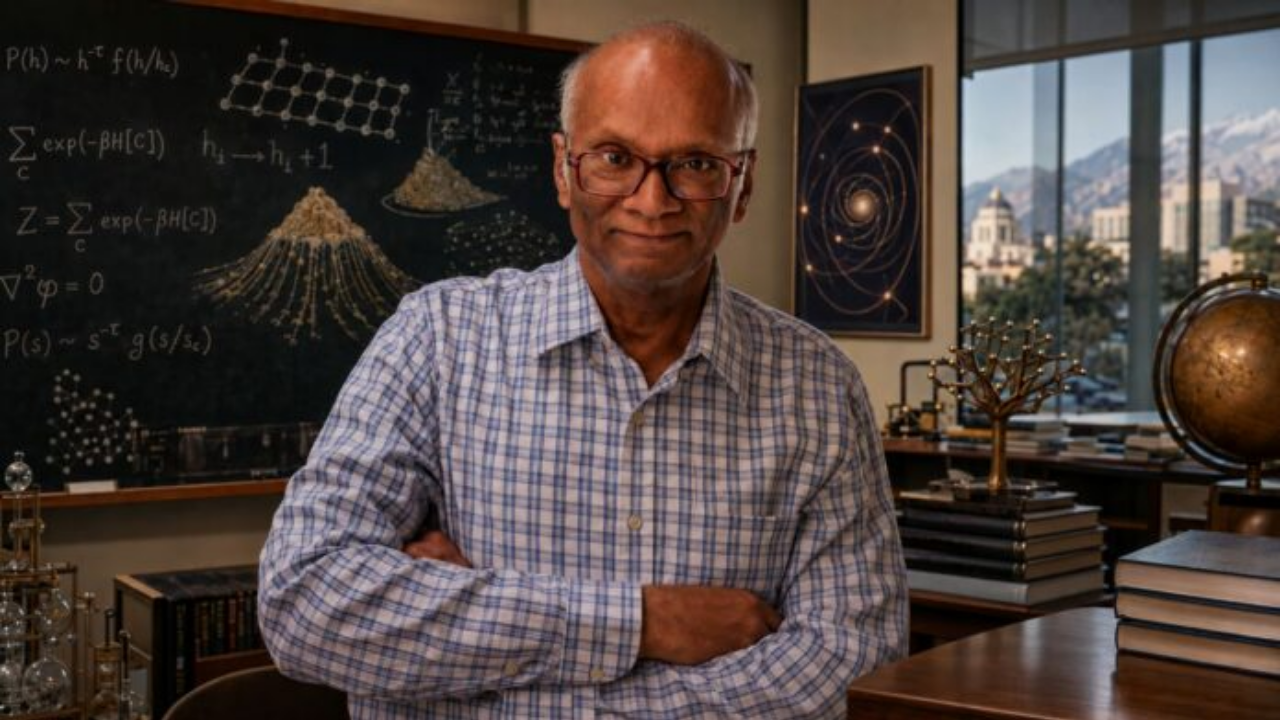
In a landmark achievement for Indian science, eminent theoretical physicist Professor Deepak Dhar has been awarded the prestigious 2026 Dirac Medal by the International Centre for Theoretical Physics (ICTP). Professor Dhar, currently an Indian National Science Academy (INSA) Distinguished Professor at the International Centre for Theoretical Sciences (ICTS-TIFR) in Bengaluru, becomes only the second Indian scientist to receive this international accolade, following string theorist Ashoke Sen in 2012.
The ICTP Dirac Medal is widely recognized as one of the highest global honors in theoretical physics. The 2026 award has been jointly conferred upon four distinguished scientists for their groundbreaking contributions to statistical mechanics and its applications to complex systems. Alongside Professor Dhar, the other three co-recipients are Bernard Derrida from France, Marc Mézard from Italy, and Haim Sompolinsky from Israel.
This high-priority update for UPSC current affairs, daily GK update, and competitive exam news today provides an exhaustive analysis of the award, Professor Dhar’s scientific career, and its direct relevance for the UPSC Civil Services Examination and State PSC tests. Candidates can access broader scientific current events via the Atharva Examwise UPSC Current Affairs Portal and track national developments through the Atharva Examwise Daily GK Updates.
Overview of the ICTP Dirac Medal and Its Historical Legacy
The Dirac Medal was instituted in 1985 by the International Centre for Theoretical Physics (ICTP) in Trieste, Italy, in honor of Paul A.M. Dirac, one of the founding fathers of modern quantum mechanics.
Award Announcement Date: The medal is traditionally announced every year on August 8, commemorating Paul Dirac’s birth anniversary.
Eligibility Criteria: The award recognizes theoretical physicists who have made significant research contributions but have not yet received the Nobel Prize or the Fields Medal.
Prestige and Legacy: Over the past four decades, the ICTP Dirac Medal has been conferred upon some of the world's most renowned theoretical physicists, including Stephen Hawking.
Indian Awardees: String theorist Professor Ashoke Sen became the first Indian to win the Dirac Medal in 2012. Professor Deepak Dhar's 2026 selection makes him the second Indian recipient of this global honor.
Further institutional insights into global physical research centers can be explored at the official International Centre for Theoretical Physics (ICTP) platform and the International Centre for Theoretical Sciences (ICTS-TIFR).
Life and Educational Journey of Professor Deepak Dhar
Born on October 30, 1951, in Pratapgarh, Uttar Pradesh, Professor Deepak Dhar spent his early childhood in a Hindi-medium educational environment. While his mother aspired for him to join the Indian Administrative Service (IAS), his father nurtured his scientific inquiry by regularly providing science literature, notably the magazine Understanding Science.
Undergraduate Studies: Completed his Bachelor of Science (B.Sc.) degree from the University of Allahabad in 1970.
Postgraduation: Earned his Master of Science (M.Sc.) degree in Physics from the Indian Institute of Technology (IIT) Kanpur in 1972.
Doctoral Research at Caltech: Traveled to the United States to join the California Institute of Technology (Caltech) under a Richard Feynman Fellowship. He completed his Ph.D. in 1978 under doctoral advisor Jon Mathews while working closely with legendary physicist Richard Feynman as his teaching assistant.
Return to India: Choosing to build his career in India, Professor Dhar joined the Tata Institute of Fundamental Research (TIFR) in Mumbai in 1978 as a research fellow, gradually rising to the position of Professor.
Academic Contributions: After nearly four decades at TIFR, he served for nearly eight years as a Distinguished Professor at the Indian Institute of Science Education and Research (IISER) Pune, before taking up his current position at ICTS-TIFR in Bengaluru.
Core Scientific Achievements: Statistical Mechanics and Complex Systems
Statistical mechanics represents the foundational branch of theoretical physics that analyzes how large collections of microscopic particles collectively interact to give rise to macroscopic physical phenomena. Professor Dhar’s research focuses on complex systems, stochastic processes, and non-equilibrium statistical mechanics.
Self-Organised Criticality and the Sandpile Model
In 1987, physicists Per Bak, Chao Tang, and Kurt Wiesenfeld proposed the concept of "self-organised criticality" to explain how complex dynamical systems spontaneously evolve toward a critical threshold. In this critical state, a minute disturbance can trigger outcomes ranging from imperceptible shifts to massive system-wide avalanches.
Professor Deepak Dhar provided the definitive mathematical framework for this phenomenon by formulating the Abelian Sandpile Model. The term Abelian signifies that regardless of the order in which sand grains topple or cascade, the final equilibrium state of the system remains identical. This insight transformed sandpile models into solvable mathematical problems, allowing physicists to calculate exact solutions for complex behaviors.
Dhar's Burning Algorithm and Interdisciplinary Applications
To determine whether a specific state in a sandpile model is recurrent, Professor Dhar introduced a mathematical technique known as Dhar's Burning Algorithm. Beyond theoretical physics, these statistical tools have provided actionable frameworks for analyzing diverse complex systems, including:
Earthquake magnitude distributions and seismic stress propagation
Urban traffic congestion and network bottleneck dynamics
Volatility, crashes, and algorithmic behaviors in financial markets
Computational neural networks and information processing in artificial intelligence
Profile of the 2026 ICTP Dirac Medal Co-Recipients
| Scientist Name | Institutional Affiliation | Primary Research Field & Key Contributions |
|---|---|---|
| Prof. Deepak Dhar | ICTS-TIFR Bengaluru, India | Exact solutions in statistical mechanics, Abelian sandpile models, and self-organised criticality |
| Prof. Bernard Derrida | Collège de France, France | Non-equilibrium statistical mechanics, disordered systems, and microscopic flow dynamics |
| Prof. Marc Mézard | Bocconi University, Italy | Spin glass theory, optimization problems, statistical physics in machine learning algorithms |
| Prof. Haim Sompolinsky | Harvard University, USA | Theoretical neuroscience, computational models of brain function, and neural network dynamics |
Major Awards and National Honors Received by Professor Deepak Dhar
| Name of Award / Honor | Awarding Institution / Body | Year |
|---|---|---|
| INSA Young Scientist Medal | Indian National Science Academy | 1983 |
| Shanti Swarup Bhatnagar Prize | CSIR, Government of India | 1991 |
| ICTP J. Robert Schrieffer Prize | ICTP, Trieste, Italy | 1993 |
| INSA S. N. Bose Medal | Indian National Science Academy | 2001 |
| TWAS Prize in Physics | The World Academy of Sciences | 2002 |
| Boltzmann Medal | IUPAP (First Indian recipient) | 2022 |
| Padma Bhushan | Government of India (Science & Engineering) | 2023 |
| ICTP Dirac Medal | ICTP, Trieste, Italy (Second Indian recipient) | 2026 |
Why this matters for your exam preparation
Understanding the scientific contributions of Professor Deepak Dhar and the prestige of the ICTP Dirac Medal is important for aspirants targeting high marks in UPSC Preliminary and Mains examinations, as well as State Public Service Commission tests.
Exam-Relevant Key Facts for UPSC Prelims & Objective Tests:
First and Second Indian Awardees: Ashoke Sen became the first Indian to win the Dirac Medal in 2012, while Deepak Dhar is the second Indian winner in 2026.
Boltzmann Medal Milestone: Professor Dhar was the first Indian scientist to receive the Boltzmann Medal in 2022, awarded triennially by the International Union of Pure and Applied Physics (IUPAP).
Civilian Honors: He was awarded the Padma Bhushan in 2023 for his service to science and engineering.
Instituting Body: The Dirac Medal is awarded by the ICTP (based in Trieste, Italy) and announced annually on August 8.
Scientific Terminology: Questions may test concepts like Self-Organised Criticality, Abelian Sandpile Model, and Statistical Mechanics in General Science modules.
Analytical Value for UPSC Mains (GS Paper III - Science & Technology):
Indigenous Research Excellence: Professor Dhar’s decision to return to India in 1978 after his Ph.D. at Caltech underscores the role of national research institutes like TIFR, IISERs, and ICTS in building world-class domestic science infrastructure.
Interdisciplinary Impact of Fundamental Research: Mains questions often address how theoretical science yields real-world technological applications. Professor Dhar’s theoretical models demonstrate how statistical physics provides foundational tools for emerging technologies, including artificial intelligence, complex neural network architecture, market volatility modeling, and disaster management systems.
Candidates can reinforce their preparation by attempting practice questions in the Atharva Examwise Science and Technology Module and subscribing to daily notifications for comprehensive current affairs updates.