
Siddi Dhamal Folk Dance of Gujarat: UPSC Current Affairs and Daily GK Update
Overview of Siddi Dhamal and Ethno-Cultural Context
In the cultural landscape of Western India, Siddi Dhamal—also known in regional traditions as Goma or Mashira Nritya—stands as a distinct testament to cross-continental migration and syncretic art. Performed primarily by the Siddi community of Gujarat, this tribal performing art integrates East African musical heritage with South Asian Sufi devotional practices. Far from being a mere form of recreational entertainment, Siddi Dhamal operates as a vital medium for preserving collective ancestral memory, religious faith, and social cohesion among Afro-Indian populations. For candidates tracking UPSC current affairs and competitive exam syllabi, this folk form provides an important case study at the intersection of tangible and intangible cultural heritage, subcontinental history, and tribal governance.
The Siddi people represent an ethno-linguistic minority of African origin whose ancestors settled in the Indian subcontinent over several centuries. Although smaller populations reside in Karnataka, Maharashtra, and Telangana, the primary hub of the community is concentrated in Gujarat. Within Gujarat, Siddis inhabit the Gir forest ecosystem, Junagadh, Jamnagar, Rajkot, Amreli, Bhavnagar, Bharuch, and the Kutch region. The village of Jambur in Junagadh district, located approximately 100 kilometers from the district center, maintains such a high concentration of the tribe that it is colloquially referred to as "Gujarat’s South Africa". Over generations, the Siddi community has adapted to local social structures by adopting the Gujarati language and regional customs, while simultaneously safeguarding key aspects of their East African ancestral lineage through performance.
| Demographic & Socio-Cultural Parameter | Analytical Details |
|---|---|
| Ethnic Ancestry | Afro-Indians descended primarily from East African Bantu populations. |
| Primary Geographic Distribution | Gujarat (Gir Forest, Junagadh, Jamnagar, Jambur, Bharuch, Kutch), Karnataka, Maharashtra, and Telangana. |
| Constitutional & Legal Classification | Scheduled Tribe (ST) status in Gujarat and Karnataka; beneficiary under the Forest Rights Act (FRA), 2006. |
| Linguistic Adaptation | Gujarati dialect integrated with Swahili Creole phrases (Kiswahili blended with Hindi, Urdu, and Gujarati). |
| Religious Practices | Predominantly Sufi Islam, incorporating ancestor worship (Hiriyaru), with smaller subsets practicing Hinduism or Christianity. |
| Key Performance Contexts | Sufi saint Urs (death anniversaries), village fairs (melas), weddings, and communal celebrations. |
Historical Migration Corridors and Diaspora Evolution
The historical trajectory of the Siddi diaspora across the Indian Ocean maritime network spans over eight hundred years. Primary historical migrations occurred between the 12th and 17th centuries, driven by Indian Ocean trade systems. Early arrivals entered the subcontinent via Arab maritime traders as early as the 10th century, followed by larger-scale transportations carried out by medieval Islamic rulers and European colonial powers, particularly the Portuguese.
Within the socio-political structures of medieval and early modern India, individuals of Siddi origin held diverse operational roles ranging from physical labor and domestic service to elevated military and administrative positions. Historical records confirm that Siddis served as sailors, traders, palace guards, army commanders, harem custodians, state treasurers, and Sufi spiritual leaders. Their physical endurance and military aptitude enabled several Siddi leaders to play decisive roles in power struggles involving the Mughal Empire, the Maratha Confederacy, and regional Sultanates. Notably, independent Siddi-ruled principalities were established at Janjira in present-day Maharashtra and Jafrabad in Gujarat.
In the Saurashtra region of Gujarat, local royal courts and the Nawab of Junagadh recruited Siddis for military service, palace security, and agricultural work. Over time, segments of the population established isolated settlements within the Gir forest region, allowing them to preserve their distinct cultural identity while gradually integrating into the local socio-economic fabric of Gujarat.
Syncretic Cosmology, Sufi Traditions, and Ritual Practices
The spiritual framework underlying Siddi Dhamal represents a syncretic blend of East African Bantu cosmology and South Asian popular Sufism. The term Dhamal itself reflects South Asian Sufi traditions denoting ecstatic, trance-like dancing, wild joy, and ascetic fire-walking, which aligns conceptually with the East African Bantu tradition of ngoma—a term that encompasses drumming, dancing, and communal ritual healing.
A foundational element of Siddi spiritual life is the veneration of Bava Gor, an Abyssinian (Ethiopian) Sufi saint who migrated to Gujarat via Nubia, Syria, and the Indian Ocean coastline, eventually settling near the carnelian mines of Ratanpur in Rajpipla. The community also honors other historical ancestor-saints, including Bava Gor's sister Mai Misra, Baba Habash, and Sidi Nabi Sultan. Shrines dedicated to these figures serve as sacred spaces where Siddi fakirs (spiritual mendicants) mediate healing powers and lead communal rituals.
The devotional compositions sung during Dhamal performances are known as zikrs (Sufi chants of divine remembrance). These chants are rendered in a Swahili Creole language that interweaves Kiswahili roots with Gujarati, Hindi, and Urdu vocabulary. For instance, zikrs composed in honor of Sidi Nabi Sultan incorporate Swahili linguistic markers such as "hu" (an expression of agreement) and "sabaya" (signifying peace or well-being), expressing faith that saintly intercession protects the community from adversity.
During peak moments of a performance, dancers frequently achieve a state of spiritual ecstasy (masti or spirit possession). In this ritual context, the dancers are viewed as temporal vehicles for the presence of ancestral Siddi saints, transforming the dance from an aesthetic display into an active sacred rite.
Musical Formats, Performing Mechanics, and Organology
Siddi Dhamal is executed in two distinct, interconnected performance formats: Baithaaki Dhamaal (seated performance) and Dance Dhamaal (kinetic performance). While both styles honor the community's spiritual lineage, they differ in their physical delivery, musical emphasis, and structural execution.
| Structural Dimension | Baithaaki Dhamaal (Seated Format) | Dance Dhamaal (Kinetic Format) |
|---|---|---|
| Primary Focus | Textual narrative, vocal melody, and poetic recitation of zikrs. | High-tempo rhythmic percussion, expressive body movements, and physical feats. |
| Performance Posture | Performed entirely in a seated circle or semicircle. | Executed standing, moving from circular group steps to fast individual acrobatics. |
| Gender Roles & Leadership | Frequently led by senior women who guide call-and-response chanting. | Historically performed by men, now featuring both male and female participants in social festivals. |
| Rhythmic Progression | Slow to moderate tempo with minimalist percussion accompaniment. | Accelerating tempo building to intense, frenzied drum rhythms. |
| Ritual Acrobatics | None; strictly focused on devotional singing. | Includes coconut cracking on the skull, fire-walking, and mimetic animal postures. |
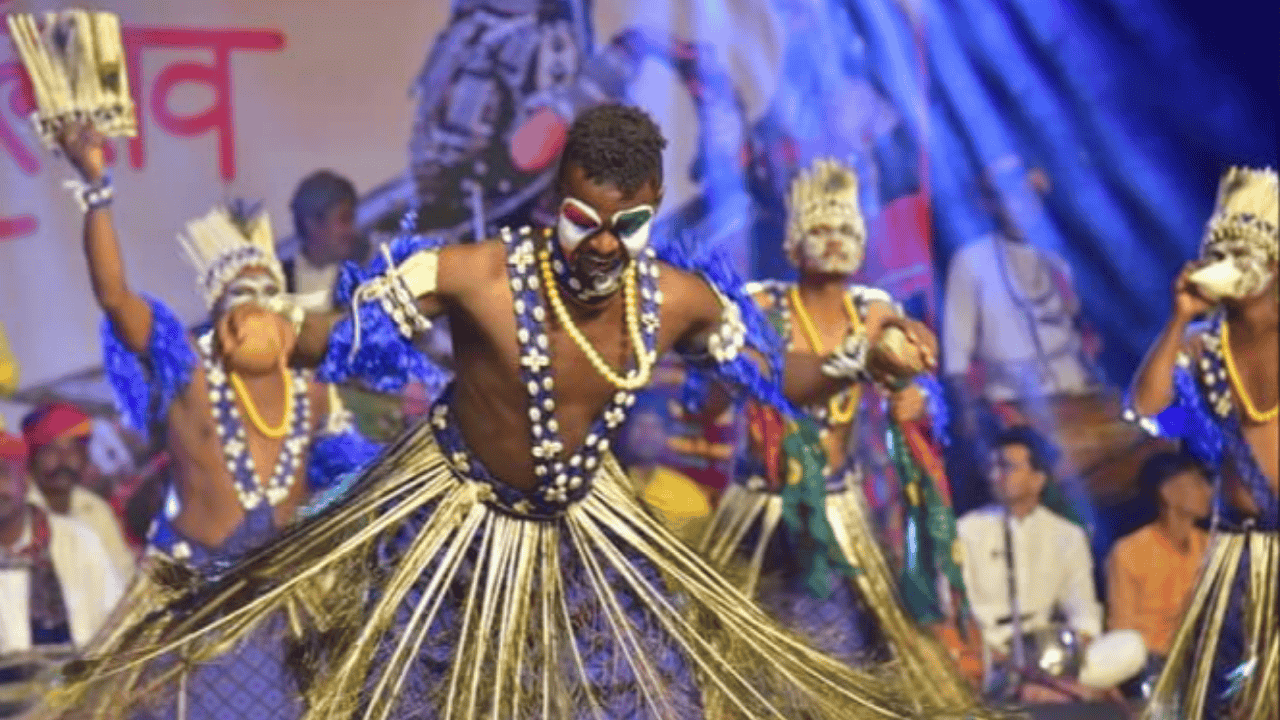
A standard Siddi Dhamal performance begins with the sounding of a conch shell (shankh), which signals the purification of the sacred floor. The performance typically starts in the slow, seated Baithaaki format, accompanied by deliberate foot-thumping—a ritual practice rooted in East African dances designed to establish a connection with the earth. As the tempo accelerates, dancers rise and form a circle around the drummers who occupy the center space.
The choreography features mimetic physical movements that simulate forest hunting practices (Misra dance), wild animals, swaying trees, and natural water bodies. Dancers demonstrate waist and neck flexibility, increasing their movement speed alongside the accelerating drum beats. Male performers wear traditional head coverings or turbans, paint their faces with intricate designs, and adorn themselves with peacock feather fans, shell-studded belts, and foliage. Female performers wear traditional garments and jewelry while leading the call-and-response vocal choruses.
The performance also includes intense physical feats:
Coconut Cracking: Dancers toss whole coconuts high into the air and catch them on their skulls, cracking the hard shell open in a display of bodily strength.
Fire-Walking: Performers tread barefoot over burning coals (live embers), symbolizing spiritual protection against physical harm.
Acrobatic Contortions: Rapid limb movements executed in synchronicity with complex rhythm structures.
The instrumentarium used in Siddi Dhamal illustrates a unique organological blend, combining East African percussion and rattle instruments with traditional South Asian instruments.
| Instrument Name | Cultural & Geographic Origin | Organological Description & Function |
|---|---|---|
| Musindo | East Africa (Kenya) | A double-sided cylindrical drum providing primary bass rhythms. |
| Mugarman | East Africa (Tanzania) | A large, single-sided cylindrical drum used to signal tempo changes. |
| Misr Kanga (Mai Misra) | East Africa (Ethiopia) | A funnel-shaped rattle filled with small stones, associated with the female saint Mai Misra. |
| Malunga | Sub-Saharan Africa | A single-string braced musical bow with a gourd resonator that produces rhythmic drone notes. |
| Mbira / Kalimba | Sub-Saharan Africa | A wooden board instrument with plucked metal tines, adding melodic texture. |
| Dholak & Nagada | South Asia (India) | Double-headed hand drums and kettle drums that reinforce accent beats. |
| Manjira & Harmonium | South Asia (India) | Hand cymbals and reed organ used to guide pitch during zikr chants. |
Socio-Legal Status and Tribal Governance Framework
In contemporary India, Siddi Dhamal serves as a key mechanism for cultural preservation and social visibility. As an Afro-Indian minority facing socio-economic challenges, the community utilizes cultural performance to assert its identity and secure livelihoods.
The legal status of the Siddi community is tied to constitutional safeguards for indigenous populations. In Gujarat and Karnataka, the Siddis are recognized as a Scheduled Tribe (ST), granting them access to affirmative action policies, educational quotas, and targeted development programs. Furthermore, under the Scheduled Tribes and Other Traditional Forest Dwellers (Recognition of Forest Rights) Act, 2006 (FRA), Siddi settlements within the Gir forest area hold statutory rights to occupy, cultivate, and manage traditional forest resources.
State cultural agencies and the Ministry of Tribal Affairs regularly feature Siddi Dhamal groups in national folk festivals and international cultural exchanges. These initiatives help preserve the performance tradition while integrating the Siddi diaspora into the broader framework of Indian cultural diplomacy.
Why this matters for your exam preparation
For candidates preparing for competitive exams like the UPSC Civil Services Examination (CSE), state PSCs, and SSC tests, tracking cultural developments updated in daily GK update modules is essential for scoring well in Art & Culture, Indian History, and Social Justice papers.
Relevance to UPSC Civil Services Examination
General Studies Paper I (Art & Culture & Indian Society):
Salient Aspects of Performing Arts: Siddi Dhamal serves as an example of folk dance traditions, tribal performing arts, and organological diversity in India.
Cultural Diversity & Syncretism: Illustrates historical Indian Ocean trade routes, Afro-Indian diaspora integration, and the blending of East African Bantu cosmology with South Asian Sufism.
General Studies Paper II (Governance & Social Justice):
Welfare Schemes for Vulnerable Sections: Provides context for examining Scheduled Tribe (ST) rights, constitutional protections under Article 342, and the implementation of the Forest Rights Act (FRA), 2006, among forest-dwelling tribal communities.
UPSC CSE Prelims (Objective General Knowledge):
Direct questions often test state-wise tribal pairings (e.g., Siddi Tribe – Gujarat/Karnataka), traditional instruments (Musindo, Mugarman, Malunga), or historical sites (e.g., Bava Gor shrine in Rajpipla).
Key Takeaways for Quick Revision
Dance Name & Synonyms: Siddi Dhamal, Goma, Mashira Nritya.
Associated Community: Siddi Tribe (Afro-Indians descended from East African Bantu populations).
Primary Geography: Gujarat (Gir Forest, Junagadh, Jamnagar, Jambur village, Bharuch) and Karnataka.
Performance Formats: Baithaaki Dhamaal (seated, lyric-focused) and Dance Dhamaal (kinetic, percussion-focused).
Spiritual Basis: Sufi devotionalism and ancestor worship (Bava Gor, Mai Misra); singing of zikrs in Swahili Creole.
Key Visual & Ritual Elements: Opening conch shell blast, face painting, peacock feather attire, cracking coconuts on head, and fire-walking.
East African Instruments: Musindo, Mugarman, Misr Kanga, Malunga, Mbira/Kalimba.
Constitutional Protection: Scheduled Tribe (ST) status; rights under the Forest Rights Act (FRA), 2006.
Aspirants can access additional analysis and exam notes on Indian folk heritage through Atharva Examwise current news and stay fully prepared for competitive exam news today.