UPSC Current Affairs Daily GK Update: Commonwealth Games 2026, Sports Governance Act 2025, and India’s Soft Power
Overview of Commonwealth Games 2026: Key Highlights and India’s Performance
The 2026 Commonwealth Games (CWG) in Glasgow presented an extraordinary test of adaptability and institutional resilience for the Indian sporting contingent. Prior to the event, expectations were calibrated downward due to severe structural alterations in the competition program. The local organizing committee removed six of the 12 sports in which India had secured medals at the 2022 Birmingham edition—a drastic reduction affecting disciplines that previously accounted for 30 of India's 61 medals. Consequently, for many national sports federations, Glasgow served less as a seasonal peak and more as a strategic checkpoint ahead of the impending Asian Games.
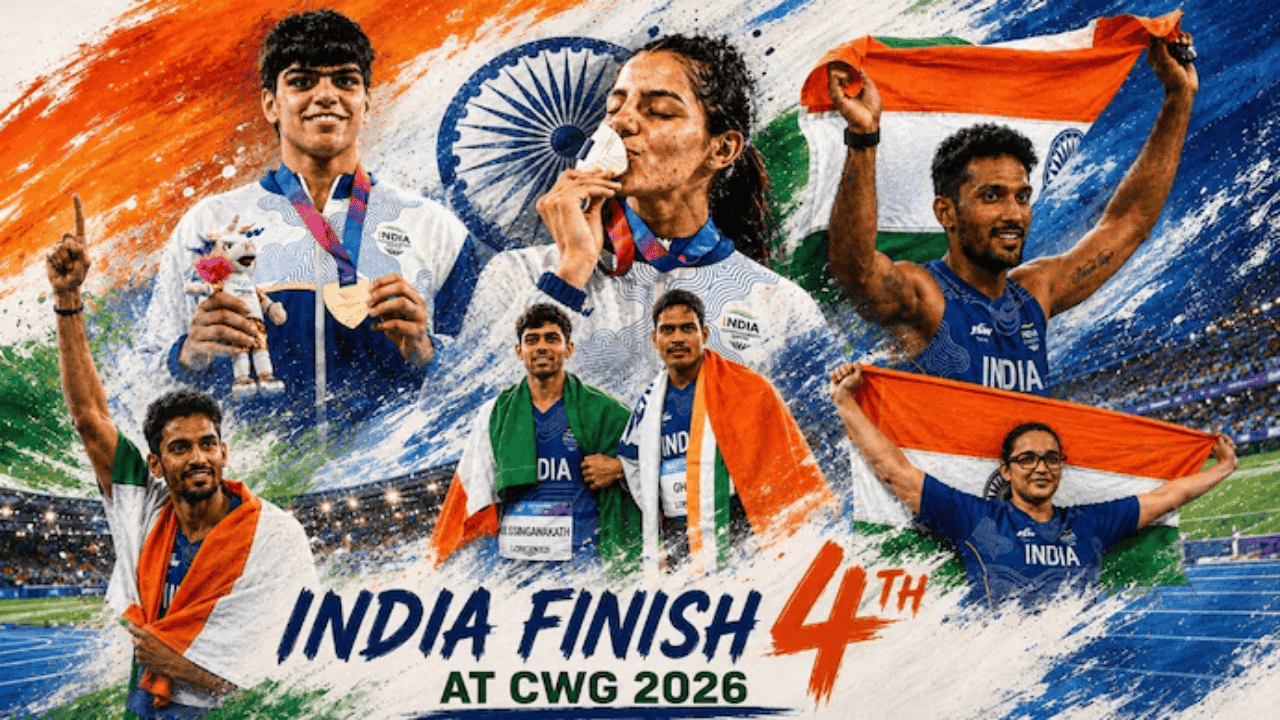
Despite these programmatic exclusions, India concluded its Glasgow 2026 campaign with an exceptional fourth-place overall finish, amassing a total of 39 medals, including 13 gold, 17 silver, and nine bronze. The campaign was defined not merely by aggregate medal volume, but by historic individual breakthroughs across track, field, ring, and mat.
| Medal Type | Medal Count | Core Contributing Disciplines |
|---|---|---|
| Gold | 13 | Boxing (7), Para-Athletics (3), Weightlifting (1), Judo (1), Track & Field (1) |
| Silver | 17 | Athletics, Boxing, Judo, Weightlifting |
| Bronze | 9 | Athletics, Judo, Wrestling/Combat Sports |
| Total | 39 | Overall Finish: 4th Position |
Key Milestones and Exam-Relevant Data
Boxing Dominance: India achieved its best-ever return in Commonwealth Games history by capturing seven gold medals in boxing, demonstrating technical dominance across multiple weight divisions.
Weightlifting Precedent: Mirabai Chanu cemented her legacy by becoming the first weightlifter in CWG history to win three consecutive gold medals across three successive editions.
Decathlon Breakthrough: Tejaswin Shankar secured India’s maiden CWG medal in the multi-discipline decathlon, highlighting expanding versatility in non-traditional events.
Distance Running Landmark: Gulveer Singh created history by securing medals in both the men’s 5,000m and 10,000m events, becoming the first Indian track and field athlete to win two individual medals at a single Commonwealth Games.
Athletics and Para-Sports Resurgence: India recorded its best track and field medal haul outside a home Games with 10 athletics medals, anchored by para-athletes who secured three gold medals.
Judo Advancement: Judo produced landmark gold and podium performances, signaling a transition from sporadic individual successes to structured national capability.
The Commonwealth of Nations: Genesis, Evolution, and Geopolitical Architecture
The Commonwealth Games is a quadrennial multi-sport event bringing together athletes from across the Commonwealth of Nations—a voluntary political association of 56 sovereign member states, the vast majority of which were formerly territories of the British Empire. First held as the British Empire Games in 1930 in Hamilton, Canada, the event has evolved through several name changes, mirroring the geopolitical decolonization of the 20th century. The title shifted to the British Empire and Commonwealth Games in 1954, the British Commonwealth Games in 1970, and finally the Commonwealth Games in 1978.
The origin of the broader political body traces back to the Balfour Declaration of 1926 at the Imperial Conference and the Statute of Westminster in 1931, which established the initial British Commonwealth of Nations among self-governing dominions. However, the modern Commonwealth of Nations was formally constituted by the London Declaration of 1949.
Upon attaining independence in 1947, India expressed a firm desire to adopt a sovereign republican constitution while retaining full membership in the association. The London Declaration resolved this constitutional paradox by declaring that sovereign republics could remain full members without swearing allegiance to the British Crown, accepting the Monarch solely as "the symbol of the free association of its independent member nations". Today, King Charles III serves as the symbolic Head of the Commonwealth, a non-hereditary role chosen by member leaders. Membership is based on voluntary cooperation, and recent additions such as Mozambique, Rwanda, Gabon, and Togo demonstrate that historical ties to the British Empire are no longer a prerequisite for entry.
India’s Historic Standing in the Commonwealth Games
India made its Commonwealth Games debut at the second edition in London in 1934 and has participated in all subsequent editions except four (1950, 1962, 1986, and 1990).
All-Time Medal Tally: Following Glasgow 2026, India has accumulated 602 total medals (215 gold, 207 silver, 180 bronze), maintaining the fourth rank on the all-time Commonwealth Games medal table.
Top Discipline: Shooting remains India’s most successful event in CWG history, yielding 135 total medals, including 63 gold medals.
Hosting Record and Future Bids: India hosted the 19th Commonwealth Games in New Delhi in 2010 (finishing second overall with 101 medals) and has designated Ahmedabad as a candidate host for the 2030 Commonwealth Games as part of a multi-decade mega-event strategy.
Comparative Analysis: Olympic Games vs. Asian Games vs. Commonwealth Games
Evaluating international multi-sport events requires a nuanced understanding of their distinct regulatory structures, field depth, and geopolitical alignments.
| Feature / Parameter | Olympic Games | Asian Games (Asiad) | Commonwealth Games (CWG) |
|---|---|---|---|
| Governing Body | International Olympic Committee (IOC) | Olympic Council of Asia (OCA) | Commonwealth Games Federation (CGF) |
| Geographic / Political Scope | Global (206 National Olympic Committees) | Continental (45 Asian National Olympic Committees) | Political Association (56 Member Nations + Territories) |
| Competitive Depth | Maximum globally across all sanctioned sports disciplines. | World-elite in archery, wrestling, shooting, table tennis, and badminton. | Variable; world-class in athletics and swimming, lower in combat sports. |
| Program Stability | High; strictly governed by the Olympic Charter. | High; broad continental representation of Olympic and regional sports. | Volatile; host cities retain wide powers to drop core disciplines. |
| Strategic Weight for India | Ultimate benchmark for national sporting excellence. | Primary metric for continental dominance and Olympic readiness. | Secondary testing ground and diplomatic soft power venue. |
Why the Asian Games is a Superior Indicator of Olympic Readiness
Sports analysts and national selectors consistently argue that the Asian Games offers a far more reliable gauge of India’s Olympic readiness than the Commonwealth Games. In core disciplines where India targets Olympic podiums—such as wrestling, shooting, archery, badminton, table tennis, weightlifting, and hockey—the Asian Games features dominant global powerhouses, including China, Japan, South Korea, Iran, and Central Asian republics. The technical field depth in these disciplines at the Asian Games directly replicates Olympic final-round conditions.
Furthermore, the Commonwealth Games Federation permits host cities extensive latitude to exclude core events to manage municipal budgets. The dropping of shooting, wrestling, and archery in recent CWG editions drastically skews India's medal returns, making CWG tallies an unreliable metric for measuring systemic Olympic progress.
Harnessing Sports Diplomacy as Soft Power in India’s Foreign Policy
As articulated by political scientist Joseph Nye, Soft Power represents the capacity of a nation to influence international actors through attraction, persuasion, and cultural appeal rather than economic coercion or military force. In modern international relations, sports diplomacy serves as a highly visible mechanism for nation-branding, bilateral bridge-building, and multilateral engagement.
India’s strategic deployment of sports diplomacy operates across several distinct dimensions:
Multilateral Reach to Small Island Developing States: Small states constitute approximately 60% of Commonwealth members. In many of these nations, India lacks formal diplomatic missions; engaging through sports provides an avenue to build diplomatic goodwill and secure crucial voting alignments in multilateral bodies like the United Nations.
Diplomatic Protocol and Distinction: Commonwealth member states exchange High Commissioners rather than Ambassadors, reflecting a unique historical association that facilitates direct diplomatic communication.
Diaspora Unification: The global Indian diaspora acts as a force multiplier during international sporting events, reinforcing cultural identity, economic linkages, and public diplomacy.
South-South Capacity Building: Providing athletic training facilities, technical coaching, and sports equipment to developing nations across Africa and Asia reinforces India’s image as a cooperative leader in the Global South.
Institutional Interventions: Evaluating Khelo India and TOPS
India's accelerating transformation into a multi-sport nation is rooted in targeted policy interventions designed to overhaul grassroots identification and elite athlete management.
Khelo India Scheme (Khelo Bharat Niti)
Replaced and updated under the National Sports Policy 2025 (Khelo Bharat Niti 2025), the Khelo India initiative targets systemic grassroots development:
Structured Competitions: Organizes annual Khelo India Youth Games, University Games, Para Games, and Winter Games to build a continuous talent pipeline.
Long-Term Financial Support: Identified talents receive financial assistance and specialized training support for up to eight years, mitigating socio-economic barriers.
Decentralized Infrastructure: Establishes district-level Khelo India Centers (KICs) to standardize coaching quality and sports science access in rural and semi-urban hubs.
Target Olympic Podium Scheme (TOPS)
Formulated by the Ministry of Youth Affairs and Sports (MYAS) through the Sports Authority of India (SAI), TOPS caters directly to elite athletes with podium potential:
Customized High-Performance Support: Directly funds international exposure trips, foreign coaches, specialized physical conditioning, and custom equipment.
Out-of-Pocket Allowance: Provides direct monthly stipends to Core and Development group athletes to ensure complete financial stability during intensive training cycles.
Biomechanical and Scientific Auditing: Employs sports psychologists, nutritionists, and data analysts to continuously optimize athlete preparation leading up to major world events.
Overhauling Indian Sports Governance: The National Sports Governance Act, 2025 and 2026 Rules
For over a decade, Indian sports administration relied on the National Sports Development Code of 2011, an executive guideline that lacked statutory enforceability. This absence of a legislative framework generated legal ambiguity, unchecked executive tenure, financial irregularities, and frequent court interventions that resulted in court-appointed ad-hoc committees running key federations.
To build a legally binding, transparent ecosystem, Parliament passed the National Sports Governance Act, 2025, which came into partial effect on January 1, 2026, alongside the notification of the National Sports Governance Board Rules, 2026 and National Sports Tribunal Rules, 2026.
Key Institutional Provisions of the 2025 Act and 2026 Rules
National Sports Board (NSB): Functions as the statutory regulator empowered to grant, suspend, or cancel recognition for National Sports Federations (NSFs), the National Olympic Committee, and the National Paralympic Committee. Government grants are strictly contingent upon NSB registration, and accounts are subject to audits by the Comptroller and Auditor General (CAG) of India.
National Sports Tribunal (NST): An independent adjudicatory body possessing the powers of a civil court to resolve sports disputes concerning selections, elections, and governance, modeled after international precedents like the Court of Arbitration for Sport (CAS).
National Sports Election Panel (NSEP): Formed to ensure fair, impartial, and standardized election processes across all recognized federations.
RTI Inclusion: Classifies all recognized sports bodies—including historically autonomous entities like the Board of Control for Cricket in India (BCCI)—as public authorities under the Right to Information (RTI) Act, 2005.
Mandatory Safe Sport Framework: Enforces strict measures against harassment, sexual abuse, and physical exploitation, requiring absolute compliance with the PoSH Act, 2013 and mandatory Internal Complaints Committees.
Athlete Representation and Gender Parity: Mandates that executive committees feature at least 10% voting members who are Sportspersons of Merit (SOMs) and that former athletes comprise at least 25% of federation executive leadership.
Tenure Caps and Age Limits: Establishes an upper age limit of 75 years for office-bearers and enforces strict term caps to eliminate entrenched administrative monopolies.
Governance Challenges and Recommended Policy Reforms
Despite legislative progress, structural hurdles persist within the sporting architecture:
Constitutional Allocation Conflict: Sports falls under Entry 33 of the State List in the Seventh Schedule of the Constitution. Enforcing a centralized Union act across state-level associations requires cooperative federalism to prevent constitutional challenge.
Autonomy Concerns under International Charters: Over-regulation by the National Sports Board risks triggering sanctions from bodies like the International Olympic Committee (IOC) or FIFA, which strictly prohibit governmental interference in national governing bodies.
To address these vulnerabilities, administrative policy should implement the recommendations of the Abhinav Bindra Task Force by transitioning federations to a competency-based management model that clearly separates policy oversight from daily operational management. Furthermore, enacting a codified, legally binding Athletes' Bill of Rights will ensure that contractual safety, medical coverage, and grievance redressal mechanisms remain institutionalized.
Related Articles on Atharva Examwise
Detailed Analysis of National Sports Governance Act 2025 and 2026 Rules
Soft Power, Sports Diplomacy, and India's Foreign Policy Priorities
Evaluating Khelo India & TOPS: Achievements and Gaps in India's Sports Ecosystem
External References
Government of India (MYAS): National Sports Governance Policy Framework
The Commonwealth Secretariat: Constitutional History & The London Declaration 1949
[cite: 1]
PRS Legislative Research: Legislative Brief on the National Sports Governance Act
[cite: 18]
Why this matters for your exam preparation
Understanding the structural, legal, and geopolitical facets of sports administration is vital for aspirants preparing for the UPSC Civil Services Examination (CSE) and state public service commissions:
UPSC Prelims (General Studies Paper I): Focuses on factual and conceptual accuracy regarding the London Declaration of 1949, Commonwealth membership criteria, statutory bodies established under the National Sports Governance Act (NSB, NST, NSEP), and constitutional entries under the Seventh Schedule.
UPSC Mains GS Paper II (Governance & International Relations): Directly applicable to questions on statutory regulatory authorities, administrative transparency, RTI applicability to private/autonomous bodies, sports diplomacy as soft power, and engagement with small island states.
UPSC Mains GS Paper III (Human Resource & Institutional Growth): Relevant for evaluating national schemes like Khelo India and TOPS, economic growth through sports infrastructure, and public policy frameworks for youth empowerment.
Essay & Personality Test: Provides analytical depth for essays on institutional reforms, gender inclusion in leadership, soft power projection, and balancing legal regulation with organizational autonomy.