
UPSC Current Affairs August 2026: Cabinet Approves ₹5,070 Crore PM Surya Sarovar Yojana | Atharva Examwise Current News & Daily GK Update
Union Cabinet Approves Pradhan Mantri Surya Sarovar Yojana (PM-SSY)
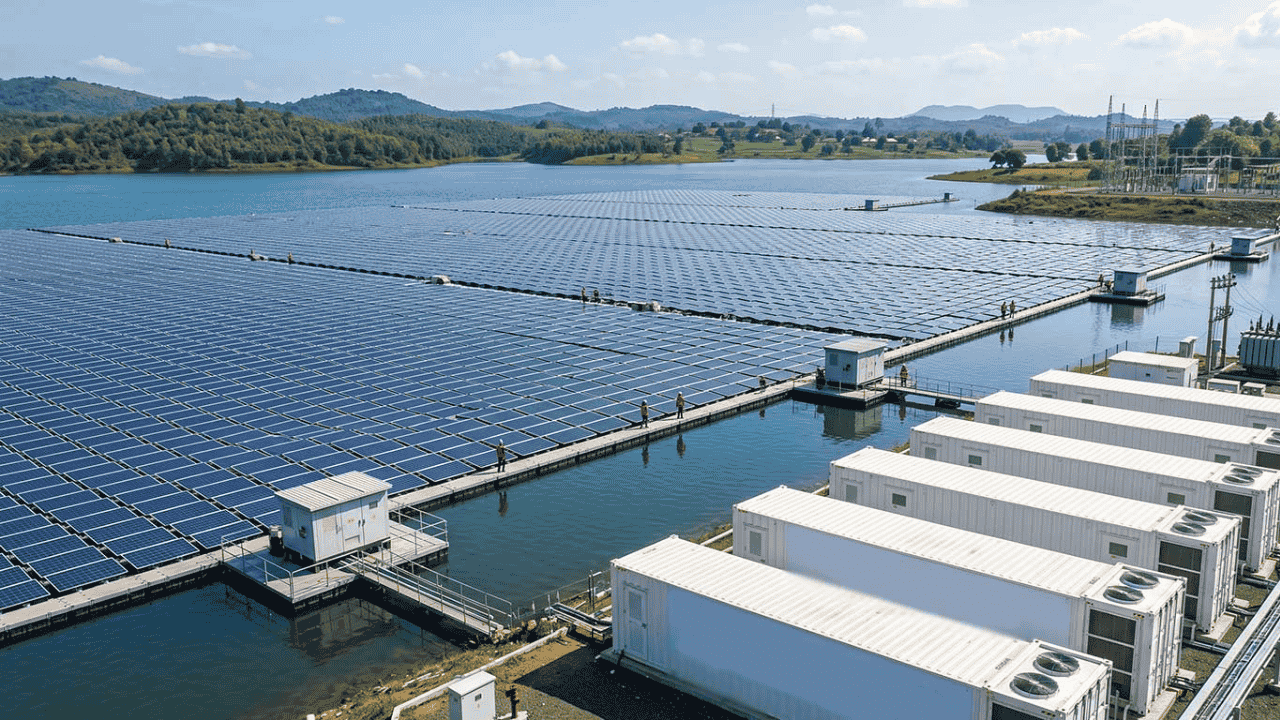
The Union Cabinet, chaired by Prime Minister Narendra Modi, approved the flagship Pradhan Mantri Surya Sarovar Yojana (PM-SSY) with a total financial outlay of ₹5,070 crore. The national scheme aims to accelerate the deployment of Floating Solar Photovoltaic (FSPV) projects integrated with co-located Energy Storage Systems (ESS) across India's water bodies. Official notifications published on the Press Information Bureau highlight that the initiative marks a major strategic transition toward utilizing water infrastructure for utility-scale clean energy generation.
Under PM-SSY, the government targets the development of 5,000 Megawatts (MW) or 5 Gigawatts (GW) of floating solar capacity. A core operational requirement of the policy is the mandatory integration of co-located Energy Storage Systems with a minimum storage duration of two hours, establishing an aggregate storage capacity of 10,000 Megawatt-hours (MWh). Project sanctions under the scheme will occur between FY 2026-27 and FY 2030-31, with Central Financial Assistance (CFA) disbursements continuing through FY 2032-33.
This scheme addresses the growing competition for land in utility-scale solar development. As an essential topic for competitive exam news today, PM-SSY establishes a framework for multi-use water body management that simultaneously expands generation capacity and strengthens national grid reliability.
Financial Architecture and Policy Framework
Subsidies, Central Financial Assistance, and Project De-risking
The financial layout of the Pradhan Mantri Surya Sarovar Yojana is structured to mitigate both early-stage development risks and long-term capital costs for developers. Central Financial Assistance (CFA) is disbursed across two distinct operational stages:
Pre-Construction De-risking Grant: To address hydro-geological uncertainties, the policy provides financial support of up to ₹50 lakh per project. This grant covers essential preparatory feasibility assessments, including bathymetric surveys, hydrographic mapping, environmental impact evaluations, and water-level variation studies.
Post-Commissioning Capital Subsidy: Eligible floating solar projects will receive a direct CFA of ₹1 crore per MW following successful commissioning and operational verification.
The scheme covers all States and Union Territories, allowing municipal bodies, state power generation companies, and private developers to utilize public reservoirs, irrigation dams, lakes, and industrial effluent ponds. By absorbing pre-construction risk through state grants, the policy encourages private capital participation in aquatic solar engineering.
Policy Comparison: PM Surya Sarovar Yojana vs. PM Surya Ghar: Muft Bijli Yojana
Aspirants tracking Atharva Examwise current news must distinguish between central schemes with similar branding. While both initiatives operate under the purview of the Ministry of New and Renewable Energy (MNRE), their targets, spatial deployments, and execution models differ substantially.
| Policy Feature | Pradhan Mantri Surya Sarovar Yojana (PM-SSY) | PM Surya Ghar: Muft Bijli Yojana |
|---|---|---|
| Primary Focus | Utility-scale floating solar with co-located storage | Residential rooftop solarization and home energy independence |
| Target Capacity / Outlay | 5,000 MW (5 GW) target with ₹5,070 crore outlay | 1 Crore residential households target |
| Surface Domain | Inland reservoirs, dams, lakes, industrial ponds | Residential roof spaces and housing society structures |
| Energy Storage Mandate | Mandatory 2-hour minimum ESS (10,000 MWh total) | Grid-tied by default; storage subsidies under discussion |
| Subsidy Structure | ₹1 crore/MW post-commissioning + ₹50 lakh feasibility grant | Direct capital subsidy up to ₹78,000 for residential systems up to 3 kW |
| Primary Beneficiaries | Power generation utilities, IPPs, State DISCOMs | Individual homeowners and Residential Welfare Associations (RWAs) |
| Key Engineering Challenge | Anchoring mooring, bathymetry, water chemistry | Rooftop structural integrity, DISCOM approvals, DCR compliance |
Resource Potential and Technical Framework
National Potential Assessment by NISE
The policy foundation of PM-SSY rests on a comprehensive assessment conducted by the National Institute of Solar Energy (NISE), an autonomous institute under the MNRE. NISE mapped major hydro-structures across India, estimating a national floating solar potential of approximately 102.18 Gigawatt-peak (GWp) across inland reservoirs and water bodies.
India's operational floating solar capacity stands at approximately 700 MW. Adding 5,000 MW under PM-SSY represents an expansion of more than seven times the existing base, tapping into a fraction of the total technical potential identified by NISE while establishing a scalable template for hydro-solar hybrid projects.
Technical Advantages and Ecological Synergies
Utility-scale ground-mounted solar installations face systemic hurdles in India, primarily due to land fragmentation, high acquisition costs, land-use conversion barriers, and local compensation claims. Floating Solar Photovoltaic (FSPV) architecture overcomes these spatial constraints by utilizing existing water surfaces, eliminating competition for fertile agricultural or forested land.
Beyond land conservation, FSPV technology offers distinct thermodynamic and environmental advantages:
The operating efficiency of silicon solar panels decreases as temperatures rise. Placing PV arrays on water creates a natural cooling effect beneath the panels. This microclimatic thermal moderation helps maintain panel temperatures closer to optimal levels, generating higher power output during hot summer months compared to ground-based panels exposed to high thermal radiation.
From a water management perspective, floating solar arrays shade the underlying water surface. This physical barrier reduces evaporative water loss, preserving water reserves in reservoirs located in arid and drought-prone regions where conservation directly supports agricultural irrigation and drinking water supplies.
Furthermore, integrating a mandatory two-hour Energy Storage System (ESS) addresses the intermittent nature of solar generation. Storing excess power during peak daylight hours allows the ESS to feed power back into the grid during evening demand peaks, providing voltage support, smoothing generation fluctuations, and enhancing overall grid stability.
Socio-Economic, Industrial, and Environmental Impact
The Pradhan Mantri Surya Sarovar Yojana directly supports India's updated Nationally Determined Contributions (NDCs) under the Paris Agreement and aligns with the national target of reaching 500 GW of non-fossil energy capacity by 2030.
The macroeconomic and ecological impact of the scheme includes several key metrics:
Emissions Reduction: The deployment of 5,000 MW of FSPV capacity is projected to cut carbon dioxide ($\text{CO}_2$) emissions by approximately 10 million tonnes annually.
Employment Creation: Project execution, maintenance, and supply chain operations are expected to create 16,000 to 17,000 full-time equivalent (FTE) jobs, generating technical employment in rural and peri-urban hydro-clusters.
Domestic Industrial Growth: To qualify for financial assistance, projects must comply with domestic content guidelines, boosting domestic manufacturing of specialized floaters, anchoring systems, PV modules, and energy storage equipment under the Aatmanirbhar Bharat initiative.
This sustainable energy push links with broader structural reforms across key sectors, such as the digital public infrastructure developments analyzed in our coverage of the Bharat-VISTAAR AI tool and cooperative service models examined in our review of Bharat Taxi.
Key Facts and Data for Competitive Exams
For rapid revision and daily GK updates, candidates should memorize the following facts:
Scheme Name: Pradhan Mantri Surya Sarovar Yojana (PM-SSY)
Nodal Ministry: Ministry of New and Renewable Energy (MNRE)
Total Outlay: ₹5,070 crore
Target Capacity: 5,000 MW (5 GW) floating solar PV
Energy Storage Mandate: Minimum 2 hours of storage (10,000 MWh total)
Assessed Potential: 102.18 GWp across reservoirs and water bodies (NISE survey)
Current Floating Solar Capacity: ~700 MW
Central Financial Assistance (CFA):
Feasibility study grant: Up to ₹50 lakh per project
Post-commissioning grant: ₹1 crore per MW
Sanction Window: FY 2026-27 to FY 2030-31
Disbursement Window: Up to FY 2032-33
Carbon Offset: ~10 million tonnes of $\text{CO}_2$ per year
Job Creation: 16,000 to 17,000 full-time equivalent (FTE) jobs
Why this matters for your exam preparation
Analyzing the Pradhan Mantri Surya Sarovar Yojana provides candidates with exam-relevant insights across multiple stages of competitive examinations.
Relevance for UPSC Prelims
For the preliminary exam, questions often test specific facts, financial numbers, and institutional roles. Candidates should focus on:
Recalling exact financial figures (₹5,070 crore outlay, ₹1 crore/MW commissioning subsidy, ₹50 lakh feasibility grant).
Differentiating PM-SSY (floating utility solar with storage) from PM Surya Ghar (residential rooftop solar).
Identifying the assessing institution (NISE 102.18 GWp potential study) and baseline statistics (~700 MW existing capacity).
Relevance for UPSC Mains (GS Paper 2 & GS Paper 3)
In GS Paper 3 (Economy, Infrastructure, Energy, Environment):
Energy Infrastructure & Grid Stability: PM-SSY provides a concrete case study on how combining Energy Storage Systems (ESS) with solar generation solves the problem of renewable power intermittency.
Land-Neutral Infrastructure: Serves as an example of policy design that expands energy infrastructure without triggering land acquisition disputes or diverting agricultural land.
Climate Commitments: Provides quantitative data points (10 million tonnes $\text{CO}_2$ reduced per year) to demonstrate India's progress toward its 2030 NDCs and long-term Net-Zero target.
In GS Paper 2 (Governance, Policy Implementation, Federalism):
Intergovernmental Coordination: The scheme covers all States and UTs, requiring cooperation between central ministries, state water resource departments, power generation utilities, and DISCOMs.
De-risking Private Investment: Demonstrates how state-funded pre-feasibility grants (bathymetry and hydrography assessments) reduce early-stage risk for private developers in public-private partnerships (PPPs).
Essay and Interview Perspectives
In the Essay Paper and Personality Test, candidates can highlight PM-SSY as an example of resource optimization and green engineering. Deploying solar panels on existing reservoirs addresses two challenges at once: saving land and conserving water by reducing evaporation.
Using this case study shows an understanding of how clean energy policy, spatial management, and financial incentives work together to advance sustainable growth. Similar structural frameworks in grassroots sports governance and human capital development are explored in our coverage of women's sports policy initiatives.