
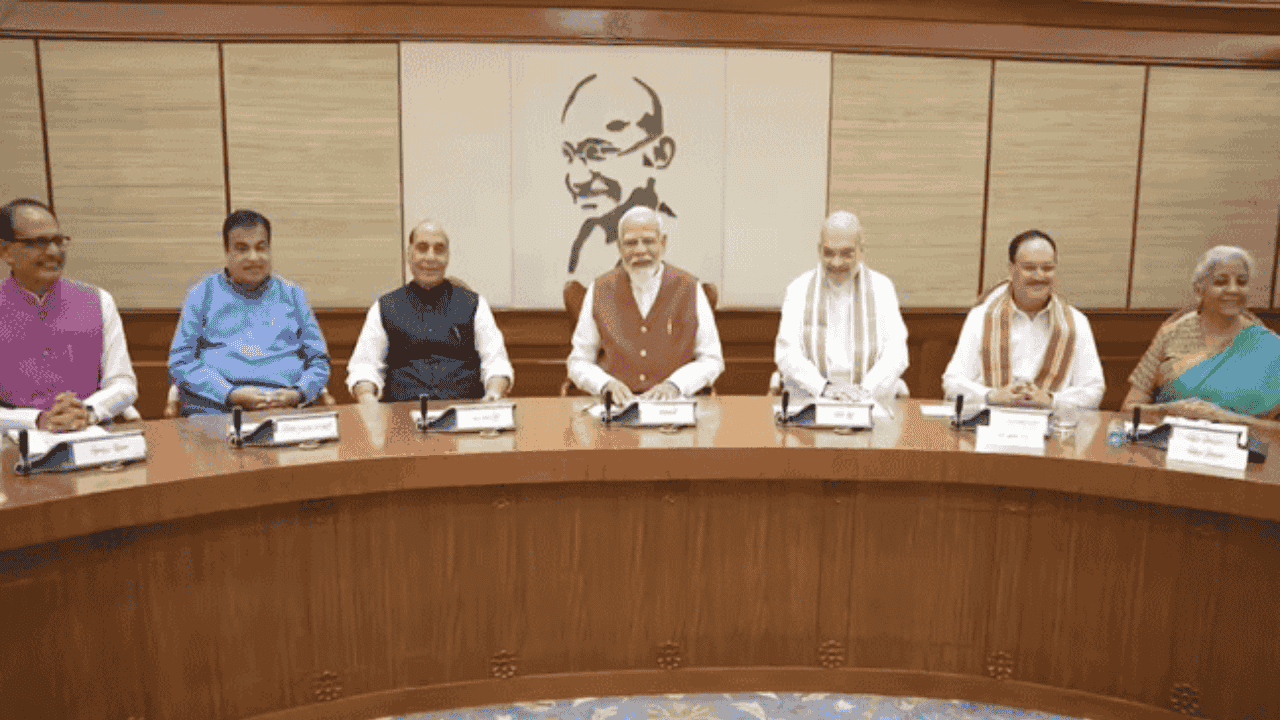
Daily Current Affairs Update: Union Cabinet Approves PM-KISAN Extension, PM Surya Sarovar Yojana, Samudra Manthan Scheme, and Revamped Khelo India
The Union Cabinet has approved a series of policy decisions spanning agricultural income support, renewable energy generation, deepwater hydrocarbon exploration, and sports infrastructure development. These structural initiatives reflect a coordinated government strategy to enhance rural resilience, transition toward sustainable power generation, strengthen domestic energy sovereignty, and institutionalize grassroots athletic development.
For civil services aspirants, these Cabinet approvals provide crucial material for General Studies Paper II (Governance, Welfare Schemes, and Institutional Frameworks) and General Studies Paper III (Agriculture, Energy Security, Industrial Policy, and Environmental Conservation). Further updates and analytical breakdowns can be accessed via the Atharva Examwise Daily Current Affairs Portal.
Extension of Pradhan Mantri Kisan Samman Nidhi (PM-KISAN) for 2026–2031
The Union Cabinet has approved the continuation of the Pradhan Mantri Kisan Samman Nidhi (PM-KISAN) scheme for a five-year period spanning FY 2026–27 to FY 2030–31, backed by a financial allocation of ₹3.15 lakh crore.
| Parameter | Policy Detail |
|---|---|
| Nodal Ministry | Ministry of Agriculture & Farmers Welfare |
| Scheme Classification | Central Sector Scheme (100% Centrally Funded) |
| Approved Outlay (2026–31) | ₹3.15 lakh crore |
| Direct Assistance Structure | ₹6,000 per year in three equal instalments of ₹2,000 via Direct Benefit Transfer (DBT) |
| Cumulative Disbursal (Launch to Date) | Over ₹4.47 lakh crore across 23 instalments |
| 23rd Instalment Disbursal | ₹18,984 crore transferred to over 9.49 crore farmer families |
| Gender Inclusion Metric | Over ₹1.06 lakh crore disbursed to female farmers (nearly 1 in 4 beneficiaries) |
Key Facts and Exam-Relevant Data
Operational Architecture: PM-KISAN is a Central Sector Scheme providing ₹6,000 annually to eligible landholding farmer families in three equal quarterly instalments of ₹2,000 transferred directly into Aadhaar-linked bank accounts.
Scale of Direct Benefit Transfer (DBT): Since its launch in February 2019, the scheme has transferred over ₹4.47 lakh crore. In the 23rd instalment, more than 9.49 crore farmers received ₹18,984 crore.
Safety Net during Exogenous Shocks: During the COVID-19 pandemic, the platform facilitated direct liquidity support exceeding ₹1.71 lakh crore to maintain rural household demand.
Impact on Agricultural Productivity: An evaluation by NITI Aayog's Development Monitoring and Evaluation Office (DMEO) reveals that 92% of beneficiaries utilize PM-KISAN transfers to purchase agricultural inputs such as high-yielding seeds, fertilizers, and irrigation equipment. Approximately 85% of recipient households reported increased farm income and lower dependence on informal micro-lenders.
Macro Output Performance: Between 2020–21 and 2025–26, coordinated support measures contributed to a 9.65% expansion in cultivated land area, a 10.53% increase in crop yield productivity, and a 21.18% overall increase in national foodgrain production.
Pradhan Mantri Surya Sarovar Yojana (PM-SSY): Floating Solar and Energy Storage
To address land scarcity in solar deployment, the Cabinet cleared the Pradhan Mantri Surya Sarovar Yojana (PM-SSY) under the Ministry of New and Renewable Energy (MNRE). The scheme is allocated ₹5,070 crore for execution between FY 2026–27 and FY 2030–31, with financial disbursements continuing through FY 2032–33.
| Operational Metric | Target / Benchmark |
|---|---|
| Total Financial Allocation | ₹5,070 crore |
| Targeted Floating Solar PV Capacity | 5,000 MW (5 GW) |
| Co-located Energy Storage Systems (ESS) | 10,000 MWh (Minimum 2-hour discharge capacity) |
| National Potential (NISE Assessment) | 102.18 GWp across inland water reservoirs |
| Baseline Floating Solar Capacity | ~700 MW |
| Capital Financial Assistance (CFA) | ₹1 crore per MW post-commissioning |
| Project Feasibility Subsidy | Up to ₹50 lakh per project for preparatory studies |
Key Facts and Exam-Relevant Data
Overcoming Land Bottlenecks: PM-SSY deploys Floating Solar Photovoltaic (FSPV) arrays on existing hydroelectric reservoirs, industrial ponds, and inland water bodies, preserving arable land while reducing water evaporation losses from reservoirs.
Mandatory Storage Integration: Projects must integrate co-located Energy Storage Systems (ESS) providing a minimum storage duration of two hours (10,000 MWh total) to reduce output intermittency and stabilize grid frequencies.
Financial Subsidies & Risk Mitigation: The scheme provides Central Financial Assistance (CFA) of ₹1 crore per MW upon successful commissioning. It also grants up to ₹50 lakh per project for pre-development feasibility studies, including bathymetric surveys, hydrographic mapping, and environmental impact assessments.
Climate and Economic Outcomes: PM-SSY is projected to reduce carbon dioxide emissions by approximately 10 million tonnes annually while generating 16,000 to 17,000 full-time equivalent jobs across domestic float manufacturing and photovoltaic component assembly. Official details are published on the Press Information Bureau (PIB).
Samudra Manthan Scheme: National Offshore Exploration Mission
To lower crude oil import dependencies, the Union Cabinet approved Samudra Manthan – The National Offshore Exploration Scheme, administered by the Ministry of Petroleum & Natural Gas. The Central Sector Scheme has an approved budget of ₹84,084 crore for implementation through FY 2030–31.
| Scheme Component | Allocated Outlay (₹ Cr) | Functional Sub-Allocation & Metrics |
|---|---|---|
| Offshore Data Acquisition | ₹28,534 | • ₹12,000 Cr for 2D Seismic basin-wide coverage
• ₹12,534 Cr for 3D Seismic data collection
• ₹4,000 Cr for NDR data re-processing with AI tools |
| Deepwater Exploratory Drilling | ₹43,200 | • Cost-sharing subsidies for 60 deepwater & ultra-deepwater wells
• Support up to 50% of cost or ₹650–675 Cr per well |
| Production & Evacuation Infrastructure | ₹10,000 | • Construction of shared offshore processing platforms & pipeline evacuation facilities |
| Oil & Gas Manufacturing Zones | ₹2,000 | • Establishment of domestic equipment manufacturing and servicing hubs |
| Digital Program Management | ₹350 | • Capacity building, international technology adoption, and digital monitoring |
Key Facts and Exam-Relevant Data
Macroeconomic Rationale: India is the world's third-largest crude oil consumer, with an annual import bill of nearly USD 144 billion (~₹13 lakh crore). Samudra Manthan aims to boost domestic production and improve energy security.
Public Risk-Sharing Mechanism: Deepwater exploratory drilling costs range from $100 million to $250 million per well. The scheme mitigates commercial exploration risks by covering up to 50% of drilling costs (capped at ₹650 to ₹675 crore per well) for 60 deepwater exploratory wells.
Targeted Output and Reserve Additions: Subject to exploration success, the scheme aims to add over 600 Million Metric Tonnes of Oil Equivalent (MMTOE) to national reserves, increase domestic oil and gas output from 62 MMTOE to 80 MMTOE annually, expand the hydrocarbon resource base from 1.6 billion to 2.2 billion TOE, and reduce annual crude oil import costs by nearly ₹1 lakh crore.
Upstream Policy Reforms: Samudra Manthan builds upon earlier policy changes under the Open Acreage Licensing Policy (OALP) and Hydrocarbon Exploration and Licensing Policy (HELP), which opened over 99% of previously restricted maritime zones within India's Exclusive Economic Zone (EEZ).
Revamped Khelo India Scheme and Support to National Sports Federations
The Union Cabinet approved the continuation and restructuring of the Khelo India Scheme alongside support for National Sports Federations (NSFs) for the 2026–27 to 2030–31 cycle, backed by a budget of ₹36,441 crore.
| Policy Dimension | Operational Framework |
|---|---|
| Total Allocation | ₹36,441 crore (2026–27 to 2030–31) |
| Nodal Agency | Ministry of Youth Affairs and Sports |
| Talent Identification Pipeline | Early-stage athletic tracking starting at the school level |
| Governance Structure | Establishment of a Coach Accreditation Board |
| Digital Infrastructure | Deployment of an Integrated Digital Sports Platform |
Key Facts and Exam-Relevant Data
Grassroots Talent Identification: Institutionalizing talent identification across primary and secondary schools, integrating local competitions into a centralized talent database.
Regulatory Standardizing: Establishing a Coach Accreditation Board to regulate coaching qualifications, certification standards, and training benchmarks across disciplines.
Digital Ecosystem: Creating an Integrated Digital Sports Platform to streamline scholarship distribution, monitor athlete progress, and track sports infrastructure utilization.
High-Performance Integration: Providing qualified athletes with access to sports science, biomechanics support, physical conditioning, and international competition exposure.
Master Summary of Cabinet Approvals (2026–2031)
| Scheme | Nodal Ministry | Approved Allocation | Key Target |
|---|---|---|---|
| PM-KISAN Scheme | Agriculture & Farmers Welfare | ₹3.15 lakh crore | ₹6,000/year income support via DBT; enhanced foodgrain production |
| PM Surya Sarovar Yojana | New and Renewable Energy | ₹5,070 crore | 5,000 MW floating solar + 10,000 MWh battery storage capacity |
| Samudra Manthan Scheme | Petroleum & Natural Gas | ₹84,084 crore | Reserve addition of 600 MMTOE; reduce oil imports by ₹1 lakh crore/yr |
| Revamped Khelo India | Youth Affairs & Sports | ₹36,441 crore | School-level talent pipeline; Coach Accreditation Board |
Why this matters for your exam preparation
Understanding these Union Cabinet decisions is essential for candidates preparing for competitive examinations. Below is a detailed breakdown connecting these policy initiatives to the exam syllabus, along with practice questions.
GS Paper II: Governance, Welfare Schemes, and Public Policy
Direct Benefit Transfer Mechanics: PM-KISAN illustrates how Direct Benefit Transfers (DBT) and JAM (Jan Dhan-Aadhaar-Mobile) integration help eliminate leakages and reduce administrative overheads.
Sports Governance and Institutional Reforms: The creation of a Coach Accreditation Board and an Integrated Digital Sports Platform under Khelo India provides a reference case for institutional reform and administrative transparency in national sports development.
GS Paper III: Economic Growth, Agriculture, Energy, and Environment
Agricultural Capital Investment vs. Income Support: NITI Aayog's DMEO evaluation provides data on how cash transfers help smallholder farmers purchase capital inputs, offering a useful perspective for questions on agricultural subsidies and income support.
Land-Energy-Water Nexus: PM-SSY addresses the competing demands for land, energy, and water by deploying floating photovoltaic systems on water reservoirs, illustrating how clean energy can expand without consuming agricultural land.
Public Risk-Sharing in Deepwater Exploration: The Samudra Manthan scheme provides an example of state-supported risk-sharing in capital-intensive, high-risk deepwater exploration to strengthen national energy security.
Sample Practice Questions for Aspirants
Prelims Practice Question
Which of the following statements regarding the Pradhan Mantri Surya Sarovar Yojana (PM-SSY) is/are correct?
It is implemented by the Ministry of Power.
It mandates the integration of co-located Energy Storage Systems with floating solar installations.
Central Financial Assistance (CFA) is provided after successful project commissioning.
Select the correct answer using the code below:
(a) 1 and 2 only
(b) 2 and 3 only
(c) 1 and 3 only
(d) 1, 2, and 3
Answer: (b). Explanation: Statement 1 is incorrect because PM-SSY is administered by the Ministry of New and Renewable Energy (MNRE). Statement 2 is correct as co-located storage with at least two hours capacity is mandatory. Statement 3 is correct because CFA of ₹1 crore/MW is disbursed following successful project commissioning.
Mains Practice Question
"While Direct Benefit Transfer (DBT) schemes provide vital liquidity support to smallholder farmers, long-term agricultural sustainability relies on structural infrastructure investments." Analyze this statement in the context of the PM-KISAN extension and recent agricultural growth trends. (250 Words, 15 Marks)
Aspirants are advised to incorporate these policy metrics, ministry designations, and economic targets into their structured revision notes. Comprehensive current affairs coverage and mock evaluations are accessible via the Atharva Examwise Portal.