NASA PRAXIS Mission: UPSC Current Affairs, Daily GK Update & Competitive Exam News Today
Overview of NASA PRAXIS Mission
In July 2026, the National Aeronautics and Space Administration (NASA) officially selected the Planetary Rings Autonomous EXploration with In-situ Sampling (PRAXIS) mission concept for Phase I development under the NASA Innovative Advanced Concepts (NIAC) program. Conceptualized at NASA's Jet Propulsion Laboratory (JPL) in Pasadena, California, under Principal Investigator Dr. B. Marco Quadrelli, the PRAXIS project introduces a novel robotic approach designed to directly sample and analyze individual particles from planetary ring systems. While previous deep-space missions relied primarily on remote optical sensing or passive dust collection during high-speed flybys, PRAXIS incorporates artificial intelligence (AI), bio-inspired robotics, and miniaturized laboratories to conduct direct physical and elemental measurements inside high-hazard ring environments. Candidates analyzing international space technology trends can review additional developments on the Atharva Examwise Current News Portal.
Scientific Objectives and Target Celestial Bodies
The core scientific objective of the PRAXIS mission is to resolve long-standing questions regarding the formation, microphysical structure, and dynamic evolution of planetary rings. The spacecraft targets millimeter- to centimeter-scale (mm to cm) particles—a specific size regime that bridges microscopic dust grains and macroscopic, house-sized boulders that earlier missions could not directly isolate or measure. Onboard instrumentation will measure particle size distributions, physical porosity, and elemental composition on site.
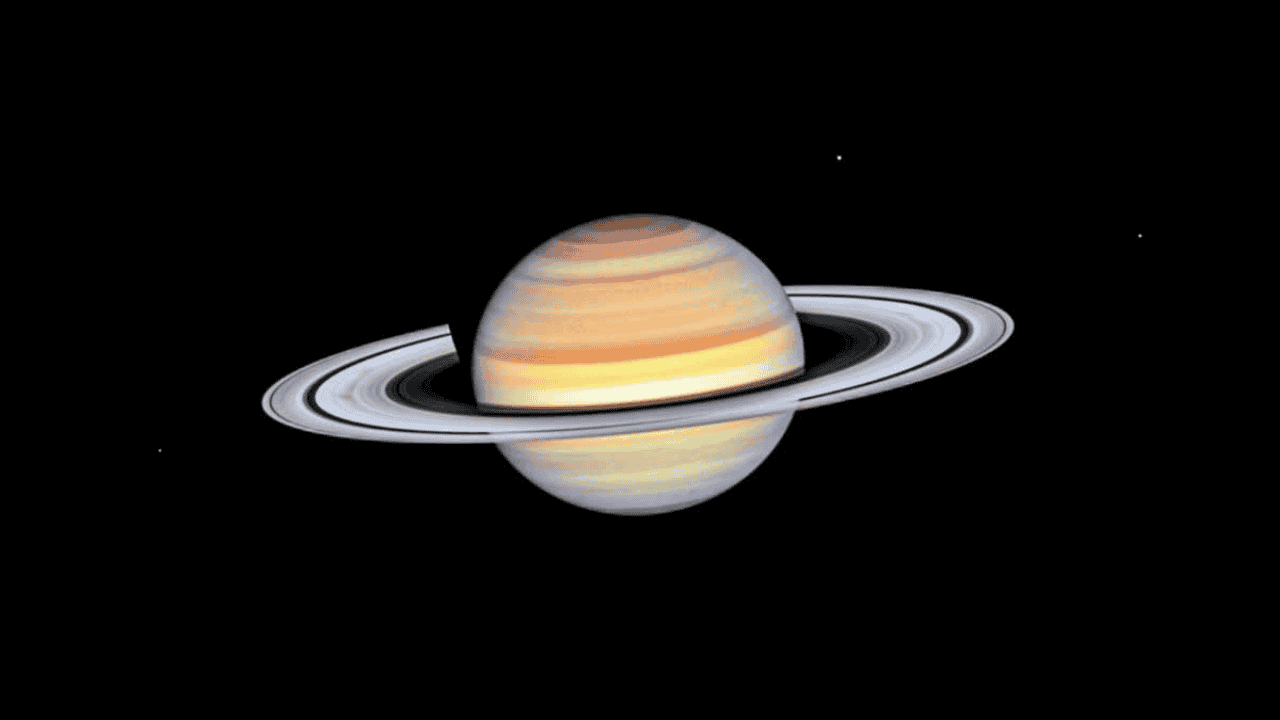
While Saturn's extensive and highly reflective ring system represents the primary operational model, the underlying technology is versatile enough to be deployed across multiple outer solar system targets. These target environments include the tenuous ring systems surrounding Uranus and Neptune, Centaur objects such as 10199 Chariklo and 2060 Chiron, and early circumstellar or protoplanetary disks. In addition, PRAXIS aims to investigate localized microphysical structures at fine spatial resolution, including self-gravity wakes, density waves, gap edges, and gravitational propellers generated by embedded moonlets.
Technological Architecture and Operational Mechanics
Navigating within a planetary ring plane presents severe operational risks, as millions of ice and rock particles orbit at rapid relative velocities, making direct traversal dangerous for traditional spacecraft. Furthermore, the multi-hour signal transmission delay between Earth and the outer solar system renders real-time teleoperation from ground stations impossible. PRAXIS addresses these operational constraints by maintaining the primary spacecraft in a safe "grazing" orbit hovering just outside or above the outer boundary of the ring plane. Integrated AI models continuously evaluate the moving particle field to select suitable targets while executing real-time collision avoidance maneuvers.
Particle collection utilizes an extended, soft, deployable robotic boom that executes an agile "touch-and-go" maneuver to collect free-floating particles using techniques adapted from sport-casting mechanics. Immediately following capture, miniaturized onboard analytical instruments examine the sample's physical structure and chemical composition before the spacecraft navigates to adjacent gaps or regions for comparative multi-site sampling. During NIAC Phase I, research focuses on computer simulations and preliminary system design, establishing the groundwork for physical prototype testing in Phase II and potential integration into future exploration missions, such as the proposed Uranus Probe.
Comparative Analysis: Cassini Mission vs. PRAXIS System
To understand the technological advancement represented by PRAXIS, candidates should contrast its operational profile with that of NASA's historic Cassini-Huygens mission.
| Mission Parameter | Cassini Mission (2004–2017) | PRAXIS Mission Concept (NIAC 2026) |
|---|---|---|
| Lead Agency & Facility | NASA / ESA / ASI (Managed by NASA JPL) | NASA Jet Propulsion Laboratory (PI: Dr. B. Marco Quadrelli) |
| Primary Sensing Method | Remote optical imaging and passive dust flyby analysis | Direct physical touch-and-go in-situ particle sampling |
| Target Particle Size | Macroscopic ring structures and sub-micron dust | Millimeter- to centimeter-scale particles (mm to cm) |
| Autonomous Control | Pre-programmed command sequences from Earth | Onboard AI for real-time collision avoidance & selection |
| Sampling Mechanism | Cosmic Dust Analyzer during planetary flybys | Soft deployable boom with sport-casting capture tech |
| Target Environment | Saturn planetary system exclusively | Saturn, Uranus, Neptune, Centaurs, and protoplanetary disks |
| Future Infusion Status | Concluded via controlled entry into Saturn in 2017 | Candidate technology for the upcoming Uranus Probe mission |
Astrophysical Context: Planetary Ring Systems and the Roche Limit
Planetary ring systems consist of disc-shaped collections of water ice, silicate dust, and rocky debris orbiting within or near a primary planet's Roche limit. The Roche limit defines the minimum distance at which a celestial body, held together solely by its own gravity, can approach a second primary body without being torn apart by tidal forces. Within this critical boundary, planetary tidal forces overcome the mutual gravitational attraction of orbital debris, preventing individual particles from coalescing into larger satellites.
Saturn's rings are approximately 99% pure water ice, with minor rock and dust contaminants, behaving as dynamic rubble piles that continuously collide, break apart, and re-accrete. By measuring particle porosity and elemental composition directly in space, PRAXIS will determine whether ring material represents primordial remnants from the solar system's protoplanetary accretion disk or fragments resulting from the catastrophic destruction of ancient icy moons.
NASA NIAC 2026 Selected Concepts
The NASA Innovative Advanced Concepts (NIAC) program operates under the agency's Space Technology Mission Directorate (STMD) to support early-stage, high-risk aerospace concepts capable of advancing future space exploration. The portfolio below outlines notable Phase I projects selected alongside PRAXIS. Additional details regarding program structures can be reviewed at the official NASA NIAC Program Page.
| Project Title | Principal Investigator | Organization | Core Technological Focus |
|---|---|---|---|
| PRAXIS | Dr. B. Marco Quadrelli | NASA Jet Propulsion Laboratory | AI-driven autonomous direct sampling of planetary ring particles |
| DimSun | Saptarshi Bandyopadhyay | NASA Jet Propulsion Laboratory | Controllable dust cloud array to modulate solar insolation |
| CANVAS | David Bugby | NASA Jet Propulsion Laboratory | Adaptable mobile architectures for high-durability Venus operations |
| Actively Steerable Femtosat Constellations | Michael Rubenstein | Northwestern University | Swarm femtosatellites for multi-point ring and magnetosphere sensing |
| OBLIVION | Jeff Nosanov | Orbital Velocity, LLC | Optical intensity correlation systems for black hole observations |
Key Examination Facts and Data Highlights
Official Mission Title: Planetary Rings Autonomous EXploration with In-situ Sampling (PRAXIS).
Funding Agency & Program: NASA Space Technology Mission Directorate via NIAC 2026 Phase I.
Lead Research Institution: NASA Jet Propulsion Laboratory (JPL), Pasadena, California.
Principal Investigator: Dr. B. Marco Quadrelli.
Target Particle Scale: Millimeter- to centimeter-scale (mm to cm) particles.
Primary Technical Innovations: AI-driven bio-inspired robotics, deployable soft boom, sport-casting capture system, and miniaturized onboard laboratories.
Target Planetary Objects: Saturn, Uranus, Neptune, Centaurs (Chariklo and Chiron), and circumstellar disks.
Why This Matters for Your Exam Preparation
Understanding developments in space technology and deep-space missions is critical for candidates preparing for competitive examinations such as the UPSC Civil Services Examination (CSE) and State Public Service Commission (State PCS) tests.
Relevance for UPSC CSE Examinations
UPSC Prelims (GS Paper I - Science & Technology): Exam questions frequently focus on international space missions, agency frameworks, and fundamental physics concepts. Key topics include NASA's NIAC program structure, planetary ring dynamics, the Roche limit, and collision-avoidance mechanisms in space robotics.
UPSC Mains (GS Paper III - Science & Technology): Aspirants can utilize PRAXIS as a practical case study illustrating the integration of Artificial Intelligence (AI) and robotics in extreme environments. The transition from pre-programmed ground telemetry to real-time AI decision-making highlights a central theme in modern technological advancement.
UPSC Mains (GS Paper I - Physical Geography): Offers foundational observational data regarding the accretion, structural evolution, and tidal dynamics of solar system celestial bodies.
For structured study materials and complete current affairs coverage, candidates can consult the Atharva Examwise Science and Technology Module.