
UPSC Current Affairs July 2026: Daily GK Update and Atharva Examwise Current News on Greco-Buddhist Gandhara Art
Historical Evolution of Gandhara Art: The Intersection of Empires
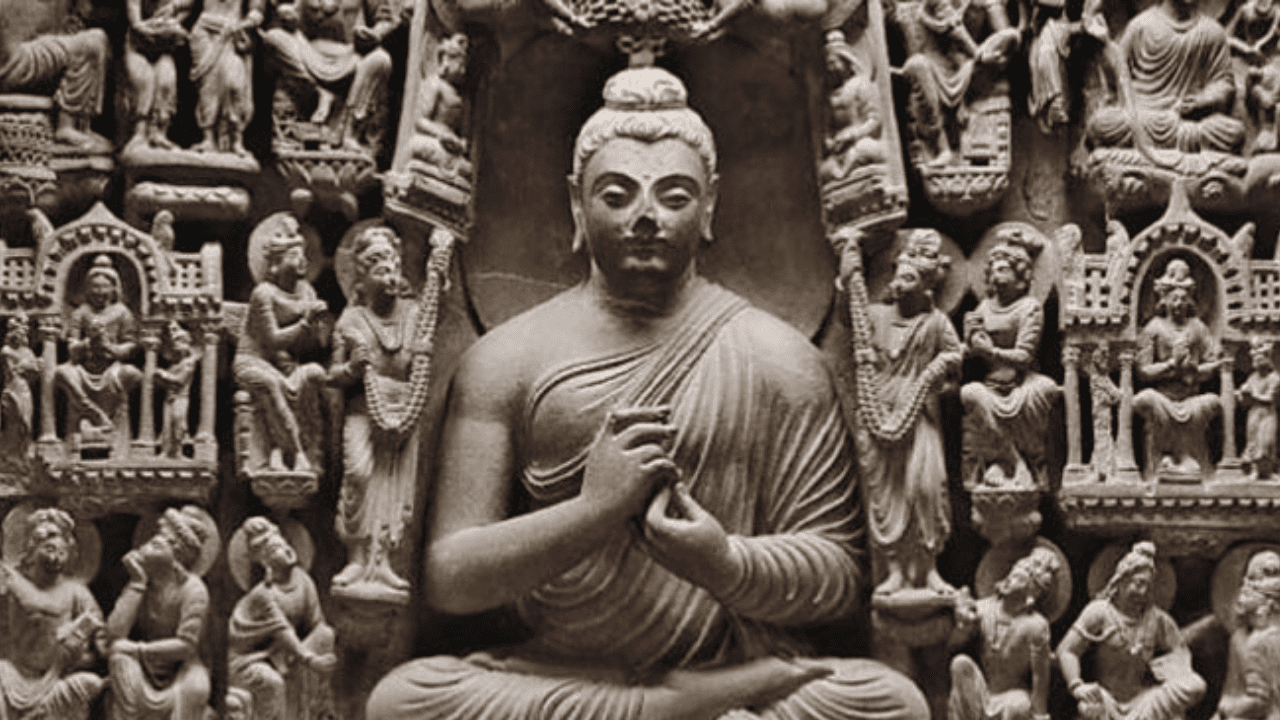
The evolution of ancient Indian sculptural art represents a rich narrative of cultural convergence, commercial exchange, and localized adaptation. Among the most prominent manifestations of this ancient globalism is the Gandhara School of Art, historically designated as Greco-Buddhist art. Flourishing primarily from the first century BCE to the fifth century CE in the northwestern frontier of the Indian subcontinent—spanning modern-day Pakistan and eastern Afghanistan—this artistic tradition successfully merged Indian Buddhist iconographical concepts with Western classical Hellenistic and Roman aesthetics.
Historically, the strategic location of the ancient Gandhara region made it a critical gateway along the Silk Road, linking the civilizations of India, Central Asia, and the Mediterranean. The core of this artistic tradition developed in key urban and monastic centers such as Taxila, Peshawar (ancient Purushapura), Swat Valley, Begram, Jalalabad, and Bamiyan. Following the military campaigns of Alexander the Great in 326 BCE, Greek cultural influence became firmly rooted in the region. Over subsequent centuries, the art form evolved under the rule of successive dynasties—including the Indo-Greeks, Shakas, and Parthians—before reaching its aesthetic and structural zenith during the Kushan Empire.
Under the direct patronage of Kushan rulers, particularly Emperor Kanishka I in the first and second centuries CE, Buddhism received unprecedented imperial support. This period witnessed the rise of Mahayana Buddhism, which facilitated a monumental shift in Buddhist art. Prior to this era, early Buddhist traditions represented the Buddha strictly through symbolic, aniconic forms such as footprints, the Bodhi tree, or the wheel of law. The Gandhara School revolutionized this tradition by depicting the Buddha in human form (anthropomorphic representation) in large numbers, providing a tangible, humanized representation of the divine. For serious civil services candidates, analyzing these dynamic updates is crucial, as UPSC current affairs increasingly focus on contemporary developments in heritage conservation, digital archaeology, and epigraphy.
Analytical Breakdown of Artistic Elements
The visual vocabulary of Gandhara sculpture is characterized by a sophisticated synthesis of foreign craft and indigenous theology. To understand this complex blending of styles, it is useful to categorize the elements according to their cultural origins.
Greco-Bactrian and Hellenistic Elements
The physical anatomy and spatial execution of Gandhara sculptures drew directly from classical Greek traditions:
Idealized Human Form: Sculptures of the Buddha and various Bodhisattvas featured symmetrical, youthful faces, an elegant nose, and a muscular physique reminiscent of the Greek sun-god Apollo.
Anatomical Realism and Stance: The implementation of realistic human anatomy and the contrapposto stance—where the weight of the figure rests primarily on one leg—was adopted from classical Greek sculptural practices.
Hair and Facial Detailing: The Buddha was represented with wavy hair treated in naturalistic patterns, often pulled into a top-knot (ushnisha), along with finely carved facial details and, in some cases, a mustache.
Architectural Features: Monastic and commemorative structures incorporated Greek elements such as Corinthian-style capitals adorned with acanthus leaves, along with classical pediments, columns, and pilasters.
Mythological Motifs: The integration of classical Hellenistic motifs, including winged cupids, centaurs, atlantes, and tritons, became standard decorative features on stupas and relief panels.
Classical Roman Elements
In addition to Greek elements, the Gandhara artisans incorporated stylistic features from classical Roman imperial art:
Drapery and Garments: The garments of the Buddha were depicted with realistic, heavy, and deeply carved three-dimensional folds. The style of these robes closely mirrored the togas worn on Roman imperial statues, draping realistically over the shoulders and limbs.
Iconographical Details: The use of a plain, unadorned halo surrounding the head of the deity, intricate ornaments, and specific decorative scrollwork (such as vine scrolls and cherubs carrying garlands) reflected classical Roman design conventions.
Central Asian Elements
As the Kushan Empire bridged the cultures of the Steppes with Northern India, distinct Central Asian artistic features were woven into the Gandharan landscape:
Nomadic Attire: Secular and aristocratic figures, including representations of Kushan kings and donors, were frequently depicted wearing Central Asian garments, such as heavy double-breasted robes, long tunics, high riding boots, and conical caps.
Facial Features and Ornaments: Certain sculptures integrated Central Asian facial profiles, characterized by high cheekbones and almond-shaped eyes, alongside Scythian-style jewelry patterns.
Material and Technological Shift: The region witnessed a distinct transition in material usage over time. In the early phase, green phyllite and blue-grey mica schist were the primary materials utilized. From the third century CE onward, sculptors increasingly shifted to stucco (lime-plaster) and clay modeling, which allowed for a high degree of plasticity, expressiveness, and detailed structural work.
While the execution, drapery, and anatomical realism were heavily influenced by foreign traditions, the core thematic focus of Gandhara art remained profoundly Indian. The depiction of the Buddha in deep yogic postures, seated on a lotus throne, and performing various symbolic mudras (hand gestures) represents a spiritual aesthetic entirely native to Indian philosophical traditions.
Comparative Framework of Ancient Indian Art Schools
To assist aspirants preparing with the daily GK update and competitive exam news today, it is essential to compare the Gandhara School with the contemporaneous Mathura and Amaravati schools of art. This comparative approach is highly valued in civil services examinations.
Art Schools of Ancient India
The table below contrasts the three dominant sculptural traditions of ancient India, highlighting their cultural origins, regional centers, and stylistic details.
| Feature | Gandhara School of Art | Mathura School of Art | Amaravati School of Art |
|---|---|---|---|
| Primary Region | Northwest India (Peshawar, Taxila, Swat, Begram, Bamiyan). | Northern plains centered around Mathura, Uttar Pradesh. | Southern Deccan region, primarily the Krishna River valley. |
| Flourishing Period | 1st Century BCE to 5th Century CE. | 1st Century BCE to 5th Century CE. | 2nd Century BCE to 3rd Century CE. |
| Imperial Patronage | Primarily the Kushan Dynasty. | Kushan Dynasty and later the Gupta Dynasty. | Satavahana Dynasty. |
| Material Used | Blue-grey mica schist, green phyllite, and later stucco. | Spotted red sandstone. | White limestone (resembling marble). |
| Aesthetic Influence | Strong Greco-Roman and Central Asian influence. | Purely indigenous tradition, evolving from Yaksha/Yakshi imagery. | Indigenous tradition characterized by dynamic, fluid compositions. |
| Religious Focus | Almost exclusively Mahayana Buddhism. | Pluralistic (Buddhism, Hinduism, and Jainism). | Primarily Buddhist. |
| Buddha's Presentation | Muscular, Apollo-like face, wavy hair, and heavy drapery. | Robust, smiling, shaven head, transparent robes covering the left shoulder. | Fluid figures, often part of complex narrative reliefs. |
| Key Examples | Colossal Bamiyan Buddhas, Taxila Buddha Head, Bimaran Casket. | Headless Kanishka, Sarnath Standing Buddha, Katra Keshav Dev sculptures. | Great Stupa of Amaravati narrative panels. |
Geographical and Chronological Distribution of the Gandhara School
The following table details the key regional centers of Gandhara art, their prominent sites, and their chronological span of influence.
| Modern Country | Prominent Historical Sites | Period of Prominence | Notable Artistic Discoveries |
|---|---|---|---|
| Pakistan | Taxila (Takshashila), Peshawar (Purushapura), Swat Valley | 1st Century BCE to 4th Century CE. | Taxila Buddha Head, Kharosthi inscriptions, carved footprints. |
| Afghanistan | Bamiyan, Hadda, Begram, Jalalabad (Bimaran) | 1st Century BCE to 8th Century CE. | Bimaran Casket, colossal Bamiyan Buddhas, stucco Bodhisattvas. |
| India (North-West) | Bordering regions, Swat periphery | 1st Century BCE to 4th Century CE. | Monastic remains, decorative stone relief work. |
Modern Horizons: Recent Archaeological and Diplomatic Updates
The study of Gandhara art is not confined to antiquity; it remains a dynamic field with major archaeological, technological, and diplomatic updates emerging in the current era.
Epigraphical Breakthroughs in Swat Valley
In late 2025, pioneering epigraphical research conducted in the Swat Valley of Pakistan by German linguistic expert Dr. Stefan Baums dramatically expanded the academic understanding of Gandharan history. Working in collaboration with the Italian Archaeological Mission, researchers documented around 100 new inscriptions from Swat alone, adding to a wider regional corpus of over 1,000 Gandharan inscriptions.
The findings illuminate the transition of scripts and shifting religious environments in the region. The early inscriptions, written in the Kharosthi script (derived from the Aramaic script of the Achaemenid Empire), record the local Gandhari language, initially for administrative use and later for Buddhist literary and spiritual purposes. Dr. Baums identified that phonetic and grammatical elements of ancient Gandhari have survived in modern Dardic languages, such as Kohistani, Gowi, and Torwali, which are still spoken in the mountainous regions of northern Pakistan, indicating a direct linguistic continuum.
By the third and fourth centuries CE, Kharosthi and Gandhari were progressively replaced by Sanskrit written in the Brahmi script. Early Brahmi inscriptions discovered at Shakurai Jahanabad include key Buddhist verses, while later Proto-Sharada and Sharada inscriptions from Barikot (dating from the 8th to the 11th centuries CE) record names of rulers like King Jaya Paladiva. These epigraphical shifts track the transition of the region from Buddhist dynasties to the rule of the Hindu Shahis, mirroring broader religious and political shifts. Furthermore, paleographic analysis of a pair of carved Buddha footprints discovered in Tirat, bearing the inscription “These are the footprints of the Buddha Shakyamuni,” dates the site to the 2nd century BCE, identifying it as one of the oldest Buddhist sanctuaries in the valley.
Immersive Technology and Global Relic Diplomacy
As physical monuments in the region face historic and environmental vulnerabilities, nations are turning to digital preservation and international exhibitions to safeguard and celebrate Gandharan heritage.
Digital Immersive Gallery, Islamabad: In late 2025, Pakistan's Department of Archaeology and Museums, in collaboration with the Korea Heritage Agency, established the country's first Digital Immersive Gallery. Using artificial intelligence, 3D projection mapping, and virtual reality, the gallery allows visitors to digitally explore ancient archaeological sites, including the historic ruins of Taxila, Takht-i-Bahi, and the colossal Bamiyan Buddhas. This technological shift marks a transition from static museum displays to interactive storytelling, making ancient history accessible to a global audience.
Relic Diplomacy: India has expanded its international cultural diplomacy by organizing sacred Buddhist relic expositions across Asia. In 2025 and early 2026, millions of devotees in Vietnam, Kalmykia (Russia), Bhutan, and Sri Lanka visited expositions of sacred Buddha relics, including the historic Piprahwa relics returned to India. This diplomacy strengthens cultural and civilisational ties across the Indo-Pacific region.
UNESCO Nominations and Heritage Status: India currently holds 44 UNESCO World Heritage Sites. For the 2025–2026 cycle, the Government of India nominated the ancient Buddhist site of Sarnath to the World Heritage List. Furthermore, during the prestigious twentieth session of the UNESCO Intergovernmental Committee held in New Delhi in December 2025, India successfully highlighted its literary and spiritual heritage, leading to the inclusion of the Bhagavad Gita and the Natyashastra into UNESCO's Memory of the World Register.
To ensure academic and physical preservation, the Archaeological Survey of India continues to maintain 3,686 centrally protected monuments. Such comprehensive preservation efforts are mirrored internationally, as discussed during the major international conferences on Gandhara's global civilizational contributions.
Why this matters for your exam preparation
For candidates preparing for the UPSC Civil Services Examination and other state PSC exams, a detailed understanding of the Gandhara School of Art is critical for several key areas of the syllabus:
Prelims (Art and Culture): Civil Services aspirants must be prepared for highly specific questions regarding material culture (e.g., the use of grey schist and stucco in Gandhara versus spotted red sandstone in Mathura), royal patronage (Kushanas vs. Satavahanas), and iconography (such as the four standard mudras of the Buddha).
Mains GS Paper I (Indian Heritage and Culture): Candidates are frequently required to analyze the syncretic nature of ancient Indian art. The synthesis of Greco-Roman realism with Indian spiritual concepts is a recurring topic in Mains questions (e.g., the 2014 and 2019 GS Paper I questions on Greco-Roman and Central Asian elements in Gandharan sculptures). Presenting structured comparisons and highlighting the shift from aniconic to iconic art can significantly improve score potential.
Contemporary Relevance (GS Paper II - International Relations): The use of "relic diplomacy" and cultural exhibitions to build soft power in Southeast Asia highlights how ancient history shapes modern diplomatic relations.
Linguistic and Epigraphical Context: The transition of scripts from Kharosthi to Brahmi and Sharada, and its reflection of political and religious shifts, provides key source material for both Ancient History and Optional History papers.
By keeping up with the Atharva Examwise current news and connecting historical topics with current archaeological discoveries, candidates can write analytical, well-structured, and high-scoring answers.