UPSC Current Affairs: India's First Hydrogen Train on Jind-Sonipat Route | Daily GK Update for Competitive Exam News Today
India's Leap in Green Rail Transport
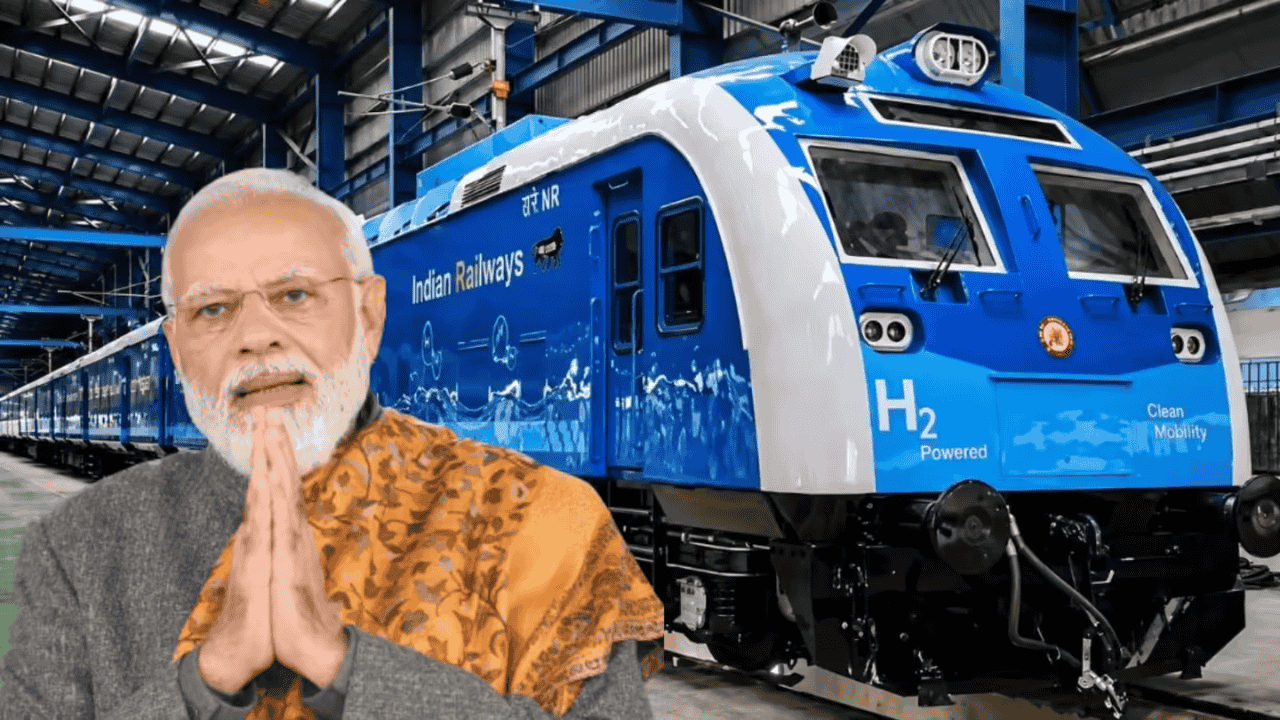
The deployment of zero-emission mass transit systems is a key part of India's green energy transition. Prime Minister Narendra Modi is scheduled to flag off India's first hydrogen-powered passenger train on July 17, 2026, from the Jind railway station in Haryana. Operating on the 89-kilometer Jind-Sonipat section of the Northern Railway, this pilot project marks India's entry into an elite global cohort of nations—including Germany, Japan, China, and the United States—that are actively exploring hydrogen-based rail traction.
This technological milestone is a vital inclusion in the current affairs syllabus and represents an important trend in the development of sustainable public infrastructure. The Atharva Examwise Current News platform highlights that this initiative is aligned with the Indian Railways' commitment to achieve net-zero carbon emissions by 2030, a goal that precedes India's national target of net-zero emissions by 2070. By transitioning non-electrified routes from diesel to hydrogen propulsion, the national transporter is laying down the infrastructure for a sustainable transport backbone.
The inaugural service, running as train numbers 74010 and 74009, will cover the 89-km distance in approximately two hours, stopping at 12 intermediate stations. These stations include Jind City, Pandu Pindara, Lalit Khera, Bhambeva, Ishapur Kheri, Butana, Khandrai, Gohana, Rabhra, Lath, Mohana Haryana, and Barwasni. This pilot route serves as a demonstration project to test the technology's performance under Indian operating conditions before its wider rollout under the "Hydrogen for Heritage" program.
Technical Architecture and Propulsion Mechanism
The core innovation of the Jind-Sonipat hydrogen train lies in its hybrid hydrogen-electric powertrain, which replaces the conventional internal combustion engine. This propulsion system was developed by retrofitting an existing Diesel Electric Multiple Unit (DEMU) rake with an advanced zero-emission propulsion system, designed by the Research Designs and Standards Organisation (RDSO) and integrated by Hyderabad-based Medha Servo Drives.
Electrochemical Power Generation
Unlike standard electric locomotives that draw alternating current via pantographs from overhead lines, hydrogen-powered trains—broadly classified under the term "hydrail"—generate electricity on board. This is achieved using a Proton Exchange Membrane Fuel Cell (PEMFC). In the fuel cell stack, pressurized hydrogen gas stored on board is combined with atmospheric oxygen. This electrochemical reaction generates electricity, leaving water vapor and heat as the only by-products, ensuring zero tailpipe emissions.
The chemical equations governing this zero-carbon energy release are:
$$\text{Anode Reaction (Oxidation): } 2\text{H}_2 \rightarrow 4\text{H}^+ + 4e^-$$
$$\text{Cathode Reaction (Reduction): } \text{O}_2 + 4\text{H}^+ + 4e^- \rightarrow 2\text{H}_2\text{O}$$
$$\text{Overall Cell Reaction: } 2\text{H}_2 + \text{O}_2 \rightarrow 2\text{H}_2\text{O} + \text{Electricity} + \text{Heat}$$
The Hybrid Energy Storage System
To manage varying load demands during transit, the train incorporates a hybrid setup pairing PEM fuel cells with a secondary Lithium Ferro Phosphate (LFP) battery bank. LFP batteries are favored in heavy-transport applications due to their high power output, long operational cycle life, and thermal safety compared to standard lithium-ion chemistries.
The power distribution within the hybrid system operates through a highly coordinated mechanism:
Initial Acceleration: When starting from a station, the train draws energy from the fuel cell. Since initial demand is low, the surplus electricity generated is directed to charge the onboard LFP battery bank.
Peak Demand (Cruising & Gradient Climbing): As the train gains speed, the battery bank supplements the fuel cell, providing the high-rate current required by the traction motors.
Deceleration and Braking: As the train approaches a station and power demand drops, the battery system is disconnected from the propulsion loop, and the constant power output from the fuel cell—supplemented by regenerative braking energy—recharges the battery, ending the journey with the battery charged to approximately 80% of its capacity.
The train has 10 coaches, featuring two Driving Power Cars (DPCs) and eight passenger coaches, with a total carrying capacity of 2,600 passengers (around 300 passengers per coach). To ensure safety during its initial run, the train has been validated by the independent German testing and certification agency TUV SUD to ensure compliance with international safety standards.
Additionally, the Ministry of Railways has mandated that for the first three months of its commercial operations, the train will be accompanied by trained technical personnel to address any en-route issues. Specialized maintenance procedures have also been set up at the Shakurbasti workshop in Delhi. Before the train is transported for servicing, its high-pressure hydrogen power system is completely shut down and verified for safety. Once cleared, a conventional diesel locomotive is used to tow the trainset to the Shakurbasti facility, preventing any high-pressure hazards inside the standard maintenance sheds.
Comparative Resource Efficiency Metrics
Transitioning to hydrogen-powered traction offers significant advantages in energy efficiency and resource conservation compared to conventional diesel and electric systems. The energy density of hydrogen is substantially higher than that of fossil fuels, enabling lower fuel consumption by mass. During field trials on the Jind-Sonipat section, the train achieved a mileage of 800 grams of hydrogen per kilometer, operating at a maximum design speed of 120 km/h, with a regulated operational speed of 75 km/h.
This technology reduces fuel consumption to just one-third of the energy equivalent consumed by a conventional diesel locomotive. To help aspirants understand these metrics for competitive exams, a comparison of these rail propulsion systems is detailed in the table below.
| Performance Indicator | Hydrogen Fuel Cell Traction (Hydrail) | Diesel Electric Multiple Unit (DEMU) | Standard Electric Traction (Overhead Lines) |
|---|---|---|---|
| Fuel / Energy Consumption | 800 grams of compressed hydrogen per km [cite: Input Data] | 1.5 to 2.0 liters of diesel per km [cite: Input Data] | ~4,600 units of electricity per hour [cite: Input Data] |
| Energy Input Cost | ₹600 to ₹700 per km [cite: Input Data] | High variable cost tied to global crude oil prices | Dependent on regional grid electricity tariffs |
| Primary Tailpipe Emissions | Harmless water vapor and heat (Zero $CO_2$) | High $CO_2$, $NO_x$, sulfur oxides, and particulate matter | Zero at vehicle level; dependent on source grid (coal vs renewable) |
| Propulsion Technology | Electrochemical reaction combining $H_2$ and $O_2$ [cite: 5, 11, 16] | Internal combustion engine driving electric generators | Direct electric current from overhead catenary system |
| Capital & Grid Infrastructure | High initial CAPEX for production & refuelling plants | Low infrastructure cost; runs on existing non-electrified lines | Very high infrastructure cost for overhead gantries & substations |
The Jind Hydrogen Production and Water-RO Infrastructure
The operational viability of hydrogen rail transport is fundamentally dependent on robust ground-level production, compression, and storage infrastructure. Storing hydrogen presents a significant engineering challenge due to its low volumetric density and highly flammable nature. To address these issues, an indigenous hydrogen storage and refuelling facility has been set up at Jind, Haryana, with licensing from the Petroleum and Explosives Safety Organisation (PESO).
This plant is the largest ground-level compressed gas storage facility in Asia, with a total storage capacity of 3,000 liters (approximately 3,000 kg). The facility produces hydrogen from groundwater using a 1-Megawatt (MW) Proton Exchange Membrane (PEM) electrolyser. The production process is water-intensive, requiring approximately 9 liters of high-purity demineralized water for every 1 kg of hydrogen gas produced. To supply this pure water, the plant operates three Reverse Osmosis (RO) systems, each with a processing capacity of 4,000 liters per day, providing a cumulative daily capacity of 12,000 liters of purified water [cite: Input Data].
To ensure safe and continuous dispensing, the plant’s 3,000 kg storage is split into two distinct systems:
Type-I Steel Cylinders: Storing approximately 2,300 kg of hydrogen at 200 bar, which acts as a primary back-up storage reservoir. This storage is insulated behind a 3-meter-high concrete fire protection wall.
Type-IV Composite Cylinders: Storing 700 kg of hydrogen at a high pressure of 500 bar. Type-IV cylinders utilize carbon-fiber-reinforced polymeric liners, which negate the risk of hydrogen embrittlement—a structural degradation process common in metals exposed to high-pressure hydrogen.
During refuelling, hydrogen expands and heats up. To prevent the train's storage cylinders from overheating, a specialized chiller plant cools the gas to $-15^\circ\text{C}$ during dispensing. The dual-dispenser system (H35 dispensers equipped with TK16 nozzles and infrared communication) allows simultaneous refuelling of both Driving Power Cars, dispensing a total of 420 kg of hydrogen in exactly one hour.
Strategic Policy Integration: NGHM and Hydrogen for Heritage
The launch of the hydrogen-powered train is directly tied to the objectives of the National Green Hydrogen Mission (NGHM), launched by the Union Cabinet in January 2023 under the administration of the Ministry of New and Renewable Energy (MNRE). Backed by an initial financial outlay of ₹19,744 crore, the NGHM seeks to position India as a global manufacturing and exporting hub for green hydrogen.
Key Targets of NGHM by 2030
Production Capacity: To scale up green hydrogen production to at least 5 Million Metric Tonnes (MMT) per annum.
Renewable Energy Integration: To add approximately 125 Gigawatts (GW) of associated renewable energy capacity specifically to power electrolysers.
Macroeconomic Benefits: The mission is projected to attract over ₹8 lakh crore in total investments, generate more than 6 lakh clean-tech jobs, and reduce India's fossil fuel import bill by over ₹1 lakh crore.
Climate Action: To abate nearly 50 MMT of annual greenhouse gas emissions, directly assisting India's Nationally Determined Contributions (NDCs).
The NGHM utilizes the Strategic Interventions for Green Hydrogen Transition (SIGHT) program, which provides direct financial incentives to lower the initial capital costs of electrolyser manufacturing and green hydrogen production. Programs like the "Hydrogen for Heritage" rail transit project provide the necessary institutional demand to help scale up the domestic supply chain, which is a key step toward bringing the market price of green hydrogen down to the target of under $1 per kg by 2030.
Under the Hydrogen for Heritage initiative, Indian Railways plans to deploy 35 hydrogen-powered trains on various heritage and hill routes across the country. These routes include:
Kalka-Shimla Railway (UNESCO World Heritage Site)
Darjeeling Himalayan Railway (UNESCO World Heritage Site)
Nilgiri Mountain Railway (UNESCO World Heritage Site)
Matheran Hill Railway (Eco-sensitive Western Ghats corridor)
Kangra Valley Railway (Himachal Pradesh)
Bilmora-Waghai (Gujarat forest reserve)
Patalpani-Kalakund (Madhya Pradesh forest corridor)
Marwar-Goram Ghat Railway (Rajasthan hill track)
Deploying hydrogen trains on these routes avoids the high capital costs and environmental disruption associated with constructing overhead electrification lines over difficult, winding terrain. The estimated cost of each heritage hydrogen train is approximately ₹80 crore, with supporting ground-level infrastructure requiring an investment of ₹70 crore per route.
Key Facts at a Glance for Daily GK Update
Inaugural Event: Flagged off on July 17, 2026, at Jind Railway Station, Haryana, by Prime Minister Narendra Modi.
Pilot Route Details: Covers the 89-km Jind-Sonipat section under Northern Railway in approximately 2 hours, making 2 round trips (356 km) daily.
Configuration: A 10-coach trainset comprising 2 Driving Power Cars (1,200 kW each, totaling 2,400 kW) and 8 passenger coaches with a total capacity of 2,600 passengers.
Fuel Consumption: Consumes 800 grams of hydrogen per kilometer (costing ₹600-700/km), which represents only one-third the energy equivalent consumed by a diesel engine [cite: Input Data].
Water Intensity: Requires approximately 9 liters of demineralized groundwater per 1 kg of hydrogen gas produced [cite: Input Data, 29].
Jind Refuelling Plant: Features Asia’s largest ground-level compressed hydrogen gas storage plant with a capacity of 3,000 liters (or 3,000 kg), operating 3 RO systems with a total capacity of 12,000 liters daily [cite: Input Data, 19, 24].
Strategic Scope: Developed by Integral Coach Factory (ICF), Chennai, with fuel cells from Ballard, Canada, and system integration by Medha Servo Drives at a retrofitting cost of ₹111.83 crore.
Why this matters for your exam preparation
For candidates preparing for the civil services and other competitive examinations, understanding the technology and policy frameworks of India’s first hydrogen train is of high relevance.
1. Relevance for UPSC Preliminary Examination (Paper I)
General Science and Technology: Questions are frequently asked about the working principles of fuel cells, proton exchange membranes, and the chemistry of hydrogen energy. Candidates should understand that fuel cells operate electrochemically and emit only water vapor and heat, distinguishing them from standard combustion technologies.
Government Schemes and Policies: The integration of the "Hydrogen for Heritage" project with the broader targets of the National Green Hydrogen Mission and the SIGHT incentive program is a high-yield topic. Candidates should be familiar with the target metrics of the NGHM, such as the 5 MMT production capacity and 125 GW renewable energy addition by 2030.
Environmental Geography and Safety Regulators: Questions may test knowledge of water consumption during electrolysis and the regulatory roles of bodies like the Petroleum and Explosives Safety Organisation (PESO).
2. Relevance for UPSC Civil Services Mains Examination (GS Paper III)
Infrastructure and Economic Development: The transition from diesel-electric multiple units to zero-emission hydrogen-electric systems serves as a case study for evaluating sustainable infrastructure development in India.
Science and Technology (Indigenization): Candidates can analyze the technology transfer aspects, highlighting the reliance on imported components, such as fuel cells from Ballard, Canada, and the need for localized R&D to establish a domestic manufacturing base.
Environmental Conservation and Climate Change: This initiative showcases practical steps taken by the transport sector to meet India's global climate commitments (COP26/COP28) and the Indian Railways' goal of net-zero emissions by 2030. Candidates can discuss the challenges of scaling up this technology, such as water scarcity, high capital expenditure, and the lower round-trip efficiency of hydrogen compared to direct electrification.
Aspirants are encouraged to continue tracking this topic and test their knowledge with mock tests on the Atharva Examwise UPSC Preparation Guide, ensuring they are well-prepared for both conceptual and fact-based questions in the upcoming exams.