
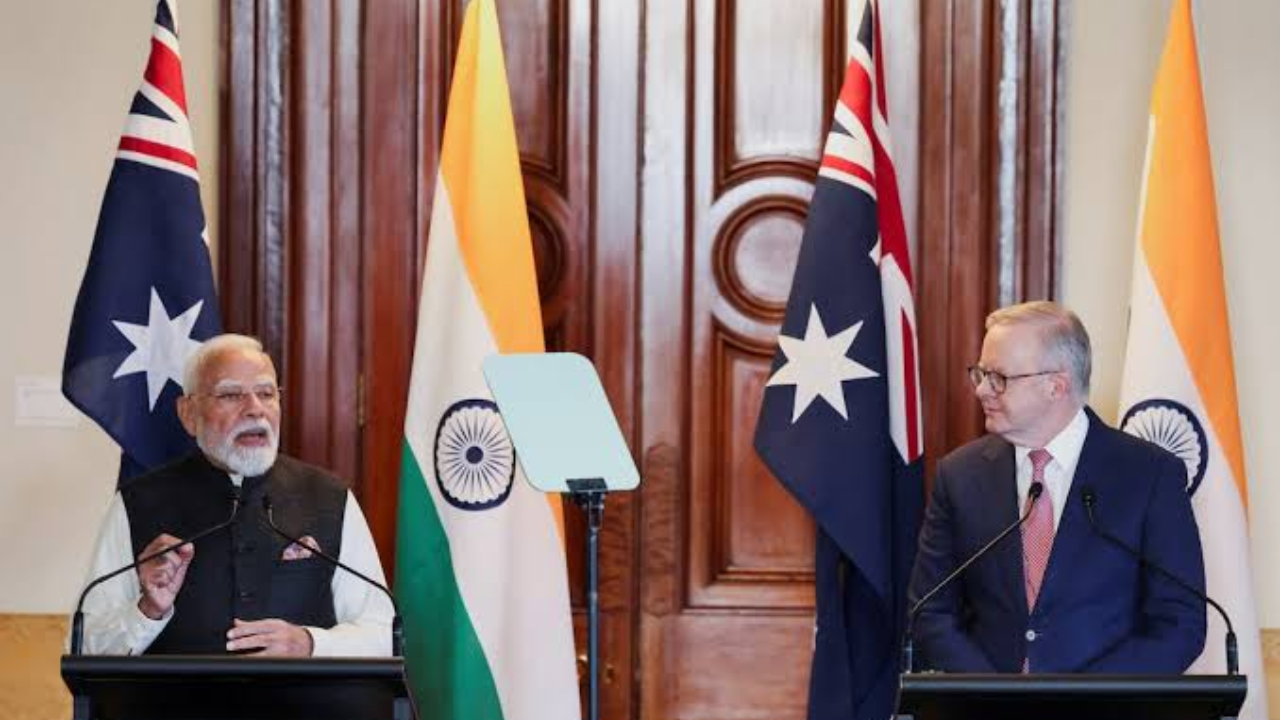
UPSC Current Affairs: India-Australia Uranium Deal & SHANTI Act 2025 | Daily GK Update
Geopolitical Reset in Melbourne: The Uranium Breakthrough
Although India and Australia inked their initial Civil Nuclear Cooperation Agreement in September 2014, commercial uranium exports remained stalled for over a decade. This prolonged delay stemmed from persistent disagreements regarding safeguards and bilateral reporting protocols. Australia, a signatory to the Nuclear Non-Proliferation Treaty (NPT), historically restricted uranium sales to non-signatory nations. Although Canberra eased its export ban in 2014—predicated on International Atomic Energy Agency (IAEA) safeguards and the separation of India's civilian and military nuclear installations—concluding the specific accounting and reporting systems required nearly two years of intense bilateral negotiations.
[2014 Bilateral Agreement] │ (Stalled on Safe Guard Reporting) │ [2-Year Intense Diplomatic Reconciliation (2024-2026)] │ (Accounting Issues Resolved) │ [July 9, 2026: Administrative Arrangement Finalized]
Under the newly finalized Administrative Arrangement, private Australian mining enterprises are legally authorized to sign commercial contracts with Indian entities to supply uranium exclusively for peaceful energy generation under continuous IAEA oversight. For Australia, which holds approximately 28% of global uranium reserves but utilizes zero nuclear power domestically, this agreement opens up a vast resources market and supports its efforts to diversify its trade partnerships beyond China. For India, secure access to Australian uranium resolves a severe domestic deficiency in natural uranium resources, allowing the country to transition away from fossil-fuel baseline power.
The broader geopolitical context of Prime Minister Modi's multi-nation tour highlights India's active regional diplomacy. Before arriving in Australia, the Indian Prime Minister visited Indonesia, where he concluded several defense and agricultural agreements, including the strategic supply of the BrahMos cruise missile system. Following his Melbourne visit, the Prime Minister departed for New Zealand on July 10, 2026, marking the first state visit by an Indian Prime Minister to the country in nearly forty years. Ahead of this visit, New Zealand's Prime Minister Christopher Luxon announced that under the recently signed India-New Zealand Free Trade Agreement, 57% of Wellington's exports to New Delhi would become tariff-free from day one, highlighting a synchronized strengthening of India's ties across the Indo-Pacific.
Bilateral Economic and Defense Integration
Beyond the civil nuclear arena, the July 2026 summit resulted in extensive agreements aimed at building economic and defense resilience. Bilateral trade between India and Australia reached AUD 54.4 billion (US$ 37.7 billion) in the 2024–2025 financial year, and both leaders agreed to fast-track negotiations to upgrade the existing Economic Cooperation and Trade Agreement (ECTA) into a Comprehensive Economic Cooperation Agreement (CECA). As a concrete signal of economic trust, Australia's largest pension fund, AustralianSuper, announced an additional investment of AUD 500 million ($347 million) into India's National Investment and Infrastructure Fund (NIIF), raising capital inflows to accelerate India’s urban and transportation infrastructure development.
On defense and maritime security, the two nations adopted the Joint Declaration on Defence and Security Cooperation (2026), which officially replaces their 2009 security pact. This updated declaration reflects a step-change in military integration, establishing the India-Australia Defence Innovation Corridor to link defense startups and industries, and implementing a unified Maritime Security Collaboration Roadmap between the Indian Coast Guard and Australia's Maritime Border Command. Furthermore, a trilateral Memorandum of Understanding was signed under the Australia–Canada–India Technology and Innovation (ACITI) umbrella, forging a Commonwealth technology alliance.
In addition, Australia announced its support for India's landmark Gaganyaan human spaceflight program by agreeing to construct a temporary space tracking terminal on the Cocos (Keeling) Islands in the Indian Ocean, providing critical telemetry and tracking data during the orbital injection phases of India's crewed space missions. During the visit, Prime Minister Modi addressed an estimated 30,000 members of the Indian diaspora at Melbourne's Marvel Stadium, celebrating the "living bridge" formed by nearly one million people of Indian ancestry currently residing in Australia. In a gesture of cultural goodwill, Australia returned three historic Indian artifacts—two idols and a trident stolen from temples in Tamil Nadu—underscoring the deepening trust between the two nations.
Inside the PACTS Framework: Cyber, Minerals, and Critical Tech
To insulate their high-tech economies from supply chain vulnerabilities, India and Australia launched the Partnership on Cyber, Critical Technologies and Supply Chains (PACTS). Succeeding and replacing the 2020 Framework Arrangement, PACTS introduces an elevated, structured model of technology governance.
The program is organized around five pillars of strategic cooperation:
| PACTS Pillar | Strategic Mechanism | Targeted Objectives & Outcomes |
|---|---|---|
| 1. Supply Chain Resilience | Bilateral trusted vendor frameworks and academic semiconductor research. | Securing undersea cable connectivity under the Quad Partnership; establishing a strategic "critical minerals corridor". |
| 2. Critical Technology | Collaborative research in Artificial Intelligence (AI), biotechnology, and advanced materials. | Establishing interoperable, consensus-driven international standards for safe, trustworthy AI based on democratic values. |
| 3. Cybersecurity | Bilateral Information and Communications Technology (ICT) mechanisms and joint workshops. | Combating transnational cybercrime; protecting critical national infrastructure; launching a cyber-skills incubator. |
| 4. Digital Resilience | Exporting Digital Public Infrastructure (DPI) principles. | Deploying and scaling low-cost DPI models (like India's UPI and identity stacks) across developing Indo-Pacific economies. |
| 5. Defence Research | Institutional ties between India's DRDO and Australia's Defence Science and Technology Group. | Collaborative R&D on multi-domain defense challenges and innovative maritime science and technology capabilities. |
Decarbonization and the Domestic Nuclear Ecosystem: The SHANTI Act 2025
The commercial viability of importing Australian uranium is directly linked to India's domestic legislative landscape. In December 2025, the Parliament of India passed the Sustainable Harnessing and Advancement of Nuclear Energy for Transforming India (SHANTI) Act, 2025. The Act repealed and replaced the obsolete Atomic Energy Act, 1962, and the Civil Liability for Nuclear Damage Act (CLNDA), 2010, consolidating India's nuclear governance under a single, market-aligned regulatory statute.
[Atomic Energy Act, 1962] [CLND Act, 2010 (Legacy)] │ (Consolidated & Subsumed Into) │ [The SHANTI Act, 2025] │ ┌───────────────────┴───────────────────┐ ▼ ▼ [Regulated Equity (49%)] [Supplier Liability Reset] (Private/Foreign Investors) (Section 17(b) CLNDA Removed)
The SHANTI Act fundamentally alters the economics of nuclear energy in India through three structural changes:
Regulated Market Participation: The Act permits domestic private companies and joint ventures to hold up to 49% equity in civilian nuclear projects, ending the historical state monopoly and mobilizing private capital to fund standardized fleets of Small Modular Reactors (SMRs).
Exclusion of Supplier Liability: To attract global reactor designers, the Act narrows the operator's "Right of Recourse" against equipment suppliers. Shifting away from the stringent provisions of Section 17(b) of the CLNDA 2010, the new law excludes supplier liability unless explicitly detailed in written contracts or in cases of proven intentional harm, aligning India with the international standards of the Convention on Supplementary Compensation (CSC).
Enhanced Regulatory Oversight: The Act elevates the Atomic Energy Regulatory Board (AERB) to a full statutory body. It also establishes a dedicated Atomic Energy Redressal Advisory Council and an Atomic Disputes Tribunal to resolve sector-specific disputes.
Legal and Market Responses to the Reform
Despite its passage, the SHANTI Act faces legal scrutiny. On February 27, 2026, the Supreme Court of India—led by Chief Justice Surya Kant and Justice Joymalya Bagchi—heard a petition filed by former civil servant E.A.S. Sarma and eminent scientists challenging several provisions of the Act. The petitioners argue that capping maximum operator liability at approximately ₹3,900 crore (the equivalent of 300 million Special Drawing Rights) violates the settled legal principles of "absolute liability" and "polluter pays". They also challenge Section 39, which empowers the government to restrict access to broad categories of nuclear information, exempting them from the Right to Information (RTI) Act with no public interest override or appeal mechanism.
Nevertheless, the industry's response remains highly proactive. Major power producers, including NTPC, Tata Power, Adani Power, and Jindal Nuclear, have announced plans to enter the civilian nuclear sector. NTPC recently issued an Expression of Interest (EoI) for global consultants to assist in deploying large-scale Pressurised Water Reactor (PWR) technology and signed non-disclosure agreements with Russia's Rosatom and France's EDF. Furthermore, domestic precision manufacturing companies—such as Tema India, Walchandnagar Industries, KSB Ltd, and Electronet Equipments—are actively expanding their capabilities to manufacture safety-critical nuclear components, anticipating a multi-decadal order pipeline.
The Mechanics of India's Three-Stage Nuclear Program
To appreciate why secure uranium imports are vital for India's long-term energy security, it is necessary to examine the design of India's Three-Stage Nuclear Power Programme. Formulated in the 1950s by Dr. Homi J. Bhabha, the program was designed to work around India's modest natural uranium reserves (representing only 1–2% of the global total) while exploiting its abundant thorium reserves (representing approximately 25% of the global total) in the monazite sands of coastal Kerala, Tamil Nadu, and Odisha.
Because thorium ($\text{Th}^{232}$) is fertile rather than fissile, it cannot sustain a nuclear chain reaction on its own; it must be transmuted into the fissile isotope Uranium-233 ($\text{U}^{233}$) inside a reactor fueled by other fissile materials, such as Uranium-235 ($\text{U}^{235}$) or Plutonium-239 ($\text{Pu}^{239}$). The three sequential stages are designed as a closed fuel cycle to progressively multiply these fissile resources:
Stage 1: Pressurised Heavy Water Reactors (PHWRs)
Fuel: Natural Uranium (containing $0.7\%$ fissile $\text{U}^{235}$ and $99.3\%$ fertile $\text{U}^{238}$).
Moderator and Coolant: Heavy Water ($D_2O$).
Mechanism: Fission of $\text{U}^{235}$ generates electricity. Concurrently, neutron capture by the fertile $\text{U}^{238}$ transmutes it into Plutonium-239 ($\text{Pu}^{239}$). The spent fuel is reprocessed to extract this plutonium, which is used to fuel the next stage.
Stage 2: Fast Breeder Reactors (FBRs)
Fuel: Mixed Oxide (MOX) fuel composed of plutonium-239 recovered from Stage 1 and natural or depleted uranium.
Coolant: Liquid Sodium.
Mechanism: FBRs are engineered to "breed" more fissile fuel than they consume. During this stage, a blanket of fertile Thorium-232 is placed around the reactor core. The neutrons escaping from the core transmute the thorium blanket into fissile Uranium-233 ($\text{U}^{233}$). The Prototype Fast Breeder Reactor (PFBR) at Kalpakkam marks India's entry into Stage 2.
Stage 3: Thorium-Based Reactors
Fuel: Fissile Uranium-233 (bred in Stage 2) combined with fertile Thorium.
Mechanism: This advanced stage exploits India's vast thorium reserves. The reactor burns $\text{U}^{233}$ while transmuting fertile thorium into fresh $\text{U}^{233}$ in a continuous, self-sustaining loop, ensuring long-term energy independence.
┌────────────────────────────────────────────────────────┐ │ Stage I: PHWRs (Natural Uranium) │ │ - Fuel: Natural Uranium │ │ - Byproduct: Plutonium-239 │ └───────────────────────────┬────────────────────────────┘ ▼ ┌────────────────────────────────────────────────────────┐ │ Stage II: FBRs (MOX Fuel & Sodium) │ │ - Fuel: Plutonium-239 + Depleted Uranium │ │ - Blanket: Thorium-232 │ │ - Byproduct: Uranium-233 (Bred fuel) │ └───────────────────────────┬────────────────────────────┘ ▼ ┌────────────────────────────────────────────────────────┐ │ Stage III: Advanced Thorium Reactors │ │ - Fuel: Uranium-233 + Thorium │ │ - Self-sustaining closed fuel cycle │ └────────────────────────────────────────────────────────┘
The transition to commercial Stage 3 operations requires a large, pre-existing inventory of plutonium and $\text{U}^{233}$ built up through decades of large-scale Stage 2 operations. During this transition, India's Separation Plan (2006) remains highly relevant. Concluded under the India-US civil nuclear deal, the plan identified and segregated India's nuclear installations into civilian facilities (placed under permanent IAEA safeguards) and strategic military facilities (kept outside international inspection).
Because safeguarded civilian reactors can only use imported uranium, securing a diversified supply of foreign uranium—such as from Canada and now Australia—is crucial to keep these civilian reactors running and to scale up the fuel inventories needed to transition to Stage 3.
Key Facts and Exam-Relevant Data
For competitive examinations, candidates should note the following high-volume data points and facts:
Uranium Reserves: Australia holds approximately 28% to 33% of the world's known uranium resources, making it the largest global reserve holder, and was the fourth-largest producer globally in 2022.
India's Nuclear Power Targets: India operates 23 to 25 commercial nuclear reactors with an installed capacity of approximately 8.8 GW, contributing around 3.1% to its total electricity generation. The short-term target is to reach 22 GW by 2032, with a long-term goal of 100 GW by 2047.
The SHANTI Act 2025: Promulgated in December 2025, it repealed the Atomic Energy Act of 1962 and the Civil Liability for Nuclear Damage Act of 2010, allowing up to 49% private and foreign equity in civilian nuclear projects.
Bilateral Trade: Trade in goods and services between India and Australia was valued at AUD 54.4 billion in the 24-25 financial year, with India ranking as Australia's fifth-largest trading partner.
Space Support: The temporary space tracking terminal on the Cocos (Keeling) Islands will provide telemetry and tracking support for ISRO's Gaganyaan human spaceflight program.
Stolen Artifacts: Australia returned three historic temple artifacts (two idols and one trident) stolen from Tamil Nadu.
India-New Zealand FTA: Signed in April, it grants duty-free access to all Indian exports and makes 57% of New Zealand's exports to India tariff-free from day one.
Why this matters for your exam preparation
For serious civil services and competitive exam aspirants, this multifaceted development intersects directly with several high-scoring segments of the syllabus:
General Studies Paper II (Polity, Governance, and International Relations)
Bilateral Groupings and Agreements: Candidates must analyze how the India-Australia Comprehensive Strategic Partnership (CSP) has evolved from a trade-focused relationship into a strategic and security-driven alignment. The finalization of the Administrative Arrangement highlights the legal and diplomatic mechanisms required to reconcile national security laws with international regimes (like the NPT and IAEA safeguards).
Statutory and Regulatory Bodies: The transformation of the AERB under the SHANTI Act, 2025, is an excellent case study for questions on regulatory independence, statutory authority, and administrative reforms.
Indian Diaspora: The geopolitical and economic influence of the "living bridge" (the 1 million-strong Indian diaspora in Australia) in shaping bilateral ties and economic diplomacy.
General Studies Paper III (Science & Technology, Economy, and Environment)
Science and Technology Developments: The structural design, physics, and fuel cycle dynamics of India's Three-Stage Nuclear Power Programme are highly relevant for both Prelims and Mains. Aspirants should understand the distinction between fertile and fissile isotopes ($\text{Th}^{232}$ and $\text{U}^{233}$) and the role of Fast Breeder Reactors in transmuting fuel.
Infrastructure and Clean Energy: The role of nuclear power as a clean, low-carbon baseload energy source crucial to achieving India's net-zero emissions target by 2070 and its 500 GW non-fossil capacity goal by 2030.
Supply Chain and Economic Security: The launching of the PACTS framework highlights the growing importance of securing critical technology supply chains, establishing critical mineral corridors, and exporting India's Digital Public Infrastructure (DPI) to build regional resilience.
Aspirants can access detailed analytical notes and mock questions on this topic on Atharva Examwise.