
UPSC Current Affairs February 2026: Ancient Instrument Ravanahatha in Daily GK Update | Atharva Examwise Current News and Competitive Exam News Today
Introduction to Ravanahatha and Its Cultural Resurgence
In the study of Indian classical and folk heritage, traditional musical instruments serve as vital markers of historical, sociological, and artistic evolution. Among these, the Ravanahatha (alternatively spelled Ravanhatta, Rawanhattha, or historically recorded as Ravanastron and Ravana hasta veena) stands out as one of the oldest known bowed string instruments of the Indian subcontinent. Widely celebrated for its sweet, melancholic, and deeply soulful tonal quality, the instrument is an invaluable asset to Indian folk music.
The cultural relevance of the Ravanahatha has been highlighted in modern administrative and public showcases, such as its inclusion in the traditional performance line-up at the Bithoor Mahotsav in Kanpur in February 2026. For candidates analyzing contemporary trends under Atharva Examwise current news, the Ravanahatha provides a multi-dimensional case study. It intersects Indian mythology, ancient acoustic technology, medieval royal history, and the contemporary struggles of nomadic preservationist communities. Aspirants tracking high-yield topics for their Atharva Examwise competitive exam news today will find this comprehensive analysis highly valuable for the General Studies Art and Culture syllabus.
Historical and Mythological Lineage
Mythological Origins and the Connection to King Ravana
According to Hindu mythology and oral lore, the creation of the Ravanahatha is attributed to the legendary demon king Ravana of Lanka, an ardent devotee of Lord Shiva. The legend states that Ravana constructed the instrument during a period of intense ascetic meditation under Mount Kailash.
When his primary veena began to break, he used his own head to replace the resonator, his hand as the soundboard, and his physical veins as strings to continue playing hymns—such as the Shiva Tandava Stotram—to appease the deity. Following the war of the Ramayana and the subsequent fall of Ravana, Lord Hanuman is said to have transported the instrument to Northern India, where it was integrated into regional folk music traditions. While modern historians view these narratives as cultural expressions rather than verifiable history, the myth remains a key part of the instrument's cultural identity.
Historical Milestones and Literature Records
The historical footprint of the Ravanahatha spans over a thousand years, reflecting its deep integration into the cultural fabric of Western India. Rather than being isolated to regional pockets, the instrument's presence is documented across historical eras and geographical borders:
Medieval Royal Patronage: Throughout the medieval period, the ruling dynasties of Rajasthan and Gujarat actively patronized folk music. The Ravanahatha was highly favored among royal families, often serving as the first musical instrument taught to young princes and noblewomen.
Literary Records: Written evidence of the instrument spans several centuries. It is mentioned under the name Ravanahatta in Nanyadeva's 11th-century CE treatise Bharatabhasya, composed in Bihar. Later, in the 17th century, the Tamil poetess Ramabhadrambha recorded its use among women in the Tanjore court. In the early 18th century, German missionary Bartholomaus Ziegenbalg documented the instrument's performance in the Malabar region of Southern India.
Social Marginalization: Despite its historical presence in royal courts, the instrument faced social decline over time. In later centuries, it was frequently marginalized and categorized as an instrument "of the beggars" due to its primary preservation by nomadic, itinerant bards.
The Transnational Dissemination Debate
A significant point of interest for musicologists is the Ravanahatha's status as a structural predecessor to modern Western string instruments. In 19th and early 20th-century publications, such as William Sandys’ The History of Violin (1864) and Geoffrey Alwyn’s The Violin and its Story, scholars argued that the Indian "Ravanastron" was the oldest ancestor of the modern violin family.
This view suggests that Arab traders transported the instrument from India to the Near East between the 7th and 10th centuries CE, where it evolved into the Arab rebab, eventually entering Europe through Spain. However, this theory is debated. Musicologist Werner Bachmann, in his 1969 paper The Origins of Bowing, contested the Indian origin, arguing instead that the practice of playing stringed instruments with a bow emerged independently in Central Asian and Middle Eastern regions after the 10th century CE.
Organological Structure and Material Composition
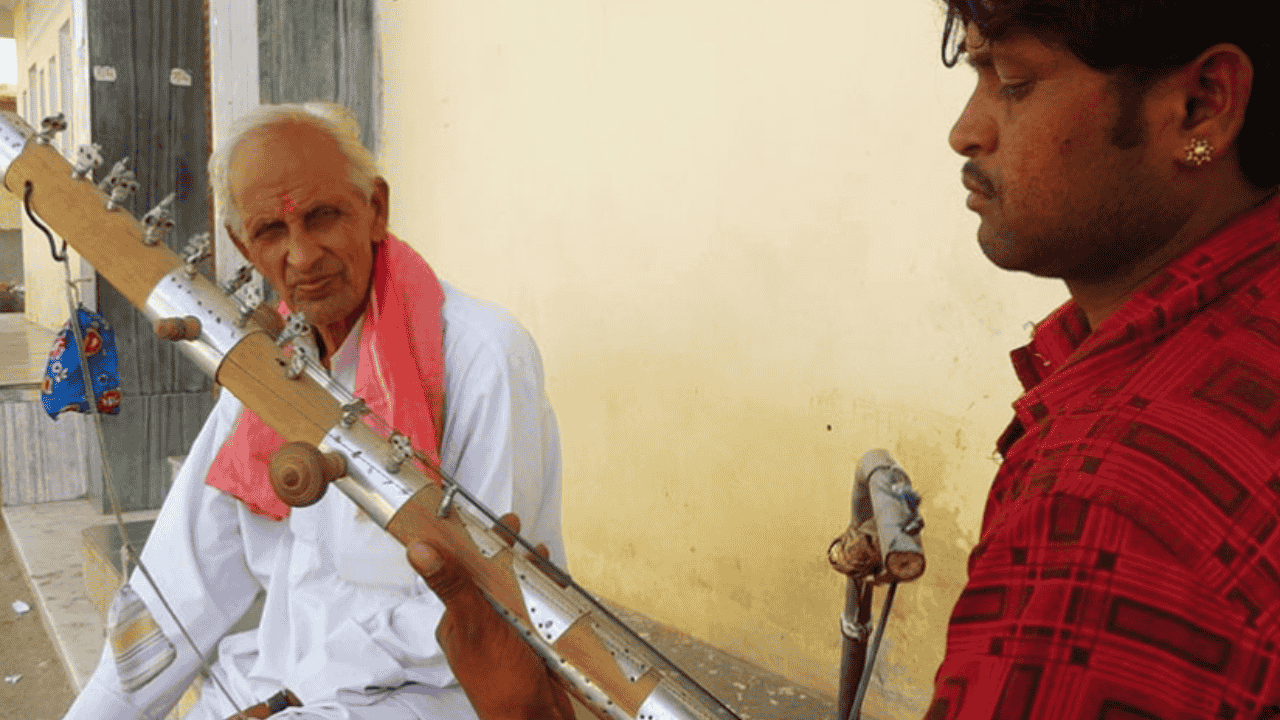
The Ravanahatha is a folk fiddle constructed from organic, locally sourced materials, reflecting the pragmatic design of nomadic artisans. Its construction typically involves the player crafting their own instrument, adjusting the physical components to achieve a personalized tone.
The main body consists of a long, straight stem called the Dandi (measuring 80 to 90 cm), made of bamboo or durable wood, which functions as both the fingerboard and neck. At one end of this stem, a resonator is attached. The resonator is crafted from a halved coconut shell, a hollowed gourd, or occasionally a wooden cylinder. A taut membrane made of goat skin or other animal hide is stretched over the open face of this shell to amplify the acoustic vibrations of the strings.
Historically, the instrument used strings made of natural fibers or horse tail hair, but modern versions often feature a combination of steel and horsehair to improve durability. In the traditional Rajasthani design, the two primary playing strings are named the Roda and the Chadhav. The Chadhav is made of horse tail hair, while the Roda is a steel wire.
These main strings are stretched over a small wooden bridge and anchored to wooden tuning pegs along the bamboo neck. The tuning system uses 15 smaller pegs called Moranis and 2 larger pegs called Moranas. Additionally, the instrument often features between 5 and 20 sympathetic steel strings (Tarab) running parallel to the neck, which vibrate automatically to create an echo effect.
The instrument is played vertically using a curved wooden bow (historically called the Gengan) strung with horse tail hair. Ravanahatha players apply a powdered resin cake (Bejara) to the bow to reduce friction, allowing for smoother pitch changes and microtonal slides. Small brass bells (ghunghroos) are often attached to the bow, providing a rhythmic percussive accompaniment to the performance.
Structural Comparison of Regional Variations
| Structural Parameter | Rajasthani Folk Variant | Gujarati Folk Variant |
|---|---|---|
| Local Nomenclature | Ravanhatta or Rawanhattha [cite: 3, 4] | Frequently referred to as Sarangi in specific ceremonial contexts |
| Fingerboard Design | Long, straight bamboo stem (Dandi) pierced through the coconut resonator | Rounded wood fingerboard penetrated through a halved coconut shell |
| Resonator Membrane | Goat skin or sheep hide stretched tautly over the coconut bowl | Covered parchment or animal skin |
| String System | 2 primary strings (Roda and Chadhav) with up to 16 sympathetic steel strings | Two principal steel strings tied to upper wooden pegs, rarely utilizing sympathetic strings |
| Traditional Purpose | Vocal accompaniment for historical and religious ballads (Pabuji Ki Phad) | Accompaniment to regional folk songs and historical morning calls for royal households |
Performance Dynamics: Folk Storytelling and the Bhopa Tradition
In contemporary India, the preservation of the Ravanahatha is closely tied to the Bhopas—a community of hereditary priest-singers and oral historians from the Nayak, Bhil, and Thori castes of Rajasthan. The Bhopas use the instrument as a vehicle for storytelling, maintaining a rich repertoire of regional epics, historical sagas, and religious narratives.
The primary performance context for the instrument is the recitation of the epic of Pabuji, a 14th-century Rathore chief worshipped as a folk deity by the nomadic Rabari camel herders. This performance, known as Pabuji Ki Phad, features a long, painted cloth scroll (Phad) that displays the martial deeds of the hero.
During the night-long ritual, the Bhopa plays the Ravanahatha and sings the epic ballad, while his wife, the Bhopini, holds a lamp to illuminate specific scenes on the scroll. The instrument's sound mimics the pitch and cadence of the human voice, helping to convey the dramatic emotion of the story.
In Gujarat, the Ravanahatha is used by nomadic bards to accompany traditional folk songs during auspicious ceremonies. Historically, it was also played in the early morning to awaken rulers. Whether in Rajasthan or Gujarat, the instrument functions as a living archive, preserving oral history and communal memory across generations.
Classical Indian Instrument Classification System
For competitive exams, it is useful to understand how the Ravanahatha fits into the traditional classification of Indian musical instruments. This system, first outlined by Bharata Muni in the Natya Shastra (composed between 200 BCE and 200 CE), categorizes instruments into four main groups based on how they produce sound:
Tata Vadya (Chordophones - Stringed Instruments): Sound is produced by the vibration of stretched strings. This group is further divided into bowed (vitat), plucked (plectral), and struck instruments. The Ravanahatha is classified as a bowed Tata Vadya.
Sushira Vadya (Aerophones - Wind Instruments): Sound is produced by the vibration of air columns within hollow tubes (e.g., Bansuri, Shehnai).
Avanaddha Vadya (Membranophones - Percussion Instruments): Sound is produced by striking a stretched membrane of animal hide over a hollow body (e.g., Tabla, Mridangam).
Ghana Vadya (Idiophones - Solid Instruments): Solid instruments that produce sound through self-vibration when struck, without requiring tuning (e.g., Manjira, Khartal).
Comparison of the Four Natya Shastra Categories
| Class of Instrument | Primary Acoustical Principle | Structural Material | Representative Examples | Systematic Sub-Categories |
|---|---|---|---|---|
| Tata Vadya | Vibration of stretched strings | Bamboo, wood, gourds, metal wire, horsehair | Sitar, Veena, Sarod, Ravanahatha, Sarangi | Bowed, Plectral, and Struck |
| Sushira Vadya | Vibration of air columns | Hollow bamboo, wood, brass, copper, reeds | Bansuri (flute), Shehnai, Nadaswaram | Flute, Double-flute (Algoza), and Reed-based |
| Avanaddha Vadya | Vibration of a stretched membrane | Wood, clay, brass covered with animal hide | Tabla, Mridangam, Dholak, Nagara | Hand-struck, Stick-struck, and Self-struck |
| Ghana Vadya | Self-vibration of solid materials | Metal, bronze, hard woods | Manjira, Ghatam, Khartal, Chimpta | Clappers, Cymbals, and Clay vessels |
Key Facts and Exam-Relevant Data for Quick Revision
Age and Origin: The Ravanahatha has a documented history of over a thousand years, with oral traditions linking its early design to the Hela civilization of ancient Sri Lanka.
Bowing Precedence: It is recognized as one of the oldest bowed string instruments in the world, and is noted by historians as an early precursor to the modern violin.
Historical References: The instrument is recorded in Nanyadeva's 11th-century Bharatabhasya (Bihar), Ramabhadrambha's 17th-century texts (Tanjore), and Bartholomaus Ziegenbalg's 18th-century accounts (Malabar).
Bhopa Epic Performance: In Rajasthan, the instrument is used by the Bhopa community during the recitation of Pabuji Ki Phad and Devnarayan Ki Phad, using a painted cloth scroll (Phad) as a visual aid.
Acoustic Mechanics: The traditional Rajasthani version features two primary strings—the Roda (steel) and the Chadhav (horsehair)—tuned with 15 Moranis and 2 Moranas, and supplemented by up to 20 sympathetic steel strings.
Philatelic Recognition: In September 2020, India Post issued a commemorative 5-rupee postage stamp depicting the Ravanahatha as part of its "Musical Instruments of Wandering Minstrels" series.
Modern Cultural Platform: The instrument was featured in traditional performance segments at the Bithoor Mahotsav in Kanpur in February 2026, highlighting ongoing efforts to preserve regional folk arts.
Why this matters for your exam preparation
For candidates preparing for the UPSC Civil Services and other competitive examinations, studying the Ravanahatha is highly relevant for several reasons:
UPSC GS Paper I (Art and Culture): Questions on Indian musical instruments, their regional associations, and their classification under the Natya Shastra are common in both the Prelims and Mains exams. Understanding that the Ravanahatha is a bowed Tata Vadya is essential for answering classification questions.
Intangible Cultural Heritage: The instrument represents India's rich oral storytelling traditions, highlighting the role of nomadic and tribal communities in preserving regional folklore.
Regional Folk Traditions: Distinguishing between the performance of Pabuji Ki Phad (which uses the Ravanahatha) and Devnarayan Ki Phad (which uses the Jantar) is a highly specific topic often tested in state public service exams, such as the RPSC/RAS.
Socio-Economic Aspects: The transition of hereditary musicians to urban areas due to the decline of traditional patronage systems connects with larger GS Paper II and III topics regarding the welfare of vulnerable communities and the preservation of heritage.
To deepen your understanding of Indian heritage and access more high-yield study materials, visit the Atharva Examwise platform for regular updates and comprehensive exam preparation resources.