
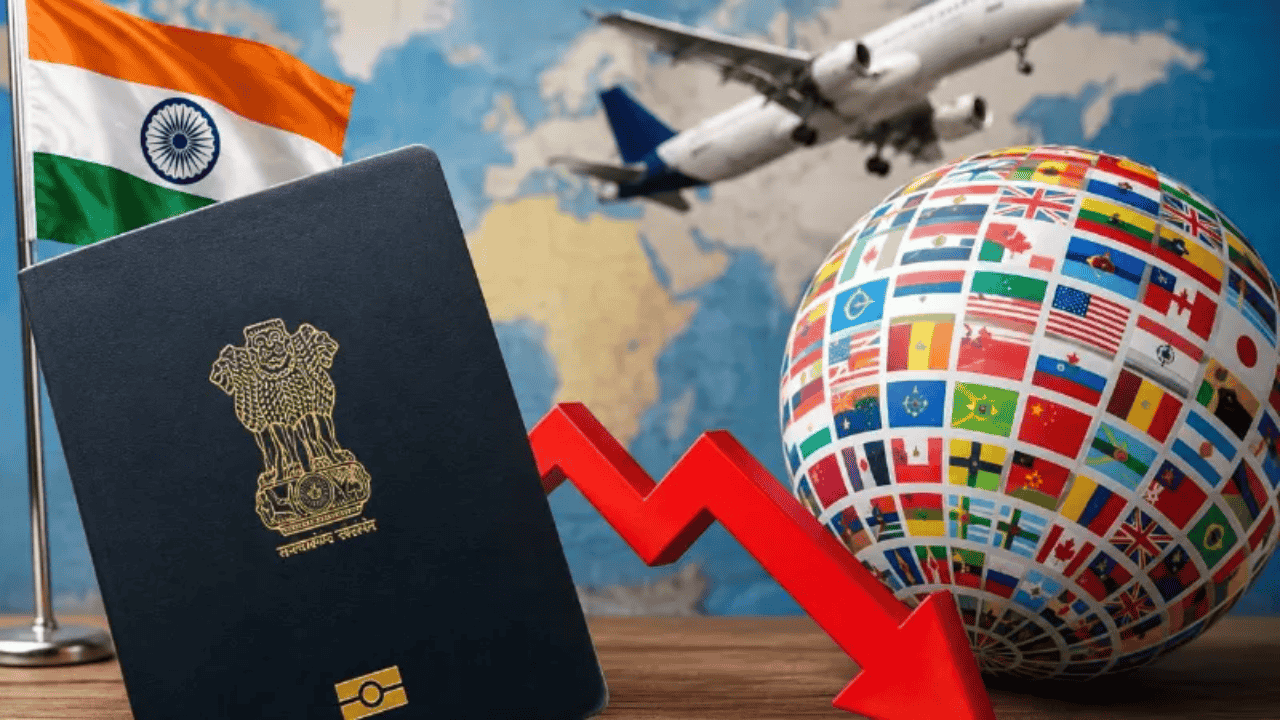
UPSC Current Affairs July 5 2026: India Ranks 125th in Global Passport Index 2026 | Daily GK Update
The latest findings of the fifth annual edition of the Global Passport Index (GPI) have been released by the residency and citizenship advisory firm Global Citizen Solutions (GCS). Published on June 30, 2026, the comprehensive ranking assesses 197 countries and territories to provide a detailed snapshot of global mobility, economic opportunity, and standard of living.
For serious civil services aspirants, this index represents a crucial crossover between international relations, human development metrics, and domestic passport administration policies. Navigating these multi-dimensional indexes is a regular requirement for the UPSC current affairs curriculum, which evaluates how global hierarchies impact India’s strategic interest and foreign policy.
Defining the Global Passport Index: A Multi-Dimensional Metric
Unlike traditional mobility lists that evaluate passports solely by the volume of visa-free travel destinations, the Global Passport Index uses a holistic methodology. By combining fourteen separate quantitative indicators, the index measures the actual value of holding a specific nationality from the perspective of travel, investment, and international residence.
The composite score of each nation is calculated across three weighted core pillars, using empirical data sourced from prominent multilateral organizations including the World Bank, the World Economic Forum, and the Sustainable Development Report.
Core Pillars of the Global Passport Index
| Pillar Name | Weight | Primary Indicators and Factors Evaluated |
|---|---|---|
| Enhanced Mobility | 50% of overall score | Measures travel freedom, visa requirements, and the "desirability" of destination countries based on their domestic quality of life. |
| Investment Potential | 25% of overall score | Assesses the economic climate, national competitiveness, innovation indices, GNI per capita, and personal taxation structures. |
| Quality of Living | 25% of overall score | Evaluates healthcare infrastructure, educational outcomes, personal safety, sustainable development, cost of living, and overall happiness. |
Global Standings: Northern European Dominance and the Mobility Divide
The 2026 rankings demonstrate the absolute dominance of European nations, which occupy nine of the top ten positions. Sweden continues to lead at the global summit with a composite score of 96.05 out of 100, driven by its exceptional performance across all three pillars. Sweden ranks eleventh globally for absolute mobility, ninth for investment attractiveness, and second for overall quality of life.
Switzerland and Finland secure the second and third positions, respectively. Singapore, ranked tenth, is the sole non-European nation to enter the top ten. While Singapore leads the world in both absolute mobility and investment potential, its lower relative score for quality of life indicators pushed its overall composite rank to tenth.
The gap between the strongest passport (Sweden, 96.05) and the weakest (Afghanistan, 23.10) has widened in every edition since the index's inception in 2021. This indicates a hardening structural divide between the highly mobile Global North and the severely restricted Global South.
Top 10 Strongest Passports in the Global Passport Index 2026
| Global Rank | Country | Primary Pillar Strengths | Global Mobility Context |
|---|---|---|---|
| 1 | Sweden | High Quality of Life, Strong Economy | Access to highly desirable destinations |
| 2 | Switzerland | High Investment Attractiveness | Strong banking and economic stability |
| 3 | Finland | 1st globally in Quality of Life | Exceptional safety and social indicators |
| 4 | Germany | Consistently high scores across all pillars | Balanced travel and economic indicators |
| 5 (joint) | Denmark | Outstanding Quality of Life (4th globally) | High sustainable development and welfare |
| 5 (joint) | Netherlands | Strong Mobility and Investment metrics | Leading European trading and shipping hub |
| 7 | Ireland | Balanced EU passport benefits | High standard of living and open economy |
| 8 | United Kingdom | High Quality of Life and Investment scores | Travel mobility impacted by post-Brexit friction |
| 9 | Norway | Strong combination of travel and safety | High GNI per capita and environmental scores |
| 10 | Singapore | 1st in Mobility and Investment pillars | Restricted overall by Quality of Life ranking |
(Note: Due to a tie for the fifth position, there is no sixth-ranked country in the overall standings.)
[cite: 13, 14]
Among other major world powers, France and the United States shared the eleventh position, narrowly missing the top ten, while Canada secured the thirteenth spot overall.
India's Standing in the Global Passport Index 2026: A Dual-Track Narrative
The fifth edition of the Global Passport Index paints a mixed picture for the Indian passport. India has slipped one place to the 125th spot out of 197 countries, down from 124th in 2025. Over the long term, India's trajectory has remained relatively stagnant, moving up only two positions from its 127th rank in 2021.
However, India's composite score has reached a five-year high of 45.1. This demonstrates that while domestic economic and social reforms are improving India's objective metrics, other developing nations are expanding international travel agreements and visa-free access at a much faster pace, causing India to slip in relative terms.
Indian Performance Across the Weighted Sub-Indices
The internal metrics of India’s 125th global ranking show a notable imbalance across the three main parameters:
Quality of Living Index (118th place): This represents India's most significant area of progress, climbing eleven positions from 129th last year. The improvement reflects advancements in healthcare delivery, public educational enrollment, and overall personal safety measures.
Investment Index (94th place): India improved three positions from 97th in the previous edition. This rise reflects India's status as a rapidly growing economy with robust market innovation, though high levels of personal taxation continue to keep the country outside the top tiers of GCS’s investment standings.
Enhanced Mobility Index (136th place): International travel freedom remains the largest bottleneck for the Indian passport, falling one spot from last year. The Indian passport currently offers visa-free or visa-on-arrival access to only 26 destinations.
Quick Facts: The Travel Footprint of Indian Citizens
Visa-Free / Visa-on-Arrival Access (26 Destinations): Bhutan, Nepal, Jamaica, Macau, Palestine, Tunisia, Angola, Barbados, Dominica, Federated States of Micronesia, Fiji, Gambia, Grenada, Haiti, Kazakhstan, Kiribati, Malaysia, Maldives, Mauritius, Qatar, Rwanda, Saint Vincent and the Grenadines, Senegal, Thailand, Trinidad and Tobago, and Vanuatu.
Advance Visa Mandatory (~88 Destinations): Major global destinations including the United States, United Kingdom, Germany, France, China, Andorra, and the United Arab Emirates.
Comparative Standings (Asian and Neighboring Region): When evaluated within Asia, India occupies the 29th spot. Within the immediate South Asian neighborhood, India trails China (104th) but outperforms Bhutan (132nd), Sri Lanka (141st), Nepal (164th), Bangladesh (166th), and Pakistan (188th).
Aspirants seeking to link these mobility trends with global economic disparities can read more on associated subjects via the Atharva Examwise current news platform, which offers deep dives into topics like the World Inequality Report 2026 and its domestic impact.
Methodological Comparison: Global Passport Index vs. Henley Passport Index
Candidates preparing for competitive exams must avoid confusing GCS’s Global Passport Index with the Henley Passport Index (HPI). The differences in their methodologies lead to distinct rankings for the Indian passport.
[Henley Passport Index] [Global Passport Index] - Purely Travel Mobility - Three-Pillar System - 100% Visa-Free Count - 50% Enhanced Mobility - Source: IATA Data - 25% Investment potential - India Rank: 80th (July 2026) - 25% Quality of Life - India Rank: 125th (2026)
Key Differences in Passport Evaluation
| Feature | Henley Passport Index (HPI) | Global Passport Index (GPI) |
|---|---|---|
| Primary Focus | Absolute travel mobility. | Holistic citizenship and residence value. |
| Primary Data Source | International Air Transport Association (IATA). | World Bank, WEF, Sustainable Development Report. |
| India’s Rank (2026) | 80th place (improved five positions from last year). | 125th place (slipped one position from last year). |
| Travel Access Score | 55–56 destinations allowed without a prior visa. | 26 destinations allowed without a prior visa. |
| Key Distinction | Evaluates visa-free destination numbers regardless of their destination attractiveness. | Incorporates destination attractiveness and penalizes limited travel to high-QoL nations. |
Emerging Geopolitical Trends in Global Mobility
An analytical examination of the 2026 Global Passport Index reveals two defining structural changes in how nation-states manage their borders:
1. The Consolidation of Digital Pre-Screening Systems
Borders are increasingly shifting from physical checkpoints to digital pre-screening structures. Wealthy democracies in the Global North have converged on systems such as the UK’s Electronic Travel Authorisation (ETA), the European Union’s Entry/Exit System (EES) and the upcoming ETIAS, and the United States’ Electronic System for Travel Authorization (ESTA). While these tools preserve the appearance of open travel, they add significant procedural friction and allow states to exercise stricter digital surveillance over who enters their territories.
2. The Persistence of Asymmetric Reciprocity
Bilateral travel agreements rarely operate on equal terms. The 2026 index shows that 61.5% of all bilateral travel pairs are asymmetric. Citizens of wealthier, politically aligned Western nations systematically receive unilateral visa-free entry into emerging markets, whereas travelers from the Global South must navigate highly restrictive, costly, and document-heavy visa application processes to visit those same Western countries.
Why this matters for your exam preparation
The Global Passport Index 2026 is an essential current affairs topic for civil services and other competitive state examinations, providing rich case studies and data points across multiple General Studies (GS) syllabus areas:
GS Paper II (Polity and Governance): Passport vs. Citizenship
A key administrative debate in India centers on whether a passport constitutes definitive proof of citizenship.
The Legal Position: In a clarification to Parliament, the Ministry of Home Affairs (MHA) stated that identity documents like Aadhaar, Voter ID, PAN card, and Passports are not legally designated as conclusive proofs of Indian citizenship. Instead, citizenship is strictly governed by the Citizenship Act, 1955.
Evidentiary Value vs. Creation of Status: While a passport possesses strong evidentiary value—as it is ordinarily issued only to Indian citizens—it does not create citizenship. The Supreme Court, in State of Andhra Pradesh v. Abdul Khader (1962), ruled that a passport is relevant evidence but courts must examine constitutional criteria such as domicile, birth, and migration history to determine citizenship.
Statutory Framework: Section 20 of the Passports Act, 1967, allows the central government to issue passports to certain non-citizens under public interest, proving that a passport is fundamentally a travel document rather than an exclusive certificate of citizenship.
Administrative Context: Effective July 1, 2026, the Ministry of External Affairs implemented a revised passport fee structure, raising standard 36-page passport fees to ₹2,500 and Tatkal passports to ₹5,000. This serves as an excellent factual detail for administrative updates under GS Paper II.
GS Paper II (International Relations): The Diplomacy of Mobility
North-South Geopolitical Divide: The widening score gap between Sweden and Afghanistan is a clear representation of structural inequality in global governance. Candidates can use these findings to write analytical arguments regarding the neo-colonial dimensions of international borders and global mobility rights.
Indian Diaspora and Foreign Policy: India's low mobility rank (136th) presents barriers for its highly skilled professionals. Simplifying travel pathways through bilateral agreements is a key component of India’s active space and economic diplomacy. This dynamic directly relates to initiatives like the digital integration of the Overseas Citizen of India (OCI) card to ease travel for the diaspora.
GS Paper III (Economic Development & Quality of Life)
Pillar Performance Correlation: India's rise in the Investment Index (94th) and Quality of Living Index (118th) shows the success of domestic schemes in healthcare, safety, and ease of doing business. However, the lower mobility rank acts as a structural drag, limiting India's potential to fully translate domestic economic growth into global passport power.
For structured strategies on integrating indices into your GS mains answers, explore the comprehensive resources available on the Atharva Examwise platform, such as the UPSC current affairs analysis live lectures. For further context on diverse syllabus topics, aspirants can also refer to recent updates on Tripura's Lebang Boomani Dance and its relation to Jhum cultivation.