
UPSC Current Affairs July 2026: SpudCell Breakthrough and Bottom-Up Synthetic Biology | Atharva Examwise Daily GK Update
In the rapidly evolving landscape of biotechnology, the threshold separating inanimate chemistry from living biology has historically been considered an absolute boundary. However, a major milestone achieved by researchers at the University of Minnesota Twin Cities has fundamentally redefined this paradigm. The laboratory assembly of SpudCell, a synthetic cell-like system capable of completing a full cellular lifecycle, represents a historic leap from modifying existing genetic structures to engineering life from the bottom up.
For serious competitive exam aspirants, particularly those preparing for the UPSC Civil Services Examination (GS Paper III: Science and Technology), understanding this breakthrough is vital. This comprehensive report analyzes the genomic architecture, physical mechanisms, socio-economic implications, and global governance challenges of SpudCell, integrating its relevance with India's policy initiatives.
The Genesis of the SpudCell Milestone
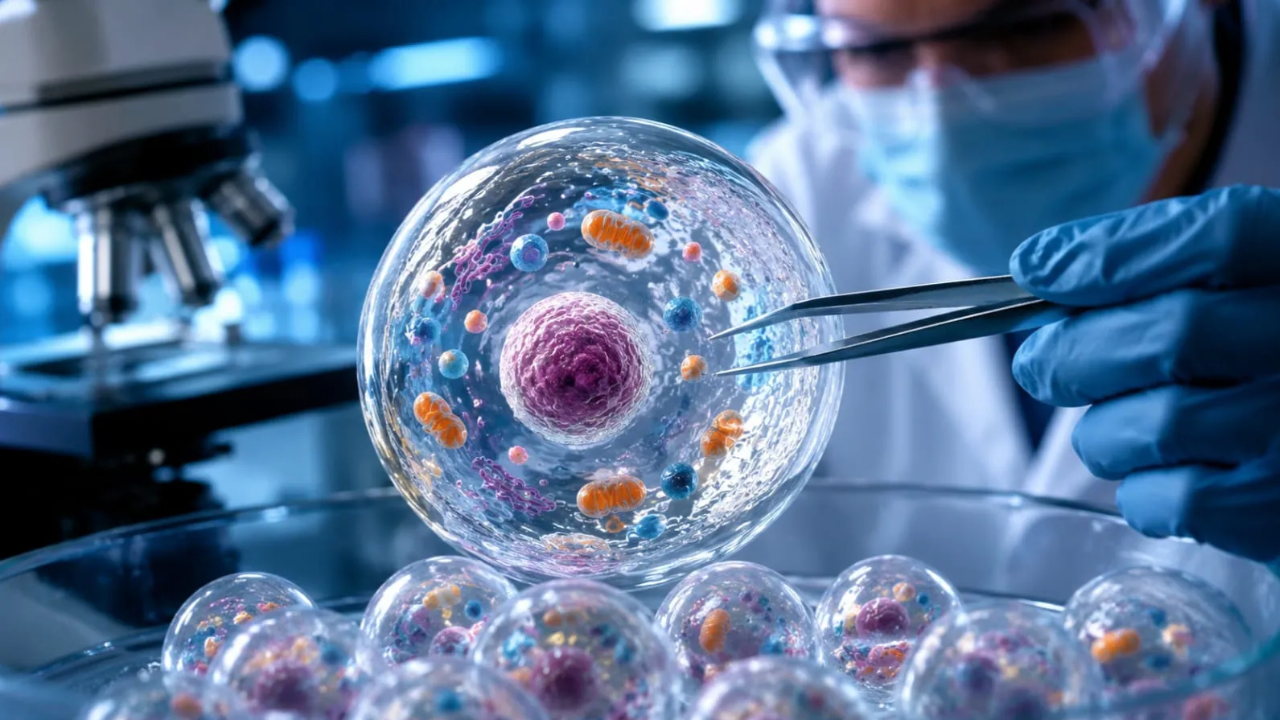
Led by associate professors of synthetic biology Dr. Kate Adamala and Dr. Aaron Engelhart, the research team successfully constructed SpudCell entirely from non-living chemical components. The moniker "SpudCell" serves a dual purpose: first, it references the cellular construct's lumpy, potato-like appearance under high-resolution microscopy, and second, it evokes Sputnik, signaling the dawn of a new space age in biological engineering.
Most synthetic biology research has historically focused on "top-down" genetic engineering, where scientists start with a living, naturally occurring organism and strip away non-essential genes. SpudCell completely reverses this logic. As a landmark achievement in "bottom-up" synthetic biology, it is assembled piece-by-piece from purified proteins, synthetic DNA, and lipids, allowing researchers to study how life-like properties emerge directly from inanimate molecular networks.
The results of this breakthrough, shared as a preprint on the bioRxiv preprint server and hosted by the public-benefit consortium Biotic, highlight a microscopic system capable of resource acquisition, DNA replication, and autonomous division across multiple generations.
Key Facts and Exam-Relevant Data
For competitive exams, the following quantitative and qualitative parameters summarize the essential details of this biological breakthrough:
Extremely Small Physical Footprint: SpudCell is microscopic, measuring approximately four times smaller than a single fine grain of sand [cite: Hindi Input].
Highly Compressed Genome: While natural cells carry thousands of genes, SpudCell operates on a minimal genome of just 36 genes.
Molecular Composition: The cell is constructed using a carefully calibrated mixture of approximately 100 to 200 distinct molecules, including structural lipids, metabolic enzymes, and DNA.
Genomic Distribution: Unlike the continuous single chromosome of bacteria, SpudCell’s $90\text{ kilobase-pair (kbp)}$ genome is split across seven separate circular DNA plasmids.
Lifecycle Longevity: Due to molecular degradation and the inability to self-synthesize ribosomes, a SpudCell lineage can replicate and survive for only 5 to 10 generations in a controlled laboratory environment.
Genomic and Molecular Architecture
To appreciate the scale of SpudCell, its genetic complexity must be contrasted with natural organisms and previous synthetic models.
Comparative Complexity of Genomic Systems
| Organism / Cellular Chassis | Genome Size | Gene Count | Genomic Structure | Structural Scaffolding (Cytoskeleton) |
|---|---|---|---|---|
| Human Cell (Homo sapiens) | $\sim 3,000,000\text{ kbp}$ [cite: 4, 21] | $\sim 20,000 \text{ to } 22,000$ [cite: 12, 23] | 46 linear chromosomes | Present (highly complex) |
| Common Bacteria (E. coli) | $\sim 4,600\text{ kbp}$ | $\sim 4,400$ [cite: 12, 23] | Single circular chromosome | Present |
| JCVI-syn3.0 (Top-Down Minimal Cell) | $531\text{ kbp}$ [cite: 24] | $473$ [cite: 7, 22, 24] | Single synthetic chromosome | Present (minimal) |
| SpudCell (Bottom-Up Synthetic Cell) | $90\text{ kbp}$ [cite: 4, 21] | $36$ [cite: 3, 12] | 7 circular DNA plasmids | Absent (membrane-crowded division) |
By dividing the genome across seven independent plasmids, the researchers developed a modular "operating system" for biology. This allows bioengineers to reprogram specific cellular functions—such as metabolic rate or protein expression—without disrupting the entire system.
Mechanistic Breakthroughs: Growth, Division, and Selection
SpudCell successfully mimics three core processes of natural life through purely chemical and physical mechanisms:
1. Osmotic Feeding and Growth
SpudCell is encapsulated by a lipid bilayer (liposome) that functions similarly to a real cell membrane. To grow, the synthetic cell absorbs lipid nutrients and chemical energy (such as ATP) directly from the surrounding liquid medium. This growth is facilitated by fusing with smaller externally supplied "feeder" liposomes. As these nutrients are integrated through membrane fusion, the physical volume of the cell expands.
2. Cytoskeleton-Free Division
In natural biology, cell division requires an internal scaffolding of protein fibers called a cytoskeleton to actively pull the cell apart. Replicating this mechanical process from scratch has been a persistent roadblock in bottom-up synthetic biology.
SpudCell bypasses this requirement through a physical mechanism known as membrane crowding. The synthetic cell is programmed to produce a membrane-bound fusion protein (specifically alpha-hemolysin). As these proteins are synthesized, they migrate to the outer membrane, swarming and packing together. This local crowding generates intense mechanical stress on the lipid bilayer, eventually forcing the membrane to split into two separate daughter cells.
3. Demonstrating Chemical Natural Selection
The researchers introduced a genetic mutation into a subset of SpudCells that increased the production of membrane proteins, allowing them to bind and fuse with feeder liposomes more efficiently. When mixed equally with the standard strain, the mutated variant secured more nutrients, grew faster, and produced a higher proportion of offspring. Within five generations, the faster-growing variant outcompeted the original wild type. Under conditions of nutrient scarcity, this competitive advantage became even more pronounced, demonstrating that Darwinian selection can operate in a fully synthetic chemical system.
Key Structural and Biological Limitations
While SpudCell represents a stunning leap forward, synthetic biologists emphasize that it cannot yet be classified as fully "alive". Its dependency on external intervention highlight the severe limits of current bottom-up technology:
Ribosome Synthesis Bottleneck: Although SpudCell carries the genetic instructions to make ribosomes—the essential macromolecular complexes that translate genetic code into proteins—it cannot assemble them autonomously. Consequently, researchers must harvest functional ribosomes from E. coli bacteria and manually add them to the surrounding fluid.
Finite Lifespan: Because these borrowed ribosomes cannot be repaired or replaced by the cell, they gradually degrade over time. This causes metabolic activity to decline, limiting the survival of a SpudCell lineage to a maximum of 5 to 10 generations.
Genomic Instability: During the mechanical splitting process, the seven plasmids are not always distributed equally. Only about $30\%$ of the progeny inherit the complete synthetic genome, while the remaining $70\%$ receive fragmented, non-viable plasmid combinations.
Lack of Homeostasis: SpudCell cannot regulate its own internal metabolism, nor does it possess a mechanism to clear metabolic waste, making it highly fragile and incapable of surviving outside of a controlled laboratory setup.
Socio-Economic Potential and the BioE3 Policy
The practical objective of engineering synthetic cells is to establish highly programmable platforms that function as microscopic factories. Unlike natural microbes, which are optimized by evolution for survival and resist drastic genetic modifications, SpudCell provides a fully characterized "blank canvas" or chassis that can be engineered for specific industrial tasks.
For further conceptual clarity, aspirants can access Atharva Examwise Science & Tech Notes to review core biotechnology concepts.
This breakthrough aligns closely with India’s newly approved BioE3 (Biotechnology for Economy, Environment, and Employment) Policy. Spearheaded by the Department of Biotechnology (DBT), the policy outlines a national blueprint to transition India from petroleum-based manufacturing to high-performance biomanufacturing.
SpudCell Integration with India's BioE3 Priority Sectors
| BioE3 Priority Sector | BioE3 Policy Objectives | SpudCell Application Potential |
|---|---|---|
| Precision Biotherapeutics | Indigenous production of cancer immunotherapies, gene therapies, and biosimilars. | Designing highly controlled drug-delivery vesicles to synthesize precise, complex therapeutic proteins that natural biology cannot produce. |
| Carbon Capture and Utilization | Developing biological models to sequester greenhouse gases and mitigate climate change. | Utilizing synthetic cells programmed with artificial, high-efficiency photosynthetic pathways to absorb atmospheric $CO_2$ and convert it to starch or biofuels. |
| High-Value Bio-Chemicals & Enzymes | Replacing harsh chemical manufacturing with biological reactions. | Performing precise molecular transformations at normal biological temperatures, significantly reducing the energy footprint of chemical production. |
| Futuristic Marine & Space Research | Exploring biological survival and research in extreme planetary or marine conditions. | Engineering robust, synthetic protocells that are fully immune to viral infections or extreme temperatures, serving as bio-sensors in deep-sea or space missions. |
To support this bio-industrial transition, the Indian government launched the first National Biofoundry Network. These automated facilities integrate artificial intelligence with high-throughput DNA synthesis to optimize engineered organisms. Bottom-up platforms like SpudCell could eventually be standardized within these biofoundries to create sustainable biopolymers, enzymes, and functional foods.
Biosecurity, Global Governance, and Ethical Safeguards
As the field of synthetic biology advances toward creating self-sustaining artificial life, it brings profound risks that require global governance:
The Dual-Use Dilemma: The same micro-technologies designed to target disease can, in theory, be repurposed to synthesize novel pathogens or enhance the resistance of biological agents.
Ecological Disruption: If an autonomous synthetic cell were to escape containment, it could undergo unmonitored mutations driven by natural selection, potentially disrupting existing ecosystems and food chains.
The Governance Deficit: Existing international biosecurity frameworks are primarily designed to regulate Genetically Modified Organisms (GMOs) and natural pathogens. They are poorly equipped to monitor organisms constructed entirely from scratch using digital DNA sequences.
To mitigate these risks, researchers are developing built-in genetic kill-switches and advocating for early-stage applications to be strictly confined to closed industrial bioreactors. Furthermore, Dr. Adamala’s team launched Biotic, a non-profit public-benefit organization. Much like the Human Genome Project, Biotic aims to keep the core technical standards of synthetic biology open-source, ensuring that safety protocols, genetic blueprints, and ethical guidelines are globally shared rather than restricted by private corporate patents.
Why this matters for your exam preparation
Understanding SpudCell and synthetic biology is critical for competitive exams, particularly for the UPSC Civil Services Examination. Candidates can expect questions across both the Preliminary and Mains stages of the exam:
1. UPSC Preliminary Examination Focus
Top-Down vs. Bottom-Up: UPSC frequently tests fundamental scientific definitions. Candidates must clearly distinguish between top-down synthetic biology (e.g., stripping down natural genomes like JCVI-syn3.0) and bottom-up synthetic biology (e.g., assembling cells from scratch like SpudCell).
Genetic Engineering vs. Synthetic Biology: Be prepared for conceptual questions. Standard genetic engineering alters specific genes within existing living cells. Synthetic biology designs and constructs entirely new biological components or systems.
CRISPR-Cas9 vs. Protocells: Remember that CRISPR is a gene-editing tool used on existing living organisms, whereas protocells are synthetic, membrane-bound chemical models built from scratch to study the origins of life.
BioE3 Policy & Biofoundries: Questions may test details of India's BioE3 Policy, its implementing agency (DBT), its target valuation of $\$300\text{ billion}$ by 2030, and the role of "Moolankur" BioEnablers and the National Biofoundry Network.
2. UPSC Mains Examination Focus (GS Paper III)
Bio-Manufacturing and Green Growth: SpudCell serves as an excellent case study for answers on sustainable technology. Candidates can argue how bottom-up cell factories can help achieve "Net-Zero" targets by replacing energy-intensive industrial chemistry with low-temperature biological synthesis.
Ethics and Global Governance: Questions on the "power and peril" of synthetic biology are common. A strong answer must analyze the dual-use nature of gene synthesis, highlight the inadequacy of traditional GMO regulations for artificial life, and propose ethical frameworks like standardizing safety kill-switches and open-source scientific initiatives like Biotic.
For more daily science and technology updates and analytical coverage of emerging national policies, refer to the Atharva Examwise Daily GK Update.