
Murchison Widefield Array Discovers First Millisecond Pulsar: UPSC Current Affairs and Daily GK Update
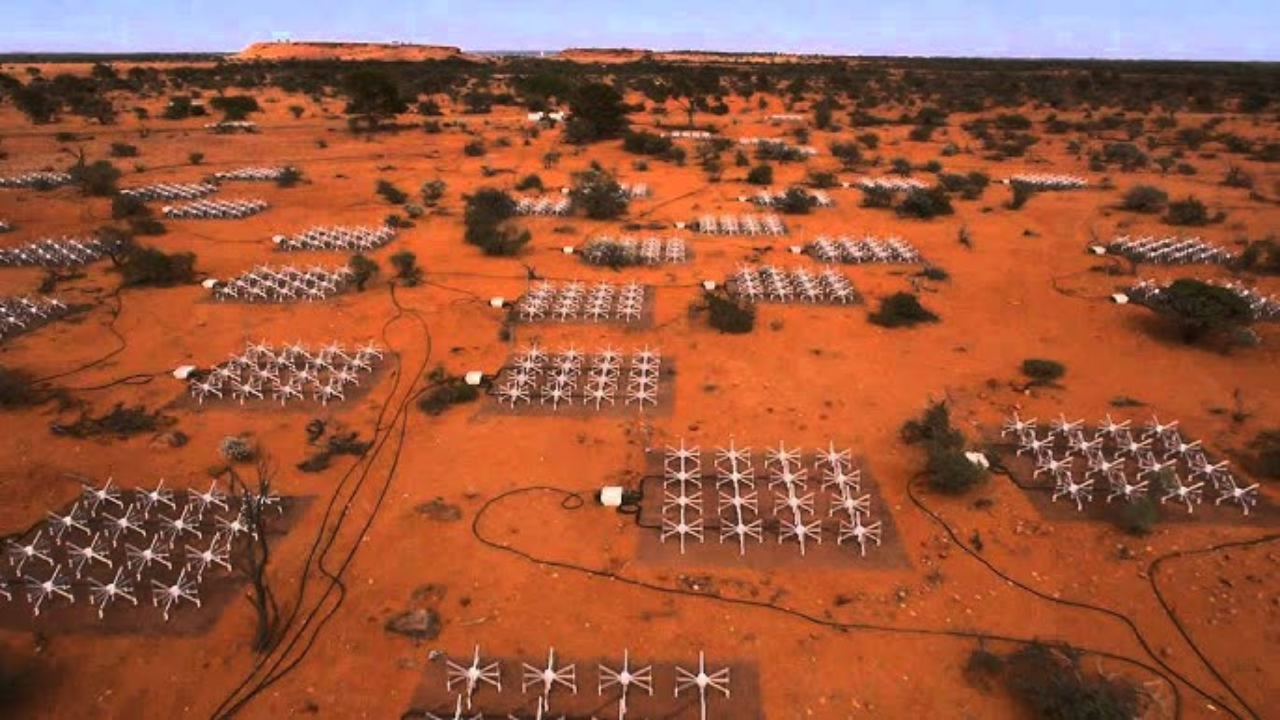
A significant scientific milestone has emerged from the fields of radio astronomy and deep-space observation, capturing the attention of the global astrophysical community. Astronomers utilizing the Murchison Widefield Array (MWA) have discovered a new millisecond pulsar, designated as PSR J0125-5854, during the ongoing Southern-sky MWA Rapid Two-metre (SMART) survey. This discovery, accepted for publication in The Astrophysical Journal Letters, represents the first time this low-frequency telescope has successfully detected a millisecond pulsar.
For serious candidates seeking high-yield science and technology updates for competitive examinations, this breakthrough represents a major technological leap. It serves as an empirical validation for next-generation astronomical systems, particularly the Square Kilometre Array (SKA), in which India is playing a leading software and design role. This comprehensive Atharva Examwise current news analysis unpacks the scientific, technological, and strategic facets of this discovery.
Astronomical Breakthrough: The Discovery of PSR J0125-5854
The discovery of PSR J0125-5854 was initially reported on the arXiv preprint server and subsequently confirmed through high-sensitivity follow-up observations using the MeerKAT telescope in South Africa and the Parkes "Murriyang" telescope in Australia.
Pulsars are highly dense, rapidly rotating neutron stars formed from the collapsed remnants of massive stars after supernova explosions. They possess extremely powerful magnetic fields that funnel charged particles along their magnetic poles, emitting concentrated beams of electromagnetic radiation across space. Because the magnetic axis is typically inclined relative to the rotational axis, these beams sweep across the Earth's line of sight like a lighthouse, producing highly regular, clock-like periodic radio signals.
Millisecond pulsars (MSPs) represent an extreme sub-class of neutron stars that rotate hundreds of times per second, featuring spin periods below approximately $30\text{ ms}$. These stars are typically "recycled" in binary systems. Over millions of years, the gravity of the neutron star pulls matter from its stellar companion, transferring angular momentum and spinning up the neutron star to extreme speeds while stripping the companion down to its core—often leaving a white dwarf.
The physical and orbital parameters of the newly discovered PSR J0125-5854 have revealed several unique astrophysical properties:
| Parameter | Observed Value | Analytical Significance |
|---|---|---|
| Spin Period | $24.6\text{ ms}$ [cite: 3] | Confirms its classification as a highly recycled millisecond pulsar. |
| Dispersion Measure (DM) | $11.66\text{ pc cm}^{-3}$ [cite: 7] | Quantifies the free electron density in the interstellar medium, estimating its distance. |
| Galactic Latitude | $-57^\circ$ [cite: 7] | Placed at a high Galactic latitude, away from the crowded stellar plane of the Milky Way. |
| Estimated Distance | $0.5\text{--}1\text{ kpc}$ ($1,600\text{--}3,200\text{ ly}$) | Pinpoints its location within our local Galactic neighborhood. |
| Orbital Period | $833.60 \pm 0.04\text{ days}$ [cite: 7] | Indicates an unusually wide binary separation, orbiting its companion for over two years. |
| Orbital Eccentricity | $0.0052 \pm 0.0006$ [cite: 7] | Shows an almost perfectly circularized orbit, suggesting long-term tidal stability. |
| Minimum Companion Mass | $0.4152 \pm 0.0001\ M_\odot$ [cite: 7] | Points to a low-mass companion, highly likely to be a Helium White Dwarf. |
| Spectral Index ($\alpha$) | $-2.2 \pm 0.3$ [cite: 7] | Confirms a steep radio spectrum, making it significantly brighter and easier to study at low frequencies. |
This unique configuration—a fast-spinning pulsar in a exceptionally long, circular orbit with a Helium White Dwarf companion—helps astrophysicists test the boundaries of stellar evolution models, gravitational theories, and the behavior of matter at nuclear densities.
Technical Overview of the Murchison Widefield Array
The Murchison Widefield Array (MWA) is a low-frequency radio interferometer located at Inyarrimanha Ilgari Bundara, the CSIRO Murchison Radio-astronomy Observatory (MRO) in Western Australia. It is operated by Curtin University on behalf of an international consortium involving 20 research institutions from Australia, Canada, China, Japan, and the United States.
Unlike traditional optical or single-dish radio telescopes, the MWA consists of $4,096$ spider-like antennas optimized to capture low-frequency radio waves between $70\text{ MHz}$ and $300\text{ MHz}$. These frequencies represent "invisible" electromagnetic signals that are completely blocked to the human eye, enabling scientists to observe cosmic environments otherwise obscured by interstellar dust.
The array's architecture offers several key advantages:
Massive Field of View: Operating with an angular field of view spanning approximately $30^\circ$ across, the MWA can map large fractions of the sky rapidly.
Digital Pointing Agility: The telescope utilizes electronic beamforming rather than physical steering to change its pointing direction instantly, allowing it to capture transient events as they happen.
Radio-Quiet Location: Sited $300\text{ km}$ inland on Wajarri country, the observatory is shielded from terrestrial radio interference (such as mobile networks and FM signals), allowing it to detect incredibly faint deep-space emissions.
These capabilities allow the MWA to study the Epoch of Reionization (when the first stars and galaxies formed), trace the evolution of galaxies, observe space weather caused by solar flares, and search for transient radio sources such as pulsars and fast radio bursts.
The SMART Survey: Probing the Southern Sky
The Southern-sky MWA Rapid Two-metre (SMART) survey is an ambitious observational project designed to map the entire southern sky for pulsars and rotating neutron stars at low frequencies. It operates primarily in the $140\text{--}170\text{ MHz}$ frequency band.
The SMART survey is unique as it is the only low-frequency pulsar search program operating in the Southern Hemisphere. It utilizes the MWA's wide field of view to cover the entire southern sky in approximately 70 observation sessions, with each patch of the sky observed for about 80 minutes. This deep integration creates petabyte-scale datasets that are processed using high-performance supercomputing facilities.
The discovery of PSR J0125-5854 from only a small fraction of the initial survey data validates the effectiveness of the search pipelines. Once completed, the SMART survey is expected to discover hundreds of new pulsars, expanding the known population of rotating neutron stars and establishing a critical reference catalog for future astronomical operations.
The Square Kilometre Array Observatory (SKAO) and India's Role
The scientific value of the MWA is amplified by its official designation as a precursor telescope for the Square Kilometre Array Observatory (SKAO). The SKAO is an international mega-science project building the world’s largest and most sensitive radio telescope network across sites in Australia and South Africa, with its operational headquarters in the United Kingdom.
┌───────────────────────────────────┐ │ Square Kilometre Array │ │ Observatory │ └─────────────────┬─────────────────┘ │ ┌────────────────────────┴────────────────────────┐ ▼ ▼ ┌─────────────────────────────────┐ ┌─────────────────────────────────┐ │ SKA-Low (Australia) │ │ SKA-Mid (South Africa) │ ├─────────────────────────────────┤ ├─────────────────────────────────┤ │ • Located at Western Australia │ │ • Located at Karoo Region │ │ • ~131,072 dipole antennas │ │ • ~197 steerable dish antennas │ │ • Frequency: 50 - 350 MHz │ │ • Frequency: 350 MHz - 15.4 GHz │ │ • Precursor: MWA │ │ • Precursor: MeerKAT │ └─────────────────────────────────┘ └─────────────────────────────────┘
India's Full Membership and Financial Commitment
India has been a pivotal player in the SKA project since its conceptualization in the 1990s. In January 2024, the Government of India formally approved its participation in the construction phase of the SKAO, backed by a financial commitment of $\text{Rs. } 1,250\text{ crore}$ over seven years. This funding is jointly managed by the Department of Atomic Energy (DAE) and the Department of Science and Technology (DST). In July 2024, India formally signed and ratified the SKAO Convention, officially becoming a full member country of the SKAO Council.
Strategic Contributions and the "Telescope Brain"
India's domestic participation is spearheaded by the SKA-India Consortium (SKAIC), which includes over 20 academic and research institutions, with the National Centre for Radio Astrophysics (NCRA-TIFR) in Pune serving as the nodal institute.
India is contributing to several critical areas of the SKAO construction phase:
Observatory Monitor and Control System: Building on its leadership of the international Telescope Manager design consortium, India is supervising the development of the software that coordinates the operations of the telescopes. This system acts as the "brain and nervous system" of the observatory, executing commands, monitoring telescope health, and orchestrating observations for the global scientific community.
Digital Hardware and Signal Processing: India is actively building station-level digital signal processing electronics for the SKA-Low antennas and radio-frequency electronics for the SKA-Mid dishes.
SKA Regional Centre (SRC): India is establishing a dedicated high-performance computing center to store, process, and distribute SKAO data products to the domestic scientific community.
Synergy with GMRT: Indian astronomers leverage immense expertise from operating the Giant Metrewave Radio Telescope (GMRT) near Pune, which is recognized as an official SKA pathfinder facility. India also maintains key radio astronomy assets in Ooty, Nainital, and Bengaluru.
Why this matters for your exam preparation
For aspirants preparing for competitive examinations, especially the UPSC Civil Services Examination, this development is a high-yield topic across multiple stages of the exam cycle:
UPSC Civil Services Prelims (General Studies Paper I):
Science & Technology: Candidates must understand basic astronomical concepts, including the lifecycle of stars, the formation of neutron stars, the physical differences between standard pulsars and millisecond pulsars, and the mechanics of radio interferometry.
International Space Programs: Questions frequently test international collaborative scientific initiatives. Understanding the structure of the SKAO (the locations of SKA-Low and SKA-Mid) and India's role as a ratifying member country of the SKAO Council is crucial.
Key Geographical Locations: Questions can link the Murchison Radio-astronomy Observatory (MRO) to Western Australia, and the Karoo region to South Africa.
UPSC Civil Services Mains (General Studies Paper III - Science & Technology):
Indigenization of Technology: India's leadership in designing the Telescope Manager and the Observatory Monitor and Control system is a stellar example of Indian software prowess translating into leadership in global mega-science projects. This showcases the capabilities of Indian academic institutions (led by NCRA-TIFR) collaborating with domestic private and public sector industries.
Exquisite Tests of Fundamental Physics: Millisecond pulsars act as highly precise natural cosmic clocks. By measuring tiny variations in their pulse arrival times via Pulsar Timing Arrays (PTAs), scientists can detect low-frequency gravitational waves. This links directly to the study of advanced concepts in general relativity and cosmology.
Niche Skill Development: Indian participation in the SKAO fosters technical capacity building in cutting-edge domains, such as high-volume optical fiber transport, sophisticated cryogenic receivers, advanced antenna design, and petabyte-scale cloud computing.
For comprehensive mock tests, test series, and structured notes on these scientific developments, aspirants can reference the dedicated UPSC Science and Technology section on the Atharva Examwise platform.