UPSC Current Affairs Today: 400-Year-Old Hemis Festival Commences in Ladakh | Atharva Examwise Current News
The high-altitude region of Ladakh has officially commenced the internationally acclaimed, two-day cultural and spiritual congregation known as the Hemis Festival. Originating as a historical tradition that has endured for nearly 400 years, this cultural event is hosted annually at the Hemis Monastery, which is situated approximately 40 to 45 kilometers southeast of Leh along the banks of the Indus River. Dedicated to commemorating the birth anniversary of Guru Padmasambhava, the 8th-century Indian Buddhist master who introduced Tantric (Vajrayana) Buddhism to the Himalayas, this festival represents a crucial intersection of religious devotion, historical preservation, and regional identity.
Every year, the festival transforms the quiet valley of Ladakh into a vibrant meeting ground for thousands of domestic and international tourists, alongside Buddhist scholars and spiritual seekers. For serious civil services aspirants preparing for the Union Public Service Commission (UPSC) examinations, tracking these cultural updates is critical under the Art and Culture, Geography, and Ecology segments of the syllabus. Comprehensive daily GK updates and structured analysis of similar topics can be accessed on the Atharva Examwise Current Affairs Portal and the Atharva Examwise Art and Culture Study Center.
Historical Origins and Royal Patronage of Hemis Gompa
The institutional history of the Hemis Monastery, or Hemis Gompa, presents a complex synthesis of early spiritual lineages and medieval royal patronage. While academic and spiritual traditions trace the initial sacred foundations of the site back to the 11th century under the influence of the revered Buddhist Mahasiddha Naropa, the modern monastic complex was established in its current form in 1672. This reconstruction was carried out under the direct patronage of the Ladakhi King Sengge Namgyal, who sought to consolidate his reign by patronizing influential Buddhist lineages.
The task of constructing and organizing the monastery was entrusted to Stagsang Raspa Nawang Gyatso (popularly known as Taktsang Shambunath), a highly respected scholar-monk of the Drukpa Kagyu sect. Under his leadership and through royal funding, Hemis grew to become the wealthiest and largest monastery in Ladakh. It assumed administrative control over a vast spiritual empire, which today encompasses more than 200 branch monasteries and provides spiritual guidance to over 1,000 monks across the trans-Himalayan region. The geographic isolation of the monastery, situated at an altitude of approximately 12,000 feet (3,600 meters) above sea level, protected its physical structures and art treasures from the military conflicts that historically affected lower-altitude valleys, ensuring the survival of its original architecture.
Theological Framework of Guru Padmasambhava and Vajrayana Buddhism
At the core of the Hemis Festival is the celebration of the birth anniversary of Guru Padmasambhava, affectionately referred to by the regional populace as Guru Rinpoche ("Precious Teacher"). Adherents of the Nyingma school and other Himalayan Buddhist traditions revere Padmasambhava as the "Second Buddha," recognizing him as a direct spiritual manifestation of Lord Buddha sent to bring teachings to the northern realms.
The theological contributions of Guru Padmasambhava are deeply linked to the propagation of Vajrayana Buddhism, a tantric school of Mahayana Buddhism that emphasizes rapid spiritual enlightenment through advanced meditation, mudras, mantras, and visualization. According to ancient records, the Guru's arrival in the Himalayas during the late 8th century was marked by his successful subjugation of hostile spirits and local demons that had repeatedly blocked the construction of the Samye Monastery in Tibet. By executing powerful ritual dances combined with tantric mudras, Padmasambhava subdued these destructive forces and committed them to protecting the Buddhadharma. This historical and mythological triumph of spiritual order over chaotic forces forms the conceptual core of the modern Hemis celebrations.
| Feature | Historical & Theological Details | Reference Sources |
|---|---|---|
| Monastery Name | Hemis Gompa (Principal seat of the Drukpa Kagyu Lineage) | [cite: 4, 7] |
| Key Founder Figures | Stagsang Raspa Nawang Gyatso, under the patronage of King Sengge Namgyal | [cite: 7, 9] |
| Geographic Location | Leh District, Union Territory of Ladakh (Elevation: ~3,600 meters) | [cite: 2, 6, 11] |
| Primary Divinity | Guru Padmasambhava (Guru Rinpoche / Second Buddha) | [cite: 1, 6, 12] |
| Sectarian Context | Drukpa Kagyu sect, a branch of the broader Kagyu school of Tibetan Buddhism | [cite: 4, 7] |
| Historical Age | Rooted in 11th-century traditions; re-established in 1672 | [cite: 2, 4, 8] |
| Surrounding Ecosystem | Hemis National Park (known for snow leopard protection and high-altitude wildlife) | [cite: 9, 16] |
The Esoteric Performance of the Cham Masked Dance
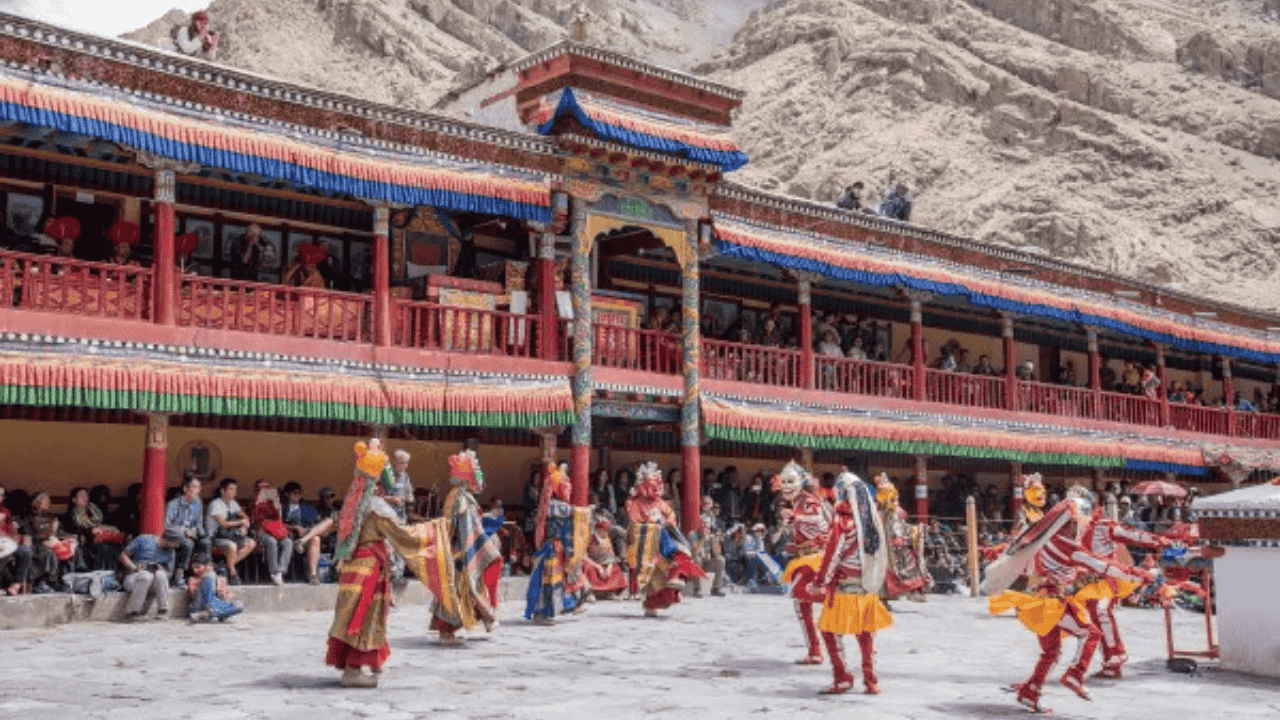
The principal public highlight of the Hemis Festival is the Cham dance, an ancient masked ritual performed by ordained monks and lamas. Rather than being a conventional performance, the Cham serves as a dynamic form of meditation and visual instruction. In historically illiterate societies where printing was scarce, these dramatic performances served as a highly effective medium for imparting moral and spiritual lessons to the lay community.
Monastic Meditation & Visualizations (Weeks Prior) │ ▼ Consecration of the Courtyard (Mandala of Action) │ ▼ Performance of Cham Masked Dancers to Sacred Music (Drums, Cymbals, Horns) │ ▼ Slaying of the Torma (Effigy of Ego and Evil) │ ▼ Casting of Fragments to Cardinal Directions (Purification of the Realm)
The execution of the Cham dance is governed by strict rules and esoteric traditions:
The Mandala of Action: The performance transforms the monastery's central courtyard into a living mandala. Monks visualize themselves as the protective deities they portray, stepping out of their human identities to channel divine, wrathful energies designed to terrify and expel evil forces.
Iconography of the Masks: The masks, crafted from clay and cotton, are painted with natural mineral pigments and polished with precious metals. Prominent figures include Mahakala (represented by a black mask), Vaishramana (the god of wealth, wearing a yellow mask), and Citipati (a pair of dancing skeletons symbolizing the impermanence of existence).
Acoustic Elements: Dancers move to the rhythms of traditional instruments, including the dungchen (long copper horns), nga (large-pan drums), and silnyen (clashing cymbals), which are played by an accompanying monastic ensemble.
The Torma Exorcism: The climax of the ritual involves the destruction of a torma—a sacred dough effigy that acts as a physical container for the collective ego, ignorance, and negative karma of the community. The leader of the Black Hat (Shanag) dancers symbolically slays this effigy, and its fragmented remains are thrown to the cardinal directions to purify the land and protect all living beings.
Architectural Spaces and Art Treasures of Hemis Monastery
The architectural design of Hemis Monastery is a prime example of the Tibetan Dzong style, built against a hillside to overlook the surrounding valley. The complex includes several temples, assembly halls, and private quarters that house some of the most valuable cultural treasures in the trans-Himalayan region.
The main prayer hall, known as the Dukhang Chenmo, serves as the spiritual center where the monastic community gathers for daily prayers and ceremonies. Adjacent to it lies the Dukhang Barpa, which contains a magnificent statue of Shakyamuni Buddha. The oldest preserved structure in the complex is the Nyingma Lhakhang ("Old Shrine"), which dates back to the initial construction phase of the monastery.
In the central courtyard, a gallery of 17th-century paintings depicts the Eighty-Four Mahasiddhas (perfected masters of tantric Buddhism). These murals were painted using ground mineral pigments and natural compounds found in the immediate vicinity. The Hemis Museum houses an extensive collection of golden statues, sacred stupas embedded with precious stones, weapons, and rare Tibetan manuscripts.
| Key Monastic Structure | Cultural & Ritual Function | Primary Artworks & Treasures | Reference Sources |
|---|---|---|---|
| Nyingma Lhakhang | The oldest shrine within the monastery, preserving early architectural styles | Early murals and historical structural elements | [cite: 3, 8] |
| Dukhang Chenmo | The main assembly hall used for collective prayers and rituals | Large murals depicting the life of Buddha and scenes from the festival | [cite: 3, 8] |
| Dukhang Barpa | Secondary prayer hall housing key icons | Intricately detailed statue of Shakyamuni Buddha | [cite: 3, 8] |
| Chhamkhang (Courtyard) | Open space with raised platforms and a sacred central pole | Host area for the Cham Dance and public gatherings | [cite: 9, 18] |
| Courtyard Gallery | Perimeter walkway surrounding the main performance arena | 17th-century paintings of the 84 Mahasiddhas using mineral pigments | [cite: 3, 4] |
The Decennial Unveiling of the Giant Silk Thangka
One of the most sacred events of the Hemis Festival is the public display of the giant, two-story-high silk Thangka of Guru Padmasambhava. This religious scroll painting is intricately embroidered with gold thread, pearls, and semi-precious gemstones.
Because of its spiritual value, this Thangka is exhibited to the public only once every twelve years during the Tibetan Year of the Monkey. The Monkey Year is considered highly auspicious in trans-Himalayan astrology, as it marks the birth year of Guru Padmasambhava. Beholding this sacred Thangka is believed to bring spiritual merit, physical health, and protection from negative influences. The Thangka was last displayed in 2016, and its next public unveiling is scheduled for 2028.
Cultural Controversies: The "Lost Years" of Jesus
Beyond its Buddhist heritage, Hemis Monastery gained international attention in the late 19th century due to a literary controversy. In 1894, a Russian journalist named Nicolas Notovitch published a book claiming that the monastery's library held an ancient Tibetan manuscript titled The Life of Saint Issa, Best of the Sons of Men. This manuscript allegedly claimed that Jesus Christ had traveled to India, Ladakh, and Tibet during his "lost years" (the period between his youth and the beginning of his ministry in Judea) to study Buddhist teachings and Vedic philosophy.
While Notovitch's narrative was later corroborated by Swami Abhedananda, who visited the monastery in 1921, modern historians and biblical scholars generally regard the story as a fabrication. The monks at Hemis have consistently denied the existence of any such document, and the manuscript Abhedananda claimed to have seen later disappeared. Despite being dismissed as a historical hoax, this narrative remains a fascinating chapter in the modern study of orientalism and the Western fascination with Himalayan monastic centers.
Socio-Ecological Integration with Hemis National Park
The cultural preservation of the Hemis Monastery is closely linked to its surrounding environment. The monastic lands extend across the Stok Kangri mountain range and overlap with the Hemis National Park. Established to protect the fragile high-altitude ecosystem, this national park covers more than 4,000 square kilometers, making it the second-largest contiguous ecological reserve in India, surpassed only by the Nanda Devi Biosphere Reserve.
The park is a globally recognized habitat for the endangered snow leopard (Panthera uncia), as well as other rare species such as the Tibetan argali, the bharal (blue sheep), and the Asiatic ibex. This close relationship between the monastery and the national park highlights the role of Buddhist monastic institutions in environmental conservation. Under the principles of the Drukpa Kagyu lineage, the surrounding valleys have historically been designated as sacred areas where hunting and environmental destruction are prohibited, creating a safe refuge for rare wildlife.
Key Facts and Exam-Relevant Data for UPSC and Competitive Exams
For aspirants preparing for competitive examinations, the key facts about the Hemis Festival and Monastery include:
Geographic Context: Hemis is located in the Leh district of the Union Territory of Ladakh, situated in a high-altitude rain-shadow valley along the Indus River.
Monastic Affiliation: It is the principal monastery of the Drukpa Kagyu lineage of Tibetan Buddhism, led by the Gyalwang Drukpa.
Historical Foundation: Originally dating to the 11th century, the monastery was rebuilt in 1672 by King Sengge Namgyal and Stagsang Raspa Nawang Gyatso.
Thematic Core: The festival commemorates the birth of Guru Padmasambhava (Guru Rinpoche), the founder of Vajrayana Buddhism in the Himalayan region.
The Cham Ritual: A sacred masked dance-drama performed by monks wearing elaborate costumes and clay-cotton masks to symbolize the victory of the Buddhadharma over evil spirits.
The Decennial Thangka: The massive, two-story silk Thangka of Padmasambhava is displayed to the public only once every 12 years during the Year of the Monkey (next scheduled for 2028).
Ecological Context: The monastery is adjacent to Hemis National Park, India's second-largest protected reserve and a key habitat for the endangered snow leopard.
Neighboring Monasteries: Important related institutions in the region include Chemrey, Hanle, and Timosgong. Gotsang Gompa, a trekking-accessible hermitage where Gotsangpa meditated, is also located nearby.
Why This Matters for Your Exam Preparation
The Hemis Festival and its associated traditions are highly relevant for the UPSC Civil Services Examination (CSE) and other competitive state exams:
General Studies Paper I (Art and Culture): Understanding the school of Vajrayana Buddhism, the teachings of Guru Padmasambhava, the structural features of Tibetan/Dzong architecture, and the cultural-philosophical significance of performing arts like the Cham Dance.
General Studies Paper I (Geography): The unique trans-Himalayan rain-shadow geography of Ladakh, its high-altitude settlements, and river networks like the Indus.
General Studies Paper III (Environment & Biodiversity): The ecological characteristics of the Hemis National Park, the conservation of the endangered snow leopard, and its status as a leading wildlife sanctuary in India.
Prelims Focus: Multiple-choice questions frequently target monastic locations, sect affiliations, festival dates, and geographical features of national parks. Aspirants are encouraged to utilize this comprehensive review to master these topics and consult the Atharva Examwise UPSC Preparation Strategy to align their study plans with current trends.