
UPSC Current Affairs: Daily GK Update on Uttarakhand's Hurkiya Baul | Atharva Examwise Current News for Competitive Exam News Today
Historical and Socio-Cultural Context of the Central Himalayas
The Himalayan region of Uttarakhand, established as a distinct political entity in the year 2000 and renamed in 2007, is divided into two prominent administrative and cultural mandals: Garhwal and Kumaon. The cultural history of this mountainous terrain is characterized by a transition of successive ruling powers, beginning with the ancient Kunindas in the second century BCE, who practiced early Shaivism and coexisted with Buddhist influences as evidenced by the Ashokan edicts at Kalsi. During the medieval period, the region was consolidated under the Garhwal Kingdom in the west and the Kumaon Kingdom under the Chand dynasty in the east. This was followed by Gorkha rule and the subsequent Treaty of Sugauli in 1816, which ceded the territory to the British.
Because of the steep, fragmented terrain of the Central Himalayas, local populations historically lived in relative isolation, cultivating highly specialized regional traditions. In these communities, performing arts and oral histories developed not merely as secular entertainment but as vital repositories of community memory, religious practice, and agricultural survival. Rather than relying on written records, these societies utilized oral epics and synchronized physical performances to preserve historical records, negotiate social structures, and sustain collective labor.
The Tradition of Hurkiya Baul: Agricultural Labor and Rain Invocation
Among the traditional performance traditions of Uttarakhand, Hurkiya Baul (frequently transliterated as Hurkiya Bol) represents a highly integrated form of agricultural theater. Primarily practiced in the rural valleys of Kumaon and select areas of Garhwal, this performance is intrinsically tied to the cultivation of the Kharif crop cycle, specifically during the labor-intensive seasons of paddy (rice) and maize transplantation (ropai) and weeding (nikai).
Performance Mechanics and Labor Synchronization
The term itself reflects the fusion of music and activity, where Hurka refers to the hand-held pressure drum and Bol (or Baul) signifies the spoken words, narrative verses, or labor songs. The physical execution of Hurkiya Baul transforms a grueling agricultural task into a highly synchronized collective performance. On the designated day of transplanting, the landowner typically observes a fast, conducts prayers to the land, and remains pious to ensure a productive season. The structural pattern of the performance unfolds as follows:
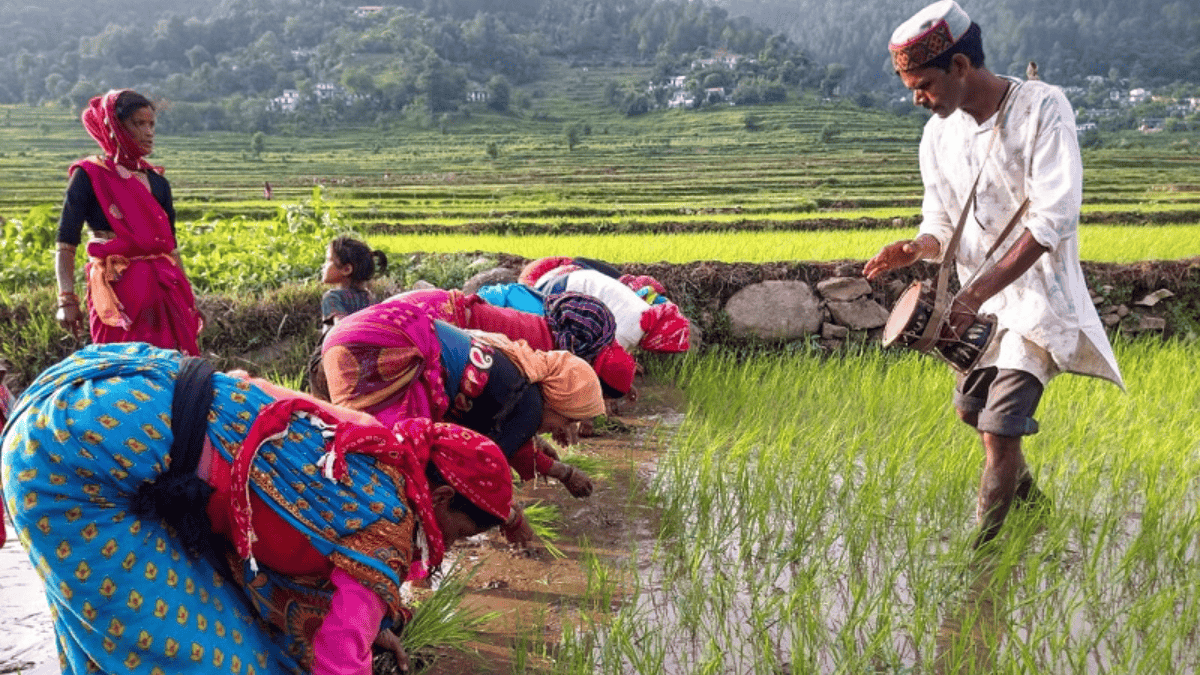
The lead singer, known as the Hurkiya, stands in the center of the muddy, terraced fields playing the Hurka drum and chanting narrative lines.
As the Hurkiya sings a line, a chorus of women workers, who are bent over in rows transplanting seedlings into the mud, repeat the line in unison.
The rhythmic, steady beat of the Hurka regulates the physical movements of the workers. The actions of bending, dibbling the plants, and moving backward along the muddy terrace are timed precisely to the tempo of the drum, creating a synchronized, dance-like visual sequence across the field.
Spiritual Dimensions and Weather Invocation
In addition to coordinating manual labor, Hurkiya Baul functions as a communal ritual designed to negotiate environmental conditions with nature deities. The agricultural verses contain direct invocations to Lord Indra (the Rain Deity), the Earth (Bhumi), and rain-cloud deities (Megh) to ensure a successful crop yield. The traditional hymns plead for a cloudy, "shady day without rain" during the actual transplantation to protect the workers and prevent the delicate, newly planted seedlings from being washed away. The songs also invoke blessings for equal speed and strength for the plowmen and the bullocks, ensuring the collective work is executed smoothly across the community’s shared terraced holdings.
Organological Analysis of the Hurka Drum
The core acoustic and ritual driver of the performance is the Hurka (also spelled Hudka or Huduk), a traditional percussion instrument closely linked with the cultural identity of Kumaon.
Structural Composition and Mechanics
Classified under classical Indian musicology as an Avanaddha Vadya (membranophone or percussion instrument), the Hurka exhibits a distinct hourglass shape similar to the Damru associated with Lord Shiva. Its construction relies on specific local materials and craftsmanship:
The primary frame is a hollow, lathe-turned wooden body, usually measuring approximately 38 centimeters in length with a symmetrical end diameter.
Circular membranes made of untreated animal hide (typically goat or sheep) are stretched over rings on both ends, with the ring diameter extending slightly beyond the wooden edges.
The unique feature of the Hurka is its dynamic pitch modulation system. The two membranes are connected by a system of central cotton bracing cords and a shoulder strap.
Acoustic and Spiritual Properties
The instrument is suspended from the shoulder, allowing the musician to hold the drum with one hand and strike one of the membranes with the fingers or a thin stick using the other hand. By pulling, squeezing, or releasing the central strap with the holding hand, the performer changes the tension of the membranes, dynamically altering the pitch by several musical notes. This produces a highly melodic, carrying tone that propagates clearly across deep mountain valleys, which is historically believed to be highly effective in invoking local deities and ancestor spirits during rituals.
To assist competitive exam aspirants in classifying traditional Himalayan instruments under the four classical categories of Indian musicology, the following structured table summarizes the key instruments of Uttarakhand:
| Instrument | Traditional Classification | Primary Region | Material and Performance Context |
|---|---|---|---|
| Hurka (Hudka) | Avanaddha Vadya (Membranophone) | Kumaon & Garhwal | Lathe-turned wood and animal hide; modulates pitch via cord tension; used in agricultural songs and spirit invocations. |
| Dhol | Avanaddha Vadya (Membranophone) | Both divisions | Large double-headed wooden barrel drum; played with sticks; used in communal dances like Jhora and weddings. |
| Damau | Avanaddha Vadya (Membranophone) | Garhwal | Small, brass-coned single-headed kettle drum; played alongside the Dhol in sacred temple rituals. |
| Ransingha | Sushira Vadya (Aerophone) | Both divisions | S-shaped curved horn made of copper or brass; used to signal temple ceremonies and processions. |
| Sarangi | Tata Vadya (Chordophone) | Both divisions | Bowed string instrument with a wooden resonator; traditionally played by mendicant communities to accompany narrative ballads. |
| Mashak (Mashakbaja) | Sushira Vadya (Aerophone) | Garhwal | Traditional bagpipe adapted from European military bands; utilized in weddings and festive processions. |
Traditional Performing Castes and Feudal Patronage
The continuity of the oral epics performed during Hurkiya Baul is historically preserved by specific hereditary musician communities in Uttarakhand. Within the traditional feudal hierarchy of the medieval hill states, these groups occupied a complex socio-cultural position.
The Hurkiya Community as Custodians of History
The primary performers of the Hurkiya Baul are members of the Hurkiya (or Harariya) community, a hereditary sub-caste historically categorized within the broader Dom group. Under the feudal rule of the Chand dynasty (10th to 18th centuries) and local Khas Rajput chieftains, the Hurkiyas served a dual function:
Royal Bards and Chroniclers: They were attached to royal houses and wealthy patrons, such as Bhotiya traders, acting as keepers of genealogy. They composed and performed virgathas (heroic ballads) and pavadas (panegyrics) to celebrate the battle exploits of their patrons, reinforcing local social hierarchies.
Agrarian Facilitators: During the transplanting season, they left the courts for the agricultural fields, translating military and mythological epics into labor-motivating songs for landowning patrons.
Other hereditary groups in the region include the Auji (or Bajgi), who are the ritual guardians of the Dhol and Damau, and the Jagariyas, who act as spirit-invocation priests using the Thali and Daur percussion instruments to resolve community and health crises.
Contemporary Socio-Economic Transformations
In the modern era, the traditional system of feudal patronage has collapsed. This shift has forced a significant portion of the Hurkiya community to diversify their livelihoods. While some performers continue to showcase their inherited arts at regional state-sponsored cultural festivals, a majority have transitioned to manual daily wage labor, agriculture, or specialized artisan work, such as tailoring in the Kumaon hills. This economic transition highlights the vulnerability of intangible cultural heritages in rapidly modernizing agrarian societies.
To understand the socio-cultural stratification of traditional performing groups, the following table details the community structures of Uttarakhand's folk musicians:
| Hereditary Community | Primary Instruments Played | Traditional Social Role and Context |
|---|---|---|
| Hurkiya / Harariya | Hurka (Hudka) | Court bards; genealogists; agricultural motivators and Jagar spirit channels. |
| Auji / Bajgi / Dasi | Dhol, Damau, Ransingha | Hereditary temple and wedding musicians; sacred guardians of drumming patterns. |
| Mirasi | Various folk instruments | Professional folk singers focused on historical ballads and lineage recitation. |
| Jagariya | Thali, Damau, Daur | Shamanic ritual specialists who invoke local deities for community healing. |
Narrative Subversion: The Epic of Rajula-Malushahi
The textual content of Hurkiya Baul consists of complex oral literature passed down through generations. Among the various narratives, the romantic epic of Rajula-Malushahi is highly significant.
The Legend of Rajula and Malushahi
Dating back to the medieval period (estimated between the 13th and 15th centuries), this epic tells the love story of Rajula, the daughter of Sunapati Shauk, a wealthy trader of the Shauka community in the high-altitude Johar Valley, and Malushahi, a young prince of the Katyuri dynasty of Bairath.
The narrative proceeds through a series of dramatic events:
The Symbolic Childhood Bet: The parents of Rajula and Malushahi perform a symbolic childhood marriage after visiting the Bagnath temple in Bageshwar. However, the premature death of Malushahi’s father leads the royal court to brand the match as an ill omen, separating the children.
The Conflict of Forced Marriage: As Rajula grows up, a powerful Hun king, Vikhipal, demands her hand in marriage, threatening her family with violence.
The Flight and Asceticism: Defying her family and the Hun king, Rajula escapes her home, traveling alone across high-altitude Himalayan passes, rivers, and rugged peaks to find Malushahi. Meanwhile, Malushahi’s mother uses a powerful sleeping herb to keep her son unconscious. Upon waking, Malushahi renounces his kingdom, takes vows of asceticism (Sanyas) under Baba Gorakhnath, and travels disguised as a jogi to rescue Rajula.
The Resolution: Depending on regional variants, the story ends either in tragedy—where the lovers are poisoned by rivals in the Hun kingdom—or in a triumphant elopement that defies feudal and geopolitical boundaries.
Thematic Subversion and Cultural Memory
The performance of Rajula-Malushahi during agricultural transplantation represents a unique socio-cultural phenomenon. In a highly patriarchal, structured hill society, the epic celebrates a strong-willed female protagonist who actively exercises agency, rejects a forced marriage contract, and physically navigates a dangerous wilderness to secure her self-chosen union. This narrative provides a psychological space for female agricultural laborers to express themes of personal freedom and defiance against social constraints.
In the mid-20th century, the epic was documented and adapted for national theater by the Kumaoni cultural revivalist Mohan Upreti, and its preserving archives were subsequently published by the Sangeet Natak Akademi in 1980. Other narrative ballads common to the Hurkiya Baul repertoire include Syunraji Bora, which relates the physical strength and agricultural successes of a legendary local pioneer.
Regional Performing Arts and Archaeological Heritage
To build a comprehensive perspective for competitive examinations, it is necessary to contextualize Hurkiya Baul within the wider artistic and archaeological landscape of Uttarakhand. The state boasts prehistoric roots of artistic expression, such as the painted rock shelters of Barechina along the Suyal River in Almora, displaying finger-drawn figures of humans and animals in black, red, and white pigments. During the medieval era, the Garhwal School of Painting—championed by artists who fled the Mughal court of Suleman Shikoh—produced world-class miniature paintings illustrating the Ramayana, the Gita Govinda, and secular romantic themes.
In the performing arts, the region features a rich array of dramatic and celebratory dances:
Chhapeli: A stylized duet dance representing a courtship duel, traditionally performed by two male actors where one is cross-dressed as a woman.
Chholia: A highly kinetic sword dance of Kumaon performed during weddings and festive processions, originating from ancient martial traditions when marriage ceremonies were accompanied by armed Rajput warriors.
Jhora and Chancheri: Group dances performed in circular formations during spring festivals like Harela and Holi, emphasizing communal solidarity across caste lines.
Pandav Nritya: A multi-day narrative dance-drama practiced in Garhwal that reenacts characters and events from the Mahabharata epic, reflecting deep historical links to early epic traditions.
The following table contrasts these prominent performing arts to provide a structured revision tool for aspirants:
| Performance Art | Divisional Origin | Key Performers | Main Narrative and Occasion |
|---|---|---|---|
| Hurkiya Baul | Kumaon & Garhwal | Hurkiya bards and female agriculturalists | Recited in terraced fields during Kharif transplantation; invokes rain and sings of legendary love and valor. |
| Chholia | Kumaon | Rajput community dancers | Martial sword and shield dance executed during wedding processions and regional fairs. |
| Chhapeli | Both divisions | Duet performers | Dramatic, flirtatious performance depicting the romantic interactions of young couples. |
| Pandav Nritya | Garhwal | Community members | Ritualistic reenactment of Mahabharata events to seek protection and invoke rain. |
| Langvir Nritya | Garhwal | Acrobatic male performers | High-energy performance involving acrobatic feats atop a high vertical bamboo pole. |
Why this matters for your exam preparation
Understanding the cultural, historical, and organological dimensions of Hurkiya Baul provides key preparation advantages for those writing competitive examinations such as the UPSC Civil Services Exam and State PSCs.
Direct Syllabus Alignment
General Studies Paper I (Art and Culture): Candidates are frequently tested on the diverse spectrum of folk dances, traditional musical instruments, and oral literature across different Indian states. Questions can range from identifying regional classifications of instruments (such as comparing the hourglass-shaped Hurka with the South Indian Udukai or Idakka) to matching harvest festivals with their signature dances.
General Studies Paper I (Indian Society): The tradition of Hurkiya Baul provides a real-world case study on the interrelationship between caste, economic labor, and cultural hegemony.
State PSC Examinations (UKPSC): Direct, high-value questions are asked regarding the unique performing arts, historical dynasties (Katyuri, Chand), and linguistic heritages of Kumaon and Garhwal.
Analytical Insights for UPSC Mains and Essay Papers
When drafting subjective answers, demonstrating an understanding of the following second- and third-order analytical concepts will help secure higher marks:
Functionalism of Agrarian Art Forms: Traditional performances like Hurkiya Baul are not merely decorative; they serve as functional economic tools. By synchronizing physical movements to a steady tempo, the music acts as a cognitive offloader, reducing physical fatigue and optimizing labor productivity in exceptionally harsh geographic terrains.
The Agency of the Marginalized: While the Hurkiya bards were placed at the lower end of the traditional caste system, they held significant cultural authority. As the sole keepers of genealogies and heroic histories, the ruling upper-class elites relied on these bards to legitimize their socio-political standing. This shows how oral traditions allowed marginalized communities to negotiate power dynamics in feudal systems.
Agrarian Spaces as Sites of Resistance: Singing the highly subversive epic of Rajula-Malushahi in gender-segregated transplanting fields highlights how folk traditions can serve as psychological safety valves. Within these spaces, female agriculturalists can safely celebrate and reinforce ideals of female agency, self-determination, and resistance to patriarchal authority.
For further high-yield notes on cultural heritage, traditional music systems, and regional art forms, candidates can consult the comprehensive study modules and UPSC Current Affairs resources available directly on Atharva Examwise. Stay updated with our daily GK update to ensure competitive readiness for all competitive exam news today.