
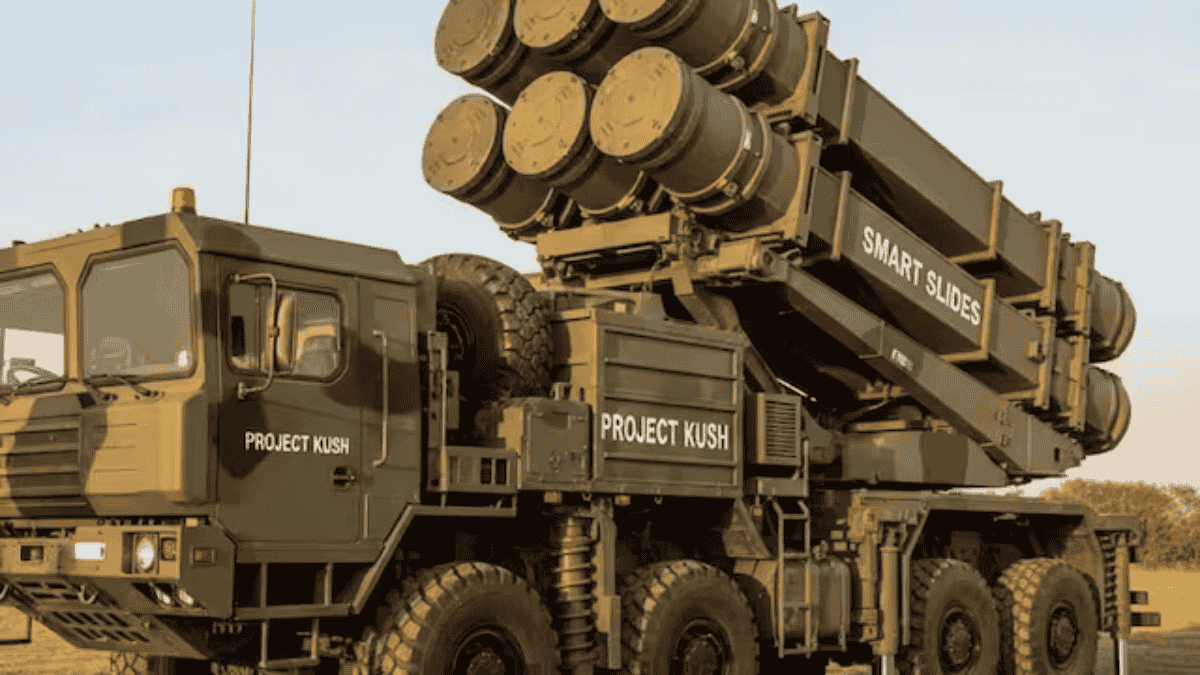
UPSC Current Affairs June 2026: Project Kusha, India's Indigenous Air Defence Shield under Mission Sudarshan Chakra
Introduction: India's Indigenous Sky Shield
The geopolitical landscape of South Asia demands a robust, resilient, and multi-layered defensive shield to counter evolving threat vectors from regional adversaries. On June 12, 2026, the Union Defence Minister of India officially inaugurated the Advanced Weapon System Complex at the Defence Research and Development Laboratory (DRDL), located within the Dr APJ Abdul Kalam Missile Complex in Hyderabad. During this landmark event, Project Kusha was characterized as an indigenous "game-changer" for national security, compared to the protective Govardhan Hill of Indian tradition.
Project Kusha (प्रोजेक्ट कुशा) is India's premier indigenous air defence system designed and developed by the Defence Research and Development Organisation (DRDO). The primary operational objective of this state-of-the-art system is to identify, track, and destroy diverse aerial threats, including enemy fighter aircraft, stealth platforms, unmanned aerial vehicles (UAVs), cruise missiles, and ballistic missiles. Serving as a strong, integrated protective canopy over Indian airspace, Project Kusha plays a vital role in shielding critical military installations, civil infrastructure, and metropolitan population centers from hostile aerial attacks.
Aspirants tracking UPSC current affairs and looking for a comprehensive daily GK update will find that Project Kusha represents a critical leap in India’s drive for technological self-reliance (Atmanirbhar Bharat), fundamentally reshaping the nation's strategic deterrence posture.
Strategic Integration: Mission Sudarshan Chakra
Rather than operating as an isolated surface-to-air missile (SAM) unit, Project Kusha serves as the long-range strategic cornerstone of "Mission Sudarshan Chakra". Announced by the Prime Minister of India during the Independence Day address on August 15, 2025, Mission Sudarshan Chakra is an ambitious national defence roadmap designed to establish a highly integrated, country-wide, multi-level missile defence shield by 2035.
This overarching defence network relies on seamless data-sharing and real-time coordination between multiple military and civilian radar installations. The architecture combines short, medium, and long-range systems into a unified command structure:
Very Short-Range Air Defence Systems (VSHORADS): Configured for low-altitude, immediate point defence against tactical drones, helicopters, and low-flying aircraft.
Quick Reaction Surface-to-Air Missiles (QRSAM): Designed to neutralize agile, low-flying targets in dynamic tactical environments.
Medium-Range Surface-to-Air Missiles (MR-SAM): Co-developed to bridge defensive gaps up to an operational range of approximately 80 km.
Project Kusha (LRSAM): The heavy-tier strategic shield engineered to engage targets at extended operational ranges from 150 km up to 400 km.
Ballistic Missile Defence (BMD) Systems: Programmed to intercept intermediate-range ballistic missiles (IRBMs) with ranges between 2,000 km and 5,000 km.
Directed-Energy Weapons (DEWs): Future laser and electromagnetic systems intended to counter saturation attacks by drone swarms economically.
By networking these systems natively with the Indian Air Force's Integrated Air Command and Control System (IACCS), Mission Sudarshan Chakra ensures automated threat prioritization, faster reaction times, and coordinated missile firing during high-intensity conflict scenarios.
Technical Architecture and Interceptor Variants
Project Kusha, formally known as the Extended Range Air Defence System (ERADS), utilizes a unique three-tiered interceptor approach to provide deep-area defence. The system incorporates indigenously developed Gallium Nitride (GaN) based multi-function fire-control radars and the "Uttam" Active Electronically Scanned Array (AESA) radar platform. Unlike traditional silicon-based radars, GaN technology generates significantly less heat and provides up to 30% more detection range, allowing the system to operate continuously in extreme conditions, such as the Thar Desert or the freezing altitudes of the Himalayas.
The physical capability of Project Kusha is divided among three distinct interceptor missile variants:
| Interceptor Variant | Approximate Operational Range | Primary Strategic Role | Guidance & Propulsion Technology |
|---|---|---|---|
| Kusha-M1 | 120–150 km [cite: 4] | First long-range defensive layer beyond medium-range systems; intercepts tactical aircraft and UAVs | Active RF/IR seeker with hit-to-kill precision and optical proximity fuze |
| Kusha-M2 | 250 km [cite: 4, 5] | Specifically optimized as a "stealth hunter" to detect low radar cross-section (RCS) platforms | Advanced dual-seeker guidance (Infrared + Active Radar) to counter electronic jamming |
| Kusha-M3 | 350–400 km [cite: 4, 5] | Strategic long-range interception; targets high-value airborne assets like AWACS and aerial refuelers | High-burn solid rocket motors with dual-pulse propulsion for extended terminal-phase maneuvering |
The system features an extremely high single-shot kill probability of over 80%. The fabrication process for the initial batch of M1 missiles commenced in late 2024, with test flights scheduled to continue through 2026. Phased induction into the Indian Air Force is planned between 2028 and 2030, with a naval long-range variant also under development to intercept anti-ship ballistic missiles flying up to Mach 7.0+ at ranges exceeding 250 km.
Key Facts and Exam-Relevant Data
For candidates reviewing competitive exam news today, the following curated facts represent highly testable data points for Prelims and Mains:
Nodal Development Agency: Designed by the Defence Research & Development Laboratory (DRDL) under the Press Information Bureau (PIB) approved DRDO framework.
System Integrators: Manufactured and integrated by Bharat Electronics Limited (BEL), which produces the multi-function radars, and Bharat Dynamics Limited (BDL), which manufactures the interceptor missiles.
Financial Scope: The Defence Acquisition Council (DAC) granted Acceptance of Necessity (AoN) in September 2023 for ₹21,700 crore (approximately $2.6 billion) to procure five operational squadrons for the IAF.
Sovereign Software Independence: Developed with absolute source-code independence, preventing foreign suppliers from inserting operational limitations or remote "kill switches".
Indigenous Content and Supply Chain: Supported by a robust domestic supply chain of Indian MSMEs, start-ups, and academia, drastically reducing dependency on foreign component manufacturers.
Comparative Analysis: Project Kusha vs. S-400 Triumf
To evaluate India's strategic defense modernization, it is useful to compare Project Kusha with Russia's S-400 Triumf system, which India procured in 2018–19. While the S-400 is a highly capable system, geopolitical realities—including the Russia-Ukraine conflict—have delayed the delivery of India's final contracted squadrons, emphasizing the vulnerabilities of foreign hardware dependencies.
The following table contrasts India's upcoming indigenous system with the Russian benchmark:
| Feature/Parameter | Project Kusha (India) | S-400 Triumf (Russia) |
|---|---|---|
| Operational Status | Under development (Fabrication underway, critical user trials ongoing in 2026, induction 2028–2030) | Fully operational since 2007; inducted into the IAF from 2021 |
| Maximum Range | Up to 400 km (via M3 heavy interceptor) | Up to 400 km (via 40N6E interceptor missile) |
| Interceptor Target Speed | Designed to intercept targets moving at Mach 7.0+ [cite: 12] | Designed to intercept targets moving up to Mach 6.0 [cite: 12] |
| Software and Coding | Fully independent; localized mission algorithms | "Black Box" proprietary Russian software with restricted access |
| Financial Cost | ≈₹21,700 crore (≈$2.6 billion) for 5 squadrons | ≈₹45,000 crore (≈$5.43 billion) for 5 squadrons |
| Interception Philosophy | High maneuverability, adaptive terminal energy management, and dual-seeker active homing | Heavy reliance on high altitude, extreme initial velocity, and large blast fragmentation warheads |
Geopolitical Implications: Lessons from Operation Sindoor
The critical importance of an indigenously manufactured, highly integrated air defence shield was tested during the brief but intense border conflict known as Operation Sindoor, which occurred between May 6 and May 10, 2025. The flashpoint was triggered by a terrorist attack on April 22, 2025, near Pahalgam in Jammu and Kashmir, where 26 civilian tourists were killed by "The Resistance Front" (TRF), an offshoot of Lashkar-e-Taiba.
Following Pakistan’s refusal to dismantle the networks involved, India launched Operation Sindoor on the night of May 7, 2025, executing precision strikes on nine terror launchpads in Pakistan-administered territories. In response, Pakistan launched retaliatory strikes on May 8 using drone swarms and standoff missiles aimed at over a dozen Indian military installations, including the Srinagar, Jammu, Pathankot, Amritsar, Bhuj, and Sirsa airbases.
The conflict offered several key lessons for military planners:
The Threat of Saturation Tactics: Pakistan’s retaliatory strikes relied on cheap drone swarms to overwhelm Indian air defense radars. This highlighted the necessity of a layered system like Mission Sudarshan Chakra, where long-range assets are reserved for high-value targets while low-cost interceptors and point-defence guns manage smaller threats.
Battle-Proven Integration: Existing systems like the Akash SAM and the BrahMos cruise missile integrated successfully with the IACCS during the conflict, validating India's network-centric defence concepts.
The Power of Sovereign Control: Operating systems with domestic software allows real-time field modifications to counter dynamic jamming or unexpected electronic warfare tactics, a flexibility that "Black Box" foreign systems do not support.
Multi-Domain Deterrence: Alongside kinetic actions, India suspended the 1960 Indus Waters Treaty, leveraging resource control as a non-kinetic diplomatic instrument. This demonstrated how physical air defense and resource diplomacy work together to establish deterrence during crises.
Why this matters for your exam preparation
For serious aspirants preparing for the UPSC Civil Services Examination (CSE) and other state-level competitive exams, analyzing Project Kusha is crucial for both the Prelims and Mains stages. The topic intersects with multiple areas of the syllabus under General Studies Paper III (GS-3): Science and Technology; and Internal Security.
Candidates should focus on the following core areas:
Indigenization of Technology (GS-3): Project Kusha serves as an excellent case study on the transfer of technology, the role of public-private partnerships (DRDO-BEL-BDL), and India's transition from a leading defense importer to a self-sufficient developer.
Internal and External Security Challenges (GS-3): The transition to network-centric warfare, as demonstrated in Operation Sindoor, highlights how automated command structures, real-time sensor fusion, and layered missile defense shields protect critical national assets.
Geopolitical Deterrence and Indian Foreign Policy: The strategic independence gained through indigenous air defense systems reduces foreign policy vulnerabilities. It strengthens India’s position as a security provider in the Indian Ocean Region while maintaining strategic autonomy amid changing global alliances.
Resource and Non-Kinetic Diplomacy: The suspension of the Indus Waters Treaty during the 2025 crisis shows how non-military levers are integrated with hard power to manage escalation, a key concept for international relations and security essays.