
UPSC Current Affairs June 15 2026: Daily GK Update on Jharkhand's Traditional Products Securing GI Tags
In a landmark development for the preservation of indigenous cultural heritage and the revitalization of rural economies, 11 traditional products from the state of Jharkhand have officially been granted the prestigious Geographical Indication (GI) tag. Facilitated through the structured promotional efforts of the National Bank for Agriculture and Rural Development (NABARD) in coordination with local artisan collectives, self-help groups (SHGs), and Farmer Producer Organizations (FPOs), this extensive registration marks a significant milestone. Prior to this major development in June 2026, the Sohrai-Khovar painting stood as the sole registered GI product originating from Jharkhand.
For serious aspirants tracking competitive exam news today, this expansion serves as an important study area within the domains of art and culture, intellectual property rights (IPR), and tribal development paradigms. This daily GK update compiled by Atharva Examwise provides an exhaustive academic analysis of the legislative frameworks, product directories, and socioeconomic implications of these newly certified traditional assets.
Legal and Institutional Framework of Geographical Indications in India
A Geographical Indication (GI) is a specialized sign applied to products that possess a specific geographic origin and qualities, characteristics, or a reputation fundamentally attributable to that place of origin. Understanding the legislative basis and administrative architecture governing GIs is essential for mastering UPSC current affairs.
The Legislative Base and International Alignments
India enacted The Geographical Indications of Goods (Registration and Protection) Act, 1999 to fulfill its statutory obligations as a member of the World Trade Organization (WTO) under the Agreement on Trade-Related Aspects of Intellectual Property Rights (TRIPS). The Act, which came into force on September 15, 2003, establishes a dedicated statutory mechanism to register and protect goods categorized as agricultural, natural, manufactured, or foodstuffs.
Administrative Authority
The registry is governed by the Controller General of Patents, Designs and Trade Marks, who acts as the Registrar of Geographical Indications. The Geographical Indications Registry is headquartered in Chennai, Tamil Nadu.
Structural Differences: GI Tags versus Trademarks
While both instruments function as identifiers of origin within intellectual property frameworks, their legal characteristics differ significantly:
| Parameter | Geographical Indication (GI) | Trademark |
|---|---|---|
| Ownership | Collective/Community right belonging to a regional group of producers. | Individual or private corporate right belonging to a specific enterprise. |
| Transferability | Strictly non-transferable; cannot be licensed, sold, mortgaged, or assigned. | Fully transferable, assignable, and commercially licensable. |
| Core Function | Links product characteristics and reputation directly to a specific geographic boundary. | Distinguishes the commercial origin of goods or services irrespective of geography. |
| Validity | Valid for 10 years; renewable indefinitely for successive 10-year terms. | Valid for 10 years; renewable indefinitely under trademark laws. |
Categorized Directory of Jharkhand's 2026 GI-Tagged Products
The granting of GI tags to 11 traditional products in 2026 highlights the diverse artisanal, textile, and culinary traditions of Jharkhand. The complete list of registered products spans multiple categories, providing a structural view of the state's cultural economy:
| Product Name | Category | Primary District / Origin | Description & Key Characteristics |
|---|---|---|---|
| Bhagaiya Silk (Bhagaiya Saree & Fabrics) | Handicraft / Textile | Godda District | Hand-spun wild Tussar silk woven by Santhal women; noted for its natural golden sheen and high durability. |
| Kuchai Silk (Kuchai Silk Saree) | Handicraft / Textile | Seraikela-Kharsawan District | Organic Tussar silk cultivated on host Asan and Arun trees in regional forest ecosystems. |
| Munda Jewellery | Handicraft | State-wide (Munda Tribal Belt) | Hand-forged brass, silver, and bead ornaments displaying traditional geometric and nature-inspired motifs. |
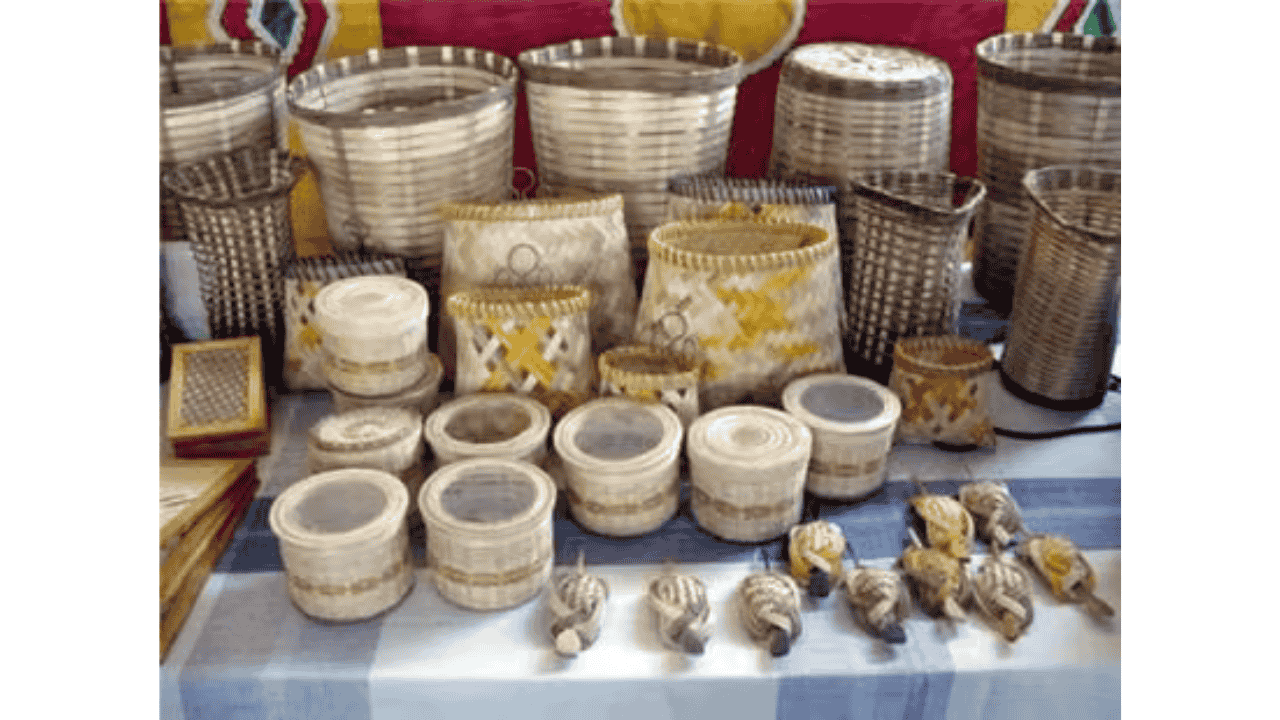
| Jharkhand Bamboo Craft | Handicraft | State-wide Forest Clusters | Eco-friendly utilitarian and decorative products processed entirely from regional bamboo species. |
| Kesaria Kalakand | Foodstuff | Koderma District | A premium, slow-cooked condensed milk sweet featuring grainy texture, rose water, and saffron. |
| Dokra Craft | Handicraft | State-wide Tribal Districts | Non-ferrous metalware hand-forged using the ancient lost-wax casting technique. |
| Jadupatua Painting | Handicraft / Art | Dumka (Santhal Pargana) | Vertical narrative scroll paintings on paper/cloth, executed with natural mineral and plant-derived pigments. |
| Dumka Chadar (Tumka Chadar) | Handicraft / Textile | Dumka District | Traditional, thick handwoven bedspreads and shawls utilized by regional tribal communities. |
| Badoni Puppets (Baroni Paintings) | Handicraft / Art | State-wide | Artisanal puppet craft and stylized folk paintings reflecting local biodiversity, forest deities, and tribal mythology. |
| Panchi Saree & Fabrics | Handicraft / Textile | State-wide | Traditional two-piece tribal attire decorated with distinctive borders that convey social and marital identity. |
| Jharkhand Benam | Handicraft / Instrument | State-wide | A traditional single-stringed bowed lute crafted from single-block wood and dried gourds. |
Deep-Dive Analysis of Core Protected Crafts
Organic Tussar Sericulture: Bhagaiya Silk and Kuchai Silk
Jharkhand accounts for approximately 40% of India's total Tussar silk production, making sericulture an essential economic engine for its forest-dependent populations.
Kuchai Silk: This variety represents a highly organic silk-rearing tradition centered in the Seraikela-Kharsawan district. Tribal rearers harvest wild Tussar cocoons (Antheraea mylitta) cultivated directly on Asan (Terminalia tomentosa) and Arun (Terminalia arjuna) trees in natural forest environments.
Bhagaiya Silk: Rooted in the Godda district, this craft relies on traditional hand-reeling and spinning processes practiced primarily by Santhal tribal women. The resulting textile is highly valued in international sustainable fashion markets for its coarse texture, high tensile strength, and characteristic natural golden hue.
[Silkworm Rearing on Host Trees (Asan/Arun)] │ ▼ (manual extraction) [Traditional Hand-Reeling of Cocoon Filaments] │ ▼ (weaving by Santhal Women) [Bhagaiya/Kuchai Golden Sheen Handloom Fabric]
Tribal Metallurgy and Material Culture: Dokra Craft and Munda Jewellery
Dokra Craft: Practiced by metallurgical artisans across Jharkhand's tribal belt, Dokra is one of the oldest surviving non-ferrous metal-casting techniques in the world, with origins dating back over 4,000 years. The craft employs the "lost-wax casting" (cire perdue) technique, where a hand-detailed clay core is layered with beeswax, encased in an outer clay mold, and baked. The molten wax drains away and is replaced by molten brass or bronze. Because the mold must be broken to extract the final piece, no two Dokra artifacts are identical.
Munda Jewellery: Hand-forged from silver, brass, and local beads, the traditional ornaments of the Munda tribe serve as a unique visual language. Specific patterns and traditional motifs, such as the nath (nose ring), signify social hierarchies, tribal lineages, and marital status.
Folk Artistry and Narrative Scroll Traditions: Jadupatua Painting
The term Jadupatua is derived from the Santhal word Jadu (meaning magician or painter) and Pat (meaning scroll). Traditionally created by the Chitrakar caste for Santhal audiences, these vertical scroll paintings are constructed by pasting sheets of paper or fabric together.
The paintings are created using natural pigments derived from clay, crushed leaves, stones, flowers, and tree bark. Historically, these scroll-painters went from house to house performing the Chakshu Daan (giving of the eyes) ritual. When a family member died, the artist presented a portrait lacking pupils in the eyes; the family paid a small donation to the Jadupatua to paint the pupils, symbolically enabling the deceased person's spirit to transition to the afterlife.
Regional Gastronomy: Kesaria Kalakand of Koderma
The inclusion of Koderma’s Kesaria Kalakand highlights the expanding role of GIs in preserving regional food cultures.
The roots of Kalakand-making in Koderma trace back to 1962–1963 in Jhanda Chowk, Jhumri Tilaiya, when Punjabi migrant brothers Hansraj Bhatia and Mulk Raj Bhatia began crafting a condensed milk-based sweet. Over time, local makers added rose water and saffron (Kesar), giving the sweet its characteristic golden color and grainy texture.
The preparation of Kesaria Kalakand is resource-intensive, requiring a concentration ratio of 4:1:
Milk Input: 4 LitersSlow Boiling/Reduction Finished Kalakand: 1 Kilogram
Comparative Regional Context
To help civil services candidates build a comparative framework for their mains answer-writing, it is helpful to look at concurrent GI registrations across neighboring states in June 2026:
Bihar's Portfolio Expansion: During the same registration cycle in June 2026, the neighboring state of Bihar secured GI tags for three of its traditional products: Bawan Buti Saree and Fabric (Nalanda), Patharkatti Stone Craft (Gaya), and Pidiya Painting (Bhojpur).
Assam's Craft Registrations: Similarly, Assam secured GI tags for four traditional products under a NABARD-backed initiative: Karbi Anglong Handloom Products, Assam Bihu Pepa, Assam Bamboo Crafts, and Deuri Handloom Products.
Institutional Interventions and Economic Ripple Effects
The systematic registration of Jharkhand's 11 GI products highlights the impact of developmental banking institutions in rural India. As the primary driving institution, NABARD played a key role throughout the registration process:
Mapping and Documentation: NABARD collaborated with technical institutions to document the history, unique characteristics, and geographical boundaries of each craft.
Value Chain Development: By organizing individual weavers and artisans into FPOs and SHGs, the institution helped streamline raw material supply chains and improve production processes.
Direct Market Access: NABARD supports ongoing market access through national exhibitions, Saras Melas, buyer-seller meets, and regional markets, helping producers connect directly with buyers.
Key Facts and Exam-Relevant Data
For quick revision ahead of the UPSC civil services exam, candidates should review these essential facts:
First GI Tag of India: Darjeeling Tea from West Bengal (granted in 2004–2005).
State with the Highest GI Tags: As of early 2026, Uttar Pradesh led the country in total registered GI tags.
Pre-2026 Jharkhand GI Tag: Sohrai-Khovar painting was the only registered product prior to 2026.
Host Trees for Kuchai Tussar Silk: Cultivated naturally on Asan (Terminalia tomentosa) and Arjun (Terminalia arjuna) trees.
Dokra Metallurgy: Utilizes a non-ferrous metal alloy cast through the lost-wax casting technique.
Jadupatua Paintings: Vertical scroll paintings native to the Santhal Pargana region of Jharkhand, traditionally depicting afterlife themes and creation stories.
GI Headquarters in India: Located in Chennai, Tamil Nadu. It is administered by the DPIIT under the Ministry of Commerce and Industry.
Why this matters for your exam preparation
For candidates preparing for the UPSC Civil Services Examination and other state-level competitive exams, this update carries significant academic and analytical value across both Preliminary and Mains formats.
Relevance in Preliminary Examination
In the UPSC Prelims, questions frequently test candidates' ability to match newly registered GI products with their respective states of origin or specific geographical regions. Candidates should pay close attention to the unique characteristics of these items—such as the host trees for Kuchai Tussar silk (Asan and Arjun), the lost-wax casting technique of Dokra craft, and the cultural context of Jadupatua scroll paintings.
Analytical Applications in Mains Examination
In the UPSC Mains, this case study can be used to enrich answers across multiple GS papers:
GS Paper I (Indian Heritage and Culture): Excellent case study on the role of geographical factors and indigenous knowledge systems in shaping traditional arts, textiles, and metallurgy across diverse tribal communities.
GS Paper III (Intellectual Property Rights & Economic Development): Demonstrates how collective intellectual property rights can serve as tools for rural development. Candidates can write about how GI tags help protect traditional designs from corporate imitation, guarantee product authenticity, and help marginalized artisans secure premium pricing by integrating into national and global supply chains.
GS Paper III (Inclusive Growth & Rural Livelihoods): Highlights how structured support from institutions like NABARD can convert traditional crafts into sustainable, scalable livelihoods. This approach helps reduce regional economic disparities, supports tribal women’s self-help groups, and offers sustainable employment in forest-dependent regions.