
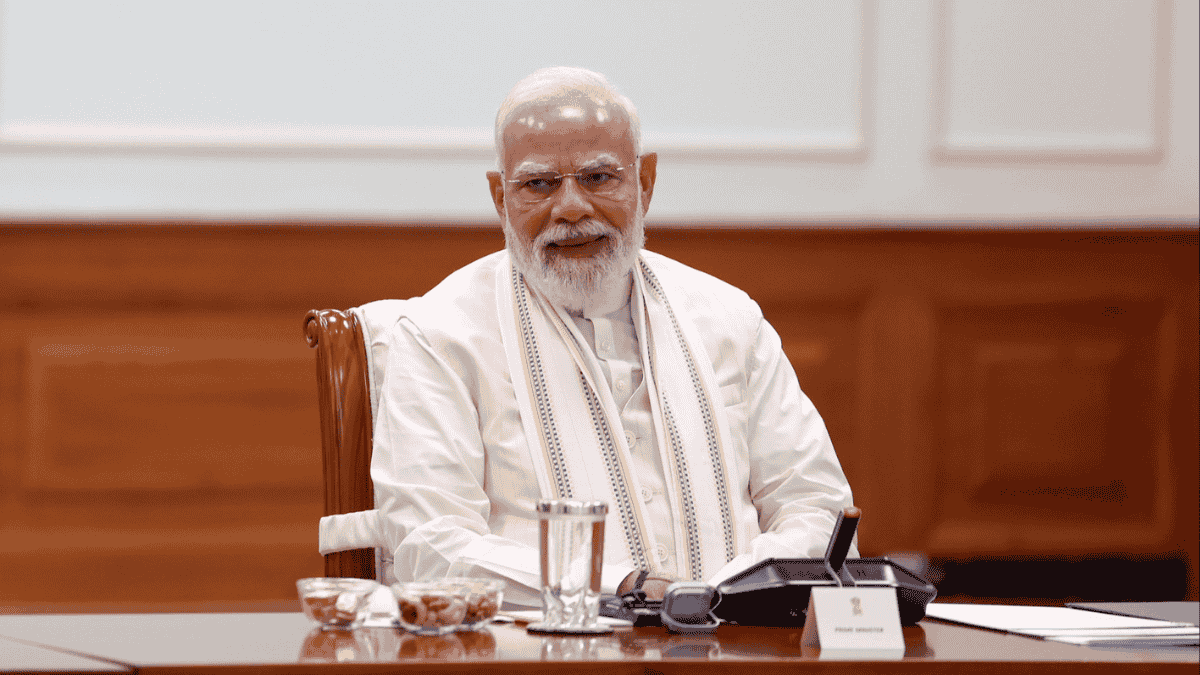
UPSC Current Affairs June 10, 2026: PM Modi Becomes India's Longest-Serving Elected Prime Minister | Daily GK Update
Introduction and Historical Background
June 10, 2026, has proven to be a historic milestone in Indian political history. On this date, Prime Minister Narendra Modi surpassed the record of independent India’s first Prime Minister, Jawaharlal Nehru, for the longest continuous tenure as an elected Prime Minister. Prime Minister Modi, who first assumed the reins of the nation on May 26, 2014, completed 4,399 continuous days in office on June 10, 2026. In contrast, Jawaharlal Nehru’s continuous tenure as an elected Prime Minister lasted for 4,398 days.
For serious aspirants preparing for competitive examinations, particularly through Atharva Examwise, this development is not merely a political fact. Instead, it symbolizes the long-term transformations within the nation's administrative, constitutional, and economic policy frameworks. The continuity of leadership at the national level is an exceptionally vital event featured in Atharva Examwise current news and daily GK updates.
Elected vs. Total Tenure: The Historical Difference in Records
To ensure factual accuracy, it is essential to clearly understand the distinction between total tenure and elected tenure. Jawaharlal Nehru holds the overall record for being the longest-serving Prime Minister of India. He governed for a total of 16 years and 286 days (6,131 days) from August 15, 1947, until his demise on May 27, 1964. However, his total tenure includes the period from 1947 to 1952 when he served as the head of the country's Interim Government.
Historically, the Interim Government was formed on September 2, 1946, under the recommendations of the Cabinet Mission of 1946, which oversaw India's independence and the transition of power. In this administration, the Viceroy’s Executive Council functioned as the Council of Ministers, with Jawaharlal Nehru serving as its Vice President and de facto Prime Minister. India's first democratic general elections were held in 1951–52. Following this, on May 13, 1952, Nehru took the oath as the democratically elected Prime Minister for the first time, and his tenure in this specific capacity lasted for 4,398 days. On June 10, 2026, Prime Minister Narendra Modi broke this specific record of an elected and unbroken tenure.
Prior to this, on July 25, 2025, Prime Minister Narendra Modi had also surpassed the record of India's former Prime Minister Indira Gandhi for the longest continuous tenure (4,077 days; January 24, 1966, to March 24, 1977). Furthermore, at the beginning of 2026, by completing over 8,930 days of cumulative elected leadership as the Chief Minister of Gujarat (October 7, 2001, to May 22, 2014) and as the Prime Minister of the country, he established the record for being the longest-serving elected head of government in Indian democratic history.
Statistical and Demographic Transition: Nehru vs. Modi Era
When the political and demographic conditions of the Nehruvian era are compared with the contemporary Modi era, the complexity of development within the country's democratic framework becomes evident. The administrative and statistical variations between these two historic eras can be understood through the following table:
| Statistical Metric | Jawaharlal Nehru Era (1951–1964) | Narendra Modi Era (2014–2026) |
|---|---|---|
| Unbroken Elected Days | 4,398 days | 4,399 days (As of June 10, 2026) |
| Population Scale | Approx. 360 million (According to the 1951 Census) | Over 1.4 billion (Contemporary estimates) |
| Registered Voters | Approx. 173.2 million (First General Election) | Over 960 million (Up to the 2024 Lok Sabha Elections) |
| Contesting Parties | 53 parties | 744 parties (Recorded in the 2024 General Elections) |
| Lok Sabha Seats & Party Status | Congress won 364 out of a total of 489 seats | Clear majority in 2014 and 2019; Coalition government in 2024 |
| Chief Election Commissioner | Sukumar Sen (First Chief Election Commissioner) | Multi-member Election Commission |
| Media Environment | Primarily Print Media and All India Radio | 24-hour Digital Media, Internet, and intense social scrutiny |
This statistical analysis reveals that immediately after independence, India experienced a phase of single-party dominance (the "Congress System"), where Nehru faced relatively minimal political opposition. The country's literacy rate was low, which necessitated the organization of a "mock election" in September 1951 ahead of the first general election to help citizens comprehend the voting process. Multi-member constituencies were also in existence during the 1950s, which were subsequently abolished in the 1960s.
In contrast, governance in the contemporary era demands a completely different set of administrative and strategic capabilities—ruling continuously by securing three consecutive mandates amid intense political competition, the rise of regional parties, volatile coalition politics, and a 24-hour active social media environment.
Constitutional Framework: Role of the Prime Minister and the Council of Ministers
Under the Indian polity, the office of the Prime Minister is governed by constitutional principles that are highly vital from both Prelims and Mains examination perspectives. Part V of the Indian Constitution outlines the structure of the Union Executive:
Article 74: It provides that there shall be a Council of Ministers with the Prime Minister at the head to aid and advise the President in the exercise of their functions. Through the 42th and 44th Constitutional Amendment Acts, it was made mandatory for the President to act in accordance with this advice, thereby making the Prime Minister the real executive head (de facto executive) and the President the nominal head (de jure executive) of the country.
Article 75: The Prime Minister is appointed by the President, and other ministers are appointed by the President on the advice of the Prime Minister. Under this Article, ministers hold office during the pleasure of the President (principle of individual responsibility), whereas their Collective Responsibility under Article 75(3) is collectively to the Lok Sabha (House of the People).
Article 75(1A) and the 91st Amendment (2003): The original Constitution did not stipulate any limit on the size of the Council of Ministers. In the year 2003, the 91st Constitutional Amendment Act mandated that the total number of ministers, including the Prime Minister, in the Council of Ministers must not exceed 15 percent of the total strength of the Lok Sabha.
Article 78: This defines the duties of the Prime Minister, under which they communicate to the President all decisions of the Council of Ministers relating to the administration of the affairs of the Union and proposals for legislation. Sharing administrative information as requisitioned by the President is also a constitutional duty of the Prime Minister.
Parliamentary Qualifications: The Prime Minister must be a member of either House of Parliament (Lok Sabha or Rajya Sabha). If a person is not a member of Parliament at the time of appointment, they must secure a seat in either House within a period of 6 months.
Evolution of the Economic Governance Model: From Planning to NITI Aayog
India's economic policies have undergone a massive transformation over the past seven decades. The journey of economic reforms—from the state-controlled economic philosophy of the Nehruvian era to the decentralized policy approach of the contemporary era—remains a central pillar of the Indian Economy (UPSC GS Paper III).
Nehruvian Socialism and Planned Economic Policies (1947–1964)
At the time of independence, India was grappling with an acute shortage of capital and industrial backwardness. Against this backdrop, Jawaharlal Nehru opted for a "Mixed Economy" framework where the state retained complete ownership over strategically vital industries (steel, coal, defense, heavy machinery), known as the "Commanding Heights" of the economy. The Planning Commission was established on March 15, 1950, to direct centralized planning via Five-Year Plans.
The First Five-Year Plan (based on the Harrod-Domar model) focused primarily on agriculture and irrigation.
The Second Five-Year Plan (Nehru-Mahalanobis model) prioritized rapid industrialization through heavy industries and import substitution.
While this model laid the foundation for heavy industries in the country and birthed institutions like the Indian Institutes of Technology (IITs), it ultimately resulted in an oppressive License Raj, bureaucratic inefficiencies, and a sluggish economic growth rate (famously dubbed the 'Hindu Rate of Growth' of around 3.5%).
Contemporary Economic Model and NITI Aayog (2014–Present)
Following the transition of power in 2014, this Soviet-style apparatus of economic planning was completely overhauled. On August 17, 2014, the Planning Commission was officially dissolved, and on January 1, 2015, NITI Aayog (National Institution for Transforming India) was established. The primary objective of NITI Aayog is to foster "Cooperative Federalism" and "Competitive Federalism".
The structural differences between the Planning Commission and NITI Aayog can be clearly understood through this table:
| Parameter | Planning Commission | NITI Aayog |
|---|---|---|
| Approach to Planning | Top-Down approach; the role of states was highly restricted. | Bottom-Up approach; continuous consultation with the states. |
| Financial Allocation Power | Executive power to allocate funds to ministries and state governments. | No financial allocation power; this authority rests entirely with the Ministry of Finance. |
| Institutional Form | Policy formulation happened first, followed by discussions with states regarding fund allocations. | Functions as a 'Think Tank' to provide strategic and technical advice. |
| Participation of States | Participation of states was limited only to the National Development Council (NDC). | The Governing Council includes Chief Ministers of all states and Lieutenant Governors of Union Territories. |
The contemporary economic governance model is fundamentally anchored in "Inclusive Developmentalism". It ensures Direct Benefit Transfer (DBT) through the JAM (Jan Dhan, Aadhaar, Mobile) trinity to eliminate corruption and the middleman system. Through Digital Public Infrastructure (DPI) and the Unified Payments Interface (UPI), the nation has gravitated toward cashless transactions. Driven by massive capital expenditure on public infrastructure and reforms favoring private entrepreneurship, the country has succeeded in alleviating multidimensional poverty and registering rapid economic growth.
Why This Matters for Your Exam Preparation
For candidates preparing for Atharva Examwise and various State Public Service Commission (PSC) examinations, the analysis of this historic event intersects with several vital subjects across both Prelims and Mains exams:
General Studies Paper-II (Polity and Governance)
Executive Stability vs. Accountability: In the Mains exam, questions may be posed on whether a prolonged continuous tenure of a single party or Prime Minister in a parliamentary democracy ensures policy continuity, and how it impacts institutional checks and balances alongside executive accountability.
Constitutional Provisions: For the Prelims exam, topics like the composition of the Council of Ministers, the constitutional duties of the Prime Minister (Article 78), and the limitations imposed by the 91st Constitutional Amendment are extremely important.
Historical Timeline: The portfolios of the members of the 1946 Interim Government and the statistical facts of the first general election (1951–52) serve as valuable resources for both the History and Polity sections.
General Studies Paper-III (Indian Economy)
Evolution of Planning: The efficacy of NITI Aayog compared to the Planning Commission, its role in promoting cooperative federalism, and the challenges arising from its lack of financial allocation powers are core topics for the Mains examination.
Comparison of Economic Models: This material provides a robust foundation for handling questions that require contrasting the achievements and constraints of the Nehruvian socialist model (Commanding Heights) with contemporary technology-driven direct benefit transfers and private investment-friendly policies.
Essay and Interview
This comparative analysis will prove highly instrumental in structuring answers with conceptual clarity and presenting balanced views before interview panels on themes such as "The Seven-Decade Journey of Indian Democracy", "Coalition Governments vs. Strong Governments", or "Shifting Trends in Democratic Leadership".
Aspirants can make use of Atharva Examwise’s daily analyses and test series for regular practice and access to similar exam-centric analytical breakdowns.