UPSC Current Affairs June 5, 2026: India-Venezuela Strategic Ties, Energy Security, and Global South Dynamics | Atharva Examwise Current News
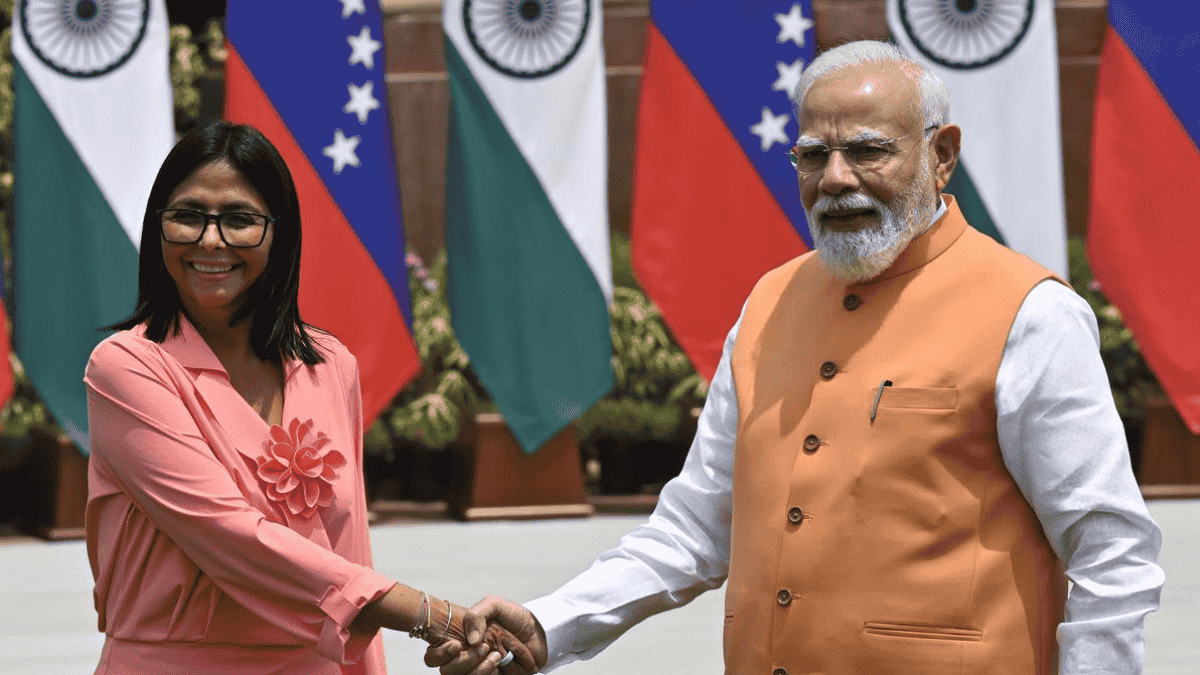
The bilateral meeting between Indian Prime Minister Narendra Modi and Venezuela’s Acting President Delcy Rodriguez on June 4, 2026, in New Delhi marks a pivotal moment in contemporary international relations. As part of the daily GK update for civil services preparation, this encounter highlights how emerging geopolitical crises force major economies to restructure their trade networks. The five-day official visit of the Venezuelan delegation, which began on June 3, 2026, occurs amidst a dramatic transition in Caracas and severe disruption in global energy supply chains. For serious aspirants, this comprehensive analysis breaks down the strategic, economic, and multilateral dimensions of the updated India-Venezuela bilateral map.
To remain competitive in daily preparations, candidates can access further daily updates through the(https://www.atharvaexamwise.com/upsc-prep-portal), which matches these complex international developments with the structured civil services syllabus.
Context of the Venezuelan Political Transition
The current diplomatic engagement cannot be understood without examining the drastic administrative changes that occurred in Caracas earlier in the year. On January 3, 2026, the United States military executed "Operation Absolute Resolve," a rapid military strike in northern Venezuela that culminated in the capture and extradition of President Nicolas Maduro and his wife, Cilia Flores, to New York. Facing federal indictments for narco-terrorism, weapons possession, and drug trafficking, Maduro’s capture left a power vacuum that was immediately filled by Vice President Delcy Rodriguez, who was sworn in as acting president.
Under Rodriguez, the Venezuelan state is undergoing a fundamental transformation. The administration has implemented significant market-oriented reforms, opening both the nationalized oil and electricity markets to private foreign capital. This warming of relations with the West has drawn internal criticism from hardline Chavismo loyalists, such as former Vice President Elias Jaua and media figure Mario Silva, particularly after the Venezuelan government permitted U.S. military training exercises in the capital and aligned its oil payment pathways with U.S. Treasury monitoring guidelines. Nonetheless, Rodriguez’s government has actively sought to project stability, describing India as a "trusted partner" during official-level talks.
Key Agenda of the Bilateral Talks: Energy and Beyond
The high-level discussions conducted at Hyderabad House, supplemented by a working lunch, prioritized a multi-sectoral economic roadmap. While energy remains the bedrock of the partnership, both leaders explored cooperation in critical minerals, agriculture, pharmaceuticals, and technology.
1. Energy Security and Transition to Long-Term Contracts
India’s domestic energy landscape is highly dependent on external sources, importing approximately 90% of its crude oil requirements. Historically, half of these imports have transited through the Strait of Hormuz. However, geopolitical instability stemming from the conflict in West Asia has effectively closed this vital maritime chokepoint, forcing the Indian government to aggressively diversify its crude procurement.
Venezuela, holding the world's largest proven oil reserves at approximately 303 billion barrels, presents a key alternative. In May 2026, India imported roughly 427,000 barrels per day (bpd) from Venezuela, positioning the South American nation as India's third-largest supplier after Russia and the UAE. The discussions led by Secretary (East) Rudrendra Tandon and Petroleum Minister Hardeep Singh Puri focused on shifting from volatile spot-market purchases to secure, long-term bilateral contracts. To operationalize these upstream and downstream joint ventures, an Indian technical team is scheduled to visit Venezuela.
2. Resolution of Unpaid Dividends
A persistent challenge in the bilateral relationship has been the repatriation of financial dividends from Indian public sector undertakings. ONGC Videsh Limited (OVL) holds a 40% equity stake in the San Cristóbal oil field, a strategic overseas asset representing a $200 million investment. Due to past unilateral U.S. sanctions, OVL has been unable to repatriate over $500 million to $600 million in accumulated dividends. Prime Minister Modi raised this issue during the working lunch. The transitional government in Caracas has agreed to work on financial mechanisms to clear these outstanding debts, enabling Indian companies to resume active upstream oil exploration.
3. Critical Minerals and Resource Security
With the global transition toward green technologies, the bilateral dialogue expanded heavily into the mining sector. Venezuela is exceptionally rich in natural resources, holding large deposits of lithium, nickel, bauxite, iron ore, gold, and diamonds. Collaborative efforts are being designed to assess these potential reserves. Access to Venezuelan lithium and nickel aligns with India’s domestic supply-chain requirements for electric vehicle (EV) manufacturing and steel production.
4. Pharmaceuticals and the Jan Aushadhi Model
To address Venezuela's public health requirements, the delegation prioritized the procurement of low-cost, high-quality generic drugs. India, widely recognized as the "pharmacy of the world," offered to share its structural expertise. Prime Minister Modi directed that the visiting Venezuelan ministers be exposed to the operational framework of India's Jan Aushadhi scheme, which provides heavily subsidized generic medicines to millions, suggesting a potential model for replication in Latin America.
Factual Breakdown of the Bilateral Engagement
To assist competitive exam aspirants in compiling precise data points for mains answer writing and prelims preparation, the structural details of the visit are organized below.
Bilateral Trade and Financial Indicators
The following table outlines the economic fluctuations and asset valuations defining the India-Venezuela economic corridor:
| Economic Indicator | Valuation / Volume | Strategic Context & Implications | Source |
|---|---|---|---|
| Proven Venezuelan Crude Reserves | ~303 Billion Barrels | Serves as a long-term buffer against Middle East energy supply shocks. | |
| Peak Bilateral Trade (2019-20) | $6.3 Billion | Reflects trade volume prior to the intensification of unilateral U.S. sanctions. | |
| Bilateral Trade Trough (2022-23) | $0.431 Billion | Demonstrates the impact of compliance risks and secondary sanctions on Indian firms. | |
| India's Crude Import Dependency | ~90% | Explains India's aggressive diversification policy in international trade. | |
| ONGC Videsh (OVL) Equity Stake | 40% (San Cristóbal field) | Significant upstream asset requiring stable political conditions to operate. | |
| Unrepatriated Indian Dividends | $500 Million - $600 Million | The primary financial bottleneck currently being resolved by the transition administration. | |
| Average Indian Crude Imports | ~427,000 bpd (May 2026) | Re-established Venezuela as India's third-largest crude supplier. |
Itinerary and Composition of the Venezuelan Delegation
Understanding the composition of the visiting diplomatic corps provides key insights into the operational areas of mutual interest:
Ministerial Representation: Acting President Rodriguez was accompanied by a high-powered delegation, including the Ministers of Economy and Finance, Foreign Affairs, Science and Technology, Communication and Information, and Transport and Communications.
Industrial Site Visits: The delegation scheduled visits to major industrial hubs, including pharmaceutical plants in New Delhi, a Tata-operated automotive facility, and Reliance Industries’ Jamnagar refinery in Gujarat—the world's largest single oil-refining complex with a capacity of 1.24 million barrels per day.
Cultural and Private Visit: Demonstrating deep cultural and people-to-people ties, Rodriguez scheduled a private visit to Puttaparthi in Andhra Pradesh to visit the ashram of Sathya Sai Baba.
Historical Context of the Visit: This marks Rodriguez's sixth trip to India. She previously traveled to the country as Foreign Minister in 2015, and subsequently as Vice President in 2019, 2023, 2024, and 2025.
Geopolitical and Strategic Implications for India
Beyond the transactional aspects of crude pricing and dividend clearance, the Modi-Rodriguez summit underscores major shifts in global power dynamics.
The Exercise of Strategic Autonomy
India's decision to rapidly expand oil imports from Venezuela, despite the political sensitivity of Maduro's capture by U.S. forces, illustrates the practice of "strategic autonomy" in Indian foreign policy. Because Indian firms operate globally and rely on international financial clearing systems, they must maintain compliance with global regimes. However, by engaging directly with the transitional government in Caracas, New Delhi is successfully protecting its commercial interests and overseas assets without becoming entangled in unilateral geopolitical maneuvers. More insights on this topic are available on the Ministry of External Affairs Official Portal for students wishing to read official diplomatic transcripts.
Leadership of the Global South
Both leaders repeatedly emphasized that close cooperation between India and Venezuela is of "immense importance for the Global South". Under the banner of solidarity, India positions itself as an advocate for developing nations, arguing that secondary and extraterritorial sanctions should not undermine the developmental and energy security needs of sovereign states. This alignment is further strengthened by mutual coordination across multilateral platforms, including the Non-Aligned Movement (NAM), the United Nations, and the International Solar Alliance (ISA).
Why this matters for your exam preparation
For competitive exam news today, the India-Venezuela summit is highly relevant for both the Prelims and Mains stages of the UPSC Civil Services Examination.
General Studies Paper II: International Relations
Bilateral Relations: The evolution of India-Venezuela relations since 1959 serves as an excellent case study of India's outreach to Latin America, a region representing over 650 million people and a $7 trillion GDP.
Effect of Policies of Developed Countries on India’s Interests: Candidates must be prepared to analyze how U.S. foreign policy transitions, military operations (like Operation Absolute Resolve), and secondary sanctions directly alter India’s domestic inflation and import bills.
Global South and Multilateralism: The strategic use of platforms such as NAM and ISA to build cooperative resource corridors is a recurrent theme in Mains questions on international groupings.
General Studies Paper III: Economic Development and Security
Energy Security: The disruption of the Strait of Hormuz due to regional wars highlights the critical necessity of geographical diversification in crude sourcing.
Critical Minerals and Infrastructure: Access to Venezuela's extensive deposits of bauxite, lithium, and nickel is directly tied to the success of India's domestic electric vehicle (EV) policy, semiconductor manufacturing, and green energy targets.
Key Analytical Terms for Answer Writing
Energy Complementarity: The structural alignment where a resource-rich nation (Venezuela) possesses raw reserves, while a rapidly growing consumer nation (India) possesses stable demand and the advanced refining technology to process heavy dense crude.
Extraterritorial Sanctions: Unilateral trade restrictions that assert jurisdiction over foreign entities, challenging the commercial sovereignty of third-party nations like India.
Upstream and Downstream Integration: Collaborative economic participation that spans both initial raw resource extraction (upstream) and final refining and distribution (downstream), moving away from a simple buyer-seller dynamic.
For further expert analysis and test series aligned with these topics, candidates are encouraged to visit Atharva Examwise Current Affairs to test their knowledge with daily mains answer writing practice.