
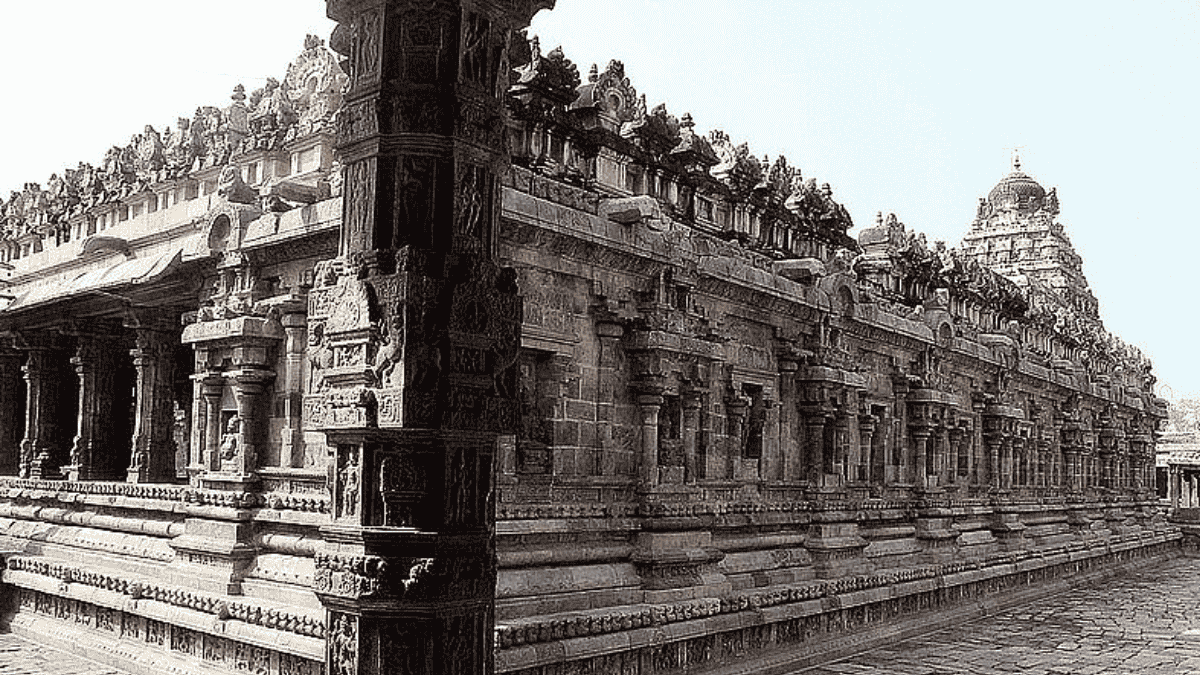
UPSC Current Affairs June 05, 2026: Jalakanteswarar Temple of Tamil Nadu and Vijayanagara Architecture | Atharva Examwise Daily GK Update
Introduction to the Jalakanteswarar Temple of Vellore Fort
South Indian temple architecture, art, and culture have always been highly significant components of the Union Public Service Commission (UPSC) and other state-level administrative service examinations (GS Paper-I). In this context, the Jalakanteswarar Shiva Temple, located in the Vellore district of Tamil Nadu, serves as a living example of historical transitions, architectural diversity, and cultural resilience.
Situated inside the ancient and impenetrable Vellore Fort, this temple is primarily dedicated to Lord Shiva, who is worshipped here as 'Jalakanteswarar'. Built during the zenith of the Vijayanagara Empire, this architectural marvel not only reflects the pinnacle of South Indian craftsmanship but also highlights contemporary debates regarding the preservation of 'Living Heritage' in India's colonial and administrative history. For a deeper analysis of history and art, candidates can also refer to other national importance analyses in the Atharva Examwise Current News section.
Historical Background and Mythological Beliefs
The construction of the Jalakanteswarar Temple and its religious origins are deeply intertwined with the local politics of the Vijayanagara period and regional folklore. According to mythological beliefs, a massive termite hill (anthill) surrounded by rainwater once stood at the site of the current sanctum sanctorum. A Swayambhu (self-manifested) Shivling was enshrined inside this anthill.
Chinna Bommi Reddy Nayaka, a Nayak ruler subordinate to Emperor Sadasiva Deva Maharaya of the Vijayanagara Empire, was directed by Lord Shiva in a dream to construct a temple at this location. Subsequently, the Nayak ruler cleared the anthill, re-established the Shivling, and built a magnificent temple. Since the Shivling had been surrounded by water since ancient times, the temple was named 'Jalakanteswarar', which literally means "Lord Shiva residing in water."
According to local legends, the original Shivling was first established by Maharishi Atri, one of the Saptarishis (seven sages). During the construction of the temple, the surrounding forests of white babool ('Vel Maram' in Tamil) were cleared, which led to the development of the city named 'Vellore'.
Temple Architecture and Structural Features
The Jalakanteswarar Temple is considered an exquisite example of South Indian Dravidian architecture, specifically the Vijayanagara architectural style. The hallmarks of the Vijayanagara style lie in its intricate carvings, lofty Gopurams, and grand pillared pavilions (Mandapams), which assimilate elements from the preceding Chola, Pandya, and Chalukya styles.
To understand the structural layout of the temple, it is essential to observe its key components and their functions:
Key Structural Components and Their Features
| Structural Component | Architectural and Artistic Features | Exam-Oriented Technical Details |
|---|---|---|
| Garbhagriha (Sanctum Sanctorum) | The innermost chamber of the temple where the main Swayambhu Shivling is enshrined. | Faces the East; it is the center of profound serenity and spiritual energy. |
| Rajagopuram | A massive, multi-tiered tower standing over 100 feet tall at the main entrance. | Adorned with dense and exquisite carvings of mythological tales, deities, and floral motifs. |
| Prakaras | Two extensive courtyards or corridors enclosing the temple. | A double-walled structure designed like a military defensive fortress. |
| Kalyana Mandapam | The temple's most famous ornate pavilion, used for wedding festivals. | Features intricately carved pillars sculpted with Yali, warriors, and deities. |
| Agazhi (Moat/Water Tank) | A massive water moat or tank surrounding the temple, acting as a protective barrier. | The total perimeter of this water boundary is estimated to be around 8,000 feet. |
Unique Carvings of the Kalyana Mandapam
The temple's Kalyana Mandapam (Marriage Hall) is highly regarded among historians and art lovers worldwide for its unmatched sculpture and architectural uniqueness. The pillars of this pavilion feature magnificent depictions of equestrian warriors carved out of single stones, mythical lion-like creatures (Yali), and scenes from Hindu epics.
The most remarkable artwork of this Mandapam is the integrated 'Bull-Elephant' (two-faced) sculpture carved from a single stone. When viewed from one specific angle, the figure appears to be a bull (Lord Shiva's vehicle, Nandi), while from another angle, it transforms into an elephant. This stands as direct evidence of the extraordinary talent and geometric precision of the artisans of the Vijayanagara period. Candidates can study the evolution of Indian temples under the relevant section at https://www.atharvaexamwise.com for more insights.
Ganga Gauri Tirtham and Water Management
Demonstrating the excellent water engineering of ancient times, a natural ancient well named 'Ganga Gauri Tirtham' is located within the temple premises. This is a natural water source that was not dug out but erupted spontaneously. The sacred water from this well is exclusively used for the daily Abhishekam (ritual bathing) of Lord Shiva, underlining the importance of water purification and conservation in Hindu rituals.
History of Political Transition in the Preservation of Vellore Fort
Vellore Fort and the Jalakanteswarar Temple within it have not just been centers of religious faith; they have also stood as silent witnesses to centuries of political conflict in South India. Changes in the control of the fort deeply impacted the temple's worship practices and its physical structure:
Historical Succession of Vellore Fort and Temple
| Timeline | Ruling Dynasty / Power | Impact on the Temple and Fort |
|---|---|---|
| 16th Century (1550–1566 AD) | Vijayanagara Empire (Nayak Rulers) | Establishment of the fort and Jalakanteswarar Temple; Cultural Golden Age. |
| Around 1650 AD | Bijapur Sultanate | Capture of the fort; partial desecration of the temple, disruption of worship, and conversion of the complex into a military arsenal. |
| 1678 AD | Maratha Empire (Chhatrapati Shivaji Maharaj) | Control of the fort following a daring night raid; partial return of Hindu dominance. |
| Post-1692 AD | Mughal Empire (Aurangzeb / Daud Khan) | Control over the fort; later transferred to the Nawabs of Arcot. |
| 1760 AD | British East India Company | Fort converted into a garrison and prison; Tipu Sultan's family and the last King of Sri Lanka were imprisoned here. |
| 1921 AD | Archaeological Survey of India (ASI) | Fort and temple declared a National Protected Monument; complete ban on worship enforced. |
| March 16, 1981 | Local Hindu Community | Re-consecration of the Shivling and restoration of worship through a historic mass movement. |
The Historic 1981 Re-consecration Movement
The modern history of the Jalakanteswarar Temple is a fascinating legal and social chapter involving the duel between Indian archaeology and the religious freedom of citizens. During the invasion by the Bijapur Sultanate in the 17th century, local residents stealthily removed the main Shivling to protect it from desecration and kept it safely at the Jalakanta Vinayagar Temple in nearby Sathuvachari. Following this, the main temple remained vacant for nearly 400 years and was used as a stable for army horses and an ammunition depot.
When the Vellore Fort came under the Archaeological Survey of India (ASI) in 1921, the ASI decided to maintain the status quo under ancient monument laws and refused to grant permission for the installation of any new religious idols or worship. Even after a meeting with Prime Minister Jawaharlal Nehru after independence, this restriction could not be lifted.
Finally, on March 16, 1981, a massive public campaign was launched under the leadership of the Hindu Munnani and local leaders. With the tacit support of the then District Collector of Vellore, Shri Gangappa, devotees bypassed administrative hurdles, brought the original Shivling back from Sathuvachari, and re-consecrated it in the sanctum sanctorum of the temple. Although this step faced stiff opposition from the ASI and the government of the time, the administration had to bow down following overwhelming public sentiment and civil lawsuits (such as the Civil Suit of 1981). Currently, the physical structure of the temple is maintained by the ASI, while daily religious rituals are managed by a local trust and the state government's Hindu Religious and Charitable Endowments (HR&CE) Department.
Religious Coexistence in Vellore Fort and the 1806 Mutiny
Vellore Fort is famous not only for its military architecture but also as a unique symbol of India’s multicultural and multi-religious fabric. Spanning over 133–136 acres, the fort houses historical places of worship belonging to three different religions:
Hinduism: Jalakanteswarar Shiva Temple (16th Century).
Islam: The historic Old Mosque (Bijapur and Mughal eras).
Christianity: St. John's Church, built during the British era in 1846.
The fort also witnessed the 'Vellore Mutiny' on July 10, 1806, which was the first major armed uprising by Indian sepoys against British rule. The primary trigger for this mutiny was the introduction of new military dress regulations by the British East India Company, which forbade Hindu soldiers from wearing tilaks on their foreheads and ordered Muslim soldiers to shave their beards. This historical sequence clearly indicates that the relationship between religious identity and political sovereignty in this region has always been highly sensitive.
Competitive Exam News Today: Important Facts
For quick revision, important facts related to the Jalakanteswarar Temple and Vellore Fort are compiled in the table below:
| Type of Fact | Description and Key Data | Relevance for the Exam |
|---|---|---|
| Location | Vellore Fort, Tamil Nadu, India. | Art & Culture - Geographical Distribution. |
| Construction Period | Around 1550–1566 AD (16th Century). | History of Vijayanagara and Nayak Dynasties. |
| Architectural Style | Dravidian Architecture (Vijayanagara sub-style). | Study of architectural classifications. |
| Key Features | Kalyana Mandapam, Yali pillars, integrated bull-elephant sculpture. | Case studies of South Indian sculpture. |
| Water Bodies | Ganga Gauri Tirtham (natural well) and Agazhi (moat). | Medieval water harvesting systems. |
| Historical Event | Vellore Sepoy Mutiny (July 10, 1806). | Modern Indian History (Pre-1857 revolts). |
| Conservation | Archaeological Survey of India (ASI). | Maintenance of historical monuments and national importance. |
Why This Matters for Your Exam Preparation
This historical and cultural analysis of the Jalakanteswarar Temple and Vellore Fort is highly vital for serious candidates preparing for civil services and other competitive exams due to the following reasons:
Art and Culture (GS Paper-I): Questions are frequently asked in the examination regarding the regional styles of Dravidian architecture, particularly the contributions of the Vijayanagara Empire. The carvings of the Kalyana Mandapam, the structure of the Gopurams, and innovative sculptural experiments (like the two-faced bull-elephant statue) can be cited as examples in Mains answers.
Modern Indian History (GS Paper-I): Vellore Fort was the epicenter of the 1806 Sepoy Mutiny. Understanding the causes, religious-cultural aspects, and consequences of this mutiny as a precursor to the Great Revolt of 1857 is essential for the history section of the Mains exam.
Indian Polity and Governance (GS Paper-II): The issue of restoring worship in ASI-protected monuments explains the balance between the preservation of 'Living Heritage' and the religious rights of citizens (Articles 25 to 28 of the Constitution). It serves as an excellent case study to understand the intersection between administrative policies and public sentiments.
Secularism and Cultural Syncretism: The coexistence of a temple, a mosque, and a church within the same fort showcases India's shared cultural heritage and secular ethos. This can be presented as an example of inclusivity and tolerance in Essays and Ethics (GS Paper-IV) answers.