Current Affairs May 21, 2026: Taiwan Travelogue Wins International Booker Prize — Daily GK Update for UPSC Current Affairs and Competitive Exam News Today
Landmark Triumph for East Asian Literature
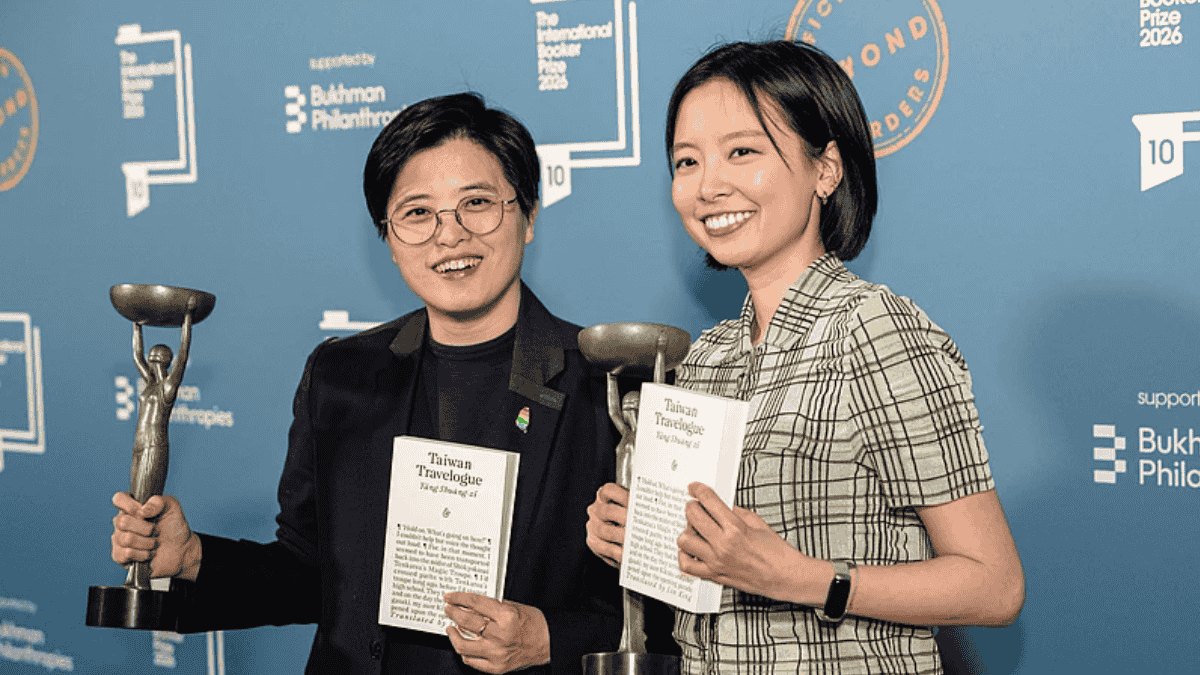
On May 19, 2026, the global literary community gathered at the Tate Modern in London for the announcement of the 2026 International Booker Prize. In a historic milestone, the novel Taiwan Travelogue, written by Taiwanese author Yang Shuang-zi and translated into English by Lin King, was declared the winner. This victory marks the first time a book originally written in Mandarin Chinese has won the prestigious award.
This achievement serves as a vital case study in cultural diplomacy and postcolonial literary dynamics, making it an essential subject for aspirants tracking(https://www.atharvaexamwise.com) and international honors. The recognition of Taiwan Travelogue highlights the growing global appreciation for translated literature and the nuanced historical narratives of East Asia.
Core Literary Profile of Taiwan Travelogue
First published in Taiwan in 2020, Taiwan Travelogue utilizes a highly creative metafictional framework. The novel masquerades as a translation of a rediscovered 1938 travel memoir written by a fictional Japanese novelist, Aoyama Chizuko, during the period of Japanese colonial rule in Taiwan.
Character Dynamics and Power Imbalances
The story follows Chizuko as she embarks on a government-sponsored lecture tour across the colonized island. She is accompanied by her local Taiwanese interpreter and traveling companion, Ō Chizuru (nicknamed Chi-chan).
Aoyama Chizuko: A successful, independent young Japanese novelist representing the colonizer class. Although she is indifferent to the imperialist agenda of her government, she possesses a form of intellectual arrogance. Her infatuation with Chi-chan is set against her privilege, which initially blinds her to the social realities and constraints of the colonized population.
Ō Chizuru (Chi-chan): A young, multilingual Taiwanese woman hired as an interpreter. Erudite, meticulous, and an exceptional cook, she introduces Chizuko to local Taiwanese cuisine. However, she maintains a careful, professional distance, rebuffing Chizuko's romantic advances. This distance stems from her realistic acceptance of her social position and the power imbalance inherent in their relationship.
Food and Language as Colonial Battlegrounds
On the surface, the book presents a detailed culinary tour of 1930s Taiwan. However, the shared love of food serves as a complex medium through which the characters navigate intimacy, resistance, and identity shifting beneath the surface of empire. The novel uses traditional literary hallmarks, such as fictional introductions, footnotes, and afterwords, alongside "real" translator footnotes added by Lin King, to create a layered commentary on what is lost, altered, or suppressed in translation under colonial hegemony.
Key Facts and Exam-Relevant Data for Aspirants
For candidates reviewing the daily GK update or looking for competitive exam news today, the following details are crucial:
The Winning Duo: Author Yang Shuang-zi became the first Taiwanese author to win the prize, while Lin King became the first Taiwanese-American translator to win.
Financial Reward: The £50,000 prize money is divided equally, with £25,000 awarded to the author and £25,000 to the translator.
Historical First: It is the first work translated from Mandarin Chinese to win the International Booker Prize in its history.
Previous Accolades: The original Mandarin text won Taiwan's highest literary honor, the Golden Tripod Award, in 2021. The English translation won the US National Book Award for Translated Literature in 2024 and the Asia Society's inaugural Baifang Schell Book Prize.
The Publisher: The English edition was published in the United Kingdom by And Other Stories, an independent, Sheffield-based, not-for-profit publisher operating out of the Sheffield Central Library.
International Booker Prize Eligibility and Rules
The International Booker Prize is subject to specific administrative and eligibility guidelines established by the Booker Prize Foundation. These criteria are summarized in the table below:
| Parameter | Eligibility Criteria & Administrative Rules |
|---|---|
| Eligible Works | Full-length novels or short-story collections originally written in any language other than English. |
| Translation Requirement | Must be translated into English and published in the United Kingdom or Ireland. |
| Publication Window | For the 2026 cycle, works must have been published between May 1, 2025, and April 30, 2026. |
| Livelihood Status | Both the author and the translator must be living at the time of submission. |
| Selection Panel | Composed of five judges appointed annually by the Booker Prize Foundation, who compile a longlist of 12 to 13 books, a shortlist of six, and the eventual winner. |
| Shortlist Reward | Each shortlisted title receives a prize of £5,000, divided equally between the author and the translator. |
Complete 2026 Shortlist and the Independent Press Success
The 2026 judging panel was chaired by novelist Natasha Brown, who was joined by mathematician Marcus du Sautoy, translator Sophie Hughes, and writers Troy Onyango and Nilanjana S Roy. The shortlist showcased a wide array of stylistic approaches to postcolonial themes, translation, and historical memory.
The 2026 Shortlisted Titles
The table below lists the six final works selected for the 2026 shortlist :
| Title of the Work | Author | Translator | Original Language | Publisher (UK) |
|---|---|---|---|---|
| Taiwan Travelogue | Yang Shuang-zi | Lin King | Mandarin Chinese | And Other Stories |
| The Director | Daniel Kehlmann | Ross Benjamin | German | MacLehose Press / Hachette |
| The Witch | Marie NDiaye | Jordan Stump | French | Two Lines Press / Fitzcarraldo |
| She Who Remains | Rene Karabash | Izidora Angel | Bulgarian | And Other Stories |
| On Earth As It Is Beneath | Ana Paula Maia | Padma Viswanathan | Portuguese | Charco Press |
| The Nights Are Quiet in Tehran | Shida Bazyar | Ruth Martin | German | Scribe Publications |
The Institutional Triumph of 'And Other Stories'
A major talking point of the 2026 awards is the success of the independent, not-for-profit publisher And Other Stories. Operating as a Community Interest Company, this small press achieved back-to-back victories, having published the 2025 winner, Heart Lamp by Banu Mushtaq (translated by Deepa Bhasthi).
This consecutive win highlights how small, subscriber-supported presses are reshaping global publishing. Unlike large commercial publishing houses, these presses are structured to take on books that are considered formally unusual, politically sensitive, or rooted in languages with smaller English-reading bases. Furthermore, their commitment to putting translators' names on the front cover and paying above industry standards has set a new benchmark for the publishing industry.
Comparative Literary Context: The Booker Prize vs. The International Booker Prize
To avoid confusion during competitive exams, it is essential to distinguish between the two primary literary awards presented by the Booker Prize Foundation. This distinction can be cross-referenced on the official portal of(https://thebookerprizes.com).
| Feature / Metric | The Booker Prize | The International Booker Prize |
|---|---|---|
| Inaugurated | 1969 (originally sponsored by Booker McConnell) | 2005 (initially a biennial career-achievement award; annual since 2016) |
| Focus | Best original work of fiction written in English | Best work of fiction translated into English |
| Eligible Forms | Full-length novels only | Novels or collections of short stories |
| Eligibility Criteria | Open to writers of any nationality, provided the work is published in the UK or Ireland | Open to translated works from any language, provided the work is published in the UK or Ireland |
| Distribution of Funds | £50,000 awarded entirely to the winning author | £50,000 split equally between the author and the translator |
Historical Perspective: Indian Laureates and Connections
India has a long history of engagement with the Booker Prizes, with several writers of Indian origin winning or being shortlisted for these prestigious honors. These achievements are frequently covered under the Atharva Examwise current news archives.
Indian Winners of the Booker Prize (English Fiction)
Several Indian or Indian-origin authors have won the primary Booker Prize since its inception :
V.S. Naipaul (1971): Won for In a Free State, a novel exploring displacement, exile, and postcolonial identity across multiple narratives.
Salman Rushdie (1981): Won for Midnight's Children, which used magical realism to parallel the life of a child born at the exact moment of India's independence with the history of the nation. This novel also won the "Booker of Bookers" in 1993 and the "Best of the Booker" in 2008.
Arundhati Roy (1997): Won for her debut novel, The God of Small Things, which explored love, caste politics, and social standards in Kerala, becoming the first Indian woman to win the prize.
Kiran Desai (2006): Won for The Inheritance of Loss, which analyzed globalization, immigration, and colonial identity crises in the Himalayas. At 35, she was the youngest woman to win the award at the time.
Aravind Adiga (2008): Won for The White Tiger, a darkly humorous critique of India's class struggles, corruption, and economic disparities.
Indian Connections to the International Booker Prize
In recent years, the International Booker Prize has also recognized translated fiction from the Indian subcontinent :
Geetanjali Shree and Daisy Rockwell (2022): Won the International Booker Prize for Ret Samadhi (Tomb of Sand), marking the first time a novel translated from Hindi claimed the award. The novel follows an 80-year-old woman who overcomes depression and travels to Pakistan to confront childhood traumas stemming from the Partition.
Banu Mushtaq and Deepa Bhasthi (2025): Won for Heart Lamp, a collection of 12 short stories translated from Kannada. This marked the first short story collection to win the International Booker Prize, as well as the first Kannada-language work to be shortlisted and win. The collection chronicles the everyday struggles of Muslim women in southern India.
Padma Viswanathan (2026): A translator of Indian origin who was shortlisted for her translation of Ana Paula Maia’s Portuguese novel, On Earth As It Is Beneath.
Why this matters for your exam preparation
Understanding international literary awards like the Booker Prizes is highly valuable for aspirants preparing for the UPSC Civil Services Examination and other state-level competitive exams. The topic carries relevance across multiple sections of the syllabus:
1. UPSC Prelims (Current Events of National and International Importance)
Factual questions regarding the winners, translators, languages of origin, and associated publishers of prominent literary awards.
Conceptual distinctions between the eligibility, history, and financial structures of the Booker Prize and the International Booker Prize.
Questions on historical milestones, such as the first Hindi work (Ret Samadhi in 2022), the first Kannada work (Heart Lamp in 2025), and the first Mandarin work (Taiwan Travelogue in 2026) to win these honors.
2. UPSC Mains GS Paper I (Indian Heritage, Art, and Culture)
Postcolonial Literature: Understanding how literature reflects, critiques, and preserves history under colonial regimes, particularly concerning the suppression and reclamation of indigenous identities.
Linguistic Diversity: The rise of regional Indian languages on the global stage through translated literature, showcasing India's soft power and cultural diplomacy.
3. UPSC Mains GS Paper II (Bilateral, Regional, and Global Groupings and Agreements)
Cultural Diplomacy as Soft Power: How national identity is projected globally through translation and international awards, and the role of cultural institutions in international relations.
4. Essay Paper
Perspectives on how translation fosters global empathy, why language is a key battleground of colonial control, and how literature serves as a vehicle for subaltern voices to challenge dominant colonial narratives.