
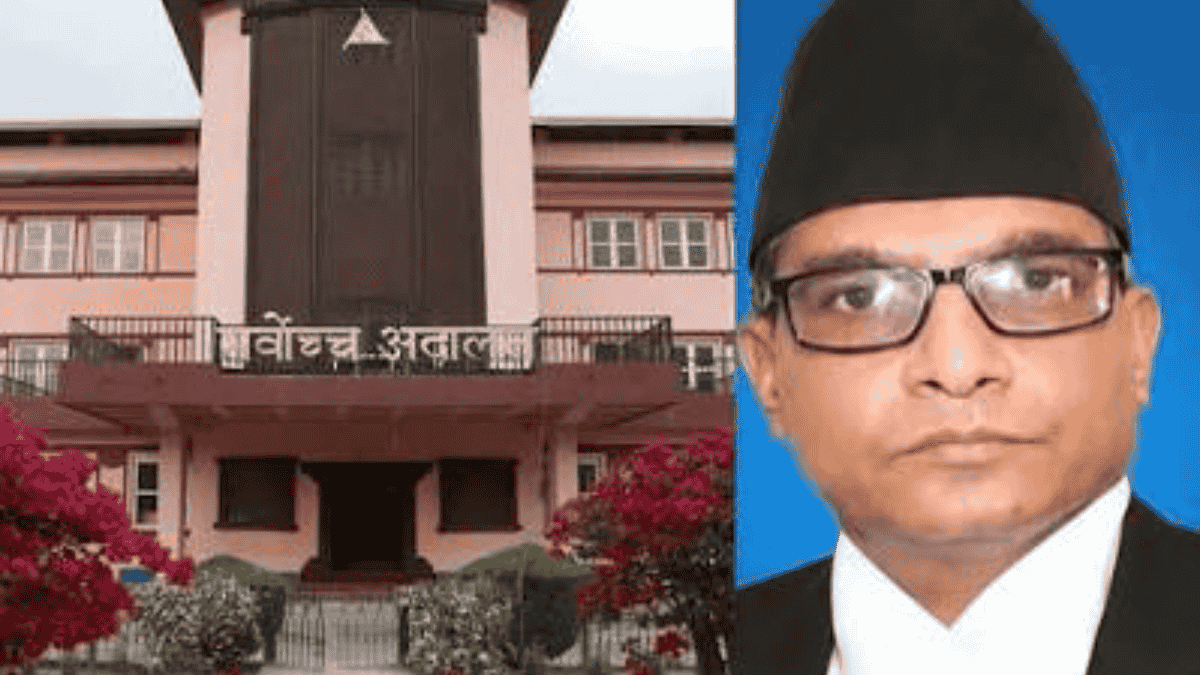
Daily GK Update: Dr. Manoj Kumar Sharma Becomes the 33rd Chief Justice of Nepal | UPSC Current Affairs - May 20, 2026
This special edition of Atharva Examwise Current News presents an in-depth analysis of the constitutional nuances of this appointment, the controversy surrounding the bypassing of seniority, and the strategic implications for India-Nepal judicial relations.
Recent Developments and Background
The apex judicial post had been vacant since the retirement of Nepal’s former Chief Justice, Prakash Man Singh Raut. During the interim, the senior-most judge, Sapana Pradhan Malla, served as the acting Chief Justice.
On May 7, 2026, the Constitutional Council of Nepal recommended Dr. Manoj Kumar Sharma for the role. Following this, his name was unanimously approved by the Parliamentary Hearing Committee, after which President Poudel officially appointed him to the post.
Dr. Sharma's tenure will extend until June 2032, giving him a rare opportunity to implement long-term institutional reforms over the longest single period in Nepal's recent judicial history.
Dr. Manoj Kumar Sharma: Academic and Professional Journey
Born on June 18, 1970, in Birgunj (Parsa district), Nepal, Dr. Manoj Kumar Sharma's academic and professional journey is deeply intertwined with the legal ecosystems of both India and Nepal:
Legal Education: He obtained his Bachelor of Laws (LLB) degree from Nepal Law Campus, Kathmandu. Following this, he earned his Master of Laws (LLM) degree in Commercial and Constitutional Law from the prestigious Savitribai Phule Pune University (formerly University of Pune) in India. He also holds a PhD in Labour Law from Tribhuvan University.
Professional Beginning: In 1995, he started his legal career as an advocate, serving as a consultant on corporate and constitutional matters for various private law firms.
Judicial Career: In June 2013, he was appointed as an additional judge in the Appellate Courts of Butwal and later Patan. On April 19, 2019, he became a permanent judge of the Supreme Court of Nepal. Since February 2024, he has been an active member of the crucial Constitutional Bench of the Supreme Court.
Nepal's Constitutional Appointment Process and the Seniority Bypass Controversy
Dr. Sharma's appointment has triggered a fresh debate across the legal and political corridors of Nepal. Understanding these systemic changes is essential for contemporary competitive examination analysis.
Constitutional Appointment Framework (Article 129)
Under Article 129(2) of the Constitution of Nepal, the Chief Justice is appointed by the President on the recommendation of the Constitutional Council. According to Article 129(3), any individual who has served as a permanent judge of the Supreme Court of Nepal for at least three years is legally eligible to become the Chief Justice.
The Seniority Bypass (Supersession) Controversy
There has been an established judicial tradition in Nepal where the senior-most judge of the Supreme Court is promoted to the post of Chief Justice to safeguard judicial independence and impartiality.
However, this time, the Constitutional Council recommended Dr. Manoj Kumar Sharma, who ranked fourth in the seniority order. In doing so, they bypassed three senior-most judges:
Acting Chief Justice Sapana Pradhan Malla
Justice Kumar Regmi
Justice Hari Prasad Phuyal
This decision has brought sharp domestic divisions to light:
Arguments of the Opponents: During the Constitutional Council meeting, National Assembly Chairman Narayan Dahal and opposition representative Bhishmaraj Aangdembe registered a written Note of Dissent. The Nepal Bar Association and several legal experts warned that bypassing senior judges without clear, objective reasoning could invite political interference and foster a culture of "political loyalty" within the judiciary. In Nepal's landmark case, Advocate Achyut Prasad Kharel v. Constitutional Council, the Supreme Court itself ruled that if seniority is disregarded, the administration must provide transparent and objective justifications.
Stance of the Supporters: Conversely, proponents of the appointment and the Constitutional Council argue that instead of making seniority the sole criterion, priority should be given to merit, professional competence, and efficiency. Dr. Sharma's stellar "Case Disposal Rate" and his reputation for delivering swift judgments were cited as the primary drivers behind his selection.
Key Judicial and Administrative Challenges Facing Dr. Sharma
During his six-year tenure, Dr. Sharma will have to navigate several systemic anomalies prevailing in Nepal's judiciary. His primary administrative and judicial hurdles are mapped out below:
| Key Challenges | Details and Impact | Necessary Administrative Reforms |
|---|---|---|
| Backlog of Pending Cases | The Supreme Court of Nepal currently has more than 22,000 pending cases. Total national pendency across all courts exceeds 375,000 cases. | Activating Campaign Units and establishing rapid-hearing mechanisms. |
| Coordination with Colleagues | Building cordial, functional relationships with the senior judges who were bypassed in the appointment process. | Ensuring absolute transparency in Bench Allocation and moving towards consensus-based decisions. |
| Relations with the Bar | The coordination mechanism between the Bar and the Bench is currently fractured and inactive. | Restoring regular coordination meetings and actively involving the Bar in planned judicial reforms. |
| Curbing Corruption & Middlemen | Eliminating low-level bribery within court premises and limiting the influence of institutional intermediaries. | Accelerating digital filing/tracking systems and holding monitoring committees accountable. |
| Weak Enforcement of Judgments | Ground-level execution of court orders remains slow; billions of rupees in fines and criminal sentences remain unexecuted. | Revitalizing and empowering the Judgment Implementation Directorate. |
India-Nepal Relations: The Role of Judicial and Academic Cooperation
Dr. Manoj Kumar Sharma earning his LLM from Pune University highlights the powerful role of shared academic heritage and "soft power" between India and Nepal. The judiciaries of both nations regularly draw inspiration from each other's landmark constitutional decisions; for instance, Nepal has integrated the "Basic Structure Doctrine" from the Indian Constitution, while the Indian Supreme Court has cited progressive judgments from Nepal in its own environmental and social rulings.
To solidify this institutional bond, the Supreme Courts of India and Nepal signed a historic Memorandum of Understanding (MoU) for judicial cooperation on April 7, 2025. This agreement was formalized in the presence of the then Nepalese Chief Justice Prakash Man Singh Raut and the Chief Justice of India, Sanjiv Khanna.
The three primary pillars of this agreement include:
Judicial Exchanges and Training: Conducting joint training modules, academic seminars, and study tours for judges and judicial officers of both countries at premier institutions like the National Judicial Academy in India.
Technical Cooperation: Exchanging Information Technology (IT) frameworks and digitization systems to modernise courtrooms, reduce backlogs, and maximize efficiency.
Joint Working Group (JWG): A dedicated working group comprising judicial officers from both nations has been formed to map out the implementation strategy and regularly monitor cooperation milestones.
Amid shifting political dynamics in Kathmandu, judicial diplomacy under India's 'Neighbourhood First' policy serves as a vital anchor for stability, predictability, and mutual trust in bilateral relations.
Why This Matters for Your Exam Preparation
This development is highly significant for the Union Public Service Commission (UPSC) Civil Services Main Examination and various State Civil Services (State PCS) exams. It can be integrated across multiple syllabus sections:
General Studies (GS) Paper-II (Comparative Constitution and Polity)
Judicial Appointment Process: Compare Nepal's 'Constitutional Council' based appointment system with India's 'Collegium System'.
Independence of Judiciary vs. Seniority Principle: Analyze the constitutional and democratic impacts of bypassing seniority (supersession). Comparing this recent development in Nepal with historical cases of seniority violations in India (1973 and 1977) can significantly enrich your Mains answers.
General Studies (GS) Paper-II (International Relations)
India-Nepal Bilateral Relations: Beyond traditional infrastructure and hydropower diplomacy, focus on the growing role of "Judicial Diplomacy" and shared academic roots. The bilateral judicial MoU signed in April 2025 serves as an excellent contemporary case study for your answers.
For Preliminary Examination and One-Day Exams (Daily GK Update)
Who is the new 33rd Chief Justice of Nepal? Dr. Manoj Kumar Sharma.
From which Indian university did Dr. Sharma complete his Master of Laws (LLM)? Savitribai Phule Pune University.
Which article of the Constitution of Nepal governs the appointment of the Chief Justice? Article 129.