UPSC Current Affairs May 20, 2026: Netherlands Returns 1,000-Year-Old Chola 'Leiden Plates' to India | Daily GK Update
In a landmark achievement for cultural diplomacy and heritage repatriation, the Netherlands officially returned the approximately 1,000-year-old Chola-era 'Anaimangalam Copper Plates' (globally recognized as the Leiden Plates) to India in May 2026. Widely regarded as one of the most critical epigraphic records of Tamil-Chola history, this priceless artifact is now back in Indian custody.
For serious civil services aspirants tracking competitive exam news today, this development is a high-yield topic intersecting ancient Indian history, art and culture, and contemporary international relations.
What are the Anaimangalam Copper Plates (Leiden Plates)?
The Anaimangalam Copper Plates are an elite set of epigraphic charters dating back to the 11th century. They provide authentic documentary evidence from the golden era of the Chola Empire, specifically during the reigns of Rajaraja Chola I (985–1014 CE) and his legendary son, Rajendra Chola I (1014–1044 CE).
Key Features and Artifact Data:
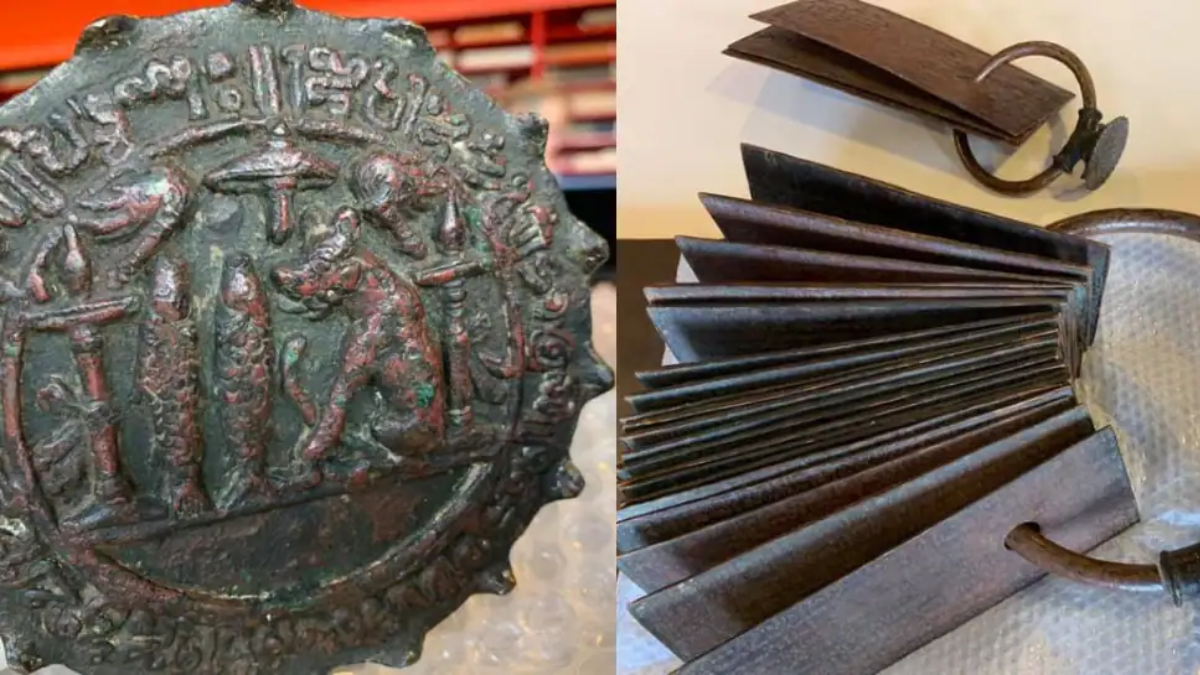
The Set Composition: The artifact consists of a total of 21 large and 3 small copper sheets.
Total Weight: The entire assembly weighs a massive 30 kilograms.
The Royal Ring and Seal: All plates are bound together by a heavy copper/bronze ring secured with the official Chola dynastic seal, symbolizing its absolute sovereign authority.
What to analyze in the visual: Notice the heavy circular bronze ring linking the plates. The intricate royal seal stamped on the ring features the Chola emblem (the seated tiger), alongside symbols of dynasties they dominated (the Pandyan fish and Chera bow). This structural mechanism ensured the imperial charter remained unedited and legally binding across maritime borders.
The Historical Inscription: What Do the Plates Record?
The plates contain a comprehensive bilingual text—one section written in Sanskrit and the other in Tamil. They function as a royal charter (shasanam) dictating a major administrative and economic grant.
The Core Decree: The text records that the Chola administration granted the entire land and revenue collection rights of Anaimangalam village (located near the historic port of Nagapattinam, Tamil Nadu) to a local Buddhist monastery.
The Southeast Asian Connection: The beneficiary was the Chudamani Vihara (also known as Chulamanivarma Vihara). This major Buddhist institution was built at Nagapattinam by King Chudamanivarman, the ruler of the powerful Shailendra/Sri Vijaya Dynasty of Southeast Asia (modern-day Indonesia and Sumatra).
Socio-Economic Insights: The bilingual text maps out precise land boundaries, detailed tax exemptions, and sophisticated revenue administration protocols practiced by the medieval Chola state.
The Joint Roles of Rajaraja I and Rajendra I
The original land grant was orally decreed by Rajaraja Chola I and initially documented on perishable palm-leaf manuscripts. To ensure its permanent legal and historical preservation, his son Rajendra Chola I ordered the text to be permanently engraved onto these durable copper plates. The royal seal locking the collection bears the specific emblem of Rajendra Chola I.
Exam Takeaway: This grant stands as an unshakeable proof of religious tolerance and secular patronage in early medieval India. It illustrates how devout Hindu Shaivite kings actively financed, legally protected, and patronized Buddhist institutions established by foreign maritime allies.
How Did the Plates Reach the Netherlands?
The journey of the Leiden Plates to Europe highlights the colonial shifts in southern India's maritime landscape:
Colonial Acquisition (18th Century): When the port town of Nagapattinam came under the administrative control of the Dutch East India Company, a Dutch official and missionary named Florentius Camper discovered these plates and transported them to the Netherlands.
Leiden University Vaults (1862): Around 1862, the plates became a cornerstone of the Asian collection at the Leiden University Library. For more than 150 years, they were kept under strict security inside climate-controlled vaults, hidden from the general public and shown only to specialized researchers under exceptional permissions.
The Restitution Process and Diplomatic Milestones
The successful return of this artifact is a triumph for Atharva Examwise current news trackers studying the recovery of Indian antiquities:
A Decade of Effort: India began formal diplomatic tracking and requests for the return of these specific plates in 2012.
Dutch Restitution Policy (2022): The breakthrough occurred when the Dutch government implemented a comprehensive policy for returning colonial-era cultural objects. This initiated a strict verification of the plates' provenance (the documented history of origin and ownership).
UNESCO Support: The case was escalated at the 24th meeting of the Intergovernmental Committee for Promoting the Return of Cultural Property (ICPRCP), a body supported by UNESCO. The committee officially validated India as the legal country of origin, urging bilateral execution.
The Handover (May 2026): During Prime Minister Narendra Modi’s state visit to the Netherlands between May 15–17, 2026, the Leiden University Library officially handed the plates back to India. The ceremony took place in the presence of PM Modi and Dutch Prime Minister Rob Jetten. The Ministry of External Affairs (MEA) characterized this as a major milestone in bilateral trust.
Impact on Modern India-Netherlands Relations
This historic restitution does more than repair historical colonial grievances; it strengthens modern strategic ties. Simultaneously, India and the Netherlands are scaling up collaborations across critical high-tech sectors, including:
Semiconductor fabrication ecosystems
Green Hydrogen production networks
Joint defense hardware and aerospace technology
Why this matters for your exam preparation
For serious civil services aspirants looking to secure high scores, this development integrates perfectly into multiple pillars of the UPSC current affairs syllabus:
1. Indian Art, Culture & History (GS Paper I / Prelims)
Primary Epigraphic Sources: The Leiden Plates are categorized among the most vital surviving archival materials for early medieval India. UPSC frequently tests concepts related to land grants (Brahmadeya, Devadana, Buddhist grants) and administrative terms.
Chola Local Governance: The plates shed light on village boundaries, tax structures, and royal decree systems. Brush up on your core static syllabus with our comprehensive analysis of Chola Imperial Administration and Local Self-Governance.
2. International Relations & Bilateral Alliances (GS Paper II)
Cultural Diplomacy: This case serves as an excellent contemporary example of soft-power diplomacy, international restitution frameworks, and UNESCO's role in heritage protection.
Indo-European Ties: It offers an insightful case study on how resolving colonial heritage disputes can generate geopolitical trust, driving deeper trade and technological treaties.