
UPSC Current Affairs May 2026: Comprehensive Analysis of Article 324(2) and the CEC Appointment Act 2023 – Atharva Examwise Daily GK Update
The smooth functioning of the Indian democratic system is predicated on the indispensable condition of free and fair elections. In the current landscape of May 2026, the Supreme Court of India is hearing a case that strikes at the very foundation of our democracy: the institutional autonomy of the Election Commission of India (ECI).
The challenge to the constitutional validity of the 'Chief Election Commissioner and Other Election Commissioners (Appointment, Conditions of Service and Term of Office) Act, 2023' has transcended legal boundaries to become a profound political and constitutional issue. For serious aspirants of the Union Public Service Commission (UPSC) and other competitive exams, understanding Article 324, landmark Supreme Court judgments, and the long journey of electoral reforms is vital. This report analyzes every nuance of the subject, from constitutional provisions to contemporary judicial observations.
Constitutional Structure of the Election Commission and Depth of Article 324
Part XV (Articles 324-329) of the Indian Constitution drafts the blueprint for the electoral system. Article 324 is the pivot upon which the entire electoral machinery turns. It not only establishes the Commission but also grants it vast powers of "superintendence, direction, and control" over elections.
Detailed Breakdown of Article 324 Clauses
The powers and structure of the Election Commission are divided under Article 324, which is crucial for aspirants to master:
| Clause | Description | Significance |
|---|---|---|
| 324(1) | Power to prepare electoral rolls and conduct elections for Parliament, State Legislatures, and the offices of President and Vice-President. | Makes the Commission an independent and all-powerful body. |
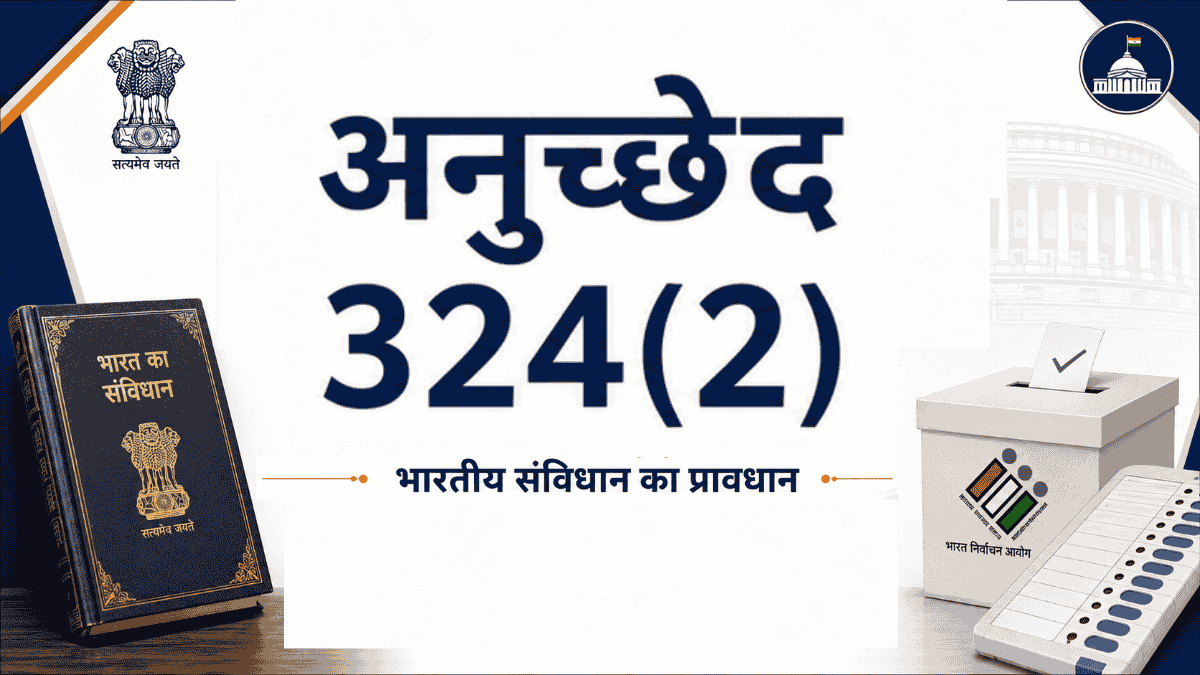
| 324(2) | The Commission consists of a Chief Election Commissioner (CEC) and other Election Commissioners (ECs) as fixed by the President. | Appointment process is subject to any law made by Parliament. |
| 324(3) | When other ECs are appointed, the CEC shall act as the Chairman of the Commission. | Clarifies hierarchy and leadership within the body. |
| 324(4) | The President may appoint Regional Commissioners to assist the Commission. | Facilitates administrative expansion during large-scale elections. |
| 324(5) | Conditions of service and tenure are determined by the President; however, the CEC can only be removed like a Supreme Court Judge. | Ensures security of tenure to safeguard independence. |
The framers of the Constitution intentionally included the provision in Article 324(2) that appointments would be "subject to" law made by Parliament. Ironically, for over seven decades, Parliament did not enact such a law, leaving the absolute power of appointment with the Central Government (Executive). In May 2026, the Supreme Court interpreted this delay as the "tyranny of the elected."
Evolution of the ECI: From a Single-Member to a Multi-Member Body
Since its inception in 1950, the Election Commission has undergone several organizational shifts. Aspirants should be familiar with this timeline as it is frequently tested in 'Static GK' sections.
The Historical Journey
From 1950 to 1989, the ECI was a single-member body, consisting only of the CEC. On October 16, 1989, the President appointed two additional ECs for the first time, making it multi-member. This was short-lived, and the positions were abolished on January 1, 1990. Finally, on October 1, 1993, the Commission was made a permanent multi-member body, a structure that continues today.
The 1991 Act and Protocol Status
The 'Election Commission (Conditions of Service of Election Commissioners and Transaction of Business) Act, 1991' ensured that the salary and status of the CEC and ECs were equivalent to a Judge of the Supreme Court. This status wasn't just for financial gain; it provided the Commission with the moral and legal authority to take action against powerful political figures and Cabinet Ministers who violated the Model Code of Conduct.
Anup Baranwal vs. Union of India (2023): A Judicial Milestone
In 2023, a five-judge Constitution Bench of the Supreme Court delivered a landmark ruling in the Anup Baranwal vs. Union of India case. The judgment was based on petitions arguing that the unilateral appointment of Election Commissioners by the Executive was detrimental to democracy.
Key Judicial Arguments and Directions
The Court held that "free and fair elections" are impossible without an independent Election Commission. It noted that Executive-led appointments carry the risk of political bias, affecting the Commission’s neutrality.
To fill this "legislative vacuum," the Court invoked its powers under Article 142 to form an interim Selection Committee comprising:
The Prime Minister of India
The Leader of the Opposition in Lok Sabha (or leader of the largest opposition party)
The Chief Justice of India (CJI)
The Court’s explicit goal was to ensure "neutrality" through judicial representation in the appointment process.
The CEC Act, 2023: Structure and Provisions
In response to the Anup Baranwal judgment, the Central Government introduced the 'Chief Election Commissioner and Other Election Commissioners (Appointment, Conditions of Service and Term of Office) Act, 2023'. Passed in December 2023, it replaced the 1991 Act.
The Two-Tier Selection Process
Under the new Act, the appointment process is split between two committees:
Search Committee: Led by the Union Minister of Law and Justice, including two other members at the rank of Secretary to the Government of India. It prepares a panel of five names.
Selection Committee: The actual power center that recommends appointments to the President.
Chairperson: The Prime Minister.
Member: A Union Cabinet Minister nominated by the PM.
Member: Leader of the Opposition or Leader of the Largest Opposition Party in Lok Sabha.
Analysis of Qualifications, Salary, and Tenure
| Criterion | Provisions of the 2023 Act |
|---|---|
| Eligibility | Must hold or have held a post equivalent to Secretary to the Govt of India; integrity and experience in election management are mandatory. |
| Tenure | 6 years or until the age of 65, whichever is earlier. |
| Reappointment | Members are not eligible for reappointment; if an EC becomes CEC, the total tenure cannot exceed 6 years. |
| Salary & Status | Salary and service conditions are now equivalent to the Cabinet Secretary (previously equivalent to a SC Judge under the 1991 Act). |
The May 2026 Legal Dispute: What are the Primary Concerns?
In the ongoing May 2026 hearings, petitioners (such as the Association for Democratic Reforms - ADR) have raised several objections to the Act.
Executive Dominance in the Selection Committee: The Act ensures a 2:1 majority in favor of the government (PM + Cabinet Minister vs. LoP). Justice Dipankar Datta questioned whether the LoP’s role has become merely "ornamental" when the Executive holds the majority. The Court argues the Commission must not only be independent but must "appear" to be independent.
Exclusion of the Chief Justice (CJI): The biggest point of contention is the removal of the CJI from the committee, replaced by a Cabinet Minister. Petitioners argue this violates the spirit of the Anup Baranwal verdict. The government maintains that Parliament has the sovereign right to create a mechanism of its choice.
Erosion of Protocol and Autonomy: Downgrading the status of ECs to that of a Cabinet Secretary is seen as a significant "downgrade." Since a Cabinet Secretary is an administrative officer under the government, critics fear the ECI might be reduced to a government department, hindering it from taking a tough stand against Ministers who outrank them in hierarchy.
Section 8 and Arbitrary Selection: Section 8 allows the Selection Committee to consider names other than those suggested by the Search Committee. Petitioners argue this eliminates transparency and allows the government to bring in preferred candidates through the "back door."
Recommendations of Various Committees on Electoral Reforms
For competitive exams, comparing the recommendations of various committees is essential. Most have advocated for reducing Executive dominance.
| Committee / Commission | Year | Selection Committee Recommendation |
|---|---|---|
| Tarkunde Committee | 1975 | PM, Leader of the Opposition, and Chief Justice. |
| Dinesh Goswami Committee | 1990 | PM, LoP, and CJI (including constitutional status). |
| NCRWC (Venkatachaliah Comm.) | 2002 | PM, LoPs of both houses, Speaker, Deputy Chairman of Rajya Sabha. |
| 2nd ARC | 2007 | PM, Speaker, LoP, Law Minister, and Deputy Chairman of Rajya Sabha. |
| Law Commission (255th Report) | 2015 | PM, Leader of the Opposition in Lok Sabha, and CJI. |
Analysis shows that the 2023 Act is a significant departure from historical recommendations, as it establishes a clear Executive majority for the first time.
Importance of the ECI as a "Fourth Branch" Institution
In modern constitutional jurisprudence, the ECI is viewed as a "Fourth Branch Institution." These are bodies that protect democracy by remaining independent of the traditional trifecta of Legislature, Executive, and Judiciary.
Other Examples of Institutional Security
The CAG and ECI are two such major bodies. Under Article 148, the CAG is also appointed by the President, and demands for an independent selection process for the CAG are also rising. The autonomy of the ECI is more sensitive because it decides who holds the keys to power. If the electoral machinery falls "under the thumb of the Executive," the basic structure of democracy may be endangered.
Independent Secretariat and Funding
The Supreme Court has suggested creating an "Independent Secretariat" and making ECI expenses "Charged" upon the Consolidated Fund of India to strengthen it financially. Currently, the Commission depends on the government for its budget, which can indirectly impact its independence.
Other Vital Powers of the ECI and Contemporary Challenges
Appointment is not the only issue under Article 324. The Commission holds several broad powers:
Model Code of Conduct (MCC): The ECI enforces the MCC using its powers under Article 324. In the May 2026 elections, it faces digital hurdles:
AI and Deepfakes: Influencing voters through misinformation.
Cryptographic Watermarking: Demanding watermarks on digital campaign material to trace the source of fake news.
48-Hour Silence Period: Enforcement is difficult due to encrypted platforms like WhatsApp.
Quasi-Judicial Functions: Registering parties, granting national/state status, and resolving symbol disputes. It can also disqualify candidates for failing to lodge election expenses.
Voter Education (SVEEP): The 'Systematic Voters' Education and Electoral Participation' program ensures an inclusive environment. National Voters' Day is celebrated every January 25th.
Internal Security and Institutional Integrity
ECI stability is linked to internal security. For instance, the "PRAHAAR" Policy (2026) by the Ministry of Home Affairs focuses on protecting democratic institutions. A neutral ECI provides the foundation for social stability and the Rule of Law.
Quick Revision Facts for Exams
Constitutional Provisions: Part XV, Articles 324-329.
Establishment: January 25, 1950 (National Voters' Day).
Multi-member status: Continuous since 1993.
2023 Selection Committee: PM (Chair), Union Cabinet Minister, Leader of Opposition.
Search Committee Head: Union Minister of Law and Justice.
Service Conditions: Now equal to Cabinet Secretary (formerly SC Judge).
Removal: CEC via a process like impeachment; ECs by President on CEC’s recommendation.
Article 326: Adult Suffrage (18 years and above).
Article 329: Bar to interference by courts in electoral matters.
Why this matters for your exam preparation
UPSC Prelims: Direct questions on committee composition, Article 324 clauses, and the 1991 vs. 2023 Act differences.
Mains (GS Paper II - Polity): Essential for writing on "Autonomy of Constitutional Bodies," "Separation of Powers," and "Free and Fair Elections."
Essay & Interview: The May 2026 SC observations and previous committee recommendations provide a solid base for logical arguments on "Institutional Neutrality in Democracy."
Stay connected with Atharva Examwise for such in-depth analysis and daily GK updates for UPSC and competitive exams. Bookmark this page and give your preparation a new direction!