UPSC Current Affairs May 13, 2026 | Daily GK Update: NESCOD Cooling Technology and the Future of India
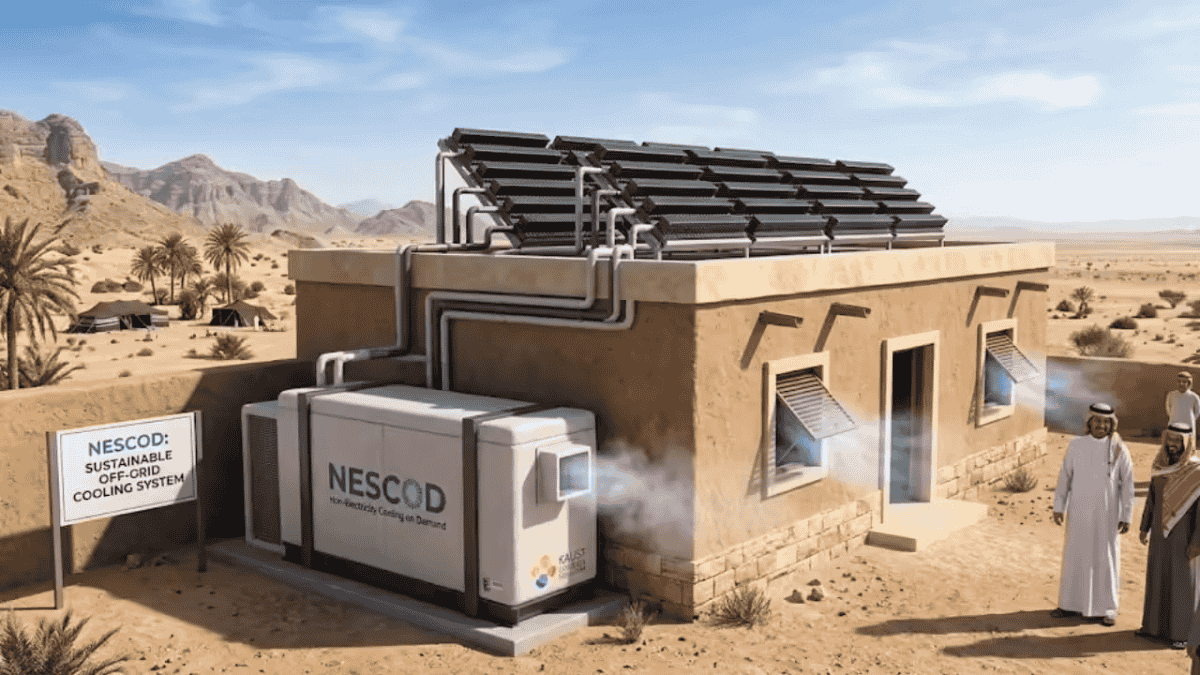
In this era of continuous global temperature rise and climate change, the demand for cooling has shifted from a luxury to a fundamental necessity. Currently, approximately 10% of the world's electricity is consumed by air conditioning and fans alone, and the International Energy Agency (IEA) estimates that this demand will triple by 2050. To address this critical challenge, researchers at the King Abdullah University of Science and Technology (KAUST) in Saudi Arabia have developed a revolutionary technology named NESCOD (No Electricity and Sustainable Cooling on Demand). This technology not only promises to reduce electricity consumption to zero but also serves as a lifeline for regions where access to electricity is limited. For UPSC aspirants, this topic is highly significant for General Studies (GS) Paper III sections on Science and Technology, Environment, and Energy Security.
NESCOD Technology: Principles and Scientific Methodology
The core foundation of the NESCOD system is the process of Endothermic Dissolution. In simple terms, this is a chemical process where a specific substance (solute), when dissolved in a solvent (such as water), absorbs heat from its surrounding environment, leading to a drop in temperature.
Role and Chemical Properties of Ammonium Nitrate
In this technology, researchers utilized Ammonium Nitrate ($NH_4NO_3$), an inorganic salt commonly used as an affordable and accessible fertilizer. While the research team tested several other salts, including Ammonium Chloride ($NH_4Cl$), Ammonium Nitrate proved most effective due to its high solubility and heat absorption capacity. The solubility of Ammonium Nitrate reaches up to 208 grams per 100 grams of water, making it four times more powerful than other alternatives.
| Parameter | Technical Data and Performance |
|---|---|
| Main Chemical Agent | Ammonium Nitrate ($NH_4NO_3$) |
| Scientific Process | Endothermic Dissolution |
| Cooling Power | $191 \text{ W m}^{-2}$ |
| Temperature Drop | $25^\circ\text{C}$ to $3.6^\circ\text{C}$ in 20 minutes |
| Solubility | $208 \text{ g} / 100 \text{ g}$ of water |
| Enthalpy of Solution | $187.6 \text{ kJ kg}^{-1}$ |
This process is not only rapid but also highly effective. Laboratory tests showed that this mixture can reduce the surrounding temperature from $25^\circ\text{C}$ to $3.6^\circ\text{C}$ within just 20 minutes. This cooling effect can be maintained for over 15 hours, which is sufficient for the storage of medicines and food products.
Solar Regeneration Cycle
The most significant feature of NESCOD is its reusability. Unlike traditional cooling packs, it can be "recharged" without electricity. For this, researchers developed a 3D Solar Regenerator. Once the ammonium nitrate is completely dissolved in water and the cooling process ends, the solution is exposed to solar energy.
The sun's heat evaporates the water, causing the ammonium nitrate crystals to reform. This process creates a complete cycle requiring no external power source. Water released during this evaporation process can also be condensed and recovered, making this technology highly suitable for arid regions. This is an excellent example of water conservation and the Circular Economy, serving as a vital case study for UPSC Mains answer writing.
Comparative Analysis of Cooling Technologies
From a UPSC GS Paper III perspective, comparing energy efficiency and environment-friendly technologies is essential. NESCOD not only challenges traditional systems but also competes with other emerging 'Passive Cooling' techniques.
NESCOD vs. Traditional Vapor Compression
Most modern air conditioners and refrigerators are based on the vapor compression cycle, which utilizes compressors and harmful refrigerants (such as HFCs).
Energy Consumption: Traditional ACs depend on grid electricity, whereas NESCOD can operate entirely off-grid.
Environmental Impact: Traditional refrigerants have a high Global Warming Potential (GWP). In contrast, the ammonium nitrate used in NESCOD is relatively safe for the environment, provided it is managed correctly.
Maintenance and Cost: Compressor-based systems carry risks of mechanical wear and tear and are expensive. NESCOD is a simple system with no moving parts, significantly reducing cost and maintenance.
NESCOD vs. Radiative Cooling
Radiative cooling is another passive technique that sends heat directly into space using the 'Atmospheric Window' (8-13 μm wavelength).
| Feature | NESCOD (Dissolution-based) | Passive Radiative Cooling (PRC) |
|---|---|---|
| Primary Energy Source | Chemical potential / Solar (Regeneration) | Thermal emission to deep space |
| Humidity Dependence | Low (Effective in high humidity) | High (Clouds/moisture reduce performance) |
| Cooling Density | High ($\sim191 \text{ W m}^{-2}$) | Moderate ($\sim100 \text{ W m}^{-2}$) |
| Main Application | Storage of medicine and food | Cooling building roofs and panels |
While radiative cooling is excellent for reducing building temperatures, NESCOD is more suitable for 'Cold Chain' logistics due to its high cooling power.
Global and Indian Perspective: The Cooling Challenge
The need for cooling is no longer just about comfort; it is deeply linked to productivity, health, and food security.
India Cooling Action Plan (ICAP)
India was among the first countries in the world to launch a comprehensive 'India Cooling Action Plan' (ICAP) in 2019. ICAP aims to reduce cooling demand across various sectors by 20-25% by 2037-38. Technologies like NESCOD can play a crucial role in fulfilling ICAP’s objective of "Indigenous R&D."
Quantitative Targets of ICAP (By 2037-38):
Reduction in cooling demand: 20% - 25%
Reduction in refrigerant demand: 25% - 30%
Reduction in cooling energy requirements: 25% - 40%
Training of service sector technicians: 1,00,000 (Under Skill India)
Given the rising 'Urban Heat Island' effect in India and power instability in rural areas, such technologies can be integrated with the 'Pradhan Mantri Awas Yojana' (PMAY) and the Smart City Mission.
Kigali Amendment and Montreal Protocol
India is committed to phasing down Hydrofluorocarbons (HFCs) under the Kigali Amendment. HFCs are potent greenhouse gases that do not damage the ozone layer but contribute significantly to global warming. 'Not-in-kind' technologies like NESCOD, which rely on physico-chemical processes rather than chemicals, are the most effective way to meet these international commitments.
Socio-Economic Impact: Health and Agriculture
The lack of cooling is a major barrier to the rural economy and public health.
Vaccine and Medicine Safety
Globally, over 700 million people live without electricity, making the storage of life-saving vaccines and medicines like insulin nearly impossible. Vaccines must generally be stored between $2^\circ\text{C}$ and $8^\circ\text{C}$. NESCOD’s ability to cool down to $3.6^\circ\text{C}$ makes it an ideal solution for remote health centers. This could prove decisive for the success of India’s 'National Immunization Programme' and 'Mission Indradhanush'.
Food Security and Farmers' Income
In India, billions of rupees worth of crops are wasted every year due to a lack of cold storage. Small and marginal farmers cannot afford the expense of large-scale cold storage. NESCOD-based micro-cooling units can empower farmers to preserve produce right on their farms, enabling them to get better prices in the market. This aligns with the goals of 'Pradhan Mantri Kisan SAMPADA Yojana' and 'Operation Greens'.
Safety and Regulatory Challenges: Management of Ammonium Nitrate
Every new technology brings certain challenges. Ammonium nitrate is a 'Dual-use' item. While it is an excellent fertilizer and cooling agent, it can be a dangerous explosive if misused.
| Risk Factor | Scientific Reason | Preventive Measure |
|---|---|---|
| Explosive Potential | Oxidation under high heat or shock | Stabilization with Calcium Carbonate |
| Moisture Absorption | Highly hygroscopic nature | Airtight storage |
| Environmental Leakage | High solubility in water | Closed-loop recycling |
The massive explosion at the Beirut Port in 2020 was a result of the unsafe storage of ammonium nitrate. Therefore, before commercially adopting NESCOD, India must develop strict safety standards and monitoring systems under the 'Explosives Act' and 'Ammonium Nitrate Rules'.
The Way Forward: Innovation and Atmanirbhar Bharat
Recent energy and technical partnerships between Saudi Arabia and India, particularly in the fields of 'Green Hydrogen' and 'Renewable Energy', create a favorable ecosystem for technologies like NESCOD. India’s leadership in the 'National Green Hydrogen Mission' and the 'International Solar Alliance' (ISA) demonstrates that India is ready for future clean energy systems.
Furthermore, supercomputing missions like 'Param Shakti' can be used in India to discover materials that are even safer and more effective than ammonium nitrate. The goal of indigenization and 'Atmanirbhar Bharat' in science and technology is not just about production but also about adopting and implementing fundamental research like NESCOD.
Conclusion: Will NESCOD Replace Traditional ACs?
Experts believe that NESCOD will not entirely replace traditional air conditioners in the near future, as mechanical systems remain more effective at humidity control and cooling large rooms instantly. However, for off-grid solutions, emergency refrigeration, and zero-carbon development, it is an indispensable complementary technology.
For a developing country like India, where energy security and Climate Resilience are priorities, such technologies should not be confined to laboratories. Their large-scale testing and adaptation according to local needs will help realize the dream of 'Viksit Bharat 2047'.
Why this matters for your exam preparation
For candidates of UPSC and other competitive exams, this news is not just a scientific discovery but a multi-dimensional subject. Its relevance can be understood through the following points:
GS Paper III (Science & Technology): Questions can be asked on principles like 'Endothermic Dissolution' and 'Solar Regeneration'. It is a prime example of 'Not-in-kind' technologies, which can add value to Mains answers.
GS Paper III (Environment): To highlight the importance of passive cooling in the fight against climate change, mentions of NESCOD and the 'India Cooling Action Plan' (ICAP) are essential.
GS Paper III (Agriculture): It is a revolutionary solution in the context of improving 'Cold Chain' logistics and doubling farmers' income by reducing crop wastage.
GS Paper II (Governance & Policy): Questions regarding the safe management of chemicals (e.g., Ammonium Nitrate rules) and the implementation of international agreements (e.g., Kigali Amendment) are frequently asked.
Preliminary Examination (Prelims): Objective questions (MCQs) can be formed on the chemical formula of Ammonium Nitrate ($NH_4NO_3$), its properties, the role of KAUST, and the specifics of NESCOD.
Candidates are advised to link this topic with the broader contexts of 'Energy Transition', 'Food Security', and 'Environmental Ethics'. Such integrated study will enable better performance not only in the Prelims but also in the Mains and Interviews.